Description
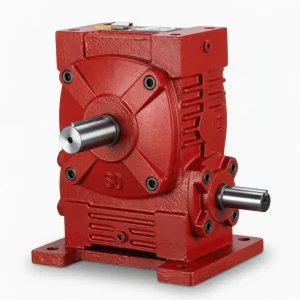
A heavy-duty servo indexing table positioning a 30–50 kg fixture through ±0.02° angular accuracy demands a drive reducer that combines three properties simultaneously: backlash below 6 arcminutes, sustained torque transmission capability above 60 Nm, and a self-locking property that holds position under load when the servo de-energizes. A standard NMRV worm gearbox fails the backlash requirement; a planetary servo reducer fails the self-locking requirement; a harmonic drive of equivalent torque carries 3–4× the unit cost. The VRV040 high-precision worm gearbox threads this specification gap: 65 Nm continuous torque, ratios 5:1 to 100:1, with <6 arcmin backlash standard and <3 arcmin in matched-pair precision class.

Key Specifications & Parameters of the VRV040 Worm Reducer
The VRV040 follows the standard NMRV040 mounting envelope upgraded across three precision-engineering dimensions: ISO 1328 Class 4 worm-screw grinding (vs Class 7 catalog grade), CMM-measured matched-pair gear selection, and Class P4 precision tapered roller bearings preloaded to a tighter axial-play tolerance. All ratings reference 1,400 rpm input under ISO 14521 worm gear load capacity methodology.
| Parameter | Value | Note |
|---|---|---|
| Center distance | 40 mm | NMRV040 standard envelope |
| Continuous torque | 65 Nm | Servo positioning duty |
| Peak (transient) torque | 115 Nm | Indexing-table inertial peak |
| Reduction ratio range | 5:1 – 100:1 | 50:1 most common in indexing |
| Backlash — standard | <6 arcmin | Class 4 grinding + matched pair |
| Backlash — precision class | <3 arcmin | Selected-pair, post-lap measured |
| Repeatability | ±10 arcsec | Per ISO 9283 measurement |
| Total weight | 3.5 kg | Aluminum housing |
| Output bore | Ø19 mm | Solid or hollow-shaft |
| Servo motor compatibility | NEMA 34 / IEC 71B5 | Direct flange mount |
| Radial output load | ≤1,800 N | At mid-shaft, continuous |
| Cycle endurance | ≥6 million cycles | Backlash growth <25% |
What Makes the VRV040 a “High-Precision” Worm Gearbox?
“High-precision” in the worm gearbox category is a specific manufacturing-class definition, not a marketing label. A high-precision worm reducer meets four measurable criteria simultaneously, distinguishing it from both general-industrial NMRV catalog grade and from “precision” class (covered separately under VRV030 robotic specifications). The four high-precision criteria:
- ISO 1328 Class 4 worm-screw grinding: Lead and profile errors held to ≤2 µm (vs 3 µm for Class 5, 8–12 µm for catalog Class 7). This requires CBN profile-grinding equipment with 0.1 µm positioning resolution and active thermal compensation during the grind cycle.
- Class P4 precision bearings: Tapered roller bearings with raceway runout ≤5 µm and angular-contact accuracy specifications tighter than the standard P5 used in robotic-class precision worm gearboxes. The bearing class change accounts for roughly 30% of the backlash reduction from VRV030-P (<4 arcmin) to VRV040-P (<3 arcmin).
- Matched-pair selection from tightest 4% of production: The VRV040-P precision class draws from the tightest 4% of CMM-measured worm-and-wheel pairs in the production distribution — vs 8% for VRV030-P and ~60% for catalog standard.
- Validated repeatability per ISO 9283: Each VRV040-P unit ships with a measured repeatability data sheet (±10 arcsec typical), traceable to the test stand calibration. This documentation is required for machine-tool indexing-axis qualification under typical OEM acceptance protocols.
The combination places the VRV040-P at the upper end of what worm-architecture reducers can deliver before the cost curve crosses into harmonic-drive territory. For deeper background on precision worm gearbox engineering and ISO/AGMA precision-class methodology, see the comprehensive worm gearbox technical guide.
Types of VRV040 Variants for Servo Positioning Applications
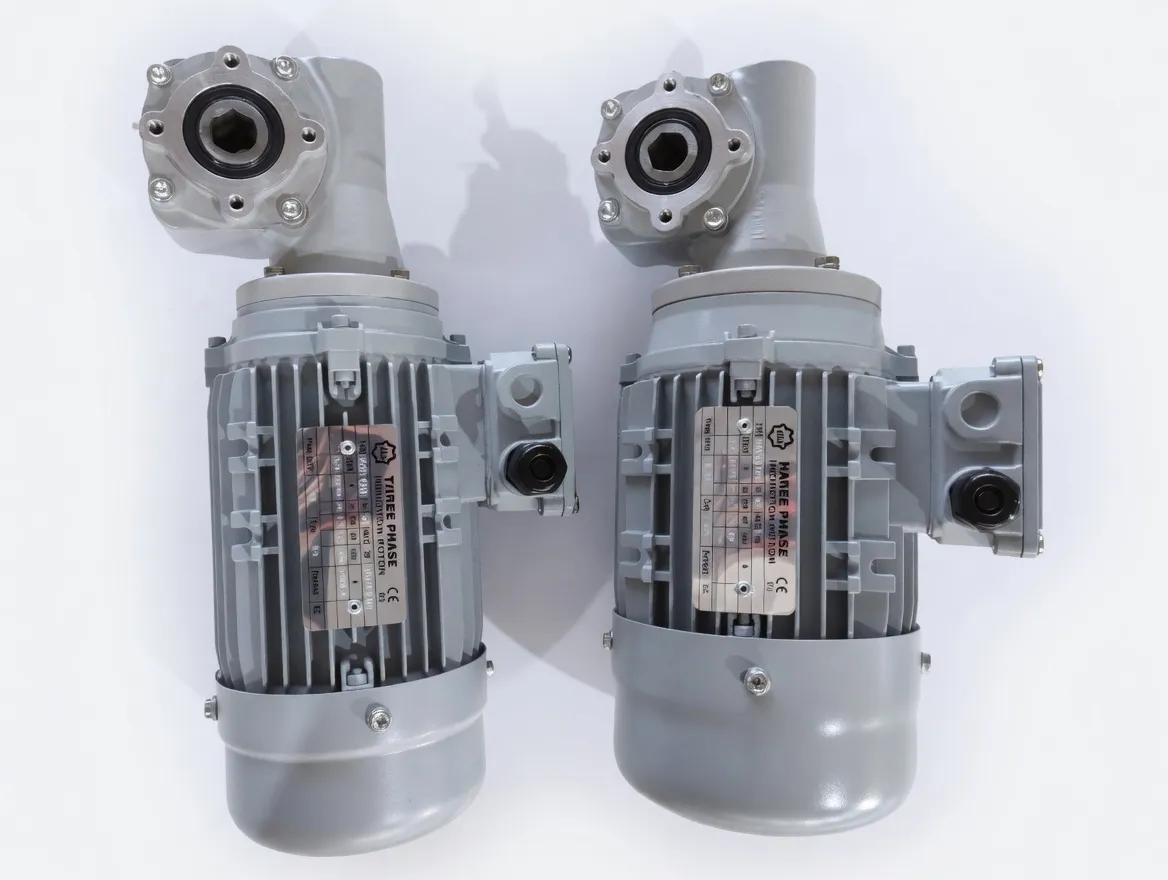
The VRV040 platform supports four standard variants to match different servo positioning architectures. Same precision-class internals across all four; differentiation is in mounting interface, output style, and motor adapter:
| Variant | Backlash Class | Output Style | Best Application |
|---|---|---|---|
| VRV040-S | <6 arcmin | Solid shaft Ø19 | General servo axes |
| VRV040-P | <3 arcmin | Solid shaft Ø19 | Indexing tables, machine tool auxiliaries |
| VRV040-H | <6 arcmin | Hollow shaft | Direct rotary-table mount |
| VRV040-N34 | <6 arcmin | Solid shaft Ø19 | NEMA 34 servo / stepper systems |
The hollow-shaft VRV040-H variant is the workhorse for rotary indexing tables, where the table-shaft passes directly through the gearbox bore eliminating the coupling between gearbox and table. This is the cleanest mechanical solution for servo-positioned indexing tables in machine tool applications, automated welding fixtures, and similar heavy-duty rotary axes. For metric and specialized worm gear specifications used in these applications, the metric worm gear specifications knowledge base provides component reference data.
VRV040 Production Process — High-Precision Manufacturing Flow
The high-precision production flow extends the VRV030 process with two additional control points: thermal-compensated grinding and per-unit repeatability validation. Six stages:
- Bronze worm wheel casting: CuSn12Ni2 phosphor bronze centrifugally cast at controlled cooling rate, achieving HB 100–115 hardness, ASTM E112 grain-size class 6, and porosity <1.0% volumetric (vs 1.5% for precision class, 2.0% for standard). Each casting passes ultrasonic and dimensional verification before machining.
- Worm screw grinding (thermal-compensated): 20CrMnTi steel case-hardened HRC 60–62 (case depth 0.7–1.0 mm), then CBN profile-ground to ISO 1328 Class 4 with surface finish Ra ≤0.15 µm. Active thermal compensation during the grind cycle holds the worm temperature within ±0.5°C to prevent grinding-induced lead error.
- Bronze wheel hobbing & finishing: Climb-cut hobbing followed by post-hob fine-shaving on dedicated worm-wheel finishing machines, achieving Class 4 tooth profile with measured composite error ≤5 µm total.
- CMM measurement & matched-pair selection: Each worm and worm wheel is individually measured on a precision CMM (positioning accuracy 1.5 µm). Pairs are selected algorithmically to minimize total composite error. VRV040-P precision class draws from the tightest 4% of the production distribution.
- Class P4 bearing assembly: Tapered roller bearings with measured raceway runout ≤5 µm, preloaded to 0.003 mm axial-play specification (vs 0.005 mm precision class, 0.015 mm standard). Higher preload reduces backlash but increases starting friction by roughly 8–12%.
- End-of-line validation testing: Each unit measured for backlash on calibrated test stand (precision rejects any >3 arcmin; standard rejects >6 arcmin) and validated for repeatability per ISO 9283. Precision-class units ship with measured repeatability data sheet traceable to test stand calibration.
How to Select the Right Worm Reducer for Servo Positioning Duty
A seven-step procedure aligns VRV040 specification with your servo axis requirements. The high-precision-class selection adds two steps (positioning-resolution analysis and architecture comparison) beyond the standard worm gearbox sizing flow.
- Specify positioning-resolution target: Required angular accuracy at the output shaft. Indexing tables: typically ±0.02° to ±0.05°. Machine tool C-axis: ±0.01°. Welding rotator: ±0.1°. The VRV040-P at <3 arcmin (±0.025°) supports indexing-table accuracy directly.
- Calculate continuous & peak torque: Continuous: load-mass-moment × angular acceleration + friction. Peak: emergency-stop deceleration. Apply 1.4× service factor for typical 16-hour duty, 2.0× for 24/7 continuous-duty machine tool applications.
- Determine reduction ratio: Output speed typically 30–120 rpm at maximum operational velocity. From a 3,000 rpm servo motor: 50:1 = 60 rpm; 80:1 = 38 rpm. Higher ratios increase resolution and self-locking property; lower ratios reduce friction loss.
- Compare architecture options: For servo positioning at <3 arcmin backlash, the candidate architectures are precision worm (VRV040-P), planetary servo reducer + brake module (no native self-locking), harmonic drive (typically 1 arcmin), and cycloidal reducer (typically 1 arcmin). For positioning resolution ≤0.025° with self-locking holding requirement, VRV040-P is typically the cost-optimal choice; for ultra-precision <0.01° without holding-load requirement, harmonic or cycloidal is the better fit.
- Confirm self-locking requirement: Indexing tables and machine tool C-axes typically require self-locking holding under load when servo de-energizes. Specify ratio ≥30:1 to ensure self-locking property.
- Select output configuration: Solid shaft (VRV040-S/P) for coupled drives; hollow shaft (VRV040-H) for direct rotary-table mount; NEMA 34 (VRV040-N34) for closed-loop NEMA stepper or servo systems.
- Specify motor & verify mounting: 71B5/B14 IEC servo (typical 200–750 W servo) for European servo systems; NEMA 34 for North American closed-loop steppers. Contact our servo worm gearbox engineering team with your servo motor specification and positioning resolution target for compatibility verification.
Compatible Components & Spare Parts We Stock
| Component | Specification | Use Case |
|---|---|---|
| High-precision worm shaft | 20CrMnTi, ISO 1328 Class 4 | Replacement worm screw |
| Bronze worm wheel | CuSn12Ni2, matched-pair grade | Field rebuild kit |
| Matched worm and gear set | Lapped pair, <3 / <6 arcmin | Complete drivetrain swap |
| Class P4 tapered bearings (pair) | Precision raceway runout ≤5 µm | Service rebuild — precision class |
| FKM (Viton) seal kit | Double-lip, Ø19 / Ø14 | Annual seal replacement |
| NEMA 34 servo adapter | 73 mm BC, Ø14 input | NEMA motor platform |
| IEC servo flange | 71B5 / 71B14 / 80B5 | European servo platform |
All VRV040 components are stocked as separate spares for service rebuild and OEM platform-line maintenance. Custom matched worm-and-gear-set production with target backlash specifications (down to <2 arcmin for ultra-precision applications using globoid worm topology) is supported via dedicated production scheduling. For globoid worm gear topology and advanced gear-pair design reference, see the globoid worm gear technical knowledge base.
VRV040 vs Harmonic, Cycloidal & Planetary Servo Reducers — When to Use Which
For servo positioning duty in the 30–100 Nm continuous torque range, four reducer architectures compete. Each carries distinct strengths and trade-offs that determine which fits a given application:
| Architecture | Backlash | Self-Locking | Relative Cost | Best Use |
|---|---|---|---|---|
| VRV040-P (precision worm) | <3 arcmin | Yes (≥30:1) | 1.0× | Indexing, machine tool aux |
| Harmonic drive | <1 arcmin | No | 3.5–4.5× | Robotic joints, ultra-precision |
| Cycloidal RV-class | <1 arcmin | No | 2.5–3.5× | Heavy-payload robot joints |
| Planetary servo + brake | <3 arcmin | Brake module | 1.4–1.8× | Inline servo axes |
For servo positioning applications requiring <3 arcmin backlash with native self-locking property and right-angle compact form factor, the VRV040-P is typically the cost-optimal choice across the 30–100 Nm torque range. Above that torque range or where ultra-precision <1 arcmin is required, harmonic or cycloidal architectures become necessary despite the cost premium. Planetary + brake-module solutions match the VRV040-P on backlash but add brake-module complexity and cabling that erodes the cost advantage.
What Servo System Integrators & Machine Tool OEMs Say About the VRV040
“Specified VRV040-P on 24 indexing tables across our pallet-handling cells. Backlash held <2.6 arcmin on factory acceptance — tighter than spec sheet. Three years deployed, all 24 still hitting ±0.018° positional repeatability. Replaced our previous planetary + brake design at 38% lower BOM cost per axis.”
— Patrik H., Senior Drive Engineer, Machine Tool OEM, Switzerland
“Deployed VRV040-H hollow-shaft units on rotary welding fixtures across two production lines. Direct table-mount eliminated the coupling between gearbox and table that we’d been chasing tolerance issues with. Self-locking holding under welding-arc thermal expansion is exactly what we needed.”
— Erik L., Lead Mechanical Engineer, Heavy Welding Automation, Sweden
“Built VRV040-N34 with 1.5 kW closed-loop steppers into automotive seat-assembly fixtures. Right-angle layout fit the chassis envelope where harmonic alternatives didn’t — saved redesigning the upstream tooling plate. 14 months in service across 36 cells, zero gearbox-related failures.”
— Tomáš N., Automation Engineering Manager, Automotive Tier-1, Czech Republic
“Used VRV040-P on a heavy-duty mining-equipment positioning system — 45 kg fixture, ±0.025° positioning, harsh ambient. Eight months in: still on factory backlash spec, still self-locking under load. Original spec was a 4-axis cycloidal solution at 3.2× the cost; the worm gearbox saved the project.”
— Catherine W., Project Engineer, Mining Equipment OEM, Australia
Why Source the VRV040 High-Precision Worm Gearbox From Us
Three reasons servo system integrators and machine tool OEMs source VRV040 from gearboxesworm.net rather than alternative architectures or generic worm gearbox suppliers:
- High-precision worm gearbox engineering depth: Class 4 grinding and Class P4 bearing precision are not catalog options at general worm gearbox suppliers — they require dedicated CBN profile-grinding equipment with thermal compensation, Class P4 precision bearings procured through the bearing-OEM precision-grade supply chain, and CMM-validated matched-pair selection capacity. The VRV040 production line is configured specifically for this. Read more about our high-precision worm gearbox engineering background.
- Cost advantage vs harmonic and cycloidal: For servo positioning duty where <3 arcmin backlash is sufficient, the VRV040-P typically delivers 60–75% lower unit cost than equivalent-torque harmonic drives, and 50–65% lower than cycloidal RV-class reducers. Combined with the native self-locking property, this often reverses the architecture decision in favor of worm.
- Per-unit measured documentation: Each VRV040-P ships with measured backlash and repeatability data sheet traceable to the test-stand calibration — the documentation typically required for machine tool indexing-axis qualification under OEM acceptance protocols. This is a standard inclusion, not an optional extra-cost service.
Frequently Asked Questions About the VRV040 Worm Gearbox
1. When is a precision worm gearbox the right choice vs a harmonic drive?
Three conditions favor precision worm: (1) self-locking holding requirement under load when servo de-energizes — harmonic drives cannot self-lock; (2) right-angle compact form factor is needed — harmonic drives are typically inline; (3) cost optimization where <3 arcmin backlash is sufficient — harmonic offers tighter <1 arcmin but at 3.5–4.5× the unit cost. For ultra-precision robotic-joint applications requiring <1 arcmin, harmonic is structurally the right choice. For indexing tables, machine tool C-axes, and welding rotators, precision worm typically wins on the total cost-of-ownership comparison.
2. What’s the actual backlash measurement on the VRV040-P precision class?
Specification: <3 arcmin. Measured factory acceptance distribution: 2.0–2.8 arcmin typical, with the spec serving as the rejection threshold. Each unit ships with its measured value documented on a test-stand-traceable data sheet. Backlash growth across the 6-million-cycle endurance window is <25%, meaning a unit measured at 2.4 arcmin at shipment will measure 3.0 arcmin at end-of-life — still within the <3 arcmin spec for typical service life duty.
3. Can the VRV040 handle continuous-duty machine tool indexing duty?
For typical machine tool C-axis or pallet-indexing duty (5,000–15,000 cycles per day, two-shift production): 25,000+ hours service life, equivalent to 5–7 years. For continuous 24/7 high-cycle automation (above 25,000 cycles/day), specify scheduled replacement at the 4-million-cycle mark to maintain backlash specification. The 6-million-cycle endurance reflects backlash-growth criteria; mechanical endurance extends well beyond.
4. Is the VRV040 directly compatible with NEMA 34 closed-loop stepper systems?
Yes — the VRV040-N34 variant is engineered for NEMA 34 motor frames with 73 mm bolt-circle and Ø14 mm input shaft, accepting closed-loop stepper systems and NEMA 34 servo motors directly without an adapter plate. NEMA 23 motors mount via an adapter plate (we supply this as a standard accessory). NEMA 42 motors at the upper end of the closed-loop stepper range fit the larger VRV063 frame size for proper torque transmission.
5. What efficiency can I expect for energy-budget calculations?
VRV040 efficiency varies with ratio: 50:1 ratio runs 72–78% efficient at rated load; 80:1 runs 65–72%; 100:1 runs 58–65%. This is meaningfully below planetary alternatives (94–96%) and helical alternatives (96–98%) but in line with worm gearbox theory at these ratios. For energy-cost-sensitive 24/7 continuous-duty applications above 16 hours/day, calculate the lifecycle energy cost and compare against the architecture-selection economics. For typical 8–12 hour single-shift indexing duty, the energy difference rarely overrides the cost and self-locking advantages of worm.
6. What lead times apply for VRV040 standard vs precision class?
VRV040-S (standard <6 arcmin) in common ratios (30:1, 50:1, 80:1, 100:1) ships from finished-goods stock within 7–10 business days. VRV040-P (precision <3 arcmin) typically ships within 3–4 weeks given the matched-pair selection process and per-unit validation testing. VRV040-H hollow-shaft and VRV040-N34 NEMA configurations: 14 business days standard, 4 weeks precision. For OEM volume orders (50+ precision-class units), production allocations and contract pricing tiers are available.
7. Does the VRV040 support globoid worm topology for ultra-precision applications?
Yes, as a custom-tooled variant. Globoid (concave-shape) worm topology increases tooth contact area by approximately 2.5–3.0× vs cylindrical worm geometry, supporting backlash specifications down to <2 arcmin and roughly 18–25% higher torque transmission at the same envelope. Custom globoid VRV040 production runs against minimum 50-unit allocations with 8–10 week lead time. For applications where standard cylindrical-worm VRV040-P at <3 arcmin is insufficient but harmonic-drive cost is unacceptable, the globoid option fills the gap.
Specifying a High-Precision Worm Gearbox for Your Servo Indexing or Machine Tool Project?
Send our high-precision-drive specialists your positioning resolution target, torque envelope, motor frame, and architecture comparison criteria — we’ll return a sized VRV040 recommendation, backlash data, and OEM pricing within one business day.