
“Should I use a worm gearbox or a helical gear reducer?” is the most common architecture-selection question in industrial drive engineering — and the answer is more nuanced than most comparison articles admit. The short version: a worm gearbox wins on right-angle layout, self-locking hold, high single-stage ratio, and unit cost. A helical gear reducer wins on energy efficiency, noise, and suitability for high continuous-duty power. The decision is not about which is “better” — it is about which property your specific application values most. This article works through every relevant criterion with quantified data so you can make the right call for your project.
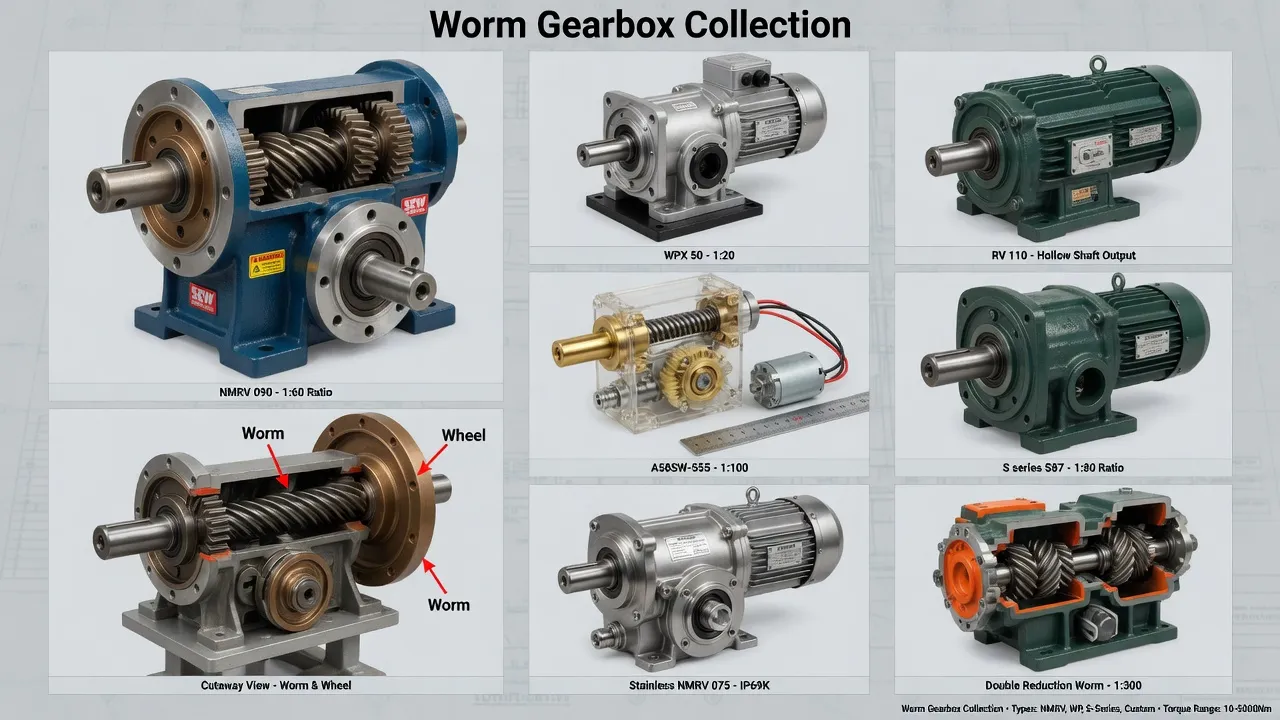
The Fundamental Difference — Gear Mesh Contact Type
Before comparing efficiency numbers and price tables, you need to understand why the two types behave so differently. The root cause is the nature of tooth-mesh contact:
- Worm gearbox: The worm thread slides against the worm wheel teeth. The dominant contact mode is sliding friction. This generates heat, reduces efficiency, and creates the self-locking property. The contact area is large (multiple teeth in mesh simultaneously), which produces quiet operation and high shock-load capacity.
- Helical gear reducer: Helical teeth engage progressively along a diagonal contact line — the dominant contact mode is rolling with minimal sliding. Rolling contact is far more efficient, generates less heat, and allows the gear mesh to support more power per unit of gear volume. The trade-off: helical gears produce an axial thrust force that must be managed by the bearing design, and they cannot self-lock.
Every performance difference between the two architectures flows directly from this fundamental physics difference. Efficiency, noise, temperature rise, self-locking, life expectancy — they are all consequences of sliding contact (worm) vs rolling contact (helical).
Efficiency — The Biggest Performance Gap
Efficiency is where the two architectures diverge most dramatically. The table below shows measured efficiency values at representative gear ratios:
| Ratio | Worm Gearbox η | Inline Helical η | Difference |
|---|---|---|---|
| 5:1 | 88–92% | 96–98% | 6–8% |
| 10:1 | 82–87% | 95–97% | 10–12% |
| 20:1 | 76–82% | 95–97% | 15–18% |
| 50:1 | 68–74% | 95–96%* | 22–26% |
| 100:1 | 58–65% | 94–96%* | 29–35% |
* Helical requires multiple stages to achieve 50:1 and 100:1 — efficiency shown is for multi-stage inline helical at equivalent ratio.
The efficiency gap compounds into significant energy cost at real production scales. Consider a 7.5 kW motor-driven belt conveyor running at 50:1 ratio for 5,000 hours per year:
| Parameter | Worm (70% eff.) | Helical (96% eff.) |
|---|---|---|
| Power loss (kW) | 2.25 kW | 0.31 kW |
| Annual energy waste (kWh) | 11,250 kWh | 1,563 kWh |
| Annual energy cost (€0.12/kWh) | €1,350 | €188 |
| Annual savings (helical over worm) | €1,162/year per drive | |
For a 20-drive conveyor system, the annual energy saving from switching to helical is €23,240 — typically a payback period of 12–18 months on the gearbox cost premium. This calculation is the foundation of the EU’s drive-efficiency push and why helical reducers have displaced worm gearboxes in pure continuous-duty conveyor applications across European industry over the past decade.
Self-Locking — Where the Worm Gearbox Is Irreplaceable
Helical gear reducers cannot self-lock. Their rolling-contact mesh has insufficient friction to prevent back-drive under output-side load — meaning when the motor de-energizes, the output shaft will rotate freely if any load is applied. For vertical-axis drives, gate openers, lifts, and any application that must hold position without active power, the helical reducer requires an electromagnetic brake module as a mandatory add-on.
The worm gearbox self-locks mechanically at ratios ≥30:1 — the gear-mesh geometry prevents output-to-input back-drive through the physics of lead angle and friction. No additional component is required. This translates to real system cost advantages:
- No brake module = €80–€280 saved per axis on typical applications
- No brake-module cabling = 20–35 min saved per axis in installation labor
- No brake-module failure mode = one fewer component in the reliability analysis
- Zero holding-current battery drain on battery-powered equipment (forklifts, AGVs)
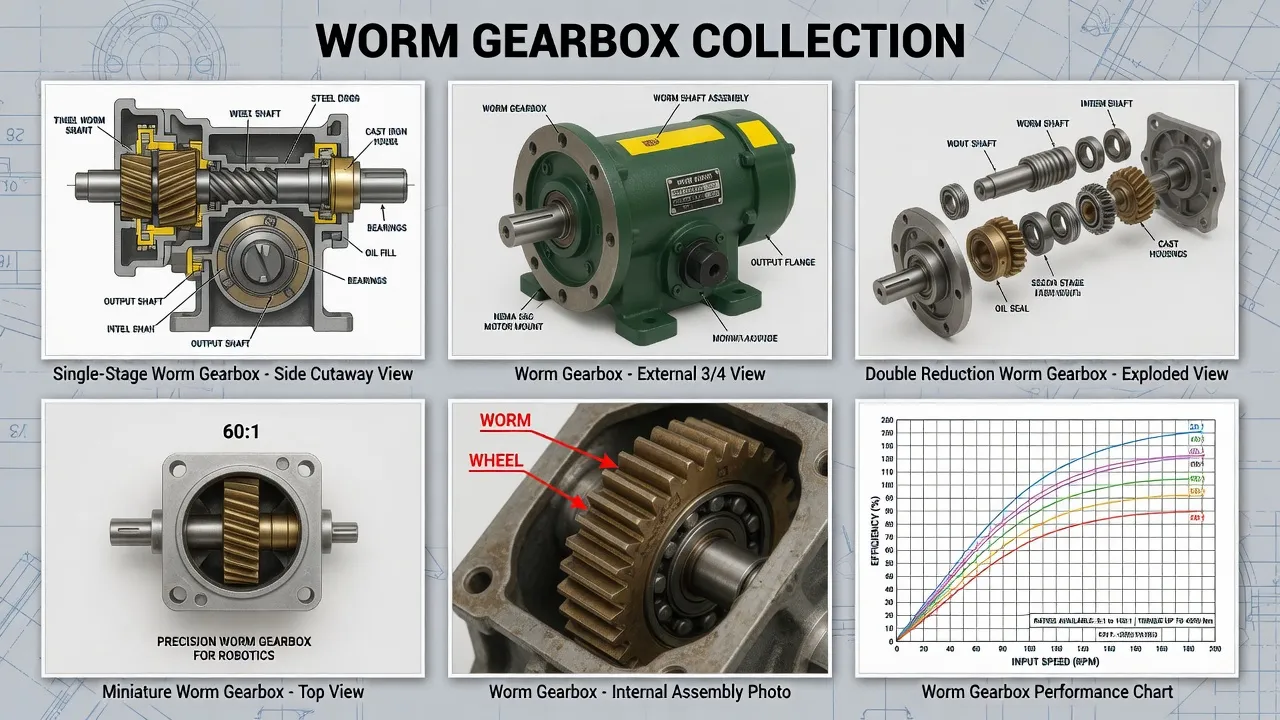
Shaft Layout & Form Factor — Right-Angle vs Inline
A worm gearbox is inherently a right-angle drive — input and output shafts are perpendicular. There is no inline worm gearbox; the 90° offset is a fundamental property of the worm-and-wheel mesh geometry. An inline helical gearbox is inherently coaxial — input and output shafts share the same axis.
This matters enormously for machine-frame design. When the motor must be mounted at 90° to the driven shaft — as is the case for most conveyor head-pulley drives, agitator vertical shafts, gate-opener mechanisms, and printing-press auxiliary axes — the worm gearbox fits the geometry without modification. Achieving the same 90° layout with helical gearing requires either a bevel-helical reducer (significantly more expensive) or a separate right-angle bevel stage (adds complexity and loss).
When the motor and the driven machine are naturally in-line — as for pump, fan, or mixing-tank top-entry drives — the inline helical reducer fits without a right-angle adaption. Forcing a worm gearbox into an inline geometry would require two right-angle offsets that cancel each other out — pointlessly inefficient.
Noise & Vibration — Where the Worm Wins
The sliding-contact worm mesh produces no tooth-impulse vibration — each tooth enters the mesh progressively, without the tooth-entry impact that generates the characteristic gear-tooth pulse in spur and helical gearboxes. Measured sound levels at rated load:
- Worm gearbox: 55–62 dB at 1 m (at rated load, 1,400 rpm input)
- Inline helical reducer: 62–72 dB at 1 m (helical tooth-pulse audible, increasing with load and speed)
- Bevel-helical reducer: 63–70 dB at 1 m
For applications in office-adjacent facilities, food retail environments, hospital logistics, or cobot-adjacent automation cells where ambient sound levels are tightly controlled, the worm gearbox’s quieter mesh profile is a meaningful selection factor — particularly given that the worm runs 8–12 dB quieter at equivalent input speeds. The frequency content also differs: worm mesh noise centers in the 0.5–2 kHz range (less annoying to human hearing) vs helical tooth-pulse in the 4–8 kHz range (sharper, more intrusive).
High Ratios in a Single Stage — the Worm’s Unique Advantage
A single-stage worm gearbox achieves ratios from 5:1 to 100:1. No other single-stage gear architecture comes close. Achieving equivalent ratios with helical gears requires two or three stages, each adding cost, length, weight, and cumulative efficiency losses.
| To achieve 80:1 ratio… | Stages needed | Approx. axial length | Typical unit cost |
|---|---|---|---|
| Worm gearbox | 1 | ~150 mm | 1.0× |
| Inline helical | 3 stages needed | ~380 mm | 1.8–2.4× |
| Bevel-helical | 2–3 stages | ~280 mm | 2.5–3.2× |
| Planetary | 2–3 stages | ~240 mm | 3.5–5.0× |
For applications like agricultural auxiliary drives, gate openers, or conveyor equipment where a 60:1–100:1 ratio is needed in the smallest possible package at the lowest cost, the worm gearbox’s single-stage high-ratio capability is unmatched. The helical alternatives simply cannot compete on compactness at these ratios.
Heat Generation & Thermal Rating — the Worm’s Key Constraint
The lower efficiency of a worm gearbox means a larger fraction of input power becomes heat rather than useful output. This has a direct engineering consequence: for high continuous-duty applications, the thermal power rating of a worm gearbox often limits the permissible input power before the mechanical torque rating does.
As a rule of thumb: if a worm gearbox will be running more than 4 hours continuously per day at high load, calculate both the mechanical torque rating and the thermal input-power rating from the catalog, and apply whichever is the more restrictive limit. Thermal-limit violations cause lubricant degradation (accelerated oxidation), seal carbonization, and bronze-wheel thermal-softening — all of which reduce service life dramatically.
Helical reducers, with 95–97% efficiency, generate so little heat at equivalent rated load that thermal rating rarely limits selection. This is the primary reason helical reducers are the preferred specification for 24/7 continuous-duty conveyors, fans, and pumps in energy-intensive industries.
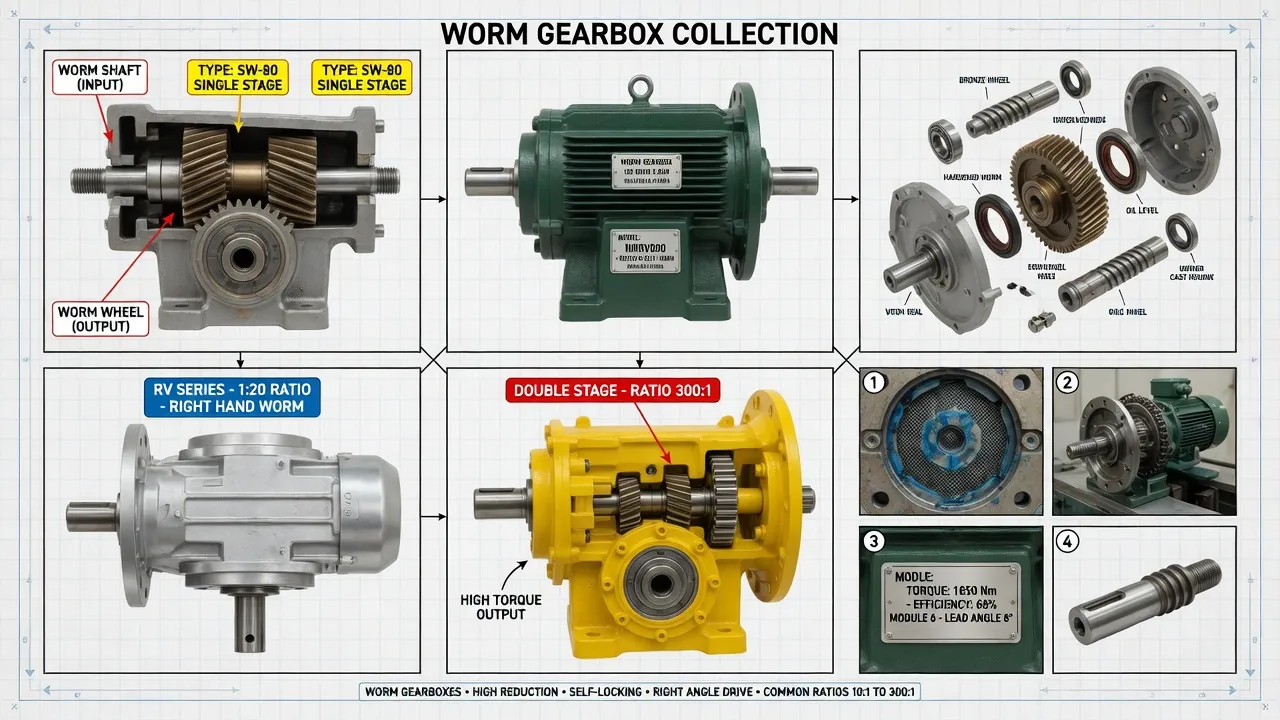
Total Cost of Ownership — Purchase Price vs Lifetime Energy Cost
Purchase price comparison favors the worm gearbox — significantly. At equivalent torque output:
- Worm gearbox (NMRV class): 1.0× (baseline)
- Inline helical reducer (R-series equivalent): 1.4–1.8× the worm gearbox cost
- Bevel-helical reducer: 2.5–3.5× the worm gearbox cost
- Planetary servo reducer: 3.5–6.0× the worm gearbox cost
However, total cost of ownership includes energy cost over the service life. For a 7.5 kW application running 5,000 hours/year at 50:1 ratio:
- Worm gearbox: purchase €120 + energy cost €6,750/year = €33,870 over 5 years
- Helical reducer: purchase €220 + energy cost €940/year = €4,920 over 5 years
The helical reducer’s total 5-year cost is seven times lower than the worm gearbox in this continuous-duty scenario — despite costing nearly twice as much to purchase. The break-even on switching from worm to helical for continuous-duty applications is typically 8–14 months. This math is why European industrial OEMs overwhelmingly specify helical for continuous-duty conveyor and pump drives, while retaining worm gearboxes for self-locking and right-angle applications where the helical alternative requires additional brake-module hardware.
The Decision Framework — Worm or Helical?
Use this decision tree to reach the right specification:
- Does the application require a 90° right-angle shaft layout? If yes → worm gearbox (or bevel-helical at much higher cost). If no → inline helical is available.
- Does the application require self-locking hold without active power? If yes → worm gearbox at ratio ≥30:1 (or helical + brake module at higher cost and complexity). If no → both are viable.
- Is the application running more than 4 hours continuously per day? If yes → calculate energy cost for both. In most cases above 2.2 kW absorbed load at 2,000+ hours/year, helical pays back within 18 months. If no (intermittent duty below 2 hours/day) → worm gearbox energy cost is not the determining factor.
- Is the required ratio above 60:1 in a compact single-stage envelope? If yes → worm gearbox is the only single-stage solution. If no → both are available.
- Is noise a critical constraint below 60 dB? If yes → worm gearbox wins on acoustic profile. If no → both viable from a noise standpoint.
The practical outcome: most well-engineered industrial drive systems use both architectures — worm gearboxes where right-angle layout, self-locking, or high single-stage ratio is needed, and helical reducers where inline continuous-duty energy efficiency is paramount. The two are complementary, not competing.
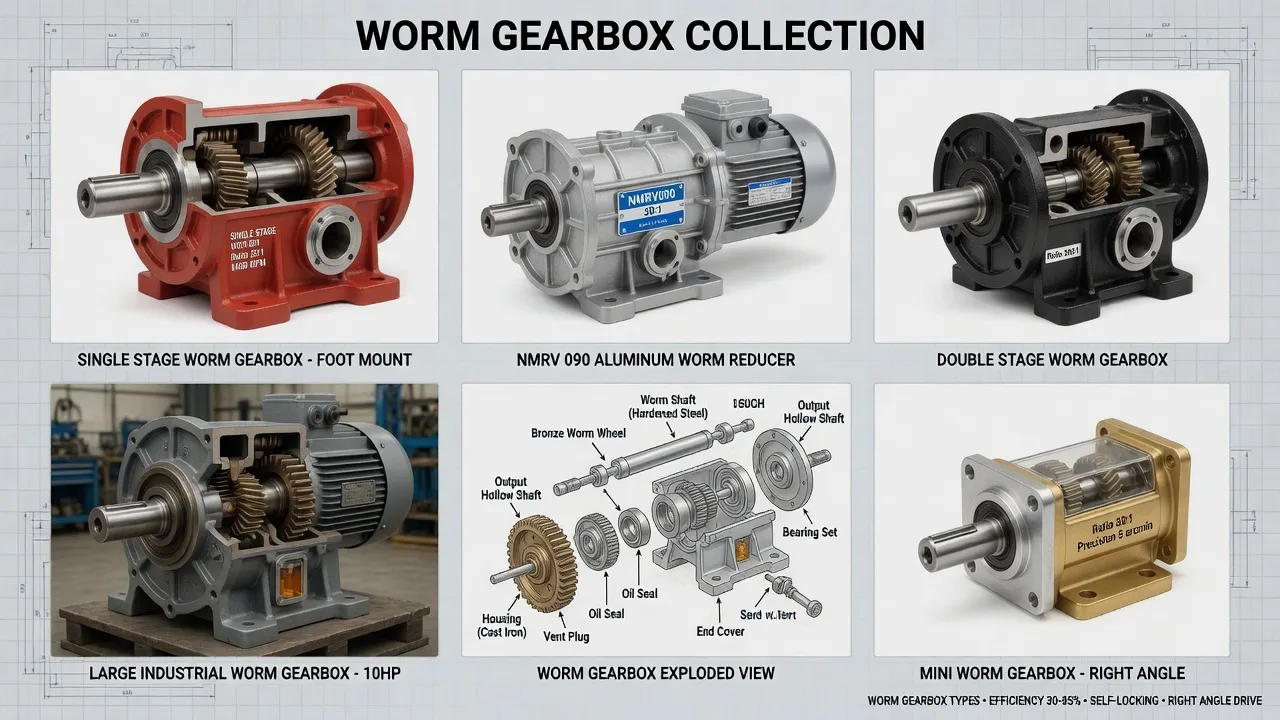
Frequently Asked Questions
Is a helical-worm gearbox better than a standard worm gearbox?
A helical-worm (S-series) combines a helical pre-stage with a worm secondary stage, improving efficiency to 75–88% vs 60–75% for single-stage worm. The helical pre-stage runs at high speed (high efficiency); the worm secondary stage handles the right-angle output at lower speed (improved worm efficiency at lower speed ratio). For continuous-duty right-angle applications above 2.2 kW absorbed load, the helical-worm pays back its price premium in 18–30 months vs standard worm. For intermittent light-duty applications, standard worm remains the cost-optimal specification.
Can I replace a worm gearbox with a helical on an existing machine?
Only if the machine geometry and application requirements permit: (1) the new helical must have an equivalent right-angle output (bevel-helical), which is larger and more expensive; (2) if the original worm was relied upon for self-locking hold, a fail-safe brake module must be added to the helical; (3) the frame mounting interface must be physically compatible. In most retrofit cases, the machine-design compromises required to substitute helical for worm make the switch impractical — purpose-design helical from the start when efficiency is the priority.
Which is more reliable — worm or helical?
Both architectures achieve 20,000–30,000 service hours when properly sized, lubricated, and operated within thermal limits. The worm gearbox has fewer moving parts (simpler mechanical system) but is more sensitive to overloading and lubricant condition. The helical reducer is more forgiving of overload and generates less heat, but has more components (multiple gear stages, more bearings). Neither is inherently more reliable; selection correctness and maintenance quality determine actual service life.
Why does a worm gearbox get hotter than a helical?
Because 25–35% of input power at typical ratios is lost as heat at the worm-wheel mesh (sliding friction), vs 2–5% for helical gear mesh (rolling friction with minimal sliding). A 3 kW worm gearbox at 70% efficiency generates 0.9 kW of heat continuously — roughly equivalent to a one-bar electric heater. A 3 kW helical at 96% efficiency generates 0.12 kW of heat. This difference in heat generation is why thermal rating frequently limits continuous-duty worm gearbox applications.
Not Sure Whether to Specify Worm or Helical for Your Application?
Send our drive specialists your duty cycle, shaft layout, torque/speed requirements, and daily operating hours — we’ll recommend the right architecture with a total-cost-of-ownership comparison.