
“What ratio do I need?” is the most-asked question when specifying a worm gearbox — and one of the most consequential. The ratio affects not just output speed, but efficiency, self-locking capability, thermal loading, and service life. Choosing 50:1 vs 40:1 vs 60:1 is not just about hitting the right rpm — it also determines whether the gearbox self-locks, how much energy it wastes, and whether the thermal rating becomes a constraint. This guide covers every standard ratio from 5:1 to 100:1, what each delivers technically, which applications each suits, and the decision rules for common scenarios where multiple ratios could technically work.
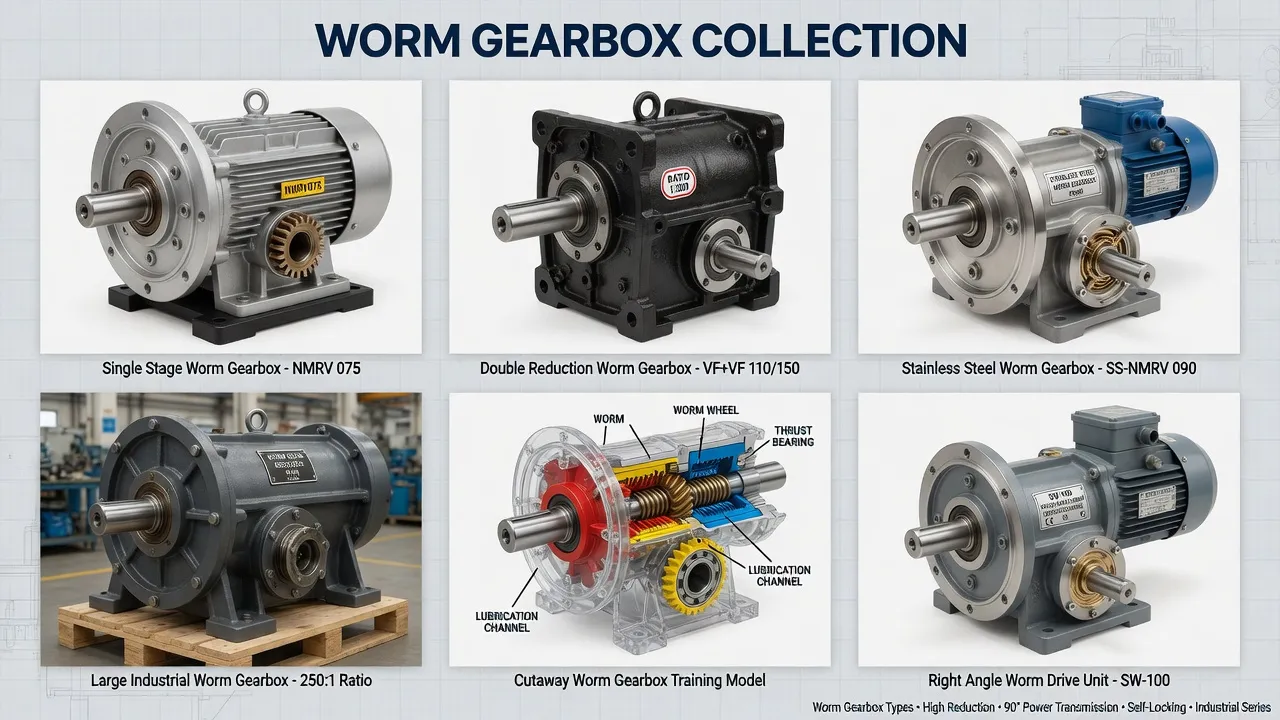
The Master Ratio Reference Table
The table below summarises what each standard ratio delivers across the dimensions that matter for real-world selection. Values assume 1,400 rpm motor input, PAO synthetic lubricant, run-in unit:
| Ratio | Output Speed | Efficiency | Self-Lock | Thermal Risk | Primary Applications |
|---|---|---|---|---|---|
| 5:1 | 280 rpm | 89–93% | No | Very low | High-speed fans, blowers, centrifugal pumps |
| 7.5:1 | 187 rpm | 87–91% | No | Very low | Moderate-speed conveyor drives, light mixers |
| 10:1 | 140 rpm | 84–88% | No | Low | Conveyors, packaging, moderate agitators |
| 15:1 | 93 rpm | 79–84% | Borderline | Low | Belt conveyors, screw conveyors, fans |
| 20:1 | 70 rpm | 76–82% | Borderline | Moderate | Agitators, slow conveyors, agricultural drives |
| 25:1 | 56 rpm | 74–80% | Usually yes | Moderate | Slow mixers, bin vibrators, food machinery |
| 30:1 | 47 rpm | 73–79% | Yes | Moderate | Gate openers, slow conveyors, lifts with brake |
| 40:1 | 35 rpm | 70–76% | Yes | Moderate-High | Gate drives, solar trackers, door operators |
| 50:1 | 28 rpm | 69–75% | Yes | Moderate-High | Most popular: conveyors, mixers, positioners |
| 60:1 | 23 rpm | 67–73% | Yes | High | Slow conveyors, hoists, rotary tables |
| 80:1 | 17.5 rpm | 63–69% | Yes | High | Very slow drives, indexing, security doors |
| 100:1 | 14 rpm | 60–67% | Yes | Very High | Very low speed precision drives, solar trackers |
The Self-Locking Threshold — Why 30:1 Is the Key Ratio
The most operationally significant ratio decision is whether to specify at or above 30:1 to achieve self-locking. Self-locking allows the output shaft to hold its position when the motor de-energizes — without any additional brake mechanism. The physics: at 30:1 and above, the worm lead angle falls below the friction threshold (approximately 6° for standard bronze-on-steel pairs), preventing back-drive from the output side.
At ratios 15:1 and 20:1, the self-locking condition is borderline — it may or may not hold depending on the lubricant condition, operating temperature, and worm-wheel wear state. These ratios should never be relied upon for safety-critical load-hold without a supplementary brake. At 25:1, most units self-lock under normal conditions but the margin is thin. At 30:1 and above, self-locking is reliable and consistent over the service life. The decision rule: if self-locking is required, specify 30:1 minimum, 40:1 preferred for reliable margin.
Ratio Selection by Application Category
Below are ratio selection guidelines for the most common worm gearbox application categories, derived from standard output speed requirements and application constraints:
- Belt conveyors (head pulley, typical belt speed 0.5–1.5 m/s, drum 200–400 mm diameter): Required output 24–90 rpm → ratios 16:1 to 58:1 → standard choices: 20:1, 25:1, 30:1, 40:1, 50:1 depending on specific belt speed.
- Screw conveyors (grain, mineral powder, cement, 30–120 rpm typical): Ratios 12:1 to 47:1 → standard choices: 15:1, 20:1, 25:1, 30:1. Use 30:1+ if anti-runback on inclined sections is required.
- Agitators and mixers (50–180 rpm typical): Ratios 8:1 to 28:1 → standard choices: 10:1, 15:1, 20:1, 25:1. Self-locking not usually required for horizontal agitators.
- Gate openers and door drives (2–10 rpm at drive shaft): Ratios 140:1 to 700:1 — requires double-stage worm gearbox (single-stage max 100:1). Alternatively, 40:1–80:1 with mechanical linkage multiplication.
- Solar trackers (single-axis: 0.05–0.25 rpm at drive shaft): Ratios 5,600:1 to 28,000:1 — double-reduction plus additional drive chain, or worm gearbox + slewing ring combination. Standard worm range provides the final gear stage.
- Packaging machinery indexing (30–90 rpm): Ratios 16:1 to 47:1 → standard choices: 20:1, 25:1, 30:1.
- Food processing (10–60 rpm): Ratios 23:1 to 140:1 → standard choices: 25:1, 30:1, 40:1, 50:1, 60:1. Prefer 30:1+ for anti-runback safety in inclined or vertical applications.
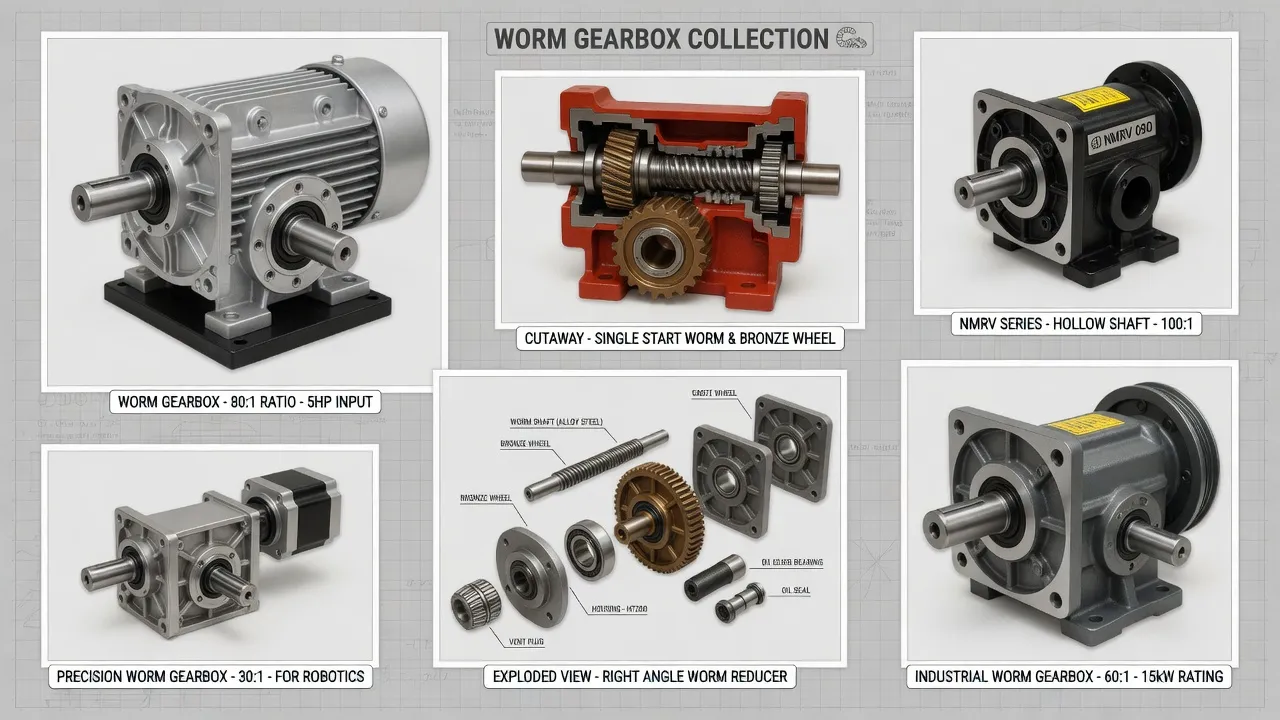
When Multiple Ratios Could Work — How to Choose
Calculated ratio: 38:1 — which falls between standard 30:1 and 40:1. Both could work from a speed standpoint. Apply these tie-breaking criteria in order:
- Does self-locking matter? If yes, both 30:1 and 40:1 self-lock → go to criterion 2. If borderline: 40:1 has more self-locking margin.
- Which output speed is more acceptable? 30:1 gives 46.7 rpm (3.6% faster than 38:1 target); 40:1 gives 35 rpm (7.9% slower). If a ±5% speed tolerance applies, 30:1 passes and 40:1 does not — choose 30:1.
- Thermal budget: 30:1 runs at ~76% efficiency; 40:1 at ~73% — slightly more heat from 40:1. If the unit is near its thermal limit, 30:1 has a small advantage.
- Energy cost: For continuous-duty applications, 30:1 wastes slightly less energy than 40:1 — generally too small a difference to govern the choice unless annual hours are very high.
For very high-torque applications in metallurgy, steel mills, and foundry equipment where ratios above 50:1 are needed with large-frame units, our heavy-duty worm gearbox range covers ratios up to 100:1 in frames rated to 78,000 Nm. For the full standard NMRV range, our NMRV worm gearbox series covers 5:1 to 100:1 from NMRV030 to NMRV150. For additional application-specific ratio guidance across industrial sectors, see the industrial worm reducer application guide.
Frequently Asked Questions
What is the most commonly specified worm gearbox ratio?
50:1 is the single most specified ratio in the global NMRV market, typically used for belt conveyors, screw conveyors, mixers, and agitators where a 1,400 rpm motor needs to drive a 25–30 rpm output shaft. It delivers reliable self-locking, manageable thermal loading, and a comfortable efficiency level (69–75% with PAO). If you’re not sure where to start and the application is a standard industrial conveyor or mixer, 50:1 is the right first candidate to evaluate.
Why does efficiency drop at high ratios — and should that change my ratio selection?
Higher ratios require a smaller worm lead angle, which increases the sliding friction at the mesh. This is a physical inevitability — not a quality issue. Whether it should change your ratio selection depends on duty cycle: for intermittent applications below 4 h/day, efficiency differences between 30:1 and 60:1 cost less than €30/year in energy per drive — negligible. For continuous-duty applications at 5 kW absorbed power running 6,000 h/year, the difference between 30:1 (76% eff.) and 80:1 (66% eff.) costs over €450/year per drive — worth specifying the lower ratio if the output speed is acceptable.
Can I get a ratio between two standard values — like 35:1 or 45:1?
Standard NMRV catalog ratios are fixed at 5, 7.5, 10, 15, 20, 25, 30, 40, 50, 60, 80, 100:1. Non-standard ratios (35:1, 45:1) are available as custom orders with minimum order quantities and longer lead times — typically 8–12 weeks vs 1–2 weeks for standard. For most applications, adjusting the motor speed via a VFD to hit the exact target output speed with a standard ratio gearbox is more economical than a custom ratio order.
Does the ratio affect the output torque?
Yes — output torque = input torque × ratio × efficiency. Higher ratios produce more output torque from the same motor at the cost of lower output speed. However, note from the catalog tables that output torque ratings don’t increase linearly with ratio — they plateau around 50:1–60:1 in most frames and slightly decrease at 80:1–100:1 due to the very small lead angle limiting gear-mesh load capacity. The peak-torque ratio for most NMRV frames is approximately 50:1–60:1.
Need Help Confirming the Right Ratio for Your Application?
Share your motor speed, required output speed, duty cycle, and self-locking requirement — we’ll confirm the optimal ratio, check the thermal budget, and recommend the correct NMRV frame within one business day.
How Ratio Affects Thermal Loading — The Practical Engineering Implication
One practical consequence of the efficiency-ratio relationship that surprises many engineers: for a given frame size, the thermal input-power rating (not the mechanical rating) often limits the permissible continuous input power, and this thermal limit becomes more restrictive as ratio increases.
For an NMRV090 as a concrete example:
- At 10:1 (η = 86%): heat generated = 14% of input. Thermal P₁ rating: approximately 4.5 kW continuous.
- At 50:1 (η = 72%): heat generated = 28% of input. Thermal P₁ rating: approximately 1.9 kW continuous.
- At 100:1 (η = 63%): heat generated = 37% of input. Thermal P₁ rating: approximately 1.2 kW continuous.
The same NMRV090 housing can handle 4.5 kW input at 10:1 but only 1.2 kW at 100:1 — not because the gears are weaker at 100:1, but because the heat generation rate per kW of input is 2.6× higher. This is why ratio selection and thermal budget analysis must be done together for any continuous-duty application above 4 hours per day.
Output Speed Quick-Reference for Standard Motor Speeds
For quick field or design-room reference — output speed for each standard ratio at common motor input speeds:
| Ratio | 950 rpm (6-pole) | 1,400 rpm (4-pole) | 2,800 rpm (2-pole) |
|---|---|---|---|
| 5:1 | 190 rpm | 280 rpm | 560 rpm |
| 10:1 | 95 rpm | 140 rpm | 280 rpm |
| 20:1 | 47.5 rpm | 70 rpm | 140 rpm |
| 30:1 | 31.7 rpm | 46.7 rpm | 93.3 rpm |
| 50:1 | 19 rpm | 28 rpm | 56 rpm |
| 80:1 | 11.9 rpm | 17.5 rpm | 35 rpm |
| 100:1 | 9.5 rpm | 14 rpm | 28 rpm |
Note that a 50:1 worm gearbox on a 2-pole 2,800 rpm motor delivers the same output speed (56 rpm) as a 20:1 on a 4-pole 1,400 rpm motor. When the required output speed can be achieved at either a lower ratio with a higher-speed motor, or a higher ratio with a standard 4-pole motor, the lower-ratio option is almost always more efficient and thermally easier to manage.
Using a Variable-Frequency Drive to Fine-Tune Ratio — When It Makes Sense
When the application requires an output speed that falls exactly between two standard ratio steps — and output speed tolerance is tighter than ±5% — specifying a variable-frequency drive (VFD) on the motor is almost always more economical than ordering a custom non-standard gearbox ratio. The VFD adjusts the motor speed to dial in the exact output speed using the nearest standard catalog ratio.
Example: required output speed 33 rpm from a 1,400 rpm motor. Calculated ratio: 1,400 / 33 = 42.4:1. Nearest standards: 40:1 (35 rpm, 5.7% high) or 50:1 (28 rpm, 15.2% low). Output speed tolerance of ±3% is too tight for either standard ratio. Options:
- Custom 42:1 ratio: Lead time 8–12 weeks, setup cost $200–$400, per-unit cost premium 15–25% vs standard.
- Standard 40:1 + VFD set to 1,320 rpm input: Standard gearbox at catalog price, VFD cost $80–$200 for this power range, 1-week lead time, exact 33 rpm output at 1,320 rpm × 1/40 = 33 rpm. Total system cost almost always lower than custom ratio option. Additionally, VFD enables soft-start (reducing motor current at start-up) and speed adjustment for future process changes.
The VFD+standard-ratio approach is not suitable for all applications: VFDs should not be used with motors that are not VFD-rated (check motor insulation class), and very low frequency operation (<20 Hz) at high torque can cause motor thermal problems without additional cooling. For most industrial OEM applications at 0.37–22 kW, VFD + standard-catalog worm gearbox is the preferred solution for non-standard speed requirements.