
The NMRV standard is the global reference envelope for compact aluminum worm gearboxes. Every manufacturer producing NMRV-class worm gearboxes nominally follows the same dimensional convention — meaning an NMRV063 from any supplier worldwide should fit on the same machine bracket, accept the same IEC motor, and deliver output torque through the same shaft dimensions. This page provides the definitive size chart for the full NMRV range from NMRV030 through NMRV150: center distances, output torque ratings across all standard ratios, shaft dimensions, mounting hole patterns, and motor flange compatibility. Bookmark this page — it is the reference you will return to every time you’re sourcing, quoting, or cross-referencing NMRV units.
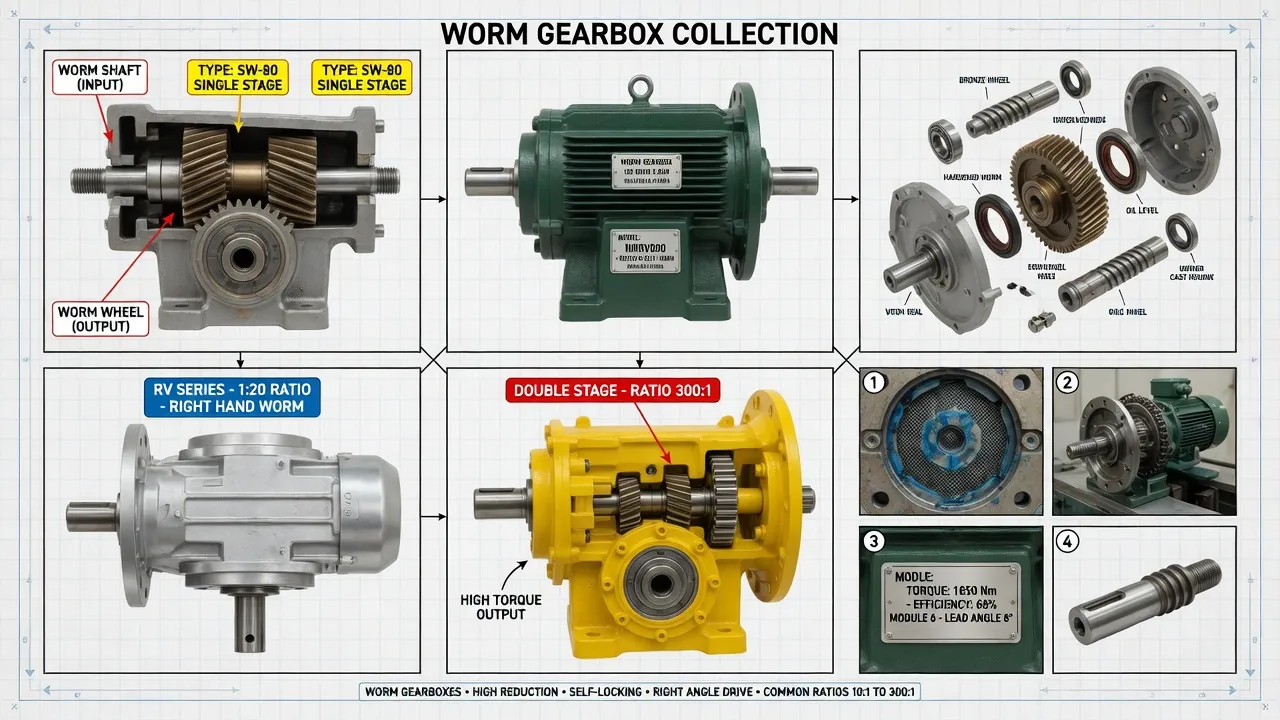
What “NMRV” Means — and Why the Size Number Matters
NMRV stands for “Norma Motor Riduttore Versatile” (Italian: standard versatile motor reducer). The suffix number is the center distance in millimetres — the distance between the worm shaft axis and the worm wheel shaft axis. This single dimension determines the physical size of every critical component in the gearbox:
- Larger center distance → larger worm and wheel diameter → more gear surface contact area → higher torque capacity
- Center distance also governs the housing outer dimensions, shaft diameters, and mounting hole pattern
- NMRV030 = 30 mm center distance (smallest standard size); NMRV150 = 150 mm center distance (largest standard NMRV)
Because the center distance is the defining dimension, all manufacturers producing NMRV-class units use the same mounting hole pattern for a given size — making competitive cross-referencing straightforward. The torque rating and efficiency may vary between suppliers (reflecting worm surface finish quality, bronze grade, and bearing specification), but the physical mounting envelope should be interchangeable within the same NMRV size class.
NMRV Size Chart — Dimensions, Shaft Sizes, and Motor Compatibility
| Frame | Center Distance | Output Shaft Ø | Input Shaft Ø | Housing W×H×L | Foot Hole Pitch | IEC Motor Flange | Weight |
|---|---|---|---|---|---|---|---|
| NMRV030 | 30 mm | 14 mm | 9 mm | 65×65×55 | 40×40 mm | IEC 56/63 B14 | 0.7 kg |
| NMRV040 | 40 mm | 18 mm | 11 mm | 88×88×72 | 56×56 mm | IEC 56/63/71 B14 | 1.4 kg |
| NMRV050 | 50 mm | 25 mm | 14 mm | 110×110×90 | 70×70 mm | IEC 63/71/80 B5/B14 | 2.8 kg |
| NMRV063 | 63 mm | 25/28 mm | 19 mm | 140×140×115 | 90×90 mm | IEC 71/80/90 B5/B14 | 5.0 kg |
| NMRV075 | 75 mm | 28/35 mm | 19/24 mm | 168×168×135 | 110×110 mm | IEC 80/90/100 B5 | 8.5 kg |
| NMRV090 | 90 mm | 35/40 mm | 24/28 mm | 200×200×165 | 140×140 mm | IEC 90/100/112 B5 | 14.5 kg |
| NMRV110 | 110 mm | 42/45 mm | 28/38 mm | 245×245×200 | 160×160 mm | IEC 100/112/132 B5 | 25 kg |
| NMRV130 | 130 mm | 50/55 mm | 38/42 mm | 290×290×235 | 200×200 mm | IEC 112/132/160 B5 | 42 kg |
| NMRV150 | 150 mm | 60/70 mm | 42/48 mm | 340×340×270 | 250×250 mm | IEC 132/160/180 B5 | 72 kg |
Housing dimensions given as approximate W×H×L in mm for standard foot-mount (B3) configuration. Actual dimensions vary slightly between manufacturers within the NMRV convention. Always verify against the specific manufacturer’s dimensional drawing before finalising machine bracket design.
Output Torque by Frame and Ratio — Full Rating Table
| Frame | 5:1 | 10:1 | 20:1 | 30:1 | 40:1 | 50:1 | 60:1 | 80:1 | 100:1 |
|---|---|---|---|---|---|---|---|---|---|
| NMRV030 | 4 | 8 | 14 | 16 | 18 | 18 | 20 | 20 | 20 |
| NMRV040 | 10 | 20 | 34 | 38 | 42 | 45 | 46 | 48 | 48 |
| NMRV050 | 22 | 45 | 75 | 85 | 92 | 96 | 98 | 100 | 100 |
| NMRV063 | 48 | 95 | 165 | 185 | 200 | 210 | 220 | 230 | 220 |
| NMRV075 | 90 | 180 | 300 | 340 | 375 | 395 | 410 | 420 | 400 |
| NMRV090 | 150 | 300 | 490 | 560 | 620 | 640 | 660 | 680 | 660 |
| NMRV110 | 240 | 480 | 740 | 820 | 890 | 930 | 955 | 970 | 950 |
| NMRV130 | 350 | 700 | 1,100 | 1,350 | 1,480 | 1,550 | 1,580 | 1,600 | 1,560 |
| NMRV150 | 525 | 1,050 | 1,700 | 2,100 | 2,280 | 2,450 | 2,490 | 2,550 | 2,480 |
Output torque in Nm at 1,400 rpm input, PAO synthetic lubricant, run-in unit, 20°C ambient. Values represent mechanical output torque rating — verify separately against thermal input-power rating for continuous-duty applications at ratios ≥40:1. Ratings vary slightly between manufacturers within the NMRV convention.
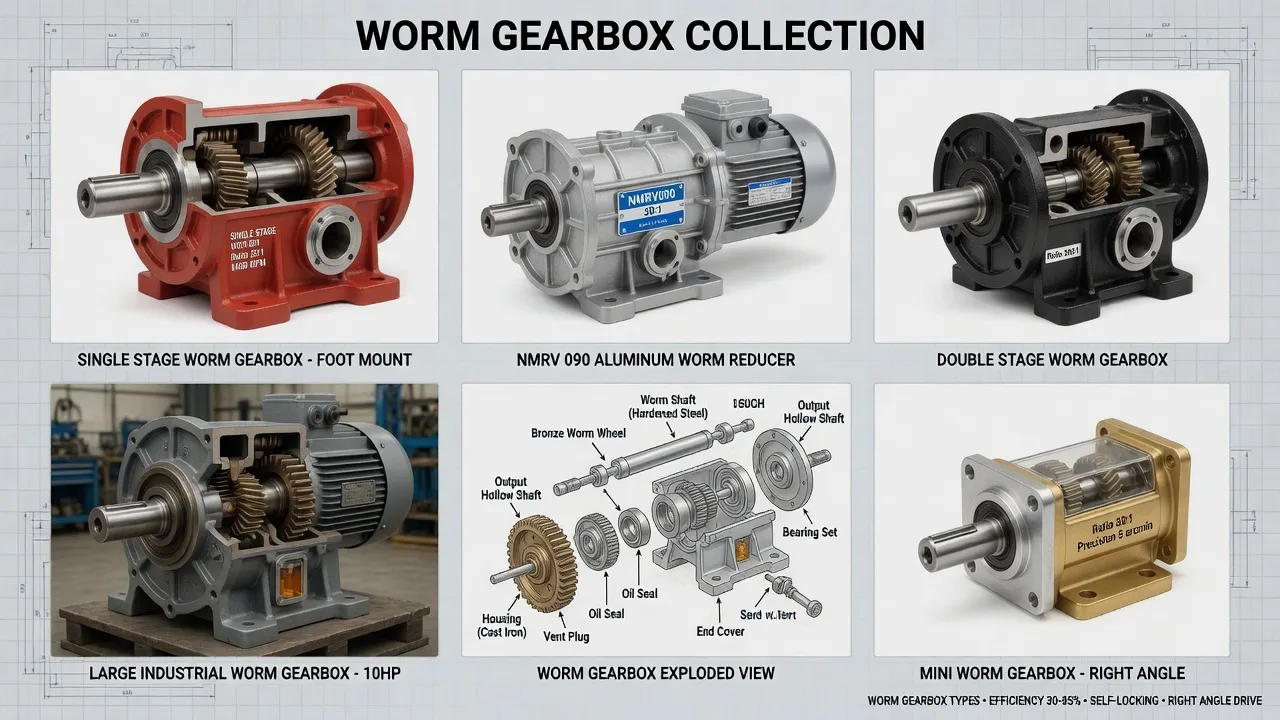
How to Find Your Frame Size in 3 Steps
- Calculate required output torque with service factor: T₂design = actual load torque × service factor (1.0–2.25 depending on duty class and daily hours).
- Find ratio column in the table above: Locate your required reduction ratio in the column headers.
- Read down the column: Select the smallest frame whose M₂ value at your ratio exceeds T₂design. That is your candidate frame.
Then verify: (a) the frame’s thermal input-power rating at your ratio and ambient temperature covers your actual input power, (b) the output shaft diameter suits your coupling or shaft-mount requirement, and (c) the motor flange listed for the frame matches your motor’s IEC frame. The complete NMRV range with full dimensional drawings and thermal ratings is available in our NMRV worm gearbox series. For compact OEM applications requiring the smallest possible envelope, our compact aluminum worm gearbox offers weight and space savings for light-duty applications below NMRV040 torque requirements. For additional dimensional specifications and cross-reference data, see the NMRV worm gearbox technical specifications reference.
Frequently Asked Questions
Are all NMRV gearboxes from different suppliers physically interchangeable?
Mounting hole pattern, input flange interface, and output shaft position should be interchangeable within the same NMRV size class — these dimensions are governed by the NMRV convention. However, the output shaft diameter, keyway dimensions, and exact housing outer dimensions may vary slightly between manufacturers. Always verify the critical interface dimensions from the specific supplier’s dimensional drawing before committing to a direct replacement without physical fitment check.
Why does the torque rating plateau and sometimes decrease at 80:1 and 100:1?
At very high ratios (80:1, 100:1), the worm lead angle becomes very small — the worm thread presses nearly perpendicular to the wheel tooth face, maximising normal contact force and friction. This limits the load the gear mesh can transmit before tooth-face pressure exceeds the bronze yield strength. The result: torque capacity stops increasing and slightly decreases in the 80:1–100:1 range compared to 60:1–70:1. For maximum torque from a given frame, the 50:1–60:1 ratio range typically delivers the highest output torque.
What is the difference between NMRV and NRV in catalog names?
NRV (without the leading M) typically designates a unit without an integral motor-mount flange — a bare gearbox housing only, intended for coupling drives or belt drives rather than direct motor mounting. NMRV (with the M for “motor”) includes the standard IEC motor mounting flange on the input face. Both follow the same center distance and torque rating convention. Most catalog and procurement systems use NMRV as the default motor-mountable variant.
What’s the largest standard NMRV size, and what comes after it?
NMRV150 (150 mm center distance, up to ~2,550 Nm) is the standard top of the NMRV compact-aluminium range. Above 2,500 Nm, the specification transitions to heavy-duty cast-iron worm gearboxes (RR/RRV or similar designations) with separate housing and shaft configurations rated to 10,000–78,000 Nm and beyond. These heavy-duty units use the same worm-and-wheel principle but with heavier housing construction, larger bronze wheels, and different input shaft arrangements suited to high-torque industrial drives.
Need NMRV Dimensional Drawings or Custom Shaft Specifications?
Contact our engineering team with your NMRV size, ratio, mounting position, and any non-standard shaft or flange requirements — we’ll send dimensional drawings and confirm availability within one business day.
Thermal Input Power Rating by Frame — Continuous-Duty Reference
At ratios above 40:1, the thermal input-power rating governs continuous-duty selection more than the mechanical torque rating. Reference values at 1,400 rpm input, 20°C ambient, PAO synthetic lubricant, B3 mounting (horizontal foot):
| Frame | P₁therm at 20:1 | P₁therm at 50:1 | P₁therm at 100:1 |
|---|---|---|---|
| NMRV030 | 0.25 kW | 0.12 kW | 0.07 kW |
| NMRV040 | 0.45 kW | 0.22 kW | 0.14 kW |
| NMRV050 | 0.8 kW | 0.40 kW | 0.25 kW |
| NMRV063 | 1.5 kW | 0.75 kW | 0.48 kW |
| NMRV075 | 2.5 kW | 1.25 kW | 0.80 kW |
| NMRV090 | 3.8 kW | 1.9 kW | 1.2 kW |
| NMRV110 | 5.5 kW | 2.8 kW | 1.8 kW |
| NMRV130 | 8.0 kW | 4.0 kW | 2.6 kW |
| NMRV150 | 12.0 kW | 6.0 kW | 3.8 kW |
Indicative values at 1,400 rpm input, 20°C ambient, B3 horizontal mount, PAO synthetic. For +40°C ambient, multiply by approximately 0.71. Verify against specific catalog for exact values before finalising continuous-duty selection.
This table immediately reveals why a gearbox “the right size for the torque” may still fail thermally: an NMRV090 at 100:1 can handle 660 Nm mechanically but only 1.2 kW continuous input thermally — corresponding to a motor of approximately 1.1 kW maximum. If your application needs more continuous input power at 100:1, the correct solution is an NMRV110 (1.8 kW thermal at 100:1) or an NMRV130 (2.6 kW), not overdriving the NMRV090.
Common Sizing Mistakes Using the Size Chart
Four mistakes engineers most commonly make when using NMRV size charts, and how to avoid them:
- Reading peak torque instead of continuous torque: Some catalogs list both “rated” (continuous) and “peak” (maximum transient, typically 1.5–2×) torque for each frame/ratio. Always size against the rated continuous torque — peak torque is for verifying survival of start-up surges and emergency stops, not for continuous running.
- Ignoring the service factor before comparing to M₂: The torque rating table gives the gearbox’s capacity. Your actual required design torque = load torque × service factor. Apply the service factor first, then find the frame that exceeds the factored value — not the unfactored load torque.
- Selecting based on torque without checking thermal limit: The torque table shows the mechanical rating. At ratios ≥40:1 for continuous duty, always cross-check the thermal input-power rating table against your actual input power. The thermal table on this page provides the reference values.
- Assuming the same size = same shaft dimensions across suppliers: NMRV110 from Supplier A may have a 42 mm output shaft; NMRV110 from Supplier B may have a 45 mm output shaft. Both are “NMRV110” but they are not shaft-for-shaft interchangeable without a new coupling. Always obtain the dimensional drawing with the quotation and verify shaft diameters against your coupling or sprocket bore before finalising the order.
The NMRV convention governs mounting hole pattern and overall envelope — shaft dimensions and some housing details are not fully standardised. This matters most in retrofit and replacement applications where a like-for-like swap is assumed.