
Output torque is the most important number on a worm gearbox selection sheet — and the most frequently miscalculated. Engineers routinely overestimate it by forgetting efficiency, misapply service factors, or confuse nominal torque with peak torque. A 15% calculation error at this stage means either a gearbox that fails prematurely under shock load, or one that is one frame size larger than needed and costs 30–40% more. This article gives you the exact worm gearbox torque calculation procedure: the complete formula, every variable defined with typical values, three fully worked examples covering different application types, and a reference table of efficiency values for each ratio so you can calculate without a catalog in front of you.
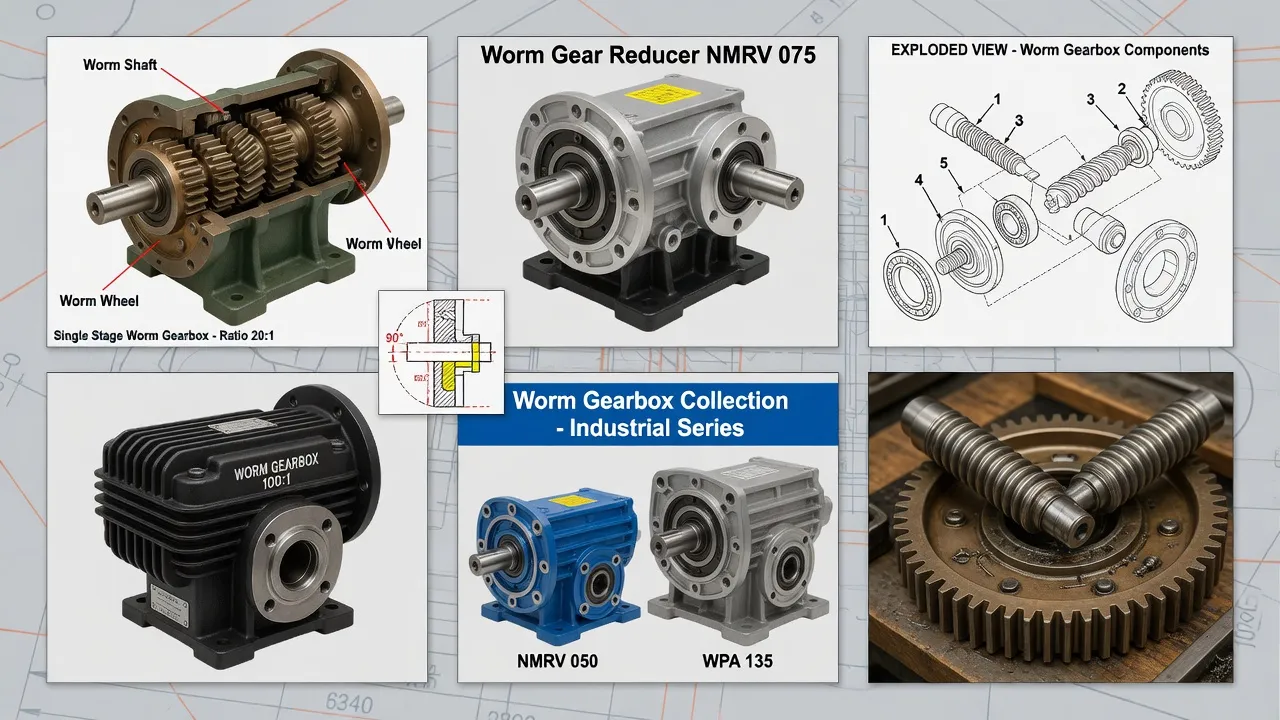
The Core Output Torque Formula — All Four Variables Defined
The output torque of a worm gearbox is:
T₂ = (P₁ × η × i) / ω₁
Or equivalently: T₂ = T₁ × i × η
Where each variable means:
| Variable | Definition | Units & Typical Values |
|---|---|---|
| T₂ | Output torque — what you need to calculate | Nm. This is what you compare to the application load torque × service factor |
| P₁ | Input power — rated power of the motor driving the gearbox | Watts. Use nameplate rated power, not peak or starting power |
| η | Gearbox efficiency — fraction of input power delivered as output | Decimal (0.60–0.92 for worm gearboxes). See efficiency table by ratio below |
| i | Reduction ratio — how many input revolutions per one output revolution | Dimensionless. Standard NMRV ratios: 5, 7.5, 10, 15, 20, 25, 30, 40, 50, 60, 80, 100 |
| ω₁ | Input shaft angular velocity in radians per second | rad/s = (rpm × 2π) / 60. For 1,400 rpm: ω₁ = 1,400 × 2π / 60 = 146.6 rad/s |
| T₁ | Input torque — motor shaft torque (alternative to P₁ / ω₁) | Nm = P₁ / ω₁. For 0.75 kW at 1,400 rpm: T₁ = 750 / 146.6 = 5.11 Nm |
The most common mistake is omitting η — using T₂ = T₁ × i without the efficiency factor. At 50:1 ratio where η ≈ 0.72, this overestimates output torque by 39%. The gearbox frame selected on that overestimate will be undersized for the actual application load.
Quick-Reference Efficiency Values by Ratio (for Torque Calculation)
Use these midpoint efficiency values when calculating output torque. They represent PAO synthetic lubricant at run-in steady-state — the correct reference condition for rated continuous-duty torque calculations:
| Ratio (i) | η midpoint (PAO) | T₂ / T₁ factor | vs Theoretical max (i × 1.0) |
|---|---|---|---|
| 5:1 | 91% | 4.6× | −9% |
| 10:1 | 86% | 8.6× | −14% |
| 15:1 | 82% | 12.3× | −18% |
| 20:1 | 79% | 15.8× | −21% |
| 30:1 | 76% | 22.8× | −24% |
| 40:1 | 73% | 29.2× | −27% |
| 50:1 | 72% | 36.0× | −28% |
| 60:1 | 70% | 42.0× | −30% |
| 80:1 | 66% | 52.8× | −34% |
| 100:1 | 63% | 63.0× | −37% |
Service Factor — Why You Must Apply It Before Selecting a Frame
The output torque formula gives you the continuous rated output torque. Before comparing this to the application load, you must calculate the design torque — the service-factor-adjusted value that accounts for duty cycle, shock loading, and daily operating hours:
T₂_design = T₂_load × Sf
The selected gearbox catalog rating must exceed T₂_design
| Load Character | ≤2 h/day | 2–8 h/day | 8–16 h/day | >16 h/day |
|---|---|---|---|---|
| Uniform smooth load (fan, centrifugal pump, conveyor) | 1.00 | 1.00 | 1.25 | 1.50 |
| Moderate shock (agitator, screw conveyor, packaging machine) | 1.25 | 1.25 | 1.50 | 1.75 |
| Heavy shock (crusher auxiliary, saw drive, bucket elevator jam) | 1.50 | 1.75 | 2.00 | 2.25 |
Source: AGMA 6034-B92 service factor table, adapted for worm gearbox duty classes. For applications with frequent reversals (more than 10 start/stop cycles per hour), add 0.25 to the table value. For applications involving VFD-driven motors with soft-start capability, a 0.25 reduction to the service factor is sometimes permitted — consult the gearbox manufacturer before applying this deduction.
Worked Example 1 — Belt Conveyor Drive (Straightforward)
Application: Horizontal belt conveyor head-pulley drive. Motor: 1.1 kW, 4-pole, 1,400 rpm. Gearbox ratio: 30:1. Operating: 16 hours/day, uniform load. Lubricant: PAO synthetic.
- Read efficiency from table: Ratio 30:1, PAO run-in → η = 76% (midpoint)
- Calculate input angular velocity: ω₁ = 1,400 × 2π / 60 = 146.6 rad/s
- Calculate rated output torque: T₂ = (1,100 W × 0.76 × 30) / 146.6 = 25,080 / 146.6 = 171 Nm
- Apply service factor: Uniform load, 16 h/day → Sf = 1.25. T₂_design = 171 × 1.25 = 214 Nm
- Select gearbox: Select NMRV with rated output torque ≥ 214 Nm at 30:1. An NMRV075 at 30:1 is rated ~240 Nm — this is the correct frame. An NMRV063 at 30:1 is rated ~170 Nm — undersized, do not use.
Note: if the calculation had omitted the efficiency factor (T₂ = T₁ × i = 7.51 × 30 = 225 Nm), the pre-service-factor torque appears larger than the correctly calculated 171 Nm. With service factor applied: 225 × 1.25 = 281 Nm — leading to selection of a larger, more expensive NMRV090. Including efficiency gives the correct (smaller) design torque and the correct frame selection. This is why the efficiency factor is not optional.
Worked Example 2 — Gate Opener (Intermittent, Self-Locking Required)
Application: Commercial sliding gate, 800 kg gate mass, 0.15 m/s travel speed, rack-and-pinion mechanism with 0.12 m pitch radius pinion. Motor: 0.37 kW, 1,400 rpm. Required ratio: 60:1. Duty: 20 cycles/day (<2 h total). Self-locking required to hold gate against wind load.
- Calculate required output torque from application load: Gate force = mass × friction coefficient × g = 800 × 0.08 × 9.81 = 627 N. Output torque = Force × pinion radius = 627 × 0.12 = 75.2 Nm required
- Apply service factor: Moderate shock (gate motor start against static friction), <2 h/day → Sf = 1.25. T₂_design = 75.2 × 1.25 = 94 Nm
- Read efficiency from table: Ratio 60:1, PAO run-in → η = 70%. Self-locking confirmed: 60:1 is firmly in the self-locking range.
- Back-calculate required input power: P₁ = T₂_design × ω₂ / η = 94 × (1400/60 × 2π/60) / 0.70 = 94 × 2.44 / 0.70 = 328 W. A 0.37 kW (370 W) motor has 13% power margin — adequate for this intermittent application.
- Verify rated output torque of selected gearbox exceeds 94 Nm at 60:1. NMRV050 at 60:1 is rated ~105 Nm — adequate. Confirm self-locking in product data sheet.
For precision gate-drive and servo positioning applications requiring tighter torque tolerances and documented backlash, our precision worm gearbox range provides matched-pair selection with <4 arcmin backlash certification.
Worked Example 3 — Agitator Vertical Shaft (24/7 Continuous Duty)
Application: Vertical shaft chemical agitator, required output torque 320 Nm at 47 rpm output. Motor available: 4-pole 1,400 rpm. Ratio required: 1400/47 = 29.8:1 → specify 30:1. Operating: 24 hours/day, 7 days/week. Moderate viscosity peaks (moderate shock).
- Apply service factor first: Moderate shock, >16 h/day → Sf = 1.75. T₂_design = 320 × 1.75 = 560 Nm
- Read efficiency: 30:1 ratio, PAO run-in → η = 76%
- Calculate required input power: P₁ = T₂_design × ω₂ / η = 560 × (47 × 2π / 60) / 0.76 = 560 × 4.92 / 0.76 = 3,624 W → specify 4 kW motor
- Select gearbox frame: Catalog rated output torque must exceed 560 Nm at 30:1. An NMRV090 at 30:1 is typically rated ~450 Nm — insufficient. Move to NMRV110 at 30:1, rated ~750 Nm — correct frame.
- Check thermal rating: 24/7 continuous duty at 4 kW input. Verify NMRV110 thermal input-power rating at 30:1 for continuous duty at 20°C ambient ≥ 4 kW. If not, specify a fan-cooled version or apply a thermal derating factor.
⚠ Thermal check for continuous duty: For any application running more than 8 hours/day, always verify the thermal input-power rating from the catalog in addition to the mechanical torque rating. At 30:1 ratio where efficiency is 76%, the gearbox converts 24% of input power to heat — for a 4 kW input that is 960 W of continuous heat generation. Many NMRV frames at this size are thermally limited to 2.5–3.5 kW continuous input — meaning an oversized motor or a fan-cooled housing variant may be required.
For the full NMRV torque and thermal rating tables across all frame sizes and ratios, see the NMRV worm gearbox series product page. For engineering reference data on industrial worm reducer torque ratings and selection methodology, see the industrial worm reducer engineering reference.
Worm Gearbox Output Torque — Quick Calculator
Use this calculator to compute output torque, input power requirement, and annual energy loss for your application. All efficiency values are loaded from the reference table above (PAO synthetic, run-in):
Rated Output Torque
— Nm
Design Torque (with Sf)
— Nm
Output Speed
— rpm
Power Loss (heat)
— W
Note: Design torque shown is the minimum gearbox catalog rating required. Select the next standard frame size above this value from the NMRV catalog. Efficiency values are PAO synthetic, run-in steady-state midpoints — use mineral oil values (5–7% lower) for conservative thermal sizing.
5 Common Torque Calculation Mistakes and How to Avoid Them
- Omitting the efficiency factor: T₂ = T₁ × i (no η) overestimates output torque by 8–37% depending on ratio. Always include η. At 100:1 ratio, the error reaches 37% — enough to select a gearbox two frame sizes too large or too small.
- Using peak motor power instead of rated power: Some motor nameplates show a short-term peak power. Always use the rated continuous power for gearbox sizing — the value the motor sustains indefinitely. Using peak power overestimates the continuous output torque and leads to thermal overloading of the gearbox in continuous duty.
- Forgetting to apply service factor: The catalog torque is the sustained mechanical limit. Real applications impose shock loads, reversals, and extended daily running that reduce effective life unless the service factor is applied. Specifying T₂_design = T₂_load without Sf saves one frame size at purchase and costs a premature failure at 18–30 months.
- Using nominal ratio without checking the exact catalog ratio: NMRV gearboxes are catalogued at nominal ratios (30:1, 50:1) but the actual ratio is often slightly different (e.g., 29.17:1, 49.50:1 depending on wheel tooth count). For output speed-critical applications (conveyor belt speed, filling machine dosing rate), use the exact ratio from the gear data sheet, not the nominal.
- Ignoring thermal rating for continuous duty: Calculating T₂ and selecting a frame purely on mechanical torque is only half the check for continuous-duty applications above 4 h/day. Always verify the thermal input-power rating from the catalog separately. The thermal limit is frequently more restrictive than the mechanical limit at ratios above 40:1.
Frequently Asked Questions
What is the difference between output torque and design torque?
Output torque (T₂) is the continuous torque the gearbox can deliver at rated input power — what the formula calculates. Design torque (T₂_design) is the catalog rating the selected gearbox must exceed, equal to the application load torque multiplied by the service factor. The two are not the same: T₂ is what you calculate from motor power; T₂_design is the threshold the gearbox rating must clear, derived from the application load with service factor applied.
How do I calculate the required torque if I only know the load force, not the load torque?
Convert force to torque via: T = F × r, where F is the force in Newtons and r is the effective moment arm radius in meters. For a belt drive: r = pulley radius. For a screw conveyor: r = half the pitch diameter of the drive shaft coupling. For a rack-and-pinion gate: r = pitch radius of the pinion gear. Once you have the load torque in Nm, apply the service factor and compare to the gearbox catalog rating.
What efficiency value should I use if I don’t know the lubricant type?
Use the mineral oil run-in value for conservative motor sizing (lower efficiency = larger power requirement = correct safety margin). Standard NMRV gearboxes shipped from stock are typically filled with mineral oil VG220 unless specified otherwise. If the unit has been in service for more than 200 hours, use the run-in value. If it is a new installation that has not been run in yet, use the new/cold value for thermal budget calculations.
Can I use this formula for a double-reduction (two-stage) worm gearbox?
Yes — use the combined efficiency (η₁ × η₂) and the total ratio (i₁ × i₂). For a 400:1 double-stage unit (20:1 × 20:1): η_combined = 0.79 × 0.79 = 0.62; i_total = 400. T₂ = (P₁ × 0.62 × 400) / ω₁. The same formula, with combined efficiency and total ratio inserted.
Need a Gearbox Sized for Your Exact Application?
Send our drive engineers your motor power, speed, required output torque or load force, duty cycle, and daily operating hours — we’ll return a correctly sized NMRV frame recommendation with service factor and thermal check within one business day.