
The design service life of a correctly specified, correctly installed, and properly maintained worm gearbox is 20,000–30,000 hours — equivalent to 8–12 years of typical 8-hour single-shift industrial operation. Yet field-failure data consistently shows a large population of worm gearboxes failing at 2,000–8,000 hours — 30–75% of their design life. The gap between design life and actual life is never random: it traces to a small set of identifiable root causes, each of which can be prevented or mitigated. This article quantifies the expected service life under various real operating conditions, identifies the eight factors that shorten it most significantly, and provides a practical framework for predicting and extending worm gearbox service life in your specific application context.
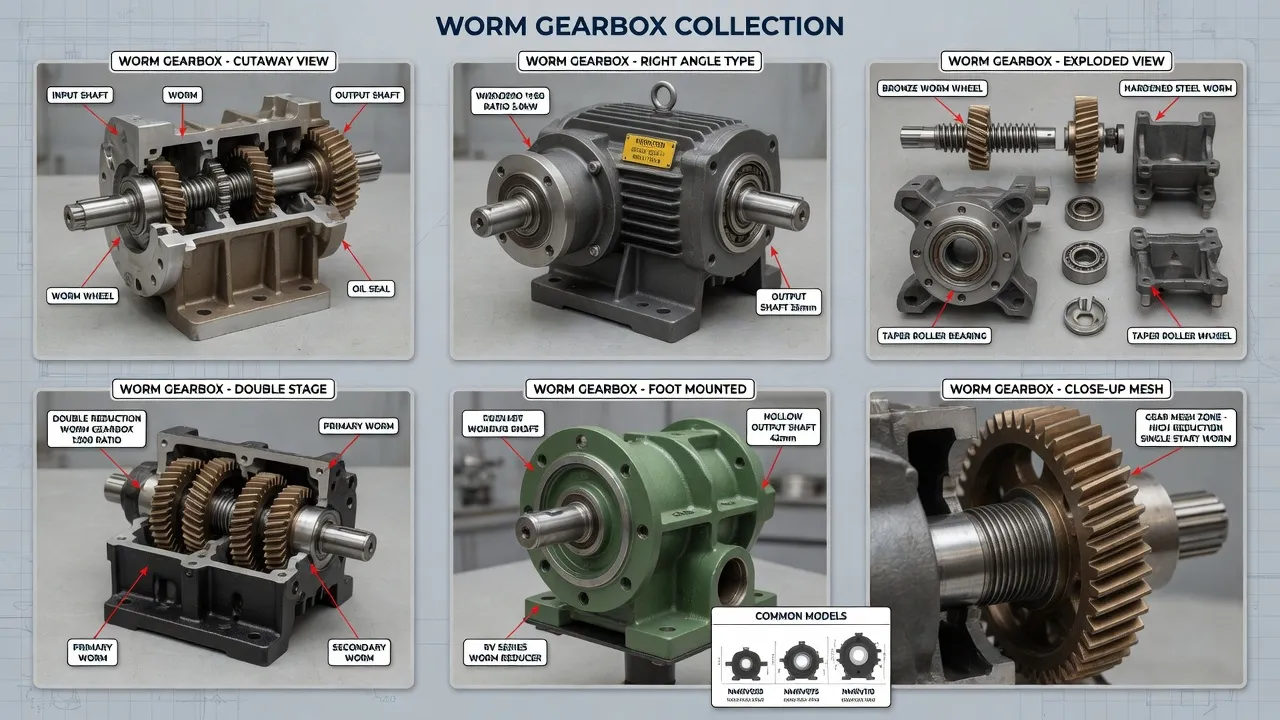
Expected Service Life Under Different Operating Conditions
| Operating Condition | Hours/Day | Expected Life (hrs) | Calendar Years | Governing Failure Mode |
|---|---|---|---|---|
| Light intermittent (gate opener, solar tracker) | <1 h/day | 30,000+ | 20–30+ years | Seal UV aging, lubricant oxidation (calendar-based) |
| Single-shift industrial (8 h/day, 65% load) | 8 h | 20,000–28,000 | 7–10 years | Bronze wheel wear (planned replacement trigger) |
| Two-shift industrial (16 h/day, 75% load) | 16 h | 15,000–22,000 | 3–5 years | Bronze wheel wear, bearing L10 life |
| Continuous 24/7 (80% load, within thermal limit) | 24 h | 10,000–18,000 | 1.5–2.5 years | Bearing L10 life, lubricant degradation rate |
| Continuous 24/7 (above thermal rating) | 24 h | 2,000–6,000 | <1 year | Accelerated lubricant degradation → bronze softening |
The Three Components That Define Service Life
Three internal components limit worm gearbox service life, typically in this priority order:
- Bronze worm wheel (primary wear component): The deliberately softer of the two meshing materials. Bronze wears gradually over the service life, increasing tooth-face clearance (backlash) and reducing mesh contact quality. Typical bronze worm wheel life at rated load: 15,000–25,000 hours for CuSn12Ni2 phosphor bronze. The failure mode is gradual — backlash increases progressively, giving ample forewarning before structural failure. Bronze wheel replacement is a planned maintenance event, not an emergency, when the trend is monitored.
- Output shaft tapered roller bearings: The output shaft bearing carries both the radial load from the worm wheel contact force and the axial load from the worm gear’s helix angle thrust. Bearing L10 life at rated load: 15,000–25,000 hours with correct preload and clean lubrication. Bearing failure mode is more abrupt than bronze wheel wear — progressive vibration increase followed by spalling or cage failure. Condition monitoring via vibration spectrum analysis detects bearing fatigue 500–2,000 hours before failure.
- Shaft seals: FKM (Viton) double-lip seals: 8,000–15,000 hours in typical industrial indoor environments. NBR seals in outdoor UV-exposed installations: 3,000–6,000 hours before elastomer hardening causes seal lip contact loss. Seals are the most economical service item — proactive replacement at 4–5 year intervals prevents the secondary damage (lubricant contamination, worm wheel wear acceleration) that follows seal failure.
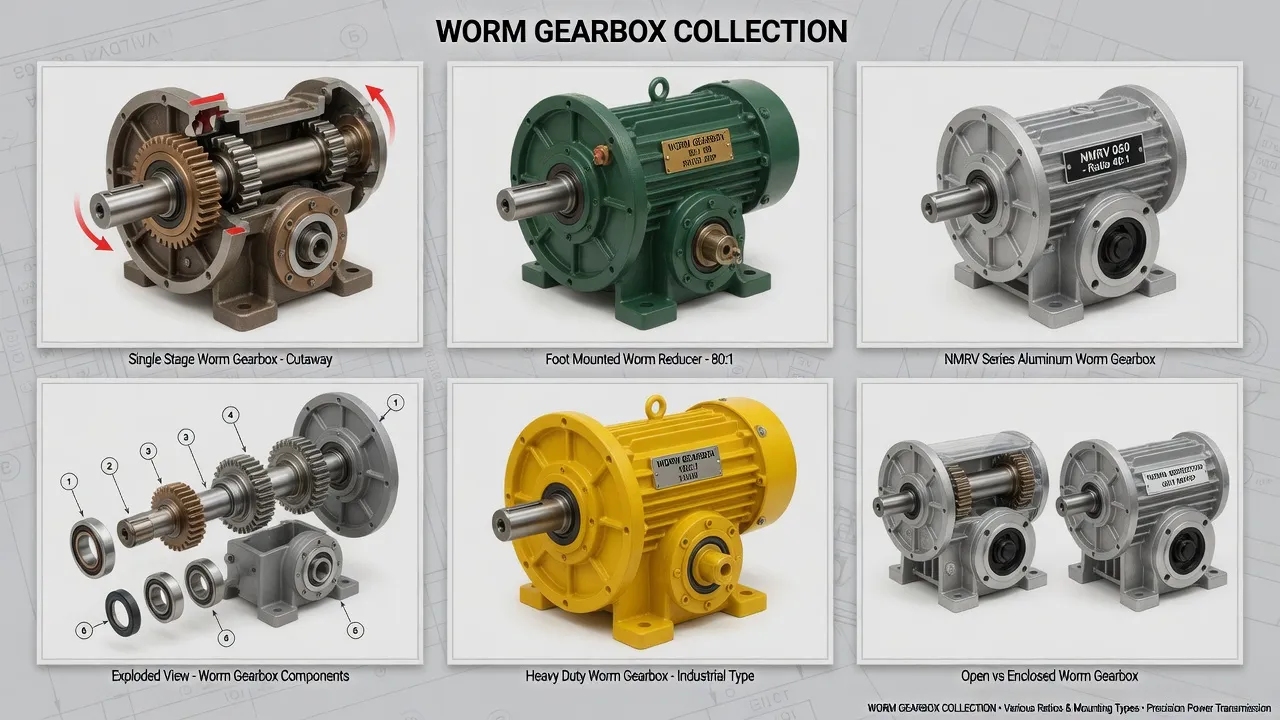
8 Factors That Shorten Worm Gearbox Service Life
- Thermal overload (the single highest-impact factor): Sustained operation above the thermal input-power rating (P₁therm) degrades lubricant at 2–3× the normal rate. Degraded lubricant — oxidised, contaminated with wear particles, or carbonised near the seal — causes the worm wheel bronze to run at higher friction temperature, softening the bronze and accelerating wear. A gearbox running 20% above its thermal rating continuously for one year typically shows worm-wheel wear that would otherwise take 4–6 years to accumulate. Fix: verify thermal rating at order; derate or upgrade frame if thermal limit will be exceeded.
- Wrong or contaminated lubricant: Lubricants containing active-sulfur EP additives corrode the bronze worm wheel, typically causing 3–5× faster wear than correctly specified oil. Contaminated oil (water ingress from failed seal, abrasive particles from worn wheel) acts as an abrasive slurry at the worm-wheel mesh. Fix: specify only bronze-compatible non-active-sulfur oil; replace contaminated oil immediately; change at 8,000-hour intervals or as indicated by oil condition sampling.
- Incorrect oil fill level for mounting orientation: Running with too little oil (underfill in a non-standard mounting position) starves the lower bearing and worm wheel of lubrication — the most common installation error and one of the most damaging. Oil starvation at the lower bearing produces bearing fatigue in 500–3,000 hours. Fix: always use the catalog mounting-position oil-fill volume table; specify mounting position at order.
- Motor shaft misalignment: Parallel misalignment of 0.2–0.3 mm at the input coupling generates cyclic radial loads that produce input bearing fatigue in 800–3,000 hours — regardless of whether the gearbox is correctly sized for the application torque. Fix: ensure B5 flange faces are flush; perform laser or dial-indicator alignment on separate-mount couplings.
- Overloading beyond service-factor-adjusted rated torque: Torque peaks from motor stalls, conveyor jams, or mixer viscosity spikes that exceed the service-factor-adjusted rating produce subsurface fatigue in the bronze worm wheel tooth face. Unlike gradual wear, fatigue cracking is sudden. Fix: apply correct AGMA service factors; for shock-load applications, specify the next larger frame size.
- Abrasive environment without shaft seal protection: In dusty installations (cement, grain, aggregates), abrasive particles ingested at the shaft seal score both the seal lip and the shaft surface. Once the shaft surface is scored, even a new seal cannot maintain a reliable contact — progressive seal failure allows abrasive-contaminated oil to circulate through the worm-wheel mesh. Fix: install labyrinth seal guards; use IP65 or IP66 instead of IP55 in dusty environments.
- Incorrect first-fill or failure to perform run-in oil change: Running without the first-fill lubricant change at 200–300 hours leaves fine bronze and steel particles in suspension — acting as an abrasive at the mesh and bearing surfaces. Fix: mandatory oil change at 200–300 hours; drain warm, inspect oil colour and metallic content, refill with fresh PAO.
- Installation in wrong frame size (under-sizing): A gearbox selected without applying the service factor and running at 120–150% of its rated torque continuously will reach the end of its worm-wheel service life in 30–50% of the expected time. Under-sizing is common when engineers use the motor nameplate torque directly without service factor adjustment. Fix: apply AGMA service factor; verify both mechanical and thermal ratings at the actual application duty before ordering.
How to Extend Service Life — The Five Most Effective Interventions
Based on the eight life-shortening factors, the five interventions with the best service-life extension ROI:
- Switch to PAO synthetic lubricant: Directly extends lubricant service life (better oxidation stability at elevated temperature), reduces operating temperature (better viscosity-temperature curve), and improves efficiency. Net effect: worm-wheel wear rate reduction of 15–25% in continuous-duty applications. Cost: minimal ($5–$15 per fill over mineral oil).
- Verify thermal budget and derate if needed: The highest-impact single intervention for continuous-duty overheating installations. If the gearbox is above its thermal rating, reducing the input power by 15–20% (smaller motor or VFD speed reduction) can extend service life from <2 years to 6–8 years. Free to implement if the process permits a small output speed reduction.
- Add housing temperature monitoring: A $2 temperature-indicating label at each gearbox provides a permanent record of any thermal exceedance between inspections. Catches thermal overload problems before they cause failure — enabling corrective action 3–12 months before a failure event.
- Implement backlash trend monitoring: A quarterly backlash measurement takes 10 minutes per gearbox and provides the most reliable leading indicator of worm-wheel remaining life. Doubling from commissioned value = plan replacement at next shutdown. Tripling = plan for emergency replacement.
- Proactive seal replacement at 4-year intervals: Seal replacement costs $8–$25 in parts and 30–60 minutes labor. A failed seal costs a contaminated oil change, cleaning of the machine area, and — if undetected — accelerated worm-wheel wear that adds $150–$800 in subsequent repair costs. The ROI on proactive seal replacement is 10:1 or better in most continuous-duty applications.
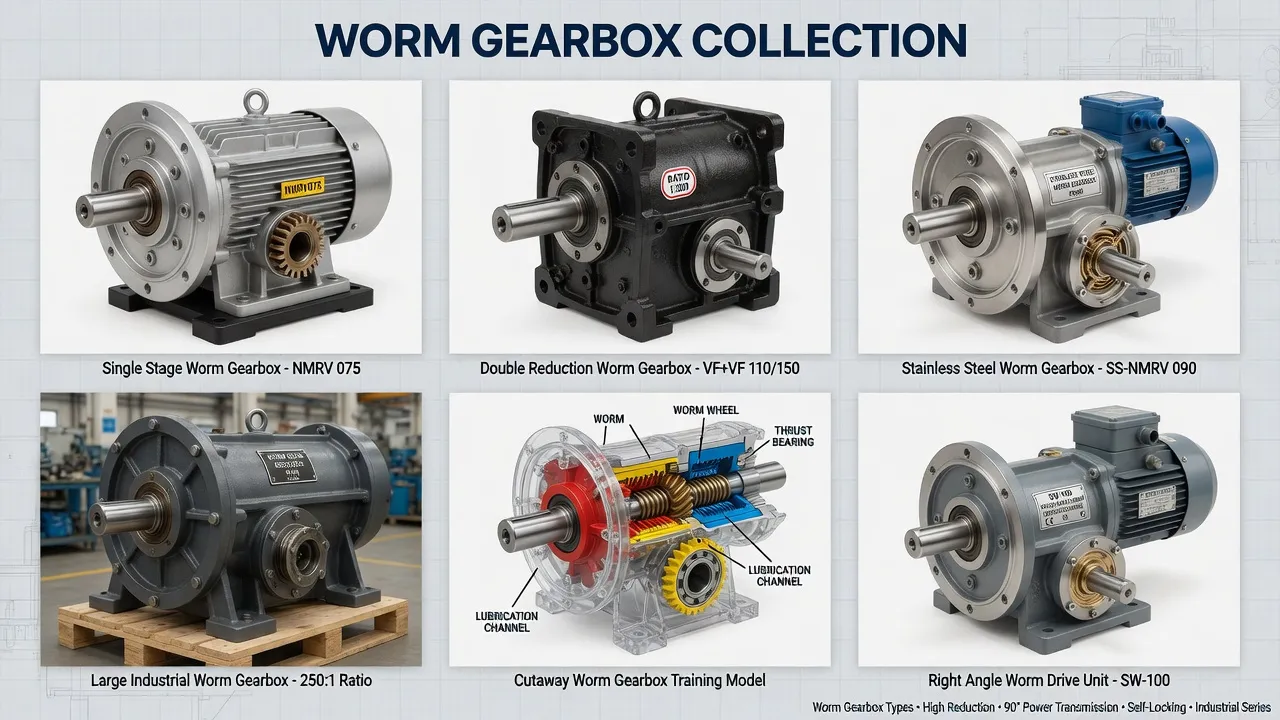
For our standard NMRV compact worm gearbox range covering typical single-shift industrial applications, the NMRV worm gearbox series is engineered for 20,000–25,000 hour L10 bearing life at rated load. For heavy-duty 24/7 continuous industrial applications requiring maximum service life between planned shutdowns, our heavy-duty worm gearbox range uses cast-iron housing and larger bronze wheel cross-sections for extended service intervals. For service-life prediction methodology and maintenance interval optimization reference data, see the worm reducer service life and maintenance guide.
Frequently Asked Questions
What typically fails first — the bronze wheel, the bearings, or the seals?
In properly maintained units running within their rated conditions: seals are typically the first service item (3–8 years depending on environment), followed by bronze worm wheel (6–12 years depending on duty), followed by bearings (8–15 years, rarely the primary failure). In poorly maintained or overloaded units: lubricant degradation causes simultaneous accelerated wear across all three components. The most common catastrophic failure sequence is: seal fails → contaminated oil → accelerated bronze wear → bearing failure from contaminated oil — all within 6–18 months of the initial seal failure that was not detected or corrected.
How much does operating above rated load by 10% shorten service life?
For bronze worm wheel wear (the primary service-life component): wear rate follows approximately a cubic power law with contact stress — a 10% torque overload (10% above catalog M₂) increases the bronze wear rate by approximately 30–35%. This reduces bronze wheel service life from, say, 20,000 hours to approximately 15,000 hours. For bearings: bearing L10 life follows a cubic inverse power law — a 10% overload reduces L10 life by approximately 27%. Operating at rated load with correct service factor applied is the single best investment in achieving design life.
Can I rebuild a worm gearbox rather than replacing it?
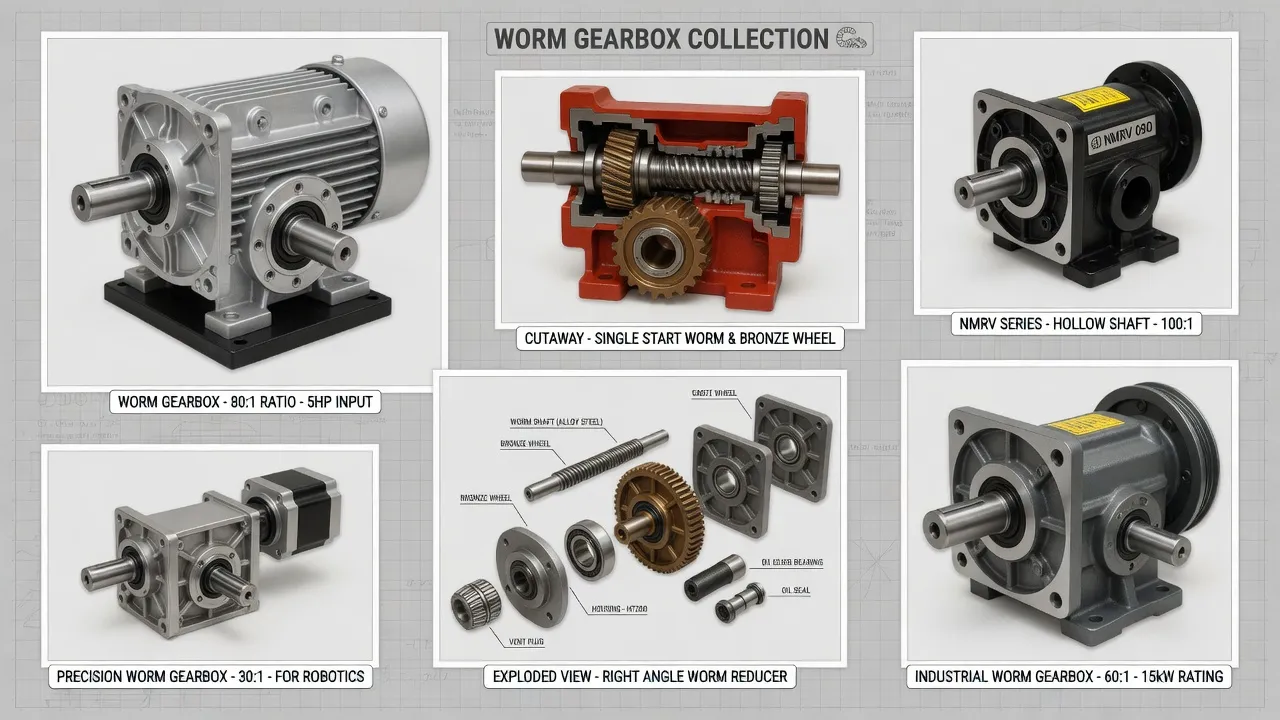
Yes — for NMRV090 and above, rebuild economics are typically favourable if the housing is undamaged and the worm screw is intact. A rebuild consists of: new bronze worm wheel (the primary wear item), new bearings, new seals, fresh lubricant, and inspection/replacement of the worm screw if worn. Rebuild cost is typically 35–55% of a new unit cost. For NMRV050 and below, new unit cost is so low that rebuild economics rarely justify the labour cost — replace the full unit. For heavy-duty industrial worm gearboxes in the RR/RRV class, rebuild is strongly preferred at end of wheel life due to the high unit cost and long lead time for large-frame replacement units.
Does running at a lower ratio (e.g., 30:1 vs 50:1) extend service life?
Indirectly yes — through two mechanisms. (1) Lower ratio = higher efficiency = lower heat generation per kW of input power = slower lubricant degradation. (2) Lower ratio = larger lead angle = higher sliding velocity at the mesh = better EHL film formation at equivalent viscosity = slightly lower friction coefficient. The combined effect: at equivalent output torque and duty cycle, a 30:1 unit typically runs 8–15°C cooler than a 50:1 unit of the same frame size — which corresponds to roughly 20–30% longer lubricant service life based on the Arrhenius degradation relationship. If the process permits using 30:1 instead of 50:1 (accepting the higher output speed), the service life benefit is real and measurable.
Want a Service-Life Assessment for Your Worm Gearbox Installation?
Send our maintenance engineering team your application duty cycle, current lubricant, operating temperature, and any symptoms — we’ll assess the remaining service life estimate and recommend any corrective actions to extend it.