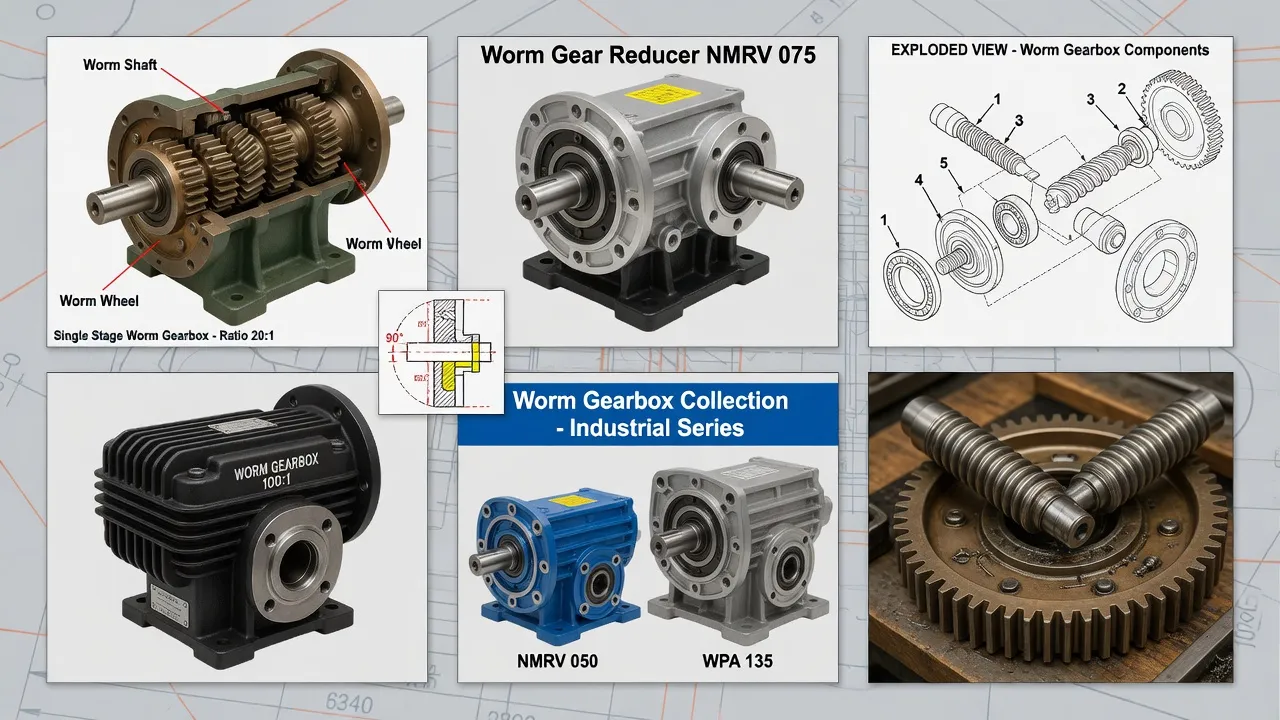
Solar tracker drives are the fastest-growing application segment for worm gearboxes globally — and the growth shows no sign of slowing. Utility-scale solar farms deploying single-axis trackers capture 15–30% more annual energy yield compared to fixed-tilt installations, and worm gearboxes are the dominant specification for the drive mechanism in trackers of all scales. The core reason is the same property that makes worm gearboxes indispensable for gate openers: self-locking. A solar tracker must hold its panel orientation under wind load when the drive motor is not actively moving the panel. The worm gearbox does this without consuming power, without a brake module, and without any control-circuit intervention — which is critical for off-grid and battery-backed tracker systems where holding-current parasitic load matters directly to system yield.
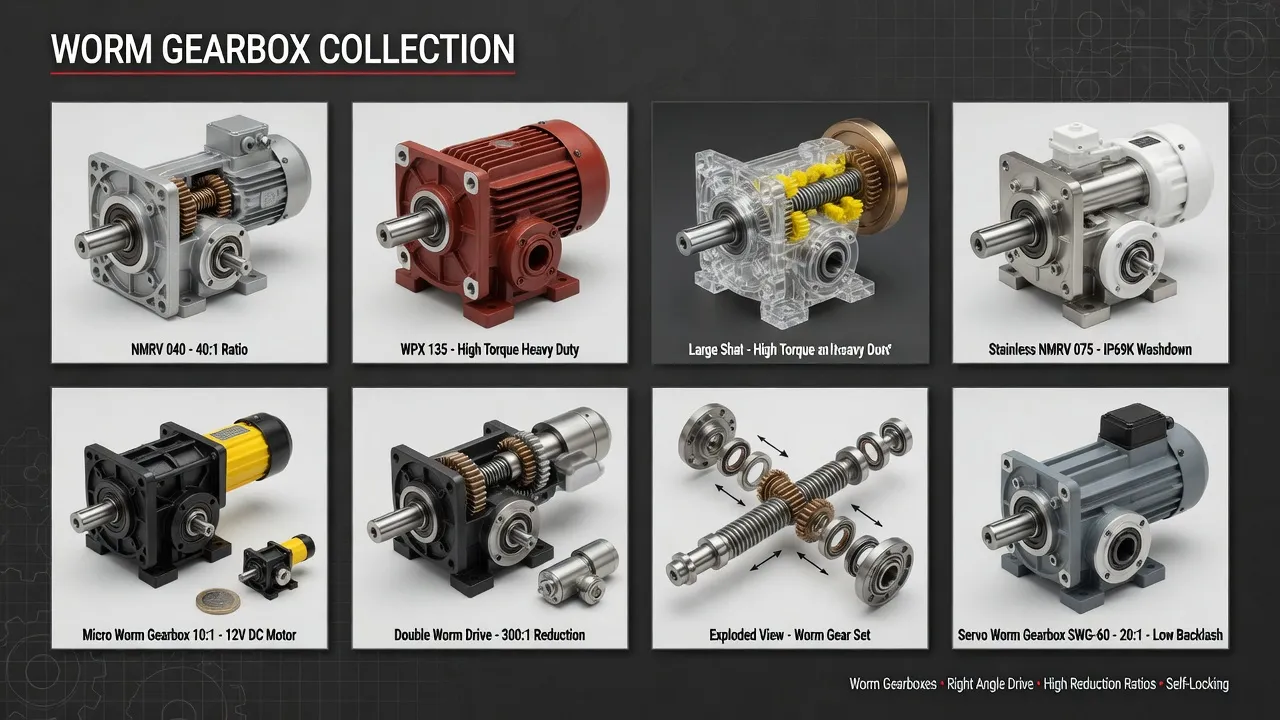
Why Self-Locking Matters in Solar Tracker Drives
A solar tracker panel array presents a significant wind load profile. A 1 m × 2 m panel at 30° tilt in a 15 m/s wind experiences approximately 250–400 N aerodynamic force perpendicular to the panel surface — generating a torque at the tracker drive shaft of 125–200 Nm for a single panel, and several thousand Nm for multi-panel row tracker systems.
Without self-locking, this wind torque would continuously back-drive the tracker away from its set position — requiring the motor to run continuously just to maintain orientation. The alternatives to worm self-locking:
- Motor continuous holding current: Motor held energized at stall current to resist wind torque. Consumes 15–40% of motor rated power continuously during the hold phase. On a 100 kWp tracker array with 50 motors, this represents 2–4 kW of continuous parasitic consumption — reducing net yield significantly.
- Electromagnetic brake: Spring-applied electromagnetically released brake on the motor shaft. Requires control power to release when tracking, adds failure mode (brake release solenoid), and adds cost. For large multi-thousand-unit tracker farm deployments, 5,000 electromagnetic brake modules represent significant additional BOM cost and maintenance scope.
- Self-locking worm gearbox: Zero holding current. Zero brake module. Zero control circuit for hold function. The tracker shaft is mechanically locked against wind back-drive whenever the motor is de-energized. For solar trackers, this is not just a cost saving — it is a system architecture simplification that reduces the number of components requiring maintenance in a 25-year operating asset.
Single-Axis vs Dual-Axis — Gearbox Requirements
| Parameter | Single-Axis Tracker | Dual-Axis Tracker |
|---|---|---|
| Tracking axis | East-West rotation (tilt axis) only | East-West (tilt) + North-South (azimuth) |
| Daily tracking range | 60°–120° East-West daily sweep | 180° azimuth + 60°–90° elevation daily |
| Gearboxes per tracker | 1 drive per row (row tracker) or 1 per panel | 2 drives per tracker (azimuth + elevation) |
| Drive mechanism | Worm gearbox + torque tube / slewing ring | Worm gearbox + slewing ring for each axis |
| Typical output torque | 500–8,000 Nm (row system) | 100–1,500 Nm per axis |
| Typical ratio | 40:1–80:1 (+ slewing ring reduction) | 40:1–80:1 per axis |
| Self-locking requirement | Critical — prevents wind back-drive on tilt axis | Critical on both axes |
| Annual energy gain vs fixed tilt | 15–25% in most climates | 25–40% (better in high-latitude, diffuse-radiation sites) |
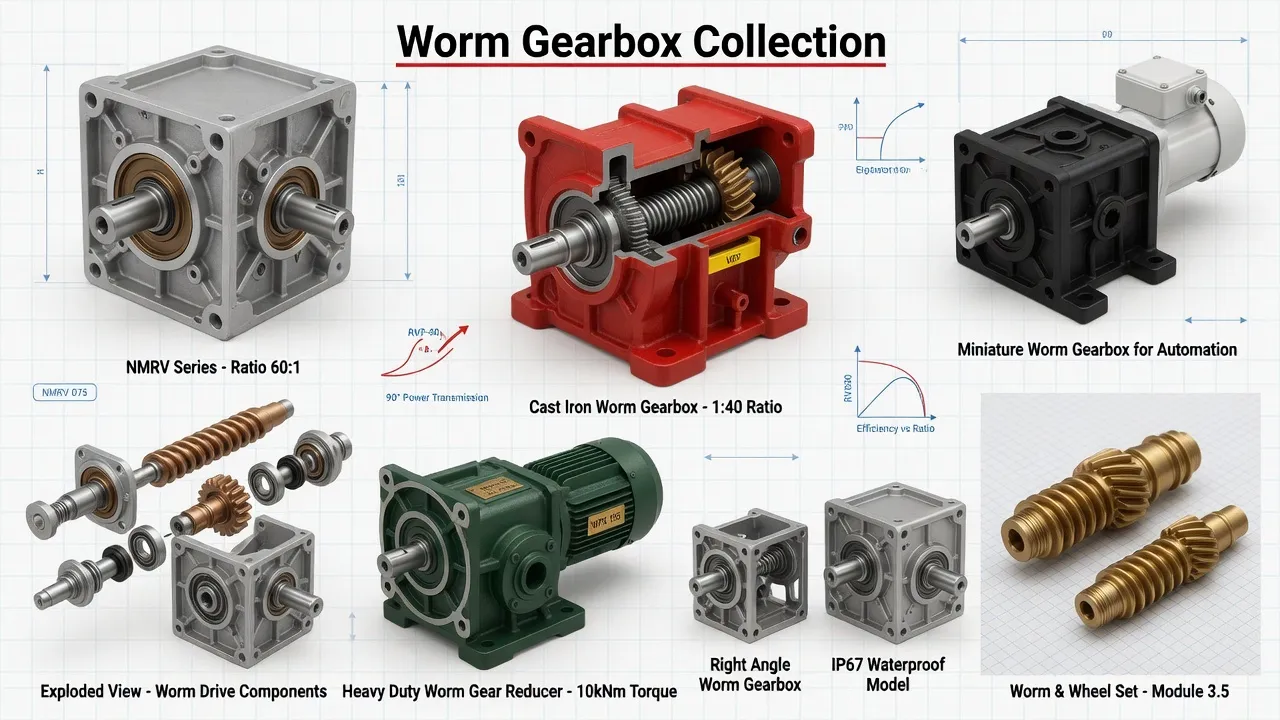
Stow Position — The Critical Wind-Load Function
Modern single-axis tracker control systems include a wind-stow function: when wind speed exceeds a threshold (typically 15–20 m/s), the controller commands all trackers to move to a stow position — typically horizontal (0° tilt) — to minimize wind-load profile and prevent structural damage. The worm gearbox’s role during a stow event:
- Controller signals motor to move to stow position — motor drives the worm, worm drives the wheel, torque tube rotates the panels to horizontal.
- Motor de-energizes when stow position sensor confirms horizontal alignment.
- Worm self-lock holds the panel array in horizontal stow position regardless of subsequent wind gusts — no further motor action required.
- When wind speed drops below the clear threshold, the controller re-activates the motor to resume tracking.
The critical failure mode to protect against: a worm gearbox that loses self-locking during a wind storm due to worm-wheel wear or lubricant degradation. A 5 MW tracker farm with 100 row-drive units each carrying 500 kg of panel mass — if self-locking fails on any unit during a 25 m/s wind event, the panel array could over-rotate to extreme tilt and generate aerodynamic loads exceeding the structural design. For high-value tracker deployments, specifying PAO synthetic lubricant (to preserve the friction coefficient of the worm-wheel mesh), annual self-locking torque verification checks, and proactive worm-wheel replacement at 12,000–15,000 hours is best practice. For detailed solar tracker drive system guidance, the solar tracker and worm gearbox drive systems guide covers sizing methodology and field maintenance protocols.
Specification Guide for Solar Tracker Worm Gearboxes
Key specification parameters for solar tracker worm gearboxes, distinct from standard industrial applications:
- Operating temperature range: Solar trackers in desert and semi-arid climates experience −10°C to +65°C housing temperature range. Specify PAO ISO VG220 for its flat viscosity-temperature curve — adequate film at +65°C and free-flowing at −10°C. Mineral oil VG220 may become too viscous for cold-morning starts and too thin at peak summer temperatures.
- Corrosion protection: Standard aluminum die-cast housing is adequate for most continental climates. For coastal, tropical, or highly polluted environments: specify epoxy-powder-coated aluminum or cast-iron housing. Salt-spray resistance per ISO 9227 (NSS test) should be requested from the supplier for coastal farm installations.
- IP66 as minimum: Solar tracker gearboxes are fully exposed to outdoor conditions — driven rain, dust storms, and UV exposure. IP65 is technically sufficient for rain exposure but IP66 provides the additional protection margin for the high-pressure condensation and driving-rain conditions that can occur in storm events.
- Service interval compatibility: Tracker farms plan maintenance activities on annual or semi-annual windows that coincide with low-solar periods (winter). Gearbox oil-change intervals should be matched to these windows — PAO synthetic at 8,000-hour intervals aligns with a 2-year change interval for single-axis trackers running 8–10 hours/day of active tracking.
- Backlash impact: Standard worm gearbox backlash (12–25 arcmin) is entirely acceptable for solar trackers where positioning accuracy of ±0.1°–0.5° is adequate. Precision low-backlash worm gearboxes are not required and should not be specified for tracker applications — the cost premium is not justified by the application accuracy requirement.
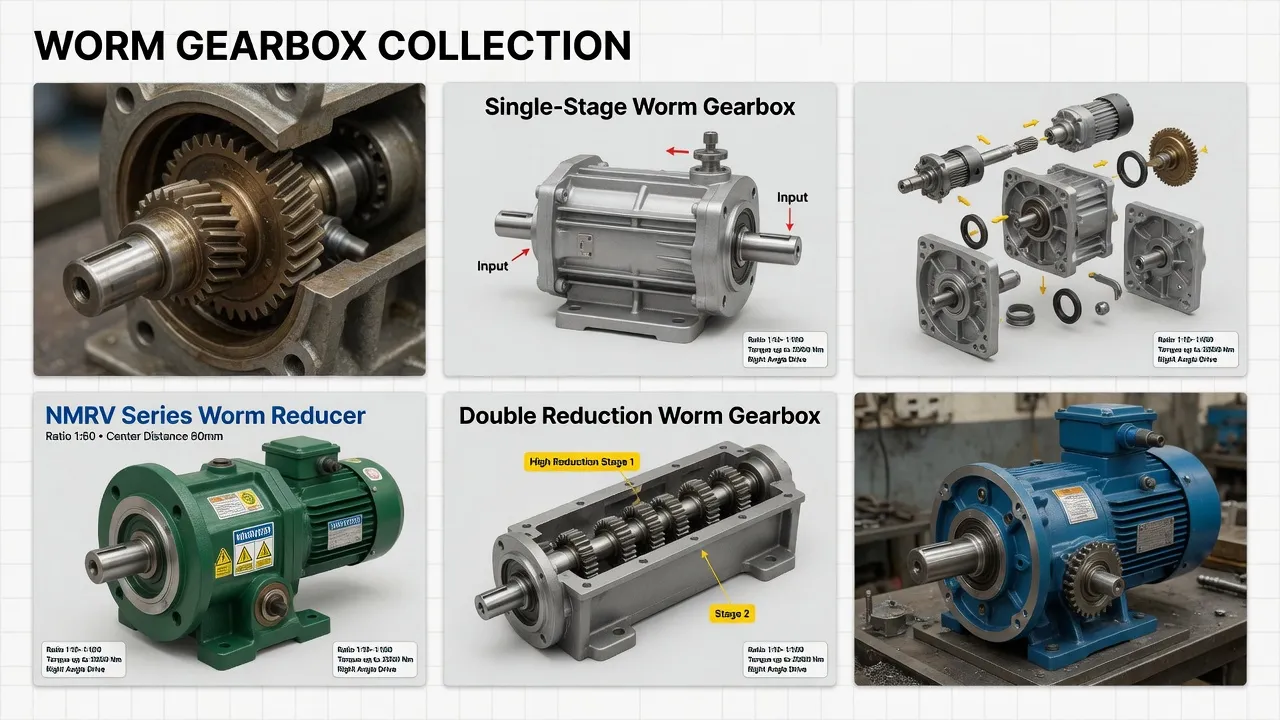
Our NMRV worm gearbox series from NMRV063 to NMRV150 covers the torque range for small-to-medium single-panel and row-tracker applications. For compact light-duty single-panel trackers, our compact aluminum worm gearbox range covers the small-frame lightweight requirement of residential and agricultural solar installations.
Frequently Asked Questions
Will the tracker panel drift from its set position if wind loads are applied?
No — provided the worm gearbox is at ratio ≥40:1 and the worm-wheel is in good condition. The self-locking mechanism resists any back-drive torque from wind loading, maintaining the set panel angle until the motor is commanded to move. Position drift indicates either an insufficient self-locking ratio (use ≥40:1), worn worm wheel (measure backlash and replace if above 2× commissioned value), or lubricant condition change (drain and refill if lubricant is contaminated or degraded).
How many cycles does a solar tracker gearbox see per year?
A single-axis tracker with a typical control algorithm performs approximately 20–40 position moves per tracking day (one move every 15–30 minutes of daylight), plus stow and unstow cycles. At 300 tracking days/year, this equals 6,000–12,000 position moves per year. Each move involves a 10–30 second run period. Annual operating hours for the gearbox motor: approximately 30–100 hours/year — very low duty cycle compared to industrial conveyor or agitator applications. The gearbox service life on the basis of operating hours is therefore very long; the governing maintenance interval is calendar time (lubricant oxidation, seal UV degradation) rather than operating hours.
Can the same worm gearbox be used for both the azimuth and elevation drives on a dual-axis tracker?
Yes — but the torque requirements are different for each axis. The azimuth (horizontal rotation) axis typically sees higher panel-weight moment arm torque; the elevation (tilt) axis sees lower torque but higher wind-load torque due to panel area exposure. Specify each axis independently from the torque calculation. In practice, many dual-axis tracker OEMs use the same NMRV frame size for both axes for inventory simplification, selecting the frame that satisfies the higher of the two torque requirements with an adequate service factor.
What is the typical service life of a solar tracker worm gearbox?
Given the very low annual operating hours (30–100 hours/year active duty), the mechanical wear life of the worm-wheel bronze and worm-screw steel is essentially unlimited — bronze wheel life at these duty cycles would exceed 50 years of mechanical wear. The practical service-life limits are: lubricant degradation (renew every 2–3 years for PAO in outdoor conditions), seal UV hardening and ozone cracking (replace FKM seals at 5–8 year intervals in UV-exposed outdoor installations), and housing corrosion in aggressive environments. A 25-year PV project design life is achievable with a standard NMRV worm gearbox under the above maintenance program.
Specifying Worm Gearboxes for a Solar Tracker Project?
Send our solar drive team your tracker type (single/dual axis), panel load, wind design load, drive mechanism (torque tube/slewing ring), annual tracker count, and climate zone — we’ll return a complete gearbox specification and volume pricing within one business day.
Sizing Example — 1 MW Single-Axis Row Tracker Farm
A 1 MWp single-axis tracker farm with 20 rows × 50 kWp per row. Each row has 20 panels, 2 m wide, connected via a central torque tube driven by a single NMRV gearbox per row. Wind design load at stow speed: 300 Nm at the torque tube shaft per row (from structural analysis). Tracking speed requirement: 2°/min maximum → output shaft speed ≈ 0.033 rpm. Motor: 24V brushless DC, 1,200 rpm.
- Ratio: 1,200 / 0.033 = 36,000:1 total. Standard solution: NMRV worm gearbox at 80:1 (output 15 rpm) + final slewing ring at ~2,400:1 → total 80 × 2,400 / 60 = varies by mechanism. More commonly: worm at 80:1 (15 rpm) + planetary reduction + chain drive to torque tube at the required final speed.
- Self-locking: NMRV at 80:1 is firmly self-locking. Wind torque of 300 Nm at the torque tube is reduced by the subsequent gear reductions before appearing at the worm output shaft — easily within self-locking margin.
- Frame size: 300 Nm wind torque at torque tube, multiplied back through the drive train to the gearbox output shaft level. Verify against NMRV catalog at 80:1. NMRV090-80 at 680 Nm output capacity provides a comfortable margin.
- 20 rows = 20 NMRV090-80 units. Contact our team for volume pricing — 20 units qualifies for the small-OEM volume tier.