
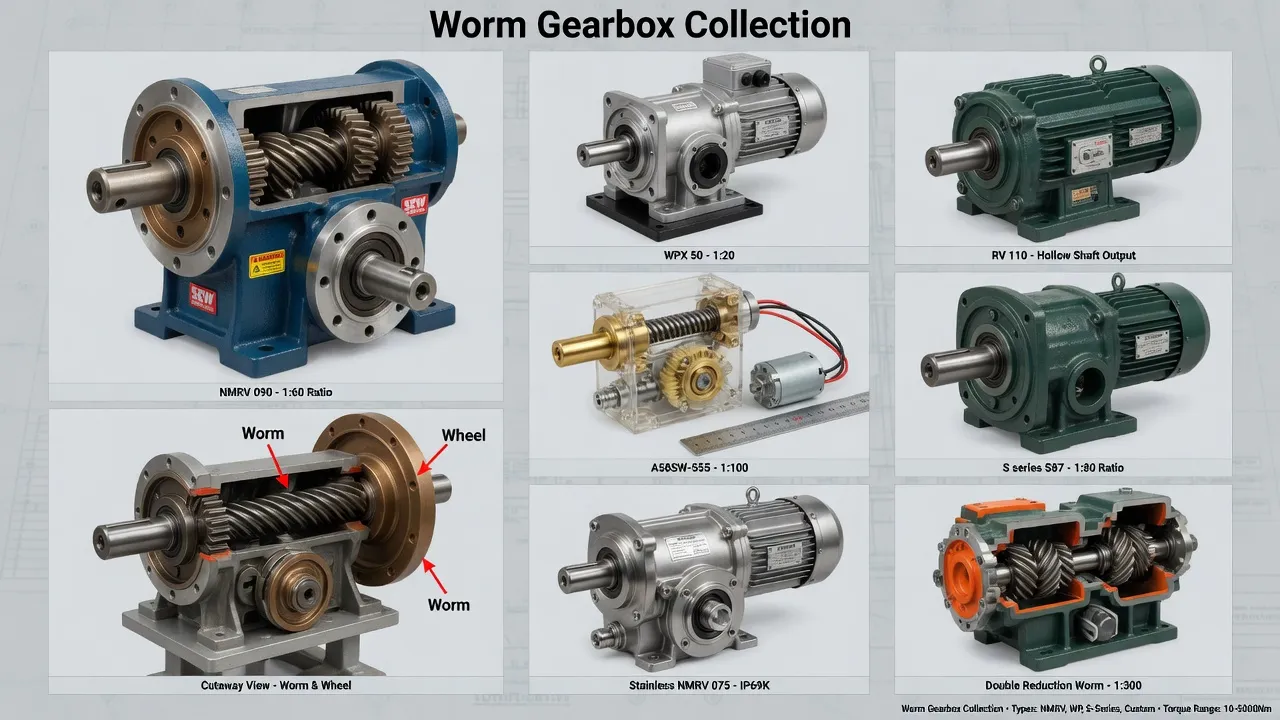
The worm wheel material is the single most important design decision in a worm gearbox — more so than the housing material, the bearing specification, or the lubricant type. The worm wheel is the deliberately sacrificial component: it wears so the steel worm does not. How quickly it wears, how well it manages the sliding-contact friction heat, and how it responds to shock loads all depend entirely on what material it is made from. Bronze, cast iron, and plastic each offer a distinct combination of friction, wear, load capacity, and cost properties — and each is the correct specification for a different operating context. This guide explains the metallurgy and tribology behind each material choice, provides the selection criteria for each, and includes the specific alloy grades that matter for real procurement decisions.
Why Material Pairing Matters — The Tribology Principle
Worm gear pairs operate under sliding contact — the worm thread slides across the worm wheel tooth face with every revolution. In sliding contact, the two surfaces must be dissimilar in hardness to prevent adhesive wear (galling) — where material transfers directly from one surface to the other, causing catastrophic seizure. The material pairing rule for worm gears:
- Worm (driving member): Must be significantly harder than the wheel — typically hardened steel at HRC 58–62 on the thread surface. The hard worm is the “permanent” element — it should outlast multiple wheel replacements.
- Worm wheel (driven member): Must be softer than the worm — acting as the sacrificial wear element that conforms to the worm geometry during run-in and wears gradually over the service life rather than causing catastrophic seizure of the harder worm.
This asymmetry is why changing the worm wheel material has a much larger effect on gearbox performance than changing any other component — the wheel material determines the coefficient of friction at the mesh, the rate of sliding-contact wear, the ability to carry high contact loads, and the gearbox’s response to operating temperature.
Bronze Worm Wheels — The Industry Standard
Bronze (copper-tin alloy) is the dominant worm wheel material for industrial worm gearboxes. The combination of properties it provides against a hardened steel worm is essentially irreplaceable in high-performance applications:
| Bronze Grade | Composition | Hardness | Max Surface Speed | Best Application |
|---|---|---|---|---|
| CuSn12Ni2 (GB1) | 88% Cu, 12% Sn, 2% Ni | HB 95–115 | >10 m/s | High-speed industrial NMRV, continuous duty |
| CuSn12 (GB2) | 88% Cu, 12% Sn | HB 90–110 | >10 m/s | Standard industrial, similar to CuSn12Ni2 |
| CuSn6Zn6Pb3 (GB3) | Cu, 6% Sn, 6% Zn, 3% Pb | HB 80–100 | 1–4 m/s | Low-speed moderate load, cost-sensitive |
| CuAl10Fe3 (Aluminium Bronze) | 88% Cu, 10% Al, 3% Fe | HB 150–180 | <1 m/s only | High-load very low speed, chemical resistance |
Why CuSn12Ni2 is the preferred specification: The 12% tin content provides the optimal combination of strength (load-carrying capacity) and conformability (ability to micro-conform to the worm thread profile during run-in). The 2% nickel improves corrosion resistance against the EP additive traces in industrial lubricants and slightly improves fatigue strength. This is the alloy specified in our NMRV worm gearbox worm wheels — it satisfies the ISO 14521 gear material requirements for industrial worm gearboxes under AGMA and DIN load-rating methodologies.
The quality trap: Lower-cost worm gearboxes sometimes substitute CuSn6Zn6Pb3 (leaded gunmetal, a significantly cheaper alloy) for CuSn12Ni2. Leaded gunmetal is adequate for low-speed, lightly-loaded intermittent duty — but wears 2–4× faster than CuSn12Ni2 under continuous duty at typical industrial speeds. Always request the bronze alloy certificate (material test report) when sourcing replacement worm wheels, and when evaluating low-price NMRV quotes. For detailed bronze alloy specifications and worm wheel material reference data, see the worm wheel material and specification guide.
Cast Iron Worm Wheels — Low-Speed Heavy-Load Alternative
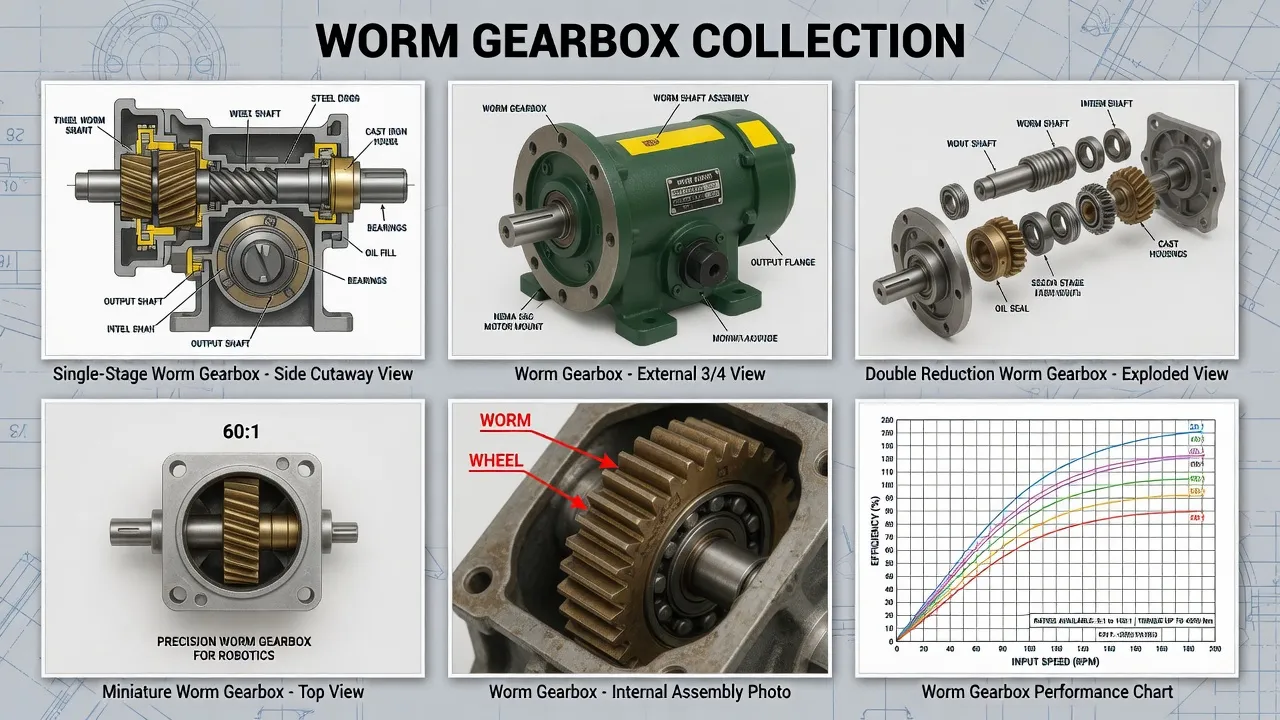
Cast iron worm wheels are specified for a specific application niche: very low sliding speeds (below 0.5–1 m/s) combined with high loads. At low sliding speeds, the EHL (elastohydrodynamic lubrication) film that normally separates the bronze wheel from the steel worm becomes too thin to prevent metal-to-metal contact — and the unique tribological property of cast iron (embedded graphite acting as a solid lubricant) makes it the superior material choice in this regime.
| Property | Cast Iron Wheel | Bronze (CuSn12Ni2) Wheel |
|---|---|---|
| Optimum sliding speed | <0.5 m/s (very low speed) | >1 m/s (industrial speeds) |
| Load capacity at low speed | High — graphite solid lube | Lower at very low speed (poor EHL film) |
| Cost vs bronze | ~30–40% of bronze cost | Baseline (higher) |
| Noise at operating speed | Noisier (harder mesh) | Quieter (softer sliding mesh) |
| Wear life at industrial speed | Rapid — unsuitable | 15,000–25,000 h |
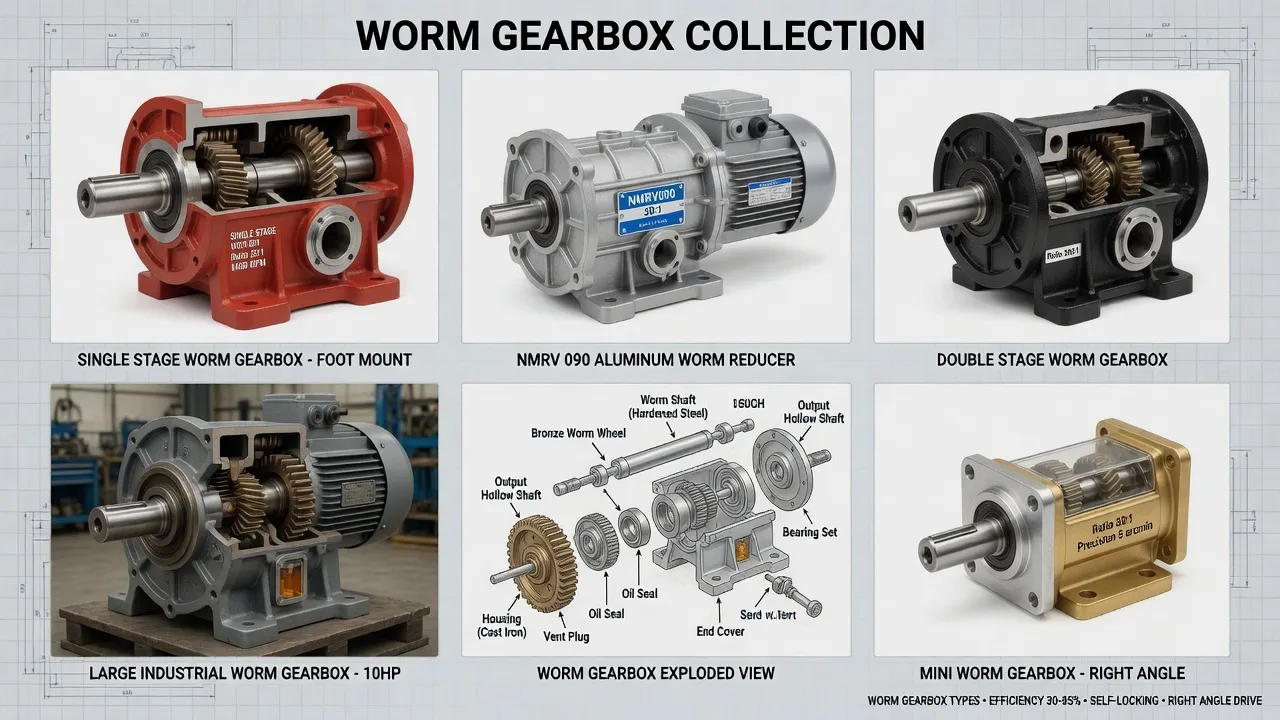
Cast iron worm wheels appear in very slow-speed worm jacks (lifting screws), large-scale slewing drives on heavy machinery, and some agricultural low-speed drives. They are not interchangeable with bronze in standard industrial NMRV worm gearboxes — a cast iron wheel substituted into a standard NMRV running at industrial speeds (5–15 m/s sliding velocity) will seize or rapidly gall within hours. For the heavy-duty large-frame worm gearbox applications where cast iron wheels are sometimes specified, see our stainless steel worm gearbox range for corrosion-resistant heavy-duty configurations.
Plastic Worm Wheels — Light-Duty Low-Cost Applications
Plastic worm wheels — primarily POM (polyoxymethylene / acetal / Delrin), PA66 (nylon), and PEEK — are used in light-duty low-load applications where self-lubrication, chemical resistance, or very low noise are the primary drivers. They are not substitutes for bronze in industrial applications:
| Plastic Grade | Max Torque (typical) | Temperature Limit | Best Application |
|---|---|---|---|
| POM (acetal) | 2–8 Nm | 90°C continuous | Consumer electronics, small appliances, light automation |
| PA66 (nylon) | 3–12 Nm | 100°C continuous | Lightly loaded noise-sensitive: medical, lab instruments |
| PEEK | 5–25 Nm | 250°C continuous | High-temperature light-duty, chemical resistance critical |
Plastic wheels are self-lubricating (no oil required in most applications), quieter than bronze, resistant to many chemicals, and significantly cheaper for small-volume production. The trade-offs are substantial: maximum torque capacity is 5–50× lower than bronze at comparable size; temperature sensitivity causes creep and dimensional instability above 90–100°C (reached routinely in industrial worm gearboxes at typical loads); moisture absorption in PA66 causes dimensional change that affects mesh quality. Plastic wheels are appropriate only in applications with confirmed maximum torque below 25 Nm, confirmed maximum temperature below 90°C, and confirmed absence of shock loads.
The Worm Screw Material — Why It Matters Too
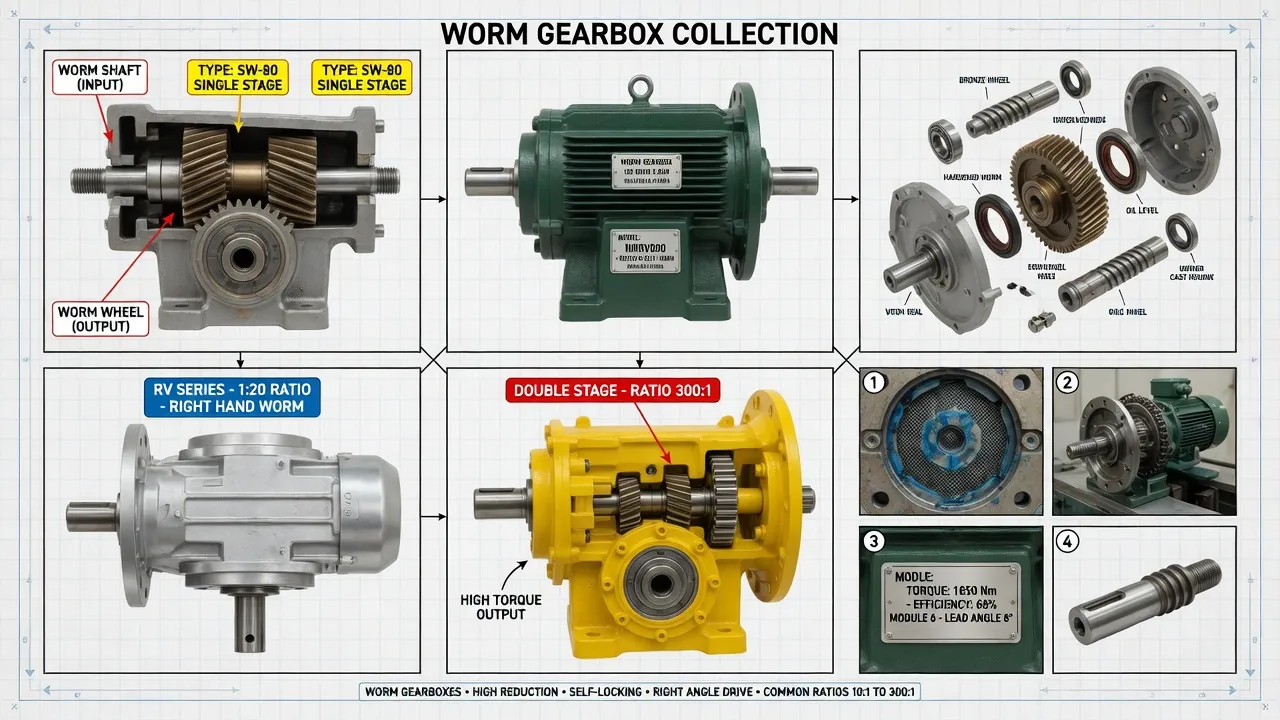
The worm screw (driving member) material specification is equally critical to the worm wheel — and less often discussed. Standard industrial worm screw specifications:
- 20CrMnTi (China standard, most common): Alloy steel, carburized and case-hardened to HRC 58–62 on the thread surface, HRC 30–38 core. The standard specification for NMRV frames up to NMRV110. Provides the required surface hardness differential against the softer bronze wheel.
- 18CrNiMo7-6 (European standard, heavy-duty): Higher core toughness than 20CrMnTi (HRC 35–42 core), same case hardness. Preferred for heavy-duty and shock-load applications where core toughness matters. Used in RR-class large-frame heavy-duty worm gearboxes.
- Surface finish requirement: Ground to Ra ≤ 0.4 µm (ISO 1328 Class 6–7) for standard industrial; CBN-ground to Ra ≤ 0.2 µm (Class 4–5) for precision and high-efficiency applications. Surface finish of the worm thread is the primary determinant of the friction coefficient at the mesh — directly affecting efficiency and wear rate.
The pairing rule: a polished hardened steel worm (Ra 0.2 µm) against a CuSn12Ni2 bronze wheel is the optimal combination for industrial worm gearboxes — lower friction, better efficiency, and longer bronze wheel life than any other commercially practical material pairing.
Material Selection Summary — Decision Guide
| Application Requirement | Specify Wheel Material | Reason |
|---|---|---|
| Standard industrial, any speed, any load | CuSn12Ni2 bronze | Industry standard; best wear/efficiency balance |
| Very low speed (<0.5 m/s), high load | Cast iron (EN-GJL-250) | Graphite solid lube outperforms bronze at low speed |
| Ultra-light duty (<10 Nm), quiet, no oil | POM or PA66 | Self-lubricating, lowest cost for micro-drives |
| Food/pharma, corrosion resistance needed | CuSn12Ni2 + NSF-H1 oil | Bronze compatible with food-grade lubricants |
| High-temp (>120°C ambient), chemical exposure | PEEK or aluminium bronze | Temperature resistance; chemical inertness |
Frequently Asked Questions
Can I use a harder bronze alloy to make the worm wheel last longer?
Counter-intuitively, no. A harder bronze wheel (e.g., aluminium bronze at HB 150–180) against a hardened steel worm creates two surfaces of similar hardness — dramatically increasing the risk of adhesive wear and galling at the mesh. The soft bronze wheel’s gradual conforming wear is a designed feature, not a defect. The correct approach to extending wheel life is to use high-quality CuSn12Ni2 (not harder alloys), maintain correct lubrication, and operate within the thermal and mechanical ratings.
How do I verify the bronze grade in a wheel I’ve received?
The most reliable field method is X-ray fluorescence (XRF) analysis — a handheld XRF gun can identify bronze alloy composition in 10–30 seconds non-destructively. A laboratory spectrometric analysis (send a sample) provides the most accurate result. Visual inspection is unreliable — CuSn12Ni2 and CuSn6Zn6Pb3 look identical. Always request the material test report (MTR) from the supplier when sourcing precision or heavy-duty replacement worm wheels.
Does the worm wheel material affect efficiency?
Yes — through the coefficient of friction at the worm-wheel mesh. CuSn12Ni2 against a polished hardened steel worm produces a friction coefficient of 0.08–0.10 (run-in, PAO). CuSn6Zn6Pb3 against the same worm runs at 0.10–0.13 — a 25–30% higher friction coefficient that directly reduces efficiency. At 50:1 ratio with CuSn12Ni2: efficiency 72–75%. The same unit with CuSn6Zn6Pb3: approximately 68–71%. The material choice thus affects both efficiency and service life.
What happens if an active-sulfur EP lubricant is used with a bronze wheel?
Active-sulfur EP additives react chemically with copper alloys, attacking the bronze wheel surface and forming copper sulfide compounds. The reaction corrodes the bronze tooth surface, producing a discoloured (dark green-black) wheel with roughened surface texture. Wear rate increases 3–5× compared to a correctly lubricated unit. The corrosion is irreversible — once active-sulfur contamination has damaged the wheel surface, the wheel must be replaced. Always use lubricants confirmed by the supplier as “safe for bronze/copper alloy gear applications” and containing no active-sulfur EP additives.
Need to Specify the Right Worm Wheel Material for Your Application?
Tell our engineering team your sliding speed, load torque, operating temperature, duty cycle, and environment — we’ll confirm the correct material specification with alloy certificate available on request.
Worm Screw Materials — The Harder Half of the Pairing
The worm screw must be significantly harder than the wheel to prevent galling. Standard specifications:
- 20CrMnTi (case-carburised, CBN-ground): Standard for NMRV-class gearboxes. Case depth 0.8–1.2 mm, surface HRC 58–62, ground to ISO 1328 Class 7. The mirror-polished CBN-ground surface is the primary driver of efficiency — the smoother the worm thread surface, the lower the sliding friction coefficient against the bronze wheel. Premium ground worms at Ra ≤0.2 µm run 3–6% more efficiently than coarse-ground equivalents at Ra 0.6 µm.
- 18CrNiMo7-6 (heavy-duty frames): Higher core toughness for large-frame heavy-shock applications — RR-series and large NMRV130/150. Case depth 1.2–2.0 mm, HRC 60–62.
- 316L stainless (food-grade units): Induction-hardened to HRC 55–58 on the worm thread surface. Slightly lower hardness than alloy steel worms — specify CuSn12Ni2 bronze to compensate. Available in our stainless steel worm gearbox range.
The worm screw hardness advantage over the wheel must be maintained throughout the service life — a worn worm screw whose case depth has been compromised by excessive wear loses this hardness advantage and begins to wear faster than the wheel, producing a runaway wear cycle. This is why monitoring backlash trend (wheel wear indicator) is important but not the only service-life indicator — inspect the worm screw thread surface at major service events for signs of case wear or scoring.