
A worm gearbox — also called a worm gear reducer or worm speed reducer — is one of the most widely deployed power-transmission devices in industrial machinery. Annual global production is estimated at more than 40 million units across size classes, and the basic architecture has remained unchanged since Archimedes first described the worm-gear mechanism around 250 BC. Yet for all its familiarity on the factory floor, the device is frequently misspecified, under-maintained, or confused with other reducer architectures. This article explains exactly what a worm gearbox is, how it works at a physical level, what each internal component does, and how to read the numbers on a manufacturer’s specification sheet so you can confidently select the right unit for your application.
What Is a Worm Gearbox — the One-Sentence Definition
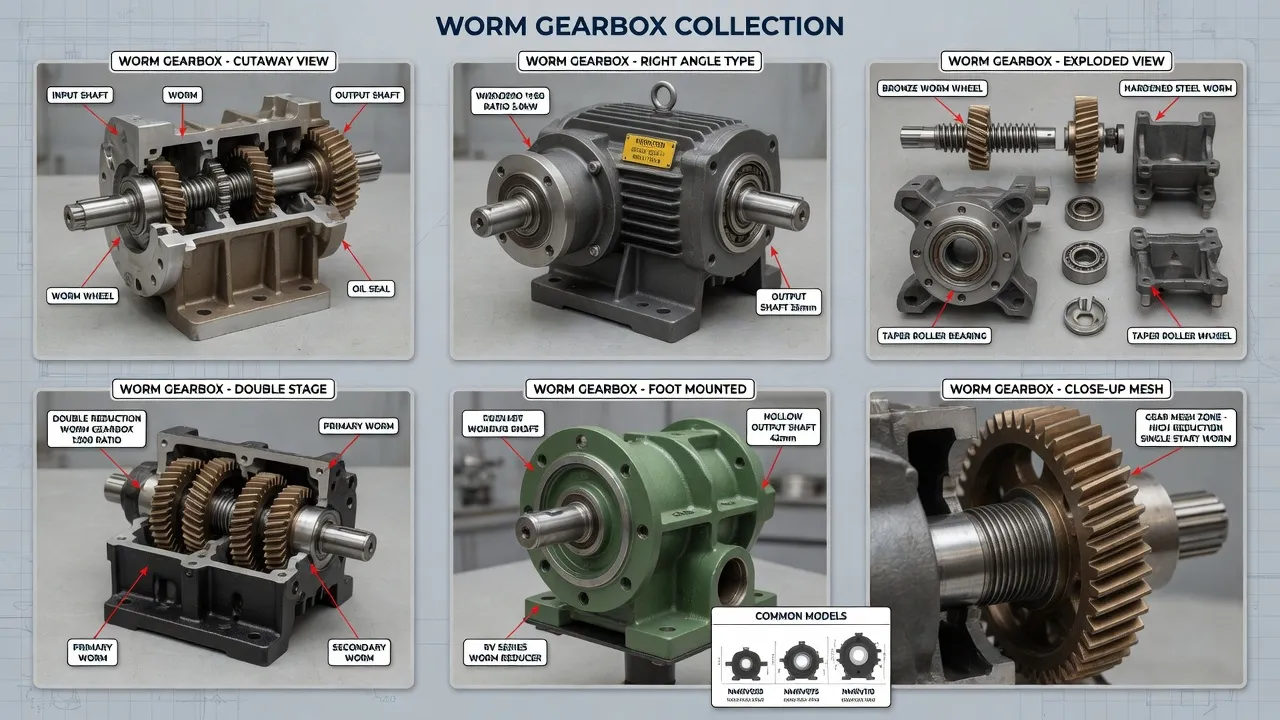
A worm gearbox is a single-stage right-angle gear reducer in which a threaded cylindrical shaft (the worm) meshes with a toothed wheel (the worm wheel or worm gear) to transmit torque at 90° with a high speed-reduction ratio in a compact envelope. The input shaft carries the worm; the output shaft carries the worm wheel. Because the shafts are perpendicular and non-intersecting, a worm gearbox always changes the direction of rotation by 90° — a geometric property no other single-stage reducer provides in as small a package.
Three numbers define a worm gearbox at the most basic level: the reduction ratio (how much the output shaft slows relative to the input), the output torque (the maximum continuous rotational force the output shaft can deliver), and the center distance (the distance between the worm shaft axis and the worm wheel axis, which sets the physical size of the unit). Everything else on a spec sheet — thermal rating, service factor, mounting position, backlash — flows from these three fundamentals.
How a Worm Gearbox Works — The Physics in Plain Language
Picture a bolt (the worm) partially threaded through a large toothed wheel (the worm wheel). When you rotate the bolt, the threads push against the wheel teeth and turn the wheel — but rotating the wheel cannot push back on the bolt threads in most configurations. That asymmetry is the physical heart of the worm gearbox.
More precisely, the meshing action between worm and wheel is dominated by sliding contact rather than the rolling contact that characterizes spur, helical, or bevel gears. Each tooth on the worm wheel slides along the worm thread as the worm rotates. This sliding contact creates three key characteristics that define worm gearbox behavior:
- High friction, lower efficiency: Sliding contact generates more heat per unit of transmitted power than rolling contact. Efficiency typically ranges from 60% to 90% depending on reduction ratio, worm geometry, and lubrication — lower than helical or planetary alternatives at equivalent ratios.
- Self-locking at high ratios: When the worm’s lead angle (the helix angle of the worm thread) is small enough — generally when the ratio is 30:1 or higher — the friction at the mesh prevents the worm wheel from back-driving the worm. The output shaft locks when the motor de-energizes, without any brake module.
- Quiet, smooth operation: Because teeth enter the mesh gradually over a large contact area, there is no tooth-impulse vibration. Worm gearboxes are among the quietest single-stage reducers, running at 55–62 dB in typical configurations vs 62–75 dB for helical alternatives.
The reduction ratio is governed simply by the number of worm teeth (starts) vs the number of wheel teeth. A single-start worm rotates the wheel by one tooth per revolution; a 40-tooth wheel with a single-start worm delivers a 40:1 ratio. A two-start worm advances the wheel by two teeth per revolution, giving 20:1 from the same wheel. This means any single-stage worm gearbox can achieve ratios from 5:1 to 100:1 — something that requires multiple stages in every other gear architecture.
Key Components Inside a Worm Gearbox
Understanding the internal components helps you interpret failure modes and maintenance requirements. A standard NMRV-class worm gearbox contains the following:
| Component | Material | Function |
|---|---|---|
| Worm screw | 20CrMnTi or 17CrNiMo6 steel, case-hardened HRC 58–62 | Input-side driver; thread profile transmits torque to the wheel |
| Worm wheel | CuSn12Ni2 phosphor bronze, HB 95–115 | Output-side driven gear; bronze provides low-friction bearing surface vs hard steel worm |
| Housing | ADC12 aluminum die-cast (standard); EN-GJL-250 cast iron (heavy-duty) | Contains the gear pair and lubricant; provides mounting interface to machine |
| Input & output shaft bearings | Tapered roller bearings (output); deep-groove ball bearings (input) | Support radial and axial shaft loads; preloaded to eliminate play |
| Shaft seals | FKM (Viton) double-lip — standard; ceramic-composite for high-temperature | Retain lubricant; exclude dust, water, and contaminants |
| Lubricant | ISO VG220 PAO synthetic (standard); ISO VG320 for high-cycle reversing; PAG for high-temperature | Forms the EHL film between worm and wheel; governs efficiency and service life |
| Motor mounting flange | Aluminum alloy, machined to IEC B5/B14 or NEMA convention | Mates the electric motor to the gearbox input; standardized for easy motor swapping |
The pairing of a hard steel worm against a softer bronze wheel is not an accident. In sliding-contact gear meshes, the two surfaces must have different hardnesses to prevent adhesive wear (galling). The bronze wheel sacrifices itself slowly over the service life while protecting the harder, more expensive steel worm. This is why bronze worm wheel replacement is the most common major service item for worm gearboxes — typically at 6–10 years of continuous service.
Types of Worm Gearboxes — What the Naming Conventions Mean
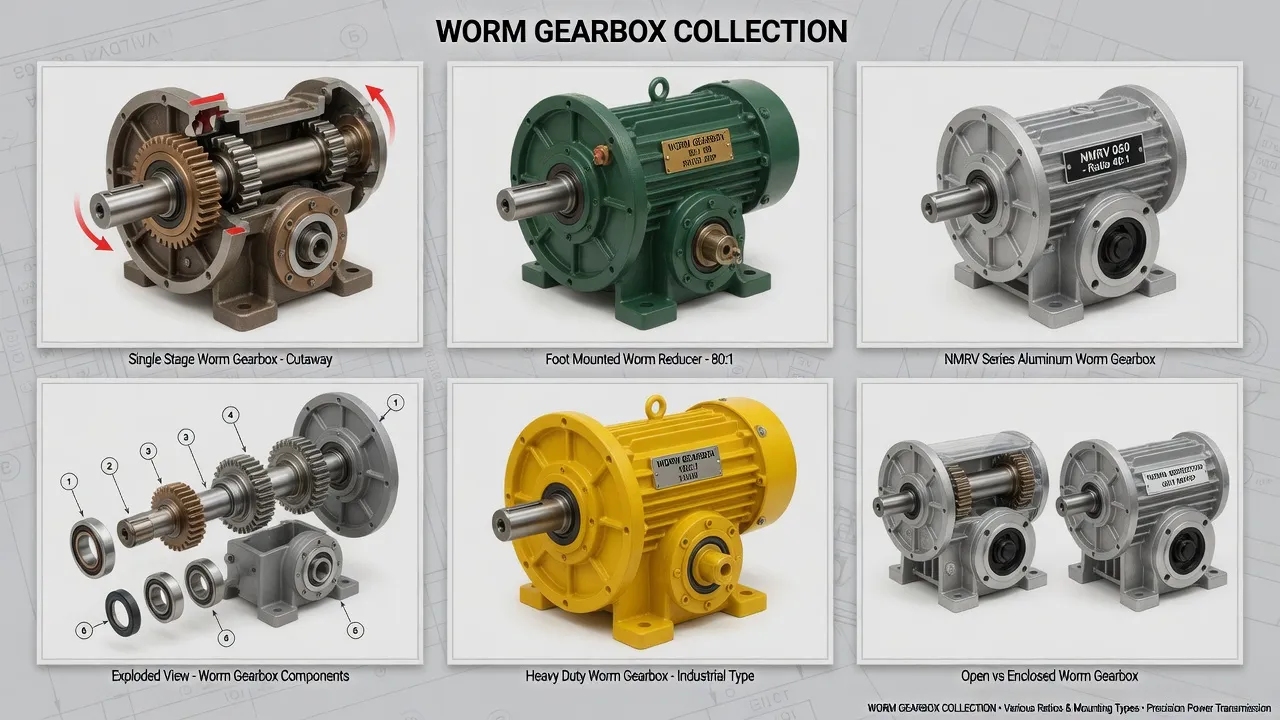
The global worm gearbox market uses several overlapping naming conventions that confuse buyers. Here is a practical guide to the most important terms:
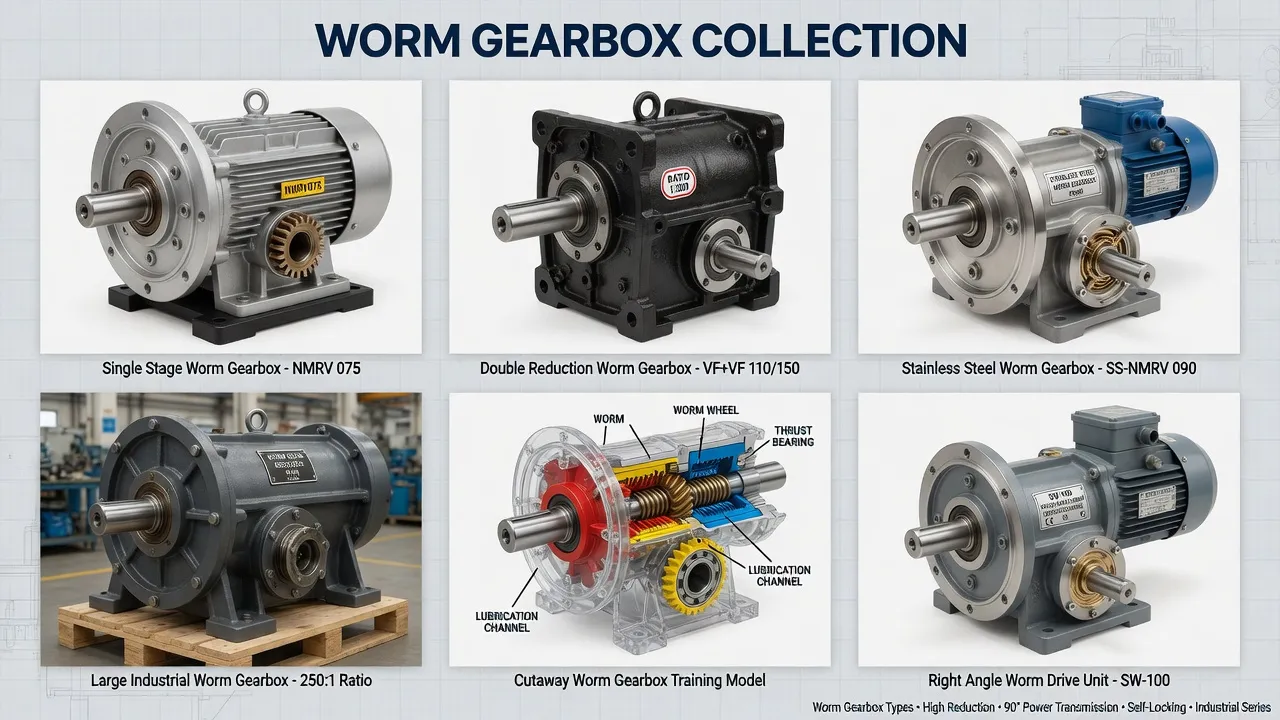
- NMRV: The dominant global standard for compact aluminum worm gearboxes. “NMRV” stands for “Norma Motor Riduttore Versatile” (Italian: standard versatile motor reducer). Frame sizes run from NMRV025 to NMRV150, with center distances from 25 mm to 150 mm. The NMRV envelope is a de-facto industry standard — any NMRV040 from any supplier worldwide shares the same mounting hole pattern, shaft dimensions, and input-flange interface.
- RV / NMRV / NRV: These are essentially the same product category — compact aluminum worm gearboxes in the NMRV size convention. Different manufacturers add prefixes (N, NR, RV) to the same underlying envelope.
- Helical-worm (S-series): A two-stage reducer combining a helical pre-stage with a worm secondary stage. The helical stage handles the high-speed input (high efficiency), while the worm stage handles the right-angle output (compact, self-locking). Combined efficiency of 75–88% vs 60–75% for single-stage worm alone.
- Double-reduction worm: Two worm stages in series. Achieves ratios from 400:1 to 3,600:1 in a single unit. Efficiency drops significantly (45–60%) because two worm meshes each subtract from overall transmission efficiency.
- Hollow-shaft worm gearbox: The output shaft is bored through to accept the driven shaft directly, eliminating a coupling. Common for conveyor head-pulley and direct-shaft-mount applications.
How to Read a Worm Gearbox Specification Sheet
A worm gearbox catalog page can look intimidating. Here are the key parameters decoded in plain language:
| Spec Sheet Parameter | What It Means | What to Watch For |
|---|---|---|
| i (reduction ratio) | Output turns per input turn, e.g. i=50 means 50 motor revolutions = 1 output revolution | Higher ratio = more torque, slower output, lower efficiency, more likely to self-lock |
| M2 / T2 (output torque) | Continuous rated output torque in Nm at reference input speed (usually 1,400 rpm) | Apply service factor (Sf) to your actual load torque before comparing to catalog M₂ |
| P1 / P1max (input power) | Continuous input power rating in kW — governed by the thermal limit, not just gear strength | Thermal rating often limits the gearbox more than mechanical strength at high duty cycles |
| η (efficiency) | Percentage of input power delivered to the output shaft | Values are measured after run-in; new units may run 5–8% lower until worm-wheel bedding occurs |
| Sf (service factor) | Multiplier applied to actual load torque to account for shock, duty cycle, and daily operating hours | Uniform light duty = 1.0; moderate shock = 1.25–1.5; heavy shock = 1.75–2.0 |
| Fr2 (radial output load) | Maximum radial (sideways) force the output shaft bearings can sustain at mid-shaft | Belt and chain drives impose significant overhang loads — verify Fr2 before specifying |
| IP rating | Ingress Protection — two digits for solid/dust and liquid protection (IP55, IP65, IP66, IP69K) | Food industry and outdoor installations typically require minimum IP65; washdown requires IP69K |
| Mounting position (B3/B5/V1 etc.) | Specifies the orientation of the gearbox relative to gravity — affects lubrication oil level | Installing a B3 (foot-mount) gearbox on its side without adjusting oil fill level voids the warranty |
One subtlety that catches buyers off-guard: catalog torque and power ratings are given at a reference input speed (usually 1,400 rpm for 4-pole AC motors). If your motor runs at 2,800 rpm (2-pole) or 950 rpm (6-pole), the gearbox thermal and mechanical rating changes. At higher input speeds, friction losses increase; at lower speeds, thermal dissipation improves. Always check whether your actual input speed matches the catalog reference condition.
Self-Locking — the Most Important and Most Misunderstood Property
Self-locking is the property that makes the worm gearbox irreplaceable in gate openers, lifts, hoists, and vertical-axis drives — yet it is also the most frequently misapplied feature on the spec sheet.
The physics: self-locking occurs when the lead angle of the worm (γ) is smaller than the arctangent of the coefficient of friction (µ) at the worm-wheel mesh. For a typical bronze-on-steel pair (µ ≈ 0.10–0.12), self-locking occurs when γ is below approximately 6°, which corresponds to ratios of approximately 30:1 and higher. Below 30:1, the gearbox is generally not self-locking; above 60:1, self-locking is essentially guaranteed under normal conditions.
Critical caution: self-locking should never be relied upon as the sole safety mechanism in life-safety or regulatory-safety applications. Worn worm wheels reduce the effective friction coefficient; cold lubricant or the wrong lubricant can alter the friction balance; vibration can cause intermittent back-drive in borderline-ratio gearboxes. Per AGMA 6034 and ISO 14521 guidance, self-locking is a design feature, not a certified safety function. Applications requiring positional hold under regulatory safety analysis (cranes, elevators, hoists) must supplement self-locking with a certified fail-safe brake.
Where Are Worm Gearboxes Used? — 10 Core Application Categories
The right-angle, high-ratio, compact, self-locking combination makes worm gearboxes the dominant specification across a broad range of applications:
- Conveyors & material handling: Belt conveyors, screw conveyors, bucket elevators — particularly where a right-angle drive and the self-locking hold during stop events is operationally valuable.
- Gate & door automation: Sliding gates, swing gates, garage doors, industrial roll-up doors — the self-locking property holds position without active power.
- Packaging machinery: Carton sealers, fill-and-seal machines, case packers — compact right-angle drives at moderate torque.
- Food & beverage processing: Mixer drives, conveyor drives, filling-machine auxiliaries — particularly in stainless and food-grade IP69K variants.
- Agitators & mixers: Chemical, pharmaceutical, and water-treatment agitator drives where vertical-shaft layout matches the worm right-angle output.
- Agricultural equipment: Seed drill drives, fertilizer spreader augers, irrigation pivot drives.
- Solar trackers: Single-axis and dual-axis solar panel positioning — the self-locking property holds tracker position under wind load without active power consumption.
- Medical & lab automation: Low-noise robotic auxiliaries, sample-handling equipment, imaging device positioning.
- Construction & access equipment: Aerial work platform drives, formwork adjusters, concrete mixer auxiliaries.
- Lifts & hoists (with supplementary brake): Goods lifts, scissor tables, stage rigging — where the worm’s self-locking contributes to the hold-load design alongside a certified brake.
Worm Gearbox vs Other Reducer Types — Quick Reference
Before selecting a worm gearbox, confirm the architecture fits the application requirements. The table below summarizes the key trade-offs:
| Property | Worm | Helical | Planetary | Bevel-Helical |
|---|---|---|---|---|
| Shaft layout | Right-angle 90° | Inline | Inline | Right-angle |
| Efficiency (50:1) | 68–72% | 95–96% | 94–96% | 92–95% |
| Self-locking | Yes (≥30:1) | No | No | No |
| High ratio (100:1) single stage | Yes | No | No | No |
| Noise level | Low | Medium | Medium | Medium |
| Unit cost (equivalent torque) | Lowest | Medium | High | Medium-high |
Frequently Asked Questions
Can a worm gearbox run in both directions?
Yes — the worm can drive the wheel clockwise or counterclockwise depending on motor direction. What it cannot do in self-locking configurations is be driven backwards by the output load. Reversing the motor changes output direction; loading the output shaft does not turn the input.
How long does a worm gearbox last?
Properly sized and maintained, a worm gearbox delivers 20,000–30,000 service hours (approximately 6–10 years of typical 8-hour single-shift duty). The bronze worm wheel is the first component to wear; proper lubrication is the single biggest variable governing service life.
What’s the difference between a worm gear and a worm gearbox?
A “worm gear” is the gear component (the worm wheel that meshes with the worm). A “worm gearbox” (also called a worm reducer or worm gear reducer) is the complete enclosed assembly including both gears, housing, bearings, seals, and lubricant. You buy components; you install a gearbox.
Do worm gearboxes need maintenance?
Standard NMRV worm gearboxes ship with sealed-for-life PAO synthetic lubricant — no scheduled oil change for the typical 8–10 year design life of light-duty OEM equipment. Heavy-duty and continuous-duty units benefit from oil-condition sampling every 2,000–4,000 hours and a lubricant change at 8,000 hours or as indicated by condition monitoring.
Need Help Selecting the Right Worm Gearbox?
Send our worm gearbox specialists your application torque, speed, ratio, and motor frame — we’ll return a sized recommendation and pricing within one business day.