
A worm gearbox running correctly is quiet, warm, and dry. Any departure from that description — unusual noise, excessive heat, vibration, or leakage — is a symptom pointing to a specific root cause that, if identified early, can be corrected before a minor issue becomes a catastrophic failure. This guide provides a systematic troubleshooting framework for the four most common worm gearbox fault categories, structured as a field-usable diagnostic flow: describe the symptom, list the most probable causes in priority order, and prescribe the correct corrective action. Print it, laminate it, attach it to the gearbox cabinet — this is the page maintenance engineers return to every time.

Symptom 1: Unusual Noise — Diagnosis and Causes
A correctly operating worm gearbox should be one of the quietest mechanical drives in your plant — the sliding-contact mesh produces no tooth-impulse vibration and should run at 55–62 dB at 1 m. Any audible change from this baseline is diagnostically significant. Characterize the noise before investigating:
| Noise Character | Most Probable Cause | Corrective Action |
|---|---|---|
| Rhythmic clicking, once per output revolution | Localised worm-wheel tooth damage (chip, pit, or flat spot) | Inspect wheel teeth; replace worm-wheel if damage confirmed |
| Continuous high-pitched whine, speed-proportional | Bearing damage (worn balls/races producing high-frequency vibration) | Replace input/output shaft bearings; check shaft runout |
| Harsh grinding or scraping | Inadequate lubrication — boundary friction at worm-wheel mesh; or metal debris recirculating in oil | Stop immediately; drain and inspect oil for metal; refill with correct lubricant; inspect gear surfaces |
| Intermittent knock under load reversal | Excessive backlash from worm-wheel wear, or loose output coupling | Measure backlash; inspect coupling; replace worm-wheel if backlash above 2× commissioned value |
| General increase in noise level (no specific character) | Advanced worm-wheel wear increasing mesh roughness; or low oil level | Check oil level; inspect wheel surface; schedule replacement if wear confirmed |
| Noise only at cold start, disappears after warm-up | Cold lubricant viscosity too high — oil starvation at mesh during start | Switch to PAO synthetic or lower-viscosity grade for cold-climate application |
The most important diagnostic rule for noise: stop the unit if grinding or scraping is heard. Unlike increased noise level (which indicates wear in progress), grinding indicates active metal-to-metal contact — continuing to run under these conditions accelerates worm-wheel failure from hours to minutes. Drain the oil immediately and inspect for metal debris before restarting.
Symptom 2: Overheating — Causes and Corrective Actions
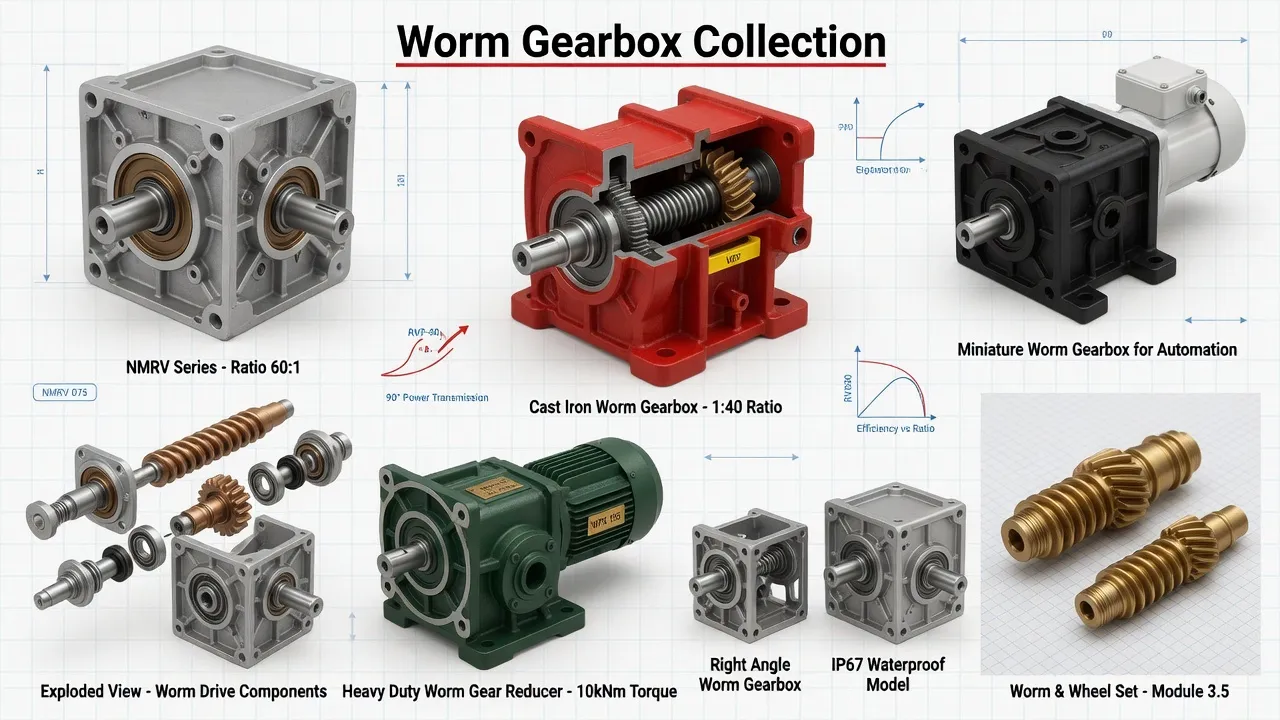
A worm gearbox running hot (housing surface above 70°C, or oil temperature above 80°C) is dissipating more heat than the housing surface can reject under the current operating conditions. The root cause is almost always one of six scenarios:
- Thermal power rating exceeded: The gearbox is running at a higher continuous input power than its thermal rating for the current ratio and ambient temperature allows. Check: catalog thermal P₁ rating at the application ratio and ambient temperature. If the application power exceeds the thermal rating, derate the motor, add forced cooling, or replace with a larger frame. This is the most common cause of worm gearbox overheating in continuous-duty applications.
- Wrong lubricant viscosity: Over-viscous lubricant (VG460 in a unit rated for VG220) increases churning losses, adding heat generation without any load. Under-viscous lubricant fails to maintain the EHL film, increasing metal-to-metal contact and mesh friction. Drain and refill with the correct ISO VG grade as specified in the catalog for the operating temperature range.
- High ambient temperature without derating: Every 10°C increase in ambient reduces the available thermal headroom by 10°C. A gearbox rated at P₁ = 2.4 kW at 20°C ambient running at 40°C ambient has an effective thermal rating of approximately 1.4 kW. If input power exceeds this derated value, the unit will continuously overheat even though the full 2.4 kW rating is never reached.
- Blocked housing ventilation: Worm gearboxes dissipate heat through natural convection across the housing surface fins. Paint buildup, grease accumulation, adjacent thermal insulation, or placement inside an enclosed cabinet without ventilation dramatically reduces convection. Clean the housing fins annually; ensure 100 mm minimum clearance on all sides in enclosed installations.
- New unit not yet run-in: During the first 50–200 hours, efficiency is 4–8% lower than steady state, generating proportionally more heat. If a new unit is running slightly hot but temperature is trending downward over the first 100 hours, this is normal run-in behavior. If temperature is still elevated at 200 hours, investigate the other causes.
- Overloading beyond rated torque: Torque peaks from motor stalls, jammed conveyors, or viscous-fluid mixer startup can exceed the continuous rated torque by 2–3×. Each overload event generates a heat spike. If overloads are frequent, apply a 2.0× service factor to the required torque and re-specify the next larger frame. Our range of NMRV worm gearbox sizes covers the full torque spectrum — if overloading is the diagnosed cause, frame upsize is the correct solution.
Symptom 3: Vibration — Sources and Diagnostic Steps
Worm gearboxes are inherently low-vibration devices — the sliding mesh produces no tooth-impulse force at the gear-mesh frequency that characterizes helical or spur gear vibration. Detectable vibration in a worm gearbox therefore almost always points to a discrete mechanical fault rather than a normal mesh-dynamics signature. Five primary vibration sources:
- Imbalance in the motor or driven machine (not the gearbox itself): Vibration at 1× and 2× running speed. Check by isolating: if vibration stops when the driven machine is decoupled from the output shaft, the source is the driven machine. If it stops when the motor is decoupled from the input, the source is the motor. The gearbox transmits vibration from either end — it doesn’t generate 1× imbalance vibration on its own.
- Worn or loose input/output shaft bearings: Vibration at bearing defect frequencies (calculated from bearing geometry). Characterized by a broadband increase in vibration floor and specific tonal components at bearing defect frequencies. Diagnose with a handheld vibration meter or accelerometer; repair by replacing bearings.
- Loose mounting hardware: Vibration level increases monotonically with load. Housing resonates at mounting-bolt looseness frequency. Inspect and re-torque all mounting bolts. This is the most common and easiest-to-fix vibration cause — check it first before disassembling anything.
- Misalignment of motor-to-gearbox shaft coupling: Angular or parallel misalignment produces vibration at 2× running speed, sometimes 1× and 3×. Characterized by high axial vibration compared to radial. Re-align the motor using a laser alignment tool or dial indicator set, targeting less than 0.05 mm parallel offset and less than 0.05°/100 mm angular misalignment.
- Worm-wheel local defect (chip, flat, pit): Vibration at 1× output shaft frequency (once per output revolution). Synchronous with the output shaft — verify by comparing vibration frequency to calculated output shaft speed. Remove the worm-wheel inspection cover and inspect the wheel teeth for the localized defect.
Symptom 4: Oil Leakage — Location-Specific Diagnosis
The leak location tells you which sealing element has failed. Clean the entire gearbox housing with degreaser before diagnosing — old accumulated oil obscures the source. After cleaning, run for 30 minutes at operating load and inspect for fresh oil at each of these locations:
| Leak Location | Most Probable Cause | Repair |
|---|---|---|
| Input shaft seal | Seal lip wear/hardening; shaft surface wear groove at seal contact; overfill overpressure | Replace seal; inspect shaft surface; check oil fill level against mounting-position spec |
| Output shaft seal | As input shaft seal; output shaft carries higher radial load so surface wear more likely | Replace seal; measure output shaft diameter at seal contact (wear below −0.05 mm requires sleeve or shaft replacement) |
| Housing-to-cover joint | Housing gasket failure; O-ring compression set; loose cover bolts; housing surface damage | Re-torque cover bolts first; if persists, replace gasket or O-ring with OEM part; inspect housing mating surface for pitting |
| Breather vent / oil fill plug | Overfill; blocked vent causing overpressure; incorrect plug installed | Check and correct oil fill level; clean or replace breather vent; install correct OEM plug with washer |
| Housing casting (no joint present) | Hairline crack in aluminium housing (impact damage, overtightened mounting bolts, thermal fatigue) | Unit replacement — cracked aluminium housing cannot be reliably repaired in the field |
The most commonly misdiagnosed leakage source is overfill. Engineers refilling after oil samples often add too much oil — the housing then has no air space, and thermal expansion during operation pressurizes the oil and forces it past the shaft seals. Always fill to the manufacturer’s level marking for the specific mounting orientation. For food-grade stainless installations where lubricant contact with product is a concern, consider our stainless steel worm gearbox with IP69K-rated double-lip seals as an upgrade to prevent any leakage reaching product. For detailed field troubleshooting case studies, see the industrial gearbox maintenance and application reference.
Rapid Diagnosis Decision Tree — First 5 Minutes on Site
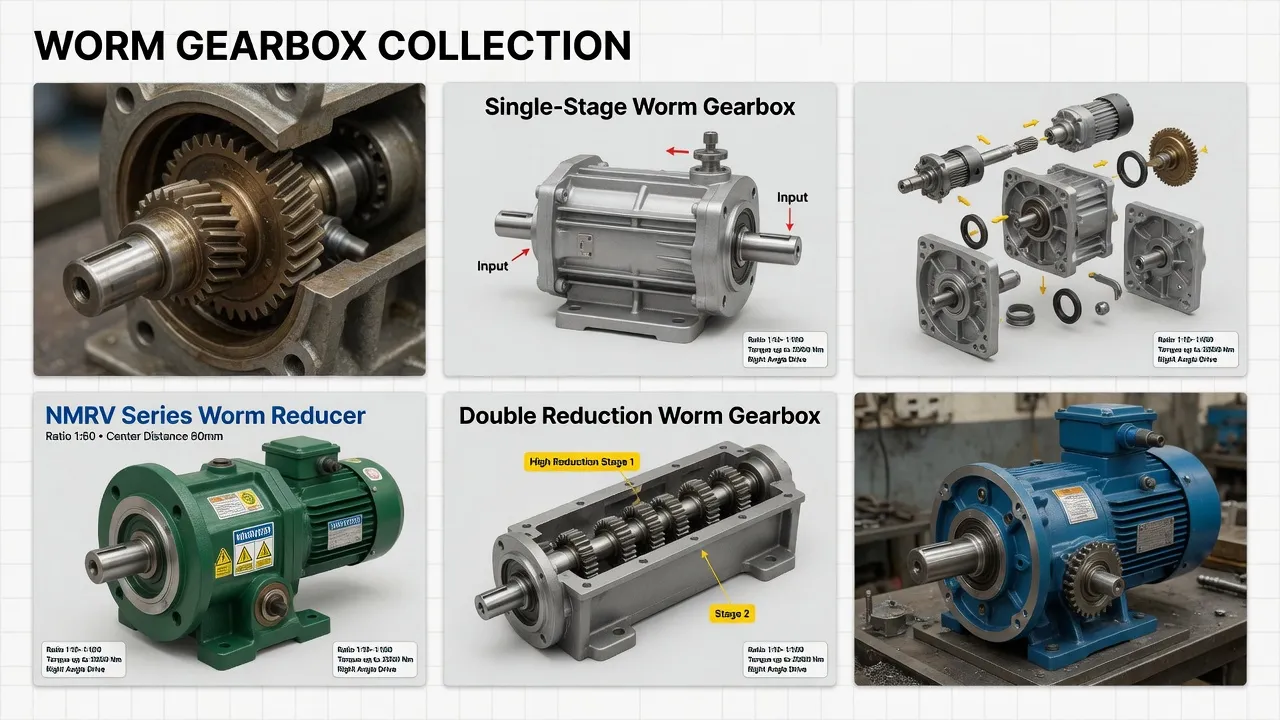
When arriving at a gearbox fault, run through this decision tree before opening any covers or draining any oil:
- Is the gearbox making a grinding or scraping noise? → Stop immediately. Drain oil. Inspect for metal debris and gear surface damage before restarting.
- Is the housing too hot to touch comfortably (surface above ~55°C)? → Check oil level and lubricant grade first. Then calculate thermal input-power budget against catalog rating at actual ambient temperature.
- Is oil visible on the floor or housing exterior? → Clean and dry the housing. Identify the precise leak location (input seal, output seal, housing joint, or breather). Do not refill before identifying and correcting the source.
- Is vibration present that wasn’t there before? → Loosen and re-torque all mounting bolts first (free repair, highest probability). If vibration persists, isolate motor and driven machine separately to identify the source.
- Is there an increase in running noise without grinding? → Check oil level. Measure backlash. Schedule inspection at next planned downtime. Log the observation with date and description for trend tracking.
Repair vs Replace — How to Make the Call
The repair-vs-replace decision hinges on three factors: fault severity, unit age, and worm-wheel condition.
- Repair (seal replacement, bearing replacement, lubricant change): Economical when the worm-wheel tooth surfaces are smooth and even (no pitting, scoring, or pronounced groove wear), the worm screw surface is undamaged, and the housing is not cracked. Repair cost is typically 15–35% of unit replacement cost. Justified when the unit has less than 60% of its design life consumed.
- Replace (new unit): The correct decision when: worm-wheel tooth surface shows pitting, scoring, or wear groove; worm screw surface shows polishing or scoring; housing is cracked; the unit is beyond 80% of its design life (typically 18,000–25,000 hours); or repair cost exceeds 60% of new-unit cost. Standard NMRV units are inexpensive enough that full replacement is often more economical than a major rebuild once the worm-wheel requires replacement.
One repair scenario that almost always leads to a second early failure: replacing only the bronze worm wheel without inspecting and addressing the root cause of the accelerated wear. A new bronze wheel on a unit that is over-loaded, incorrectly lubricated, or thermally over-driven will reach the same worn-out condition in a fraction of the normal design life. Fix the root cause first — then replace the worm wheel.
Frequently Asked Questions
My worm gearbox suddenly became much louder. What’s the most likely cause?
A sudden noise increase — as opposed to gradual — usually indicates a bearing failure or a localised worm-wheel tooth defect (chip or pit). Gradual noise increase over months indicates progressive worm-wheel wear. For a sudden change: stop the unit, drain oil and inspect for metal debris, and check bearing play by rocking the input and output shafts by hand. If metal debris is present in the oil, do not restart until gear surfaces have been inspected.
The gearbox runs hot but there’s no visible problem. What should I check first?
Check the catalog thermal input-power rating for the specific ratio and ambient temperature — this is almost always the root cause. Many engineers read the mechanical torque rating from the catalog and never check the thermal rating. At ratios above 40:1 and ambient temperatures above 25°C, the thermal rating is frequently the binding constraint. Calculate P_loss = P_input × (1 − η) and compare against the catalog thermal P₁ value at your ambient temperature.
I’ve replaced the shaft seal twice in 12 months and it keeps leaking. What’s wrong?
Repeat seal failure at the same location almost always means the shaft surface at the seal contact has a wear groove from the previous seal. The new seal lip seats in the same groove and fails at the same rate. Solution: measure the shaft diameter at the seal lip contact circle — if worn more than 0.04 mm below nominal, fit a hardened shaft repair sleeve (thin-wall stainless, press-fit over the worn area) before fitting the new seal. Alternative: fit the new seal 3–4 mm further along the shaft than the original position, placing the lip on an unworn surface.
The gearbox output shaft has noticeable play. Do I need a new gearbox?
Axial play above 0.2 mm or radial play above 0.15 mm on the output shaft indicates output bearing wear requiring replacement. Whether to repair or replace the whole unit depends on the worm-wheel condition: if the wheel teeth are smooth and even with no pitting, a bearing replacement is economical (typically 20–30% of unit cost). If the wheel shows advanced wear (scoring, grooves, tooth-face pitting), the gearbox is near end-of-life and full replacement is more cost-effective than a bearing-only repair.
Experiencing a Worm Gearbox Fault You Can’t Diagnose?
Send our maintenance engineers a description of the symptom, your gearbox model and ratio, duty cycle, and ambient conditions — we’ll provide a root-cause analysis and repair or replacement recommendation within one business day.