
When an application calls for a reduction ratio of 60:1, 200:1, or even 3,600:1, the first specification decision is whether to use a single-stage worm gearbox or a double-reduction (two-stage) worm gearbox. The answer is not as simple as “go double-stage for high ratios” — because each architecture carries distinct efficiency, cost, size, and self-locking trade-offs that matter enormously at production scale. This guide covers the full selection methodology: what ratios each stage type handles, how efficiency compounds across stages, when double-reduction is genuinely necessary, and three alternative architectures that outperform double-worm in specific high-ratio scenarios.
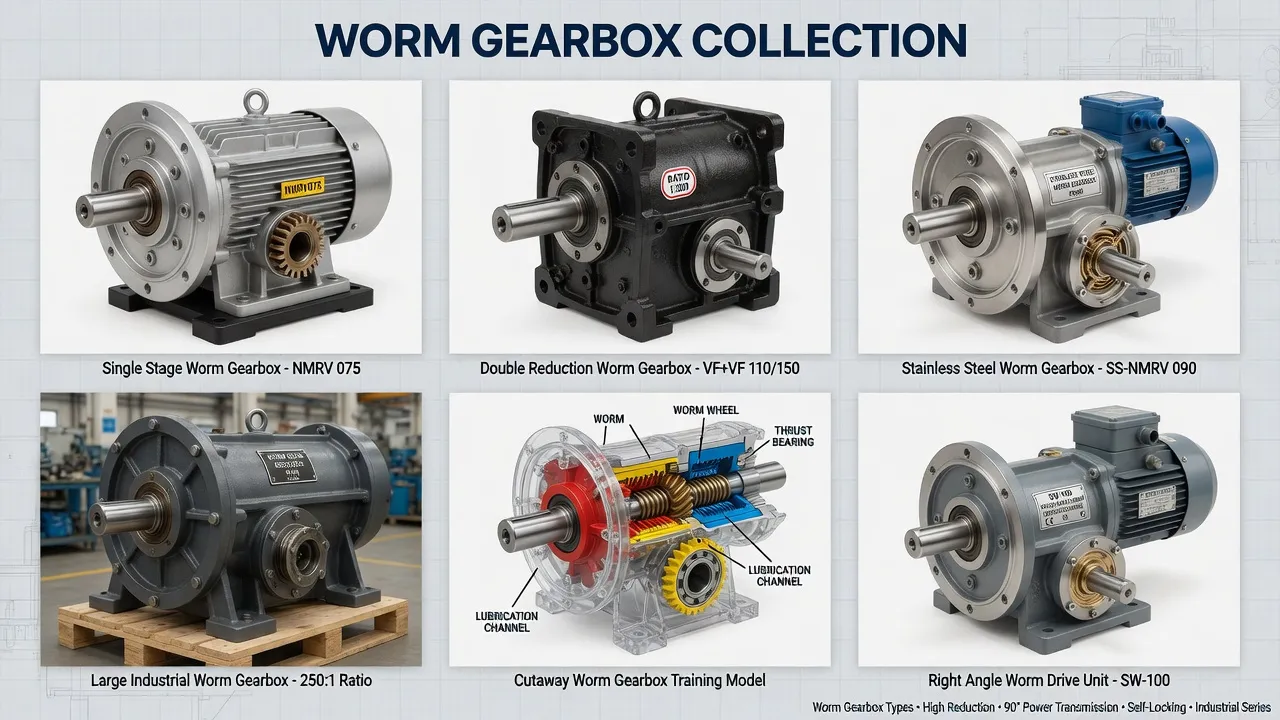
Single-Stage Worm Gearbox — Ratio Range, Limits and When It Applies
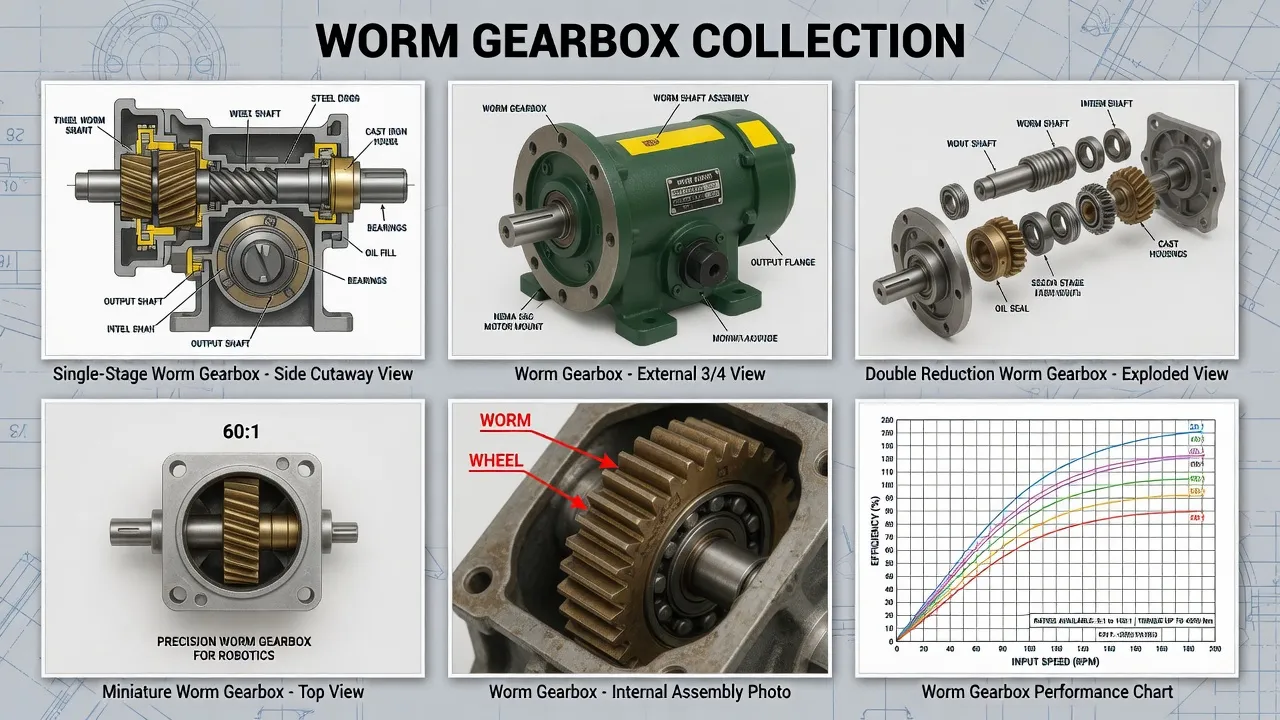
A single-stage worm gearbox achieves ratios from 5:1 to 100:1 in a single worm-and-wheel mesh. This is the most compact, lowest-cost, and highest-efficiency option within the worm architecture class. The efficiency profile across the single-stage ratio range:
| Ratio | Lead Angle | Efficiency (PAO) | Self-Locking | Thermal Limit Risk |
|---|---|---|---|---|
| 10:1 | 14°–18° | 84–88% | No | Low |
| 30:1 | 6°–8° | 73–79% | Yes | Moderate |
| 60:1 | 3.5°–5° | 67–73% | Yes | Moderate-High |
| 80:1 | 2.8°–4° | 63–69% | Yes | High |
| 100:1 | 2.3°–3.5° | 60–67% | Yes | High |
The single-stage worm gearbox is the preferred specification for ratios up to 100:1, where its single compact stage, low cost, and reasonable efficiency make it the most practical solution. Our NMRV worm gearbox series covers the full single-stage range from MRV025 to MRV150 with output torques from 4 Nm to 820 Nm.
Double-Reduction Worm Gearbox — When You Need More Than 100:1
A double-reduction (two-stage) worm gearbox places two worm-and-wheel stages in series. The input shaft drives the first-stage worm; the first-stage worm wheel drives the second-stage worm input shaft; the second-stage worm wheel provides the final output. Total ratio = Stage 1 ratio × Stage 2 ratio.
| Stage 1 Ratio | Stage 2 Ratio | Total Ratio | Combined Efficiency |
|---|---|---|---|
| 10:1 (86%) | 10:1 (86%) | 100:1 | 74% |
| 15:1 (81%) | 15:1 (81%) | 225:1 | 66% |
| 20:1 (78%) | 20:1 (78%) | 400:1 | 61% |
| 30:1 (75%) | 30:1 (75%) | 900:1 | 56% |
| 60:1 (70%) | 60:1 (70%) | 3,600:1 | 49% |
The efficiency drop in double-reduction is significant. At 3,600:1, just under half the input power is lost as heat. This is unavoidable — it is a direct physical consequence of two worm stages each subtracting from total efficiency. For a detailed technical reference on worm gearbox efficiency calculation at multi-stage configurations, see the worm gearbox technical reference.
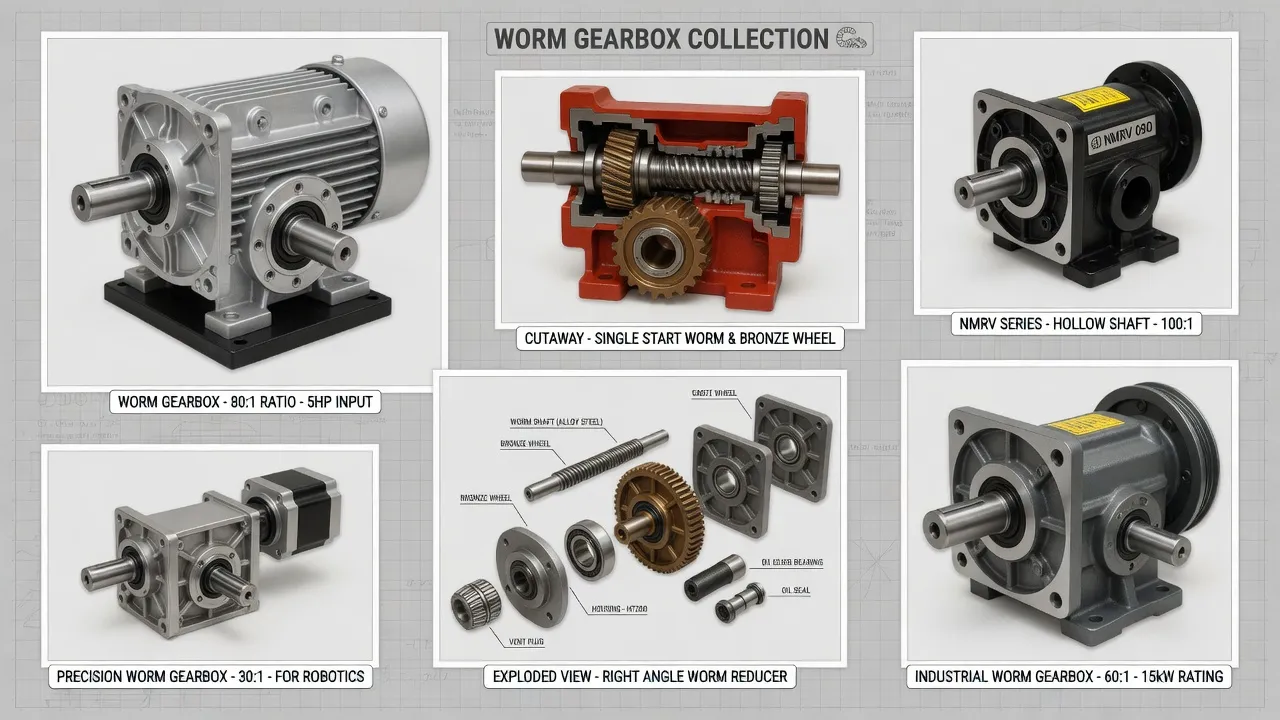
Output Torque — How Double-Stage Multiplies but Not Linearly
A common misconception is that doubling the number of stages doubles the output torque. In reality, the output torque of a double-reduction worm gearbox is:
Toutput = Tinput × itotal × ηcombined
The efficiency penalty reduces what the ratio multiplication delivers. A 400:1 double-stage at 61% combined efficiency on a 1.5 kW input delivers approximately 1,450 Nm — not the 2,300 Nm a 400:1 ratio at 100% efficiency would theoretically produce. Always calculate output torque using the combined efficiency, not the ratio alone. This is why double-reduction worm gearboxes are typically sized one frame larger than the ratio alone would suggest. Our heavy-duty worm gearbox for industrial drives covers large-frame high-torque configurations rated to 78,000 Nm for the most demanding applications.
When to Specify Double-Stage vs Alternative Architectures
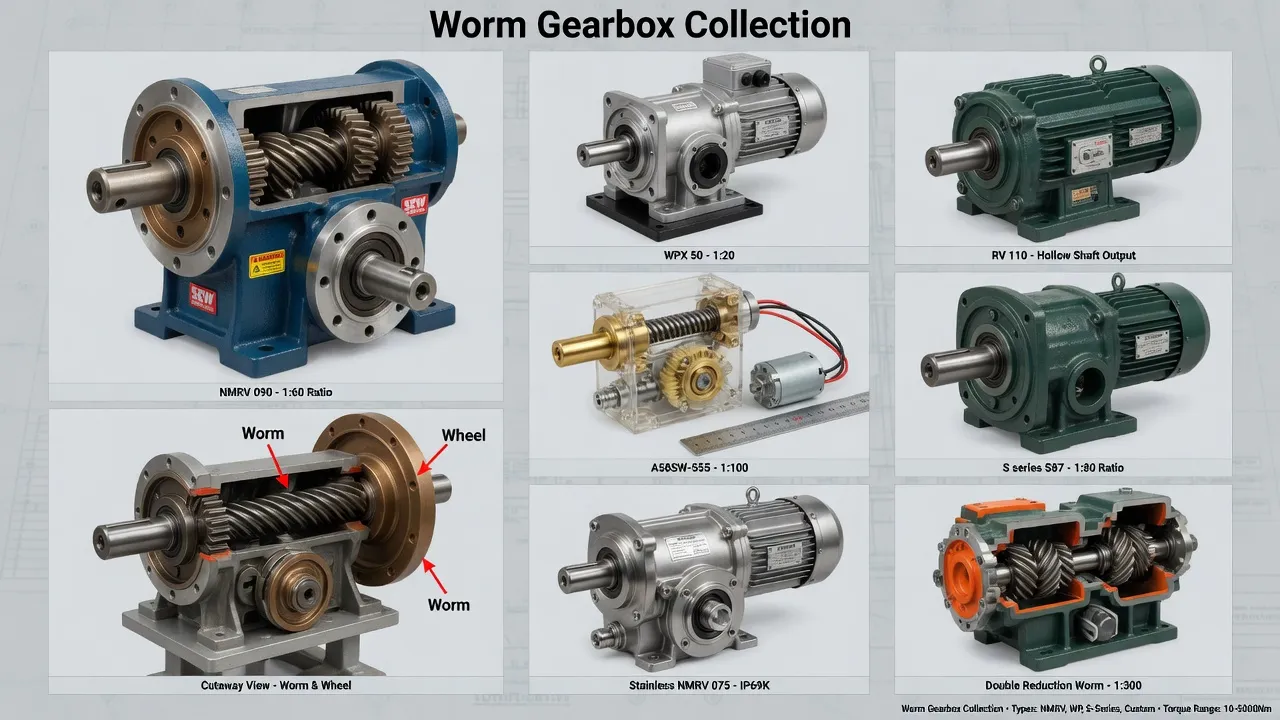
Before defaulting to double-reduction worm, evaluate these three alternative architectures for high-ratio right-angle drives:
| Architecture | Ratio Range | Efficiency | Self-Lock | Best For |
|---|---|---|---|---|
| Double worm | 100:1–3,600:1 | 45–74% | Yes | Max ratio, self-lock, low cost |
| Helical-worm (S-series) | 14:1–197:1 | 75–88% | Yes | Efficiency + self-lock up to 197:1 |
| Bevel-helical (K-series) | 5:1–197:1 | 94–96% | No | Max efficiency, no self-lock needed |
| Worm + planetary | 50:1–2,000:1 | 60–80% | Yes | High ratio + higher efficiency than double worm |
Practical Selection: Which Ratio Needs Which Architecture?
- 5:1 to 100:1 → Single-stage worm. Standard NMRV catalog. No reason to consider double-stage in this range.
- 100:1 to 197:1 → Helical-worm (S-series) first choice. Better efficiency than double worm, compact two-stage, retains self-locking. Only specify double worm if cost is the single overriding constraint.
- 200:1 to 600:1 → Double worm or worm + planetary. Double worm is simpler and lower cost; worm + planetary delivers 15–25% better efficiency. Choose based on duty cycle — if running more than 6 h/day, worm + planetary typically pays back its premium within 18 months.
- 600:1 to 3,600:1 → Double worm. Essentially the only practical compact solution at extreme ratios. Accept the efficiency trade-off as unavoidable. Check thermal rating carefully — at 3,600:1, nearly half the input power becomes heat.
Frequently Asked Questions
Does a double-stage worm gearbox self-lock?
Yes — if both individual stages are at ratios where each self-locks (typically ≥30:1 per stage), the combined unit self-locks. In practice, most double-reduction worm gearboxes self-lock reliably because both stages are in the high-ratio range where self-locking is inherent. However, the same caution applies as single-stage: wear, lubricant changes, and vibration can affect self-locking over time, so safety-critical applications still require a supplementary certified brake.
How do I calculate the output torque of a double-reduction worm gearbox?
Output torque = Input power (W) × Combined efficiency × Total ratio / (2π × input speed in rev/s). Example: 1,500 W input at 1,400 rpm, total ratio 400:1, combined efficiency 61%: T = 1,500 × 0.61 × 400 / (2π × 23.3) = 2,505 Nm. Always use the combined efficiency (product of both stage efficiencies) — using ratio alone without efficiency produces a significant overestimate.
What is the maximum ratio achievable in a double-reduction worm gearbox?
Theoretically 100:1 × 100:1 = 10,000:1 using two maximum-ratio worm stages. Practically, double-reduction units are catalogued to 3,600:1 (60:1 × 60:1). Beyond 3,600:1, the efficiency drops below 45%, making the application barely viable in terms of useful output power. For very high ratios above 1,000:1 that require better efficiency, custom worm-planetary combinations or multi-stage helical + worm combinations are the preferred engineering approach.
Is a 100:1 single-stage or 10:1 × 10:1 double-stage more efficient?
The 10:1 × 10:1 double stage is more efficient: each stage at 10:1 runs at approximately 86% efficiency (large lead angle), giving combined 0.86 × 0.86 = 74% combined. A single-stage 100:1 runs at approximately 60–67% efficiency (very small lead angle). The double-stage at equivalent total ratio delivers 7–14 percentage points better efficiency, which is why double-stage configurations are preferred for ratios above 60:1 where efficiency and thermal management matter.
Need Help Selecting the Right Architecture for Your High-Ratio Application?
Send our engineers your required ratio, output torque, duty cycle, and self-locking requirements — we’ll return a sized recommendation with efficiency and TCO comparison within one business day.
Thermal Management for Double-Stage High-Ratio Drives
At 3,600:1 in a double-stage worm configuration, nearly half the input power becomes heat. Thermal management is not optional — it is a primary design constraint. Three approaches are used in practice:
- Fan-cooled housing: An integral cooling fan on the input shaft increases surface heat dissipation by 40–70%, extending the thermal input-power rating. Adds minor noise and requires inlet air filtration in dusty environments.
- External oil cooler: For very high continuous-power applications, an external plate heat exchanger in the oil circuit removes heat directly from the lubricant before it transfers to the housing. Increases system complexity but enables continuous-duty operation at mechanical-rating power levels.
- Duty-cycle management: For intermittent applications, sizing the total ratio to keep efficiency above 55% and managing the on/off cycle to allow thermal dissipation between operating periods is often the simplest approach — no hardware modification required.
The thermal design is particularly critical for double-stage worm gearboxes in enclosed environments (control panel-mounted, inside machine casings) where ambient temperature is elevated. At +40°C ambient, the thermal input-power rating drops by approximately 25% compared to the standard +20°C catalog rating. Always apply the ambient temperature derating factor when specifying double-stage units for enclosed or hot-environment installations.
Sizing Example — Cement Kiln Drive at 800:1
To illustrate the complete selection process: a cement kiln drive requires 0.5 rpm output from a 1,450 rpm motor — 2,900:1 total ratio — delivering 18,500 Nm continuous output torque.
- Choose stage split: 2,900:1 ≈ 50:1 × 58:1 (two stages close to equal, both in the 50–60:1 range for best combined efficiency). Each stage at ~54:1 runs approximately 68% efficient; combined: 0.68 × 0.68 = 46%.
- Calculate required input power: Pinput = Toutput / (ratio × efficiency) × (2π × noutput) = 18,500 / (2900 × 0.46) × (2π × 0.0083) = 7.3 kW required input.
- Apply service factor: Cement kiln duty is severe impact — AGMA Class IV, service factor 2.0. Sized input power: 7.3 × 2.0 = 14.6 kW motor required.
- Check thermal rating: At 46% efficiency, 53% of 14.6 kW = 7.7 kW heat generated continuously. A heavy-duty double-stage unit of this torque class typically has a fan-cooled thermal input rating of 9–12 kW — verify against the specific unit catalog before specifying.
This example illustrates why high-ratio double-stage applications in heavy industry are almost always paired with significantly larger motors than the mechanical load alone would suggest — the efficiency penalty is built into the input power sizing. For heavy-duty high-torque applications in metallurgy, cement, and mineral processing, our range of heavy-duty worm gearbox for industrial drives covers the large-frame dual-reduction configurations up to 78,000 Nm.
Maintenance Intervals for Single vs Double-Stage Units
Double-reduction worm gearboxes have twice as many wear components as single-stage units — two worm-and-wheel pairs, additional bearings, and additional shaft seals. Maintenance scheduling should reflect this:
- Lubricant change: 6,000 hours or 18 months for double-stage units running above 50% rated power continuously (vs 8,000 hours for equivalent single-stage). The higher heat generation degrades the lubricant faster at equivalent load.
- Oil condition sampling: Recommended at 3,000-hour intervals for double-stage units — monitoring iron and copper particle counts from both wear stages simultaneously. A spike in iron particles indicates worm-screw case wear; copper indicates worm-wheel wear — both stages can be identified from a single oil sample.
- Backlash monitoring: Document baseline backlash at commissioning for each stage separately if possible. A double-stage unit showing rapid backlash growth may have one stage degrading faster than the other; identifying which stage is wearing helps target the correct service action.
- Seal replacement: Single-stage seals: annual inspection, replace at 4–5 years in continuous outdoor or high-temperature service. Double-stage: two sets of seals — one internal stage seal and two external shaft seals — inspect annually, replace external seals at same intervals, inspect internal stage seal at any major rebuild.