
Worm gearbox mounting position is the most frequently misunderstood specification in procurement and installation — and the root cause of more early failures than any other single factor. The mounting position code (B3, B5, B6, V1, V5, V6) does not just describe how the gearbox sits on the machine: it determines the oil fill volume required to correctly lubricate the worm-wheel bearings and gear mesh. Install a gearbox in the wrong orientation without adjusting the oil fill, and the lower bearing runs dry while the upper seal floods — creating simultaneous bearing failure and leakage within the first few hundred hours. This guide explains every standard mounting position code, shows what the gearbox orientation looks like in each case, and gives the oil-fill implications for each so you can specify and install correctly the first time.
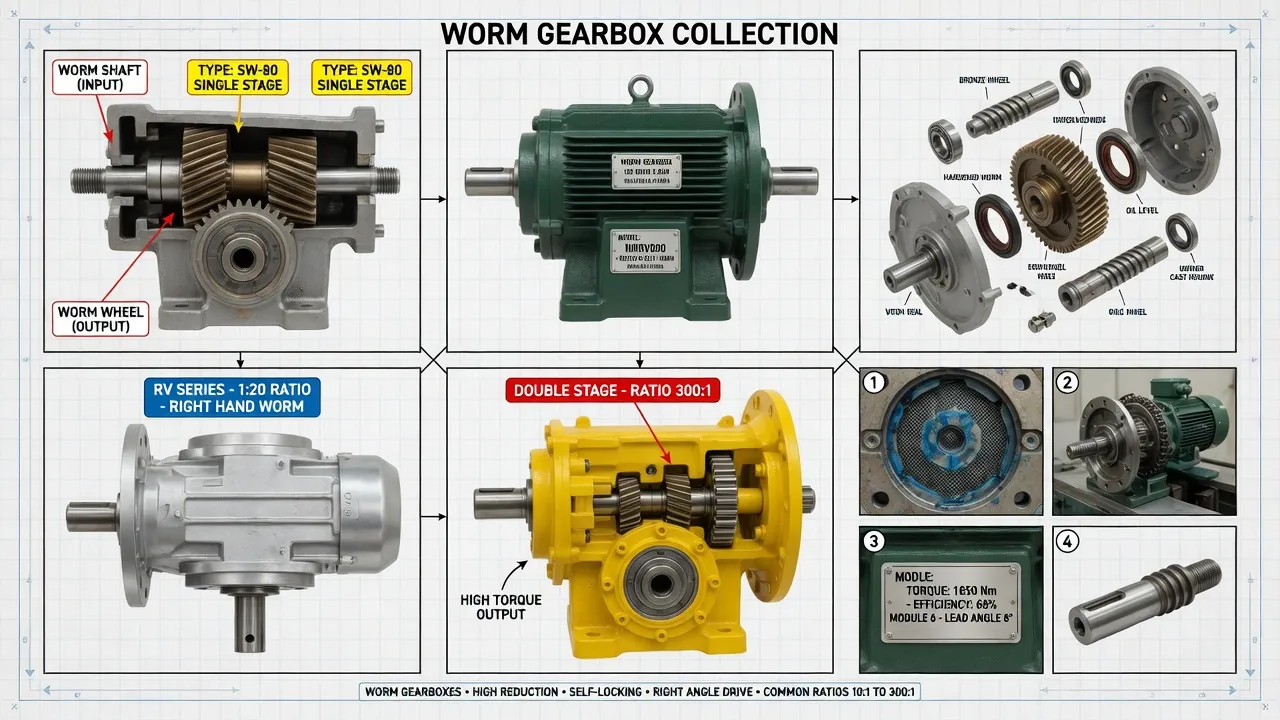
What the Mounting Position Code System Means
The IEC/DIN mounting position codes used in worm gearbox catalogs (B3, B5, B6, V1, V5, V6) describe the orientation of the gearbox relative to gravity — specifically, which face of the housing is the mounting face and which direction the output shaft points. Understanding the code structure:
- “B” prefix = the output shaft is horizontal (parallel to the floor)
- “V” prefix = the input (motor) shaft is vertical (pointing up or down)
- Number suffix = specifies which face or foot arrangement is used and the relative position of motor vs driven machine
The critical point: the worm wheel sits at the intersection of the worm shaft and wheel shaft axes. As the gearbox is rotated into different orientations, the worm wheel moves between being partially submerged (good lubrication) and only splash-lubricated (adequate for some orientations, inadequate for others without a fill-level adjustment). The oil-fill volume table in the catalog ensures the worm wheel is correctly submerged in every supported orientation.
B3 — Horizontal Foot Mount (The Standard Position)
B3 is the most common mounting position for industrial worm gearboxes. The gearbox sits on four mounting feet on a flat base plate or machine frame. The input shaft (and motor) is horizontal; the output shaft is also horizontal at 90° to the input. The housing “stands upright” with the foot mounting holes pointing downward.
- Applications: Belt conveyors, screw conveyors, base-mounted agitators, packaging machinery
- Oil fill: Standard fill — to the centre of the sight glass or oil-level plug. The catalog B3 fill volume is the reference for all other positions. The worm wheel is partially submerged at this level.
- Notes: Easiest maintenance access — oil drain plug at the bottom, fill plug at the top, sight glass on the side. Standard catalog ratings are measured at B3 — thermal and mechanical ratings at other positions may differ slightly.
B5 — Horizontal Flange Mount (Wall or Bracket Mount)
B5 is the second most common position. The gearbox is flange-mounted to a wall, bracket, or machine frame on the output side — the output flange face is the mounting face. Input and output shafts remain horizontal. The housing “hangs” from its output-side flange face.
- Applications: Wall-mounted conveyor drives, machine-frame integrated drives, door operator mechanisms
- Oil fill: Slightly different from B3 — typically 85–95% of the B3 volume for the same frame size. Check the catalog mounting-position table.
- Notes: Provides a more rigid mounting than B3 for high-vibration environments. The output shaft connects directly to the driven machine shaft without a base plate or separate coupling support required.
B6 — Horizontal Mount, Output Shaft Pointing Upward
B6 has the gearbox mounted on its side with the output shaft pointing vertically upward. The motor and input shaft remain horizontal. The housing is rotated 90° from the B3 position around the input shaft axis.
- Applications: Vertical agitator drives (motor horizontal, shaft output up), mixing tank side drives, food filling machine vertical output
- Oil fill: Reduced vs B3 — the output shaft pointing up means the output bearing is higher, requiring less oil to avoid flooding the output shaft seal. Typically 70–80% of B3 volume. Check the catalog table.
- Notes: The output bearing (now the upper bearing) receives splash lubrication only — verify the catalog specifies B6 as a supported position for the selected frame size and ratio. Not all NMRV sizes support B6 for high-power continuous duty.
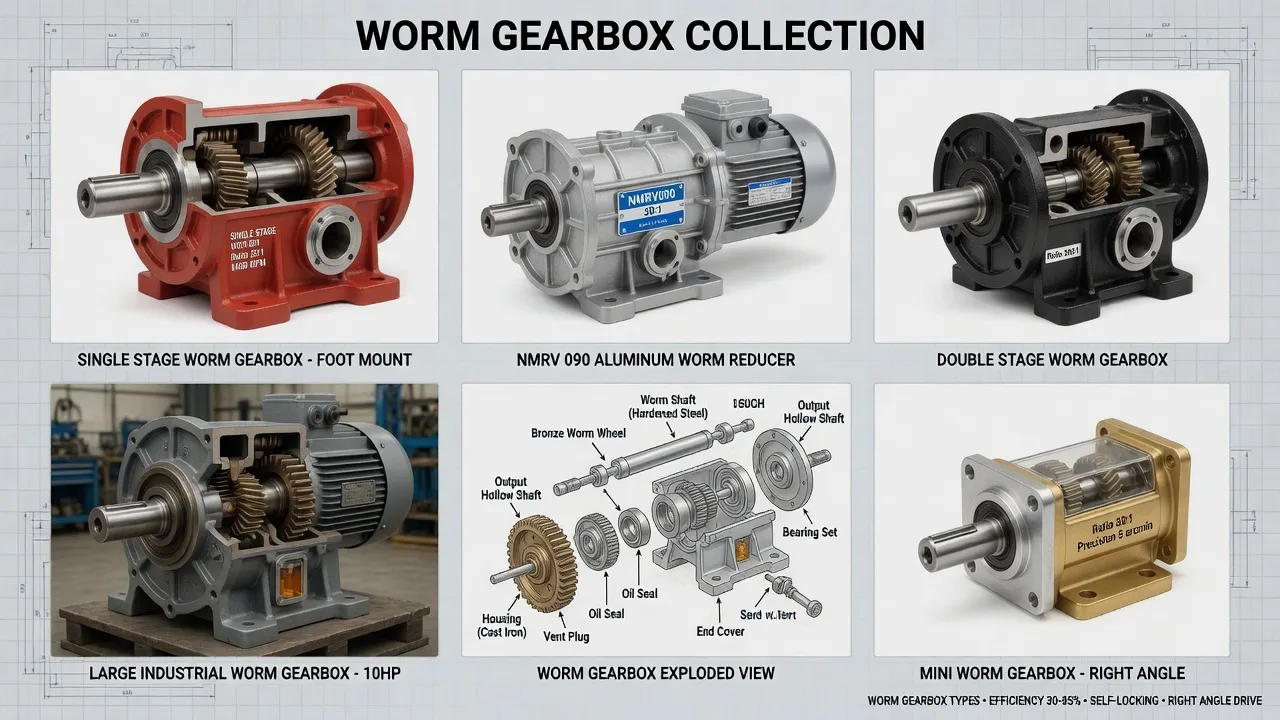
V1 — Vertical Motor Shaft (Motor on Top)
V1 has the motor mounted vertically above the gearbox — the motor shaft and worm shaft axis are vertical (pointing down), while the output shaft is horizontal. This is a commonly misinstalled position because engineers unfamiliar with oil-fill implications install a B3-configured unit in V1 without adjusting the fill.
- Applications: Vertical-shaft pump drives, agitator drives where motor space is above the equipment, conveyor drives where horizontal footprint must be minimised
- Oil fill: Increased vs B3 — the input shaft is now the highest point, requiring more oil to submerge the worm wheel that is now positioned differently relative to the oil level. Typically 110–130% of B3 volume. Check the catalog table carefully.
- Notes: The input shaft seal is now at the top — oil pressure on the seal lip is lower, reducing seal loading. However, if the unit is overfilled above the V1 specified level, oil can enter the motor through the input shaft seal. Keep fill exactly to the V1 table specification.
V5 — Vertical Motor Shaft (Motor Below)
V5 has the motor mounted vertically below the gearbox — the worm shaft points upward (into the gearbox) from the motor below. Output shaft is horizontal. This position requires careful oil-fill management because the input shaft seal (now at the bottom) is submerged and under hydrostatic oil pressure.
- Applications: Under-floor drives, equipment where motor must be below the driven machine, some overhead conveyor configurations
- Oil fill: Reduced vs B3 — only enough to maintain adequate oil bath level with the worm wheel, as the input shaft seal is at the bottom and excess oil would build hydrostatic pressure on the seal. Typically 60–75% of B3 volume. Check catalog table.
- Notes: V5 is the position most susceptible to seal leakage if overfilled. The lower input shaft seal must resist the full hydrostatic head of the oil column above it. Specify FKM (Viton) seals rather than standard NBR for V5 installations — the additional elastomer resistance reduces the risk of slow seepage under continuous hydrostatic pressure.
V6 — Output Shaft Pointing Downward
V6 has the output shaft pointing downward — the output of the gearbox drives a vertical machine shaft going down (mixer shaft, dosing auger, vertical conveyor). Motor and input shaft remain horizontal.
- Applications: Vertical agitator shafts pointing down (standard tank mixer configuration), vertical dosing augers, anchor-type mixer drives
- Oil fill: Increased vs B3 — more oil required to maintain adequate bath level at the worm wheel with the output shaft seal now at the bottom (submerged). Typically 115–135% of B3 volume. The output seal also faces hydrostatic pressure; specify FKM seals.
- Notes: Most common mistake — filling to the B3 sight-glass mark in a V6 orientation results in the worm wheel running partially dry. Always use the V6 volume from the catalog mounting-position table.
Oil Fill Volume Summary Table
The table below shows indicative oil fill volumes relative to the B3 reference for each mounting position. Actual volumes vary by frame size — always verify against the specific catalog table for your NMRV frame:
| Position | Orientation Description | Fill vs B3 | Seal Risk |
|---|---|---|---|
| B3 | Foot mount, horizontal input & output | 1.00× (reference) | Standard |
| B5 | Flange mount, horizontal input & output | 0.85–0.95× | Standard |
| B6 | Horizontal input, output shaft pointing up | 0.70–0.80× | Low (output seal high) |
| V1 | Motor on top, input vertical (down), output horizontal | 1.10–1.30× | Overfill risk → motor |
| V5 | Motor below, input vertical (up), output horizontal | 0.60–0.75× | High — input seal submerged |
| V6 | Horizontal input, output shaft pointing down | 1.15–1.35× | High — output seal submerged |
For V5 and V6 positions where shaft seals face hydrostatic oil pressure, specify FKM (Viton) shaft seals — available as an upgrade option on our NMRV worm gearbox range. For stainless food-grade units in vertical mounting positions, our HSRV stainless worm gearbox includes FKM seals and IP69K as standard. For the complete mounting position oil-fill reference tables for all NMRV frame sizes, see the worm gearbox mounting position technical reference.
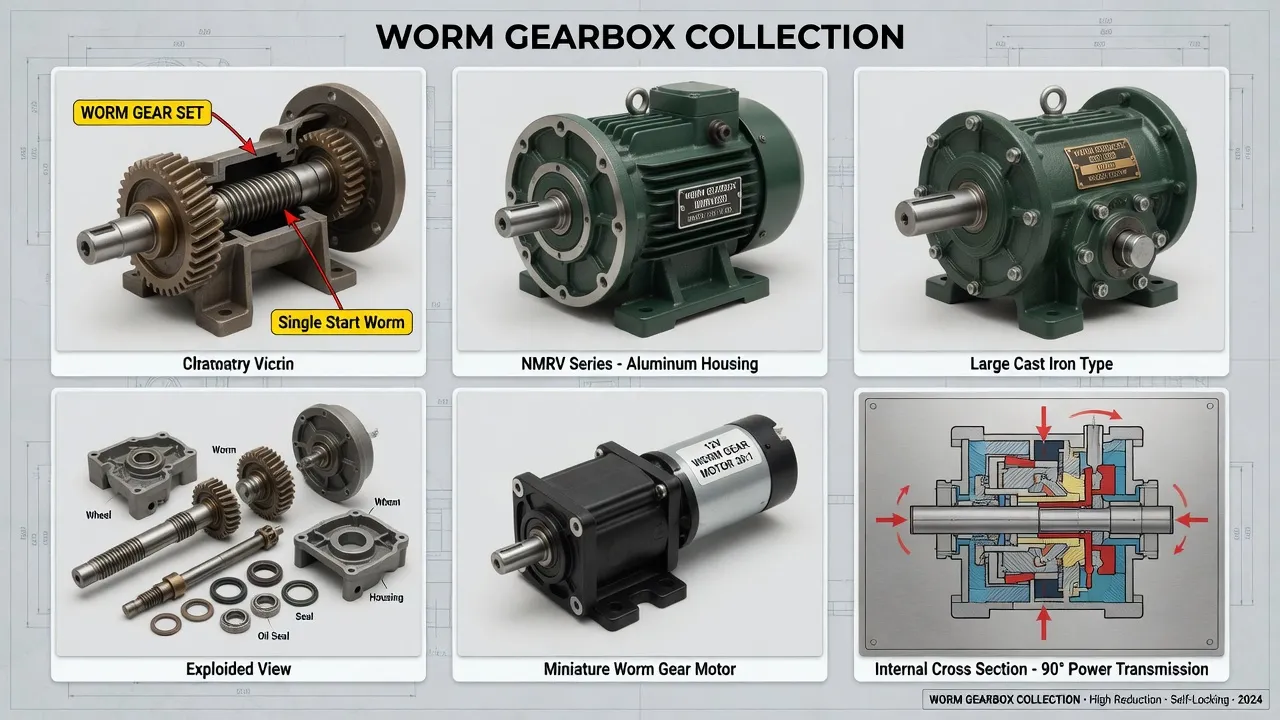
Specifying Mounting Position at Order — Why It Matters
When ordering a worm gearbox, specifying the mounting position as part of the order code (e.g., NMRV090-50-B5-V1-IP65) serves two important functions:
- Factory oil fill: Units pre-filled at the factory will be filled to the correct volume for the specified position. A gearbox ordered as V1 will arrive with 15–25% more oil than one ordered as B3 — both correct for their respective orientations.
- Housing vent and fill port positioning: Some manufacturers position the vent plug, fill plug, and drain plug at different housing ports depending on the mounting position — so that in the installed orientation, the vent is always at the top, the fill is always accessible from the side, and the drain is always at the bottom. If the wrong mounting position is specified at order, these ports may be in the wrong positions for the actual installation.
If you order for B3 but then install in V1, contact the supplier before running the unit — you may need a housing plug relocation and a refill to the correct volume. Running even 50 hours in the wrong orientation with the wrong oil level can cause irreversible worm-wheel bearing damage.
Frequently Asked Questions
Can I order a gearbox without specifying mounting position?
You can, but the supplier will default to B3 (horizontal foot mount) for factory fill and plug positioning. If you intend to install in any other orientation, you must specify the position at order — or drain and refill to the correct volume before commissioning. “I’ll figure out the orientation after delivery” is the most common path to incorrect oil fill and early failure.
My machine requires the motor at 45° — is that a standard position?
No — standard positions are B3, B5, B6, V1, V5, V6 only. Any non-standard angle (30°, 45°, etc.) requires a custom oil-fill volume calculation and may require repositioning of the vent and drain ports. Contact the manufacturer with the exact angle before specifying — some manufacturers can supply custom port configurations; others require an outboard reservoir or forced lubrication system for non-standard orientations.
What is the thermal performance difference between mounting positions?
B3 (horizontal foot mount) is the reference thermal rating condition. The B3 position exposes the maximum housing surface area to natural convection airflow around the housing. Vertical positions (V1, V5) may slightly reduce effective cooling surface area for natural convection because part of the housing is against the mounting bracket. In high-duty continuous applications where thermal rating is already the binding constraint, specifying B3 where mechanically possible maximises the available thermal budget.
Can the same gearbox be used in multiple positions across a product range?
Yes — the same physical gearbox unit can be installed in different positions across different machine variants, provided the oil fill is correctly adjusted for each position. This is standard OEM practice: a single NMRV part number is used across multiple equipment variants with different installation orientations, with the fill volume specified in the assembly instruction per position code. If the gearbox is already pre-filled at the factory, drain and refill to the correct volume for each specific installation position.
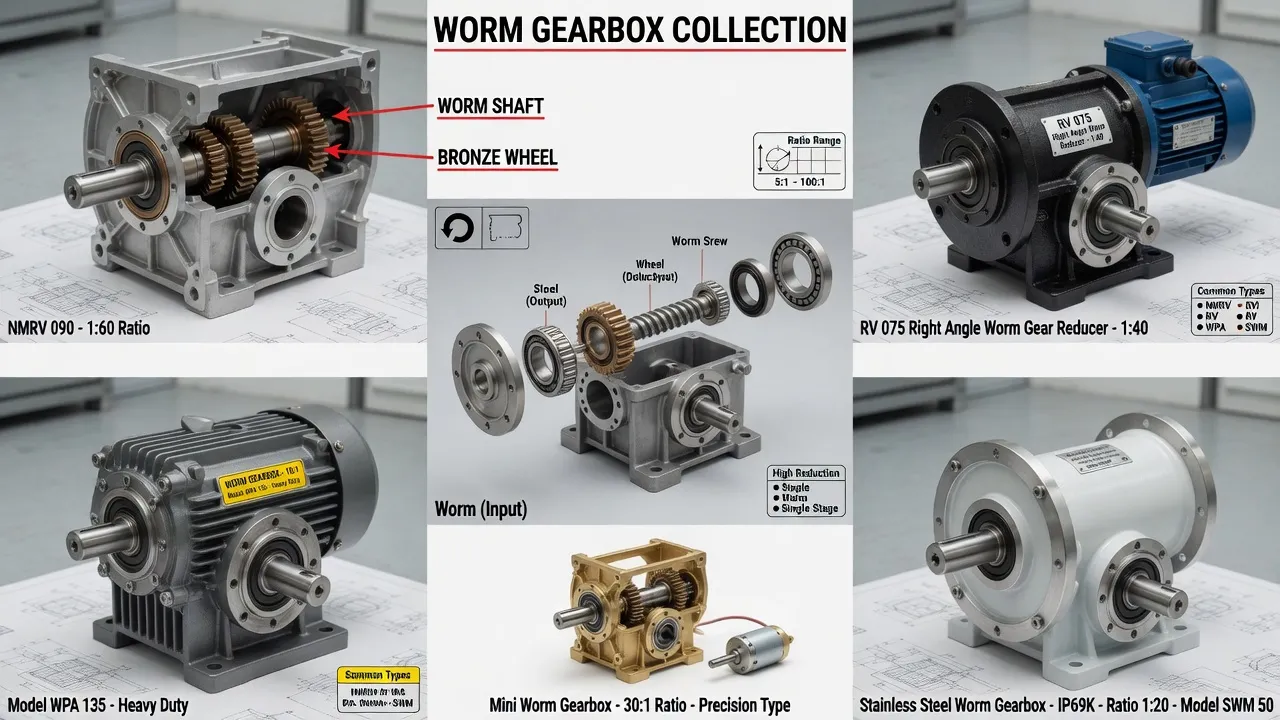
Need a Worm Gearbox Configured for Your Specific Mounting Position?
Tell us your frame size, ratio, and mounting position code — we’ll supply the unit pre-filled to the correct oil volume with the correct port positioning for your installation orientation.