
Conveyors account for the largest single application segment of worm gearboxes worldwide — estimated at 28–32% of total NMRV production volumes. The reason is straightforward: belt conveyors, screw conveyors, roller conveyors, and chain conveyors all require a right-angle drive to redirect power from a wall-mounted motor to a horizontal driven shaft, moderate-to-high reduction ratios in the 15:1–60:1 range, and optional self-locking to prevent back-run on inclined sections. Worm gearboxes satisfy all three requirements simultaneously at the lowest possible unit cost. This guide covers the complete selection methodology for conveyor applications, the specific ratio and frame-size considerations for each conveyor type, and the critical hollow-shaft configuration advantage that eliminates the most common conveyor-drive maintenance problem.
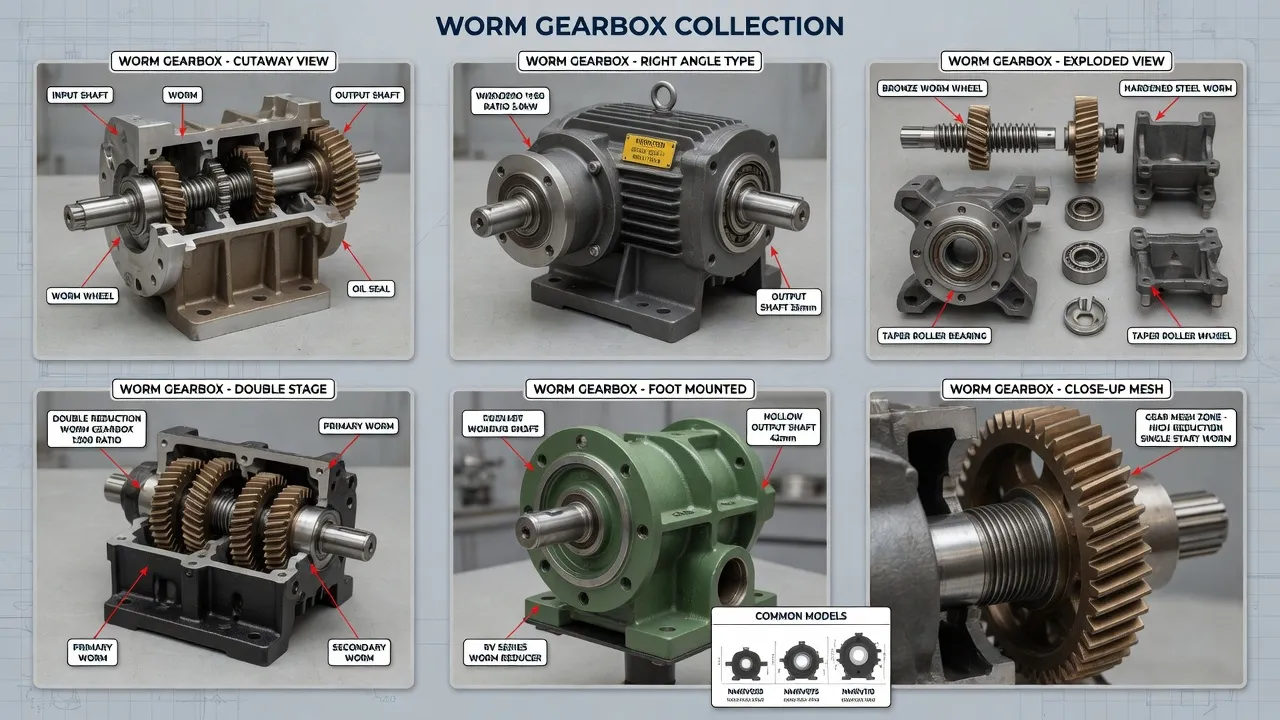
Conveyor Type vs Worm Gearbox Requirements — The Selection Matrix
Different conveyor types impose different requirements on the gearbox. The table below maps each common conveyor type to its worm gearbox specification needs:
| Conveyor Type | Typical Output Speed | Typical Ratio | Self-Lock Needed? | Preferred Config. |
|---|---|---|---|---|
| Belt conveyor (horizontal) | 25–80 rpm | 18:1–56:1 | No | Hollow shaft |
| Belt conveyor (inclined >15°) | 20–60 rpm | 23:1–70:1 | Yes | Hollow shaft |
| Screw conveyor (horizontal) | 30–120 rpm | 12:1–47:1 | No | Hollow or solid shaft |
| Screw conveyor (inclined) | 20–90 rpm | 15:1–70:1 | Yes | Hollow shaft |
| Chain conveyor / slat conveyor | 8–35 rpm | 40:1–175:1 | Sometimes | Solid shaft + chain sprocket |
| Roller conveyor / roller table | 30–120 rpm | 12:1–47:1 | No | Hollow shaft or solid + bevel |
| Bucket elevator | 20–60 rpm | 23:1–70:1 | Yes | Solid shaft + chain |
Why Hollow Shaft Wins for Belt and Screw Conveyor Drives
The hollow-shaft worm gearbox configuration mounts the gearbox directly onto the driven conveyor shaft — the shaft passes through the hollow output bore and is secured by a keyway-and-key or shrink-disc arrangement. This eliminates the coupling between the gearbox output shaft and the driven shaft. The advantages are substantial:
- Coupling eliminated: The flexible coupling between gearbox output and conveyor shaft is statistically the highest-failure-rate component on most conveyor drives — it accounts for roughly 35% of all conveyor-drive maintenance calls in well-maintained industrial facilities. Hollow shaft eliminates this entirely.
- Shaft alignment tolerance: Coupling drives require precise angular and parallel alignment (<0.05 mm parallel, <0.05°/100 mm angular) to prevent bearing wear and vibration. Hollow-shaft direct-mount needs only concentricity — a much simpler alignment requirement achievable during installation without laser tools.
- Axial length reduction: Removing the coupling and its associated shaft extension reduces the drive assembly axial length by 80–150 mm on a typical conveyor, allowing the motor to sit closer to the conveyor head structure — important in confined-space installations.
- Torque arm reaction: On belt conveyor head-pulley drives, a torque-arm variant (hollow shaft + torque arm bracket reacting against the conveyor frame) is the industry-standard configuration — the gearbox sits directly on the head-pulley shaft with zero separate base-plate required, eliminating the base-plate alignment and grouting process entirely.
The only scenario where solid-shaft configuration is preferred over hollow for conveyors: when the driven shaft diameter is non-standard or outside the hollow bore range of the gearbox, or when very high radial loads from a chain drive make solid-shaft + separate outboard bearing the mechanically superior arrangement. For detailed industrial conveyor drive application cases and gearbox specification methodology, the industrial conveyor and gear reducer application guide provides sector-specific worked examples.
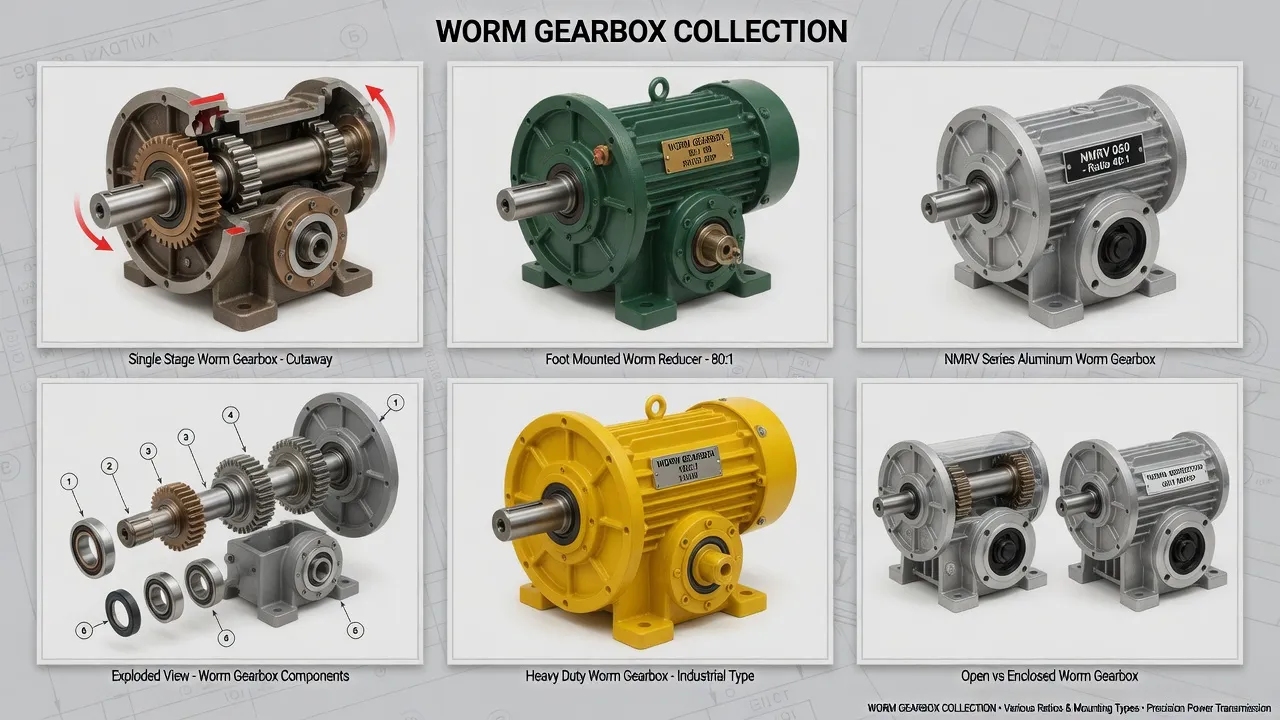
Self-Locking for Inclined Conveyors — What the Spec Means in Practice
An inclined conveyor or screw conveyor with product on the belt will back-run when the motor de-energizes — gravity drives the loaded belt or screw backward. Self-locking at ratio ≥30:1 prevents this. The engineering question is: what ratio is sufficient for the specific incline angle and load?
The self-locking back-drive torque that the gearbox must resist equals the torque generated by gravity acting on the loaded belt: Tbackrun = (belt load kg × incline angle sin θ × drum radius m × g) / (transmission efficiency factor). For a 15° incline belt conveyor at 500 kg load, 0.2 m drum radius: Tbackrun ≈ 500 × 0.259 × 0.2 × 9.81 = 255 Nm. Verify the selected ratio delivers reliable self-locking (ratio ≥30:1) AND that the static self-locking torque rating in the catalog exceeds 255 Nm with a safety margin of 1.5× (so ≥383 Nm self-locking capacity required).
Important: for steeply inclined conveyors above 25° and for bucket elevators, a supplementary backstop or brake is always recommended even with a self-locking worm gearbox. The self-locking behavior can be compromised by lubricant condition changes, vibration during E-stop events, and worn worm-wheel surfaces approaching end-of-life. A mechanical backstop (ratchet-type anti-runback device) adds €30–€80 to the drive assembly and provides a fail-safe second line of defense.
Conveyor Frame-Size and Ratio Selection — Worked Examples
Three representative conveyor applications with complete selection walkthrough:
| Application | Required Output | Motor | Service Factor | Design Torque | Selection |
|---|---|---|---|---|---|
| Grain belt conveyor, horizontal, 8 h/day | 40 rpm, 180 Nm | 1,400 rpm, 1.5 kW | 1.25 (Class II, 8h) | 225 Nm | NMRV075-35, hollow shaft |
| Flour screw conveyor, 20° incline, 16 h/day | 35 rpm, 320 Nm | 1,400 rpm, 2.2 kW | 1.75 (Class III, 16h) | 560 Nm | NMRV090-40, hollow shaft, self-lock |
| Iron ore belt conveyor, 24/7 continuous | 18 rpm, 4,200 Nm | 1,400 rpm, 11 kW | 2.0 (Class III, 24h) | 8,400 Nm | Heavy-duty RR-series, 80:1 |
Note the third example — at 8,400 Nm design torque with 24/7 continuous duty, the application moves beyond the NMRV150 (2,550 Nm) into our heavy-duty worm gearbox range. For standard conveyor applications within the NMRV range, our NMRV worm gearbox series covers the full selection.
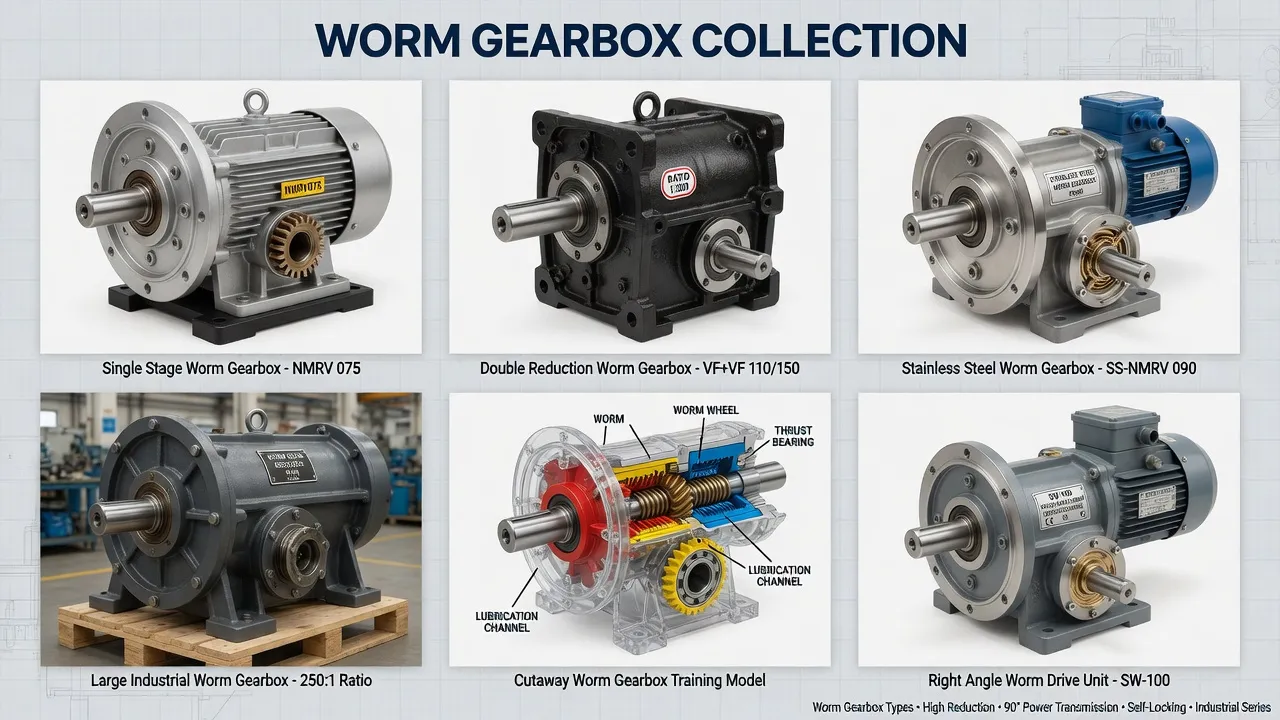
IP Rating and Environmental Specification for Conveyor Applications
Conveyor environments vary dramatically in contamination severity, and the correct IP rating must match the installation:
- IP55 (standard indoor industrial): Dry indoor conveyors, logistics, packaging. Adequate for dust-laden but non-washed environments. Most NMRV catalog units ship IP55 as standard.
- IP65 (outdoor / regular water exposure): Outdoor aggregate and quarry conveyors, water splashing from aggregate screening. FKM seals standard; external shaft seal guard recommended in dusty environments.
- IP66 (powerful water jets): Food-ingredient conveyors requiring regular hosing. Shell-and-tube housing cooling options sometimes used here for high-power continuous duty.
- IP69K (high-pressure hot washdown): Food-processing belt conveyors, conveying fresh meat, dairy, or produce. Standard specification for any conveyor in a HACCP-regulated zone. Requires double FKM lip seals and stainless fasteners minimum.
For abrasive dust environments (cement, grain, mineral processing), adding a flinger disc or labyrinth seal guard on both the input and output shaft seal is strongly recommended regardless of IP rating — standard IP55 seals exposed to abrasive particles will fail in 3–9 months; a $15 labyrinth guard extends seal life to 4–6 years.
Frequently Asked Questions
Can I use a worm gearbox for a conveyor running 24/7 continuously?
Yes, but the thermal input-power rating governs the selection for 24/7 duty — not the mechanical torque rating. At high ratios (50:1+), the thermal rating is typically 40–50% of the mechanical rating. Always check the catalog thermal P₁ at your ratio and ambient temperature, and apply the 24 h/day service factor multiplier (1.5–2.0 depending on load class). For high-power continuous-duty conveyors (above 5.5 kW absorbed at 50:1+), bevel-helical or helical-worm architecture delivers better energy economics despite higher purchase cost.
What shaft diameter hollow bore is available for conveyor drives?
Standard NMRV hollow-shaft bore diameters: NMRV050: 20–25 mm, NMRV063: 20–30 mm, NMRV075: 25–35 mm, NMRV090: 30–40 mm, NMRV110: 35–45 mm, NMRV130: 40–55 mm, NMRV150: 50–65 mm. Non-standard bore diameters within the housing range are available as custom machining — typically add 1–2 weeks lead time and a small tooling surcharge per order.
Why does my conveyor gearbox run hotter in summer than winter?
The thermal budget is fixed: the gearbox can dissipate a certain number of watts from its housing surface. At higher ambient temperature, the temperature difference between housing and air is smaller for the same heat flux — meaning the housing reaches a higher absolute temperature. At 40°C ambient vs 20°C, the gearbox housing runs 15–20°C hotter at identical load — which may be within spec in winter but exceed the oil temperature limit in summer. For outdoor installations in warm climates, always apply the ambient temperature derating to the thermal rating (×0.71 at 40°C ambient vs 20°C reference).
What is the standard mounting orientation for a belt conveyor head-pulley drive?
The standard for belt conveyor head-pulley worm gearbox drives is B3 (horizontal foot mount, input shaft horizontal) with a hollow output shaft mounted directly to the head-pulley shaft. A torque arm bracket connects the gearbox housing to the conveyor frame side-plate to react the drive torque. Oil fill level for B3 horizontal mounting is marked at the housing sight glass. Do not install a B3-specified gearbox in any other orientation without consulting the oil-fill volume table — the oil level shifts significantly between mounting positions.
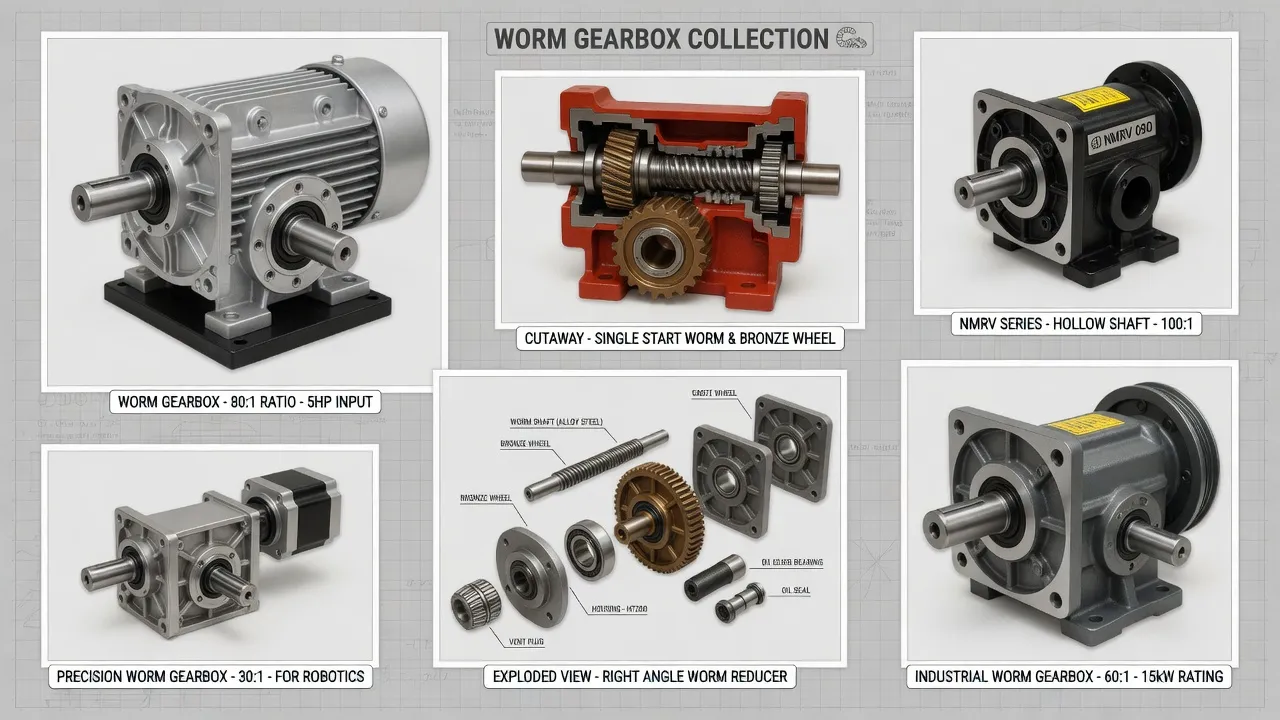
Need a Worm Gearbox Specified for Your Conveyor Drive?
Send us your conveyor type, belt speed or output rpm, load torque, incline angle, daily hours, and shaft diameter — we’ll size the correct NMRV frame, verify the thermal budget, and return a complete specification within one business day.
Maintenance Considerations for Conveyor Worm Gearbox Installations
Conveyor gearboxes operate in among the most demanding maintenance environments — often inaccessible, dusty, vibration-exposed, and subject to extended periods without attention between planned shutdowns. Five maintenance practices that maximize service life in conveyor applications:
- Temperature trend monitoring: Attach a temperature-indicating label (70°C and 90°C) to each gearbox housing at installation. At every planned shutdown, photograph the labels — a label that has triggered indicates the gearbox exceeded its thermal limit between inspections. This costs €1–2 per gearbox and can identify thermal overloads before they cause failure.
- Backlash check at annual inspection: Rock the output shaft by hand with the input shaft held. Growing backlash (measured with a dial gauge) is the primary indicator of worm-wheel wear — the only leading indicator available without disassembly. Document the baseline backlash at commissioning; schedule replacement when measured backlash exceeds 2× the commissioned value.
- Oil sampling on critical drives: For conveyors running more than 16 hours/day, draw an oil sample every 4,000 hours. Send to an industrial oil laboratory for particle count, viscosity, and water content. Iron particles: steel worm wear. Copper particles: bronze wheel wear. Water above 0.1%: seal failure. This €20–€35 test predicts failure 1,000–3,000 hours in advance — allowing planned replacement at the next shutdown rather than emergency repair.
- Check hollow-shaft connection torque: Hollow-shaft shrink-disc connections can relax over time from vibration and thermal cycling. Re-torque the shrink disc bolts to the manufacturer’s specification at the first annual inspection, and every two years thereafter.
- Torque arm inspection: On torque-arm mounted head-pulley drives, inspect the torque arm rubber buffers annually. Cracked or compressed rubber buffers allow the gearbox housing to rotate under load — adding bending stress to the hollow-shaft connection and accelerating bearing wear.