
A procurement engineer at a packaging machinery OEM submits a purchase request to “buy 12 worm gears for the new conveyor line.” The supplier responds with a quote for 12 worm-and-wheel gear sets — bare bronze wheels meshing with steel worms, no housing, no bearings, no lubrication system. The OEM expected complete gearboxes with input shafts, output flanges, oil-filled housings, and motor mounting interfaces. Two weeks of project schedule disappear while the order gets corrected. This scenario plays out hundreds of times daily across industrial procurement operations because the terms worm gear and worm gearbox describe fundamentally different things — one is a component, the other is a complete power transmission unit — but the terminology gets used interchangeably in conversation, RFQ documents, and even some technical specifications.
This guide clarifies the precise difference between a worm gear (the component) and a worm gearbox (the complete unit), explains what’s inside each, walks through when buyers actually need one versus the other, and addresses the procurement confusion that causes project delays and budget surprises. Audience: mechanical design engineers, procurement specialists, OEM purchasing managers, and maintenance technicians who source power transmission equipment.
The Short Answer: Component vs Complete Unit
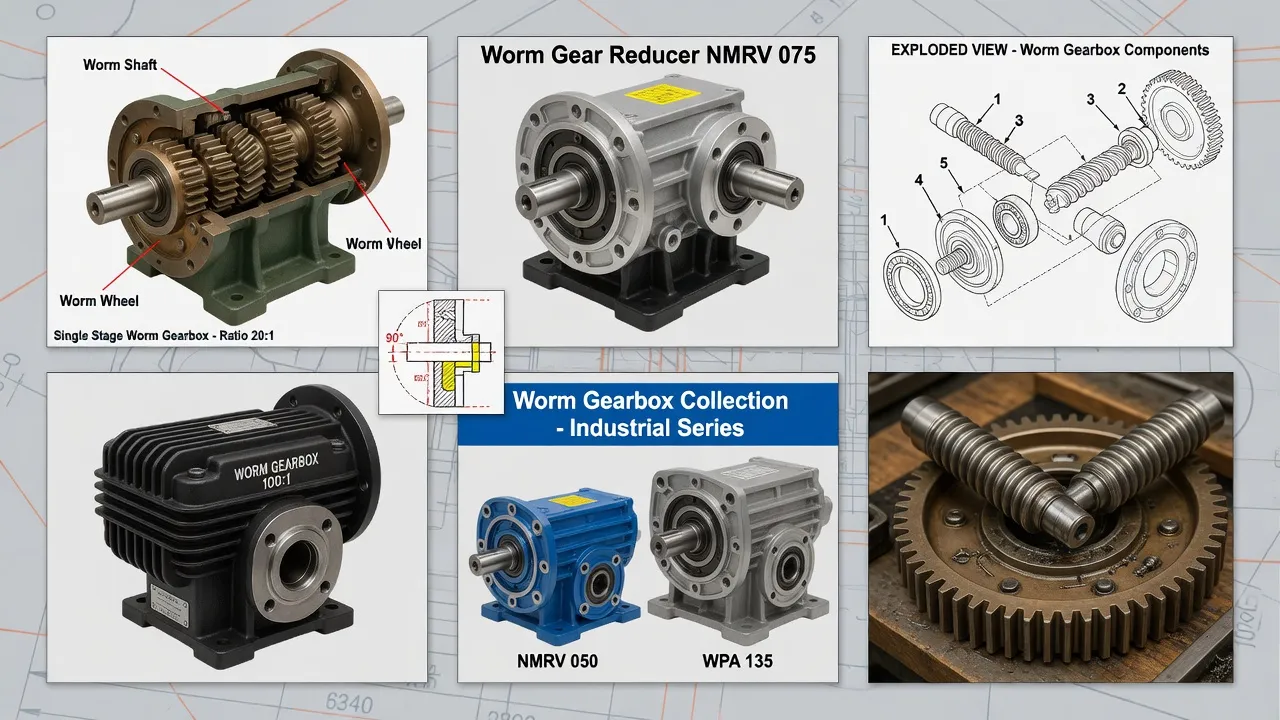
A worm gear is the mechanical gear element itself — specifically, the larger wheel-shaped component (the worm wheel) that meshes with a screw-shaped component (the worm). When engineers say “worm gear set” or “worm gear pair,” they typically mean both pieces together as a meshed pair, but in strict technical usage, “worm gear” refers to the wheel only and “worm” refers to the screw. The worm gear is one component within a larger assembly — it cannot transmit power on its own without bearings to support shaft rotation, a housing to maintain gear alignment, and lubrication to manage friction between the meshing tooth surfaces.
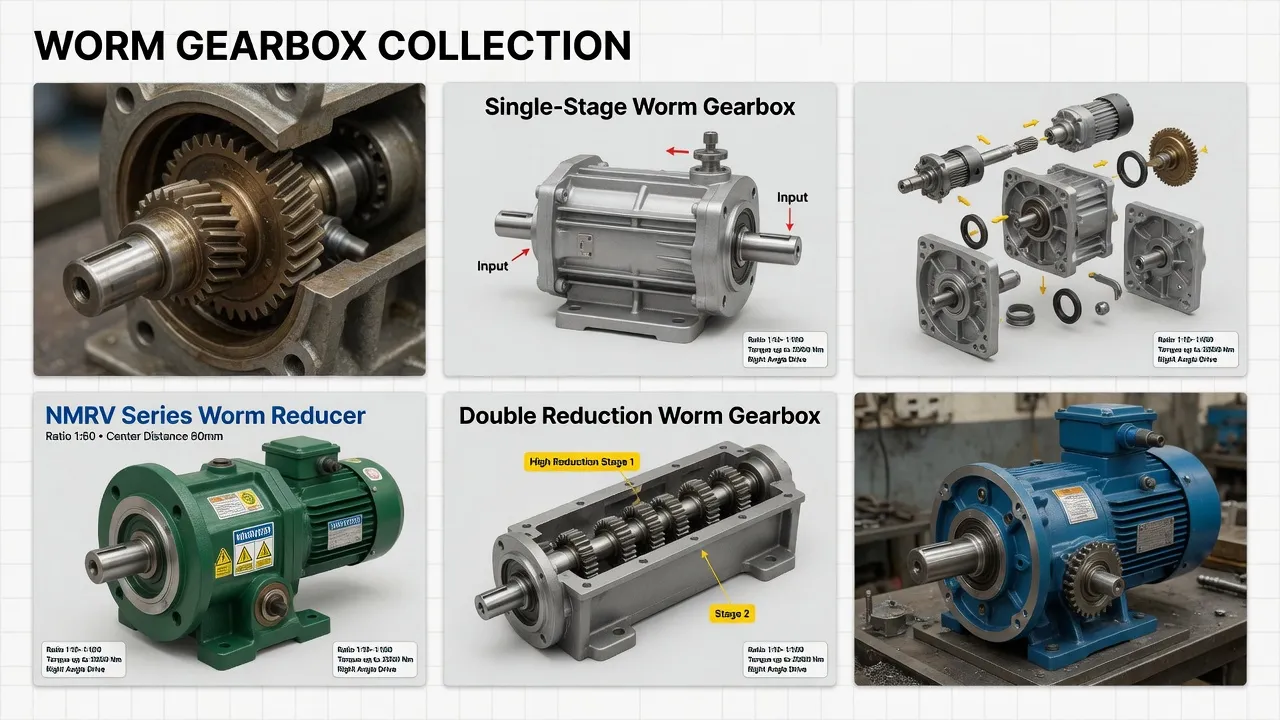
A worm gearbox is the complete sealed assembly that contains the worm gear pair plus all the supporting elements needed to function as a power transmission device. The gearbox includes: cast iron or aluminum housing maintaining precise gear alignment, premium bearings supporting input and output shaft rotation, oil seals preventing lubricant leakage, breather valves managing housing pressure during thermal cycling, synthetic or mineral oil lubricant fill, input motor mounting flange standardized to IEC or NEMA frame sizes, and output shaft configurations (solid shaft, hollow shaft, or output flange) matching the driven equipment interface. A worm gearbox is ready to bolt onto a machine and drive a load — a bare worm gear pair requires substantial additional engineering and component sourcing before it can do anything.
What’s Inside Each: Detailed Component Breakdown
The table below itemizes what you receive when you order a worm gear versus a worm gearbox, clarifying exactly where the boundary sits between these two terms.
| Component | Worm Gear Order | Worm Gearbox Order |
|---|---|---|
| Bronze worm wheel | Included | Included (inside housing) |
| Steel worm shaft | Sometimes (as gear set) | Included (inside housing) |
| Cast housing | Not included | Included |
| Bearings (input and output) | Not included | Included (factory installed) |
| Oil seals and o-rings | Not included | Included |
| Lubricant fill | Not included | Included (factory filled) |
| Motor mounting flange | Not included | Included (IEC/NEMA standard) |
| Output shaft configuration | Customer must specify and machine | Included (solid, hollow, or flange) |
| Breather valve | Not included | Included |
| Mounting feet or flange | Not included | Included (integral to housing) |
| Performance ratings | Gear-level only (AGMA tooth rating) | Unit-level (torque, power, ratio, RPM) |
The pricing gap reflects the substantial added value of the complete gearbox. A bare worm-and-wheel gear pair sized for 250 Nm output torque costs USD 35-120 depending on materials and quality grade. A complete worm gearbox in the same torque class costs USD 220-580 — roughly 4-6× the gear-only price — because of the housing, bearings, seals, lubrication, and engineering integration included. The price difference is not markup; it represents the actual cost of the supporting components plus the assembly and quality-test labor.
Anatomy of a Worm Gear Pair (The Component)
The worm gear pair consists of two meshing components engineered as a matched set. The worm is the screw-shaped component, typically machined from case-hardened steel (commonly 20CrMnTi or 18CrNiMo7-6 in heavy-duty applications) with the tooth surfaces hardened to HRC 58-62 to resist sliding-contact wear. The worm has 1-6 thread starts that determine the reduction ratio when meshed with the worm wheel — fewer starts produce higher reduction ratios. The worm wheel is the wheel-shaped component, typically cast from tin bronze (ZCuSn10P1 per ISO 1338) using centrifugal casting to produce fine grain structure with consistent mechanical properties throughout the wheel rim. The bronze material provides the bearing surface compatibility with the hardened steel worm — bronze yields slightly under contact stress, allowing the meshing tooth surfaces to conform to each other across the initial running-in period.
The geometric match between worm and wheel determines the gear pair performance characteristics including reduction ratio, mechanical efficiency, backlash, and self-locking behavior. Tooth profiles follow standardized geometries per DIN 3974 (German standard) or AGMA 6034 (North American standard), with quality grades from Q5 (premium precision) through Q11 (commercial duty) specifying the dimensional tolerances applied to tooth manufacturing. Higher quality grades (lower numbers) deliver tighter backlash and quieter operation but cost significantly more due to grinding operations replacing the hobbing operations used for commercial quality grades.
Anatomy of a Worm Gearbox (The Complete Unit)
Housing and Structural Components
The cast iron or aluminum alloy housing serves three functions: maintaining precise center-to-center distance between the worm and wheel (variation of 0.05 mm changes backlash by 30+ arcseconds), supporting the bearings that constrain shaft rotation, and containing the lubricant fill. Premium gearboxes use gray cast iron (GG-20 or higher) for the housing due to its excellent vibration damping characteristics. Aluminum housings appear in light-duty gearboxes (typically below 100 Nm output torque) where the weight savings justify the slightly reduced damping performance. The housing also integrates the mounting interface — typically four-bolt foot mounting or face-mounting flange — that secures the gearbox to the driven machine.
Bearings, Seals, and Lubrication System
The bearings supporting worm shaft and wheel shaft rotation carry both radial and thrust loads — worm gear engagement generates substantial axial thrust on the worm shaft that requires robust bearing arrangements. Premium gearboxes use tapered roller bearings (typically SKF or NSK) at both shaft ends, sized for L10 fatigue life exceeding the gearbox design service life. Oil seals at all shaft penetrations prevent lubricant leakage and contaminant ingress — premium seals use fluoroelastomer (Viton) material with stainless steel garter springs for chemical resistance and elevated-temperature capability. The lubricant fill (typically synthetic polyalphaolefin or polyalkylene glycol at ISO VG 220-460 viscosity) provides the hydrodynamic film that prevents direct metal-to-metal contact between the worm and wheel tooth surfaces.
Input and Output Interfaces
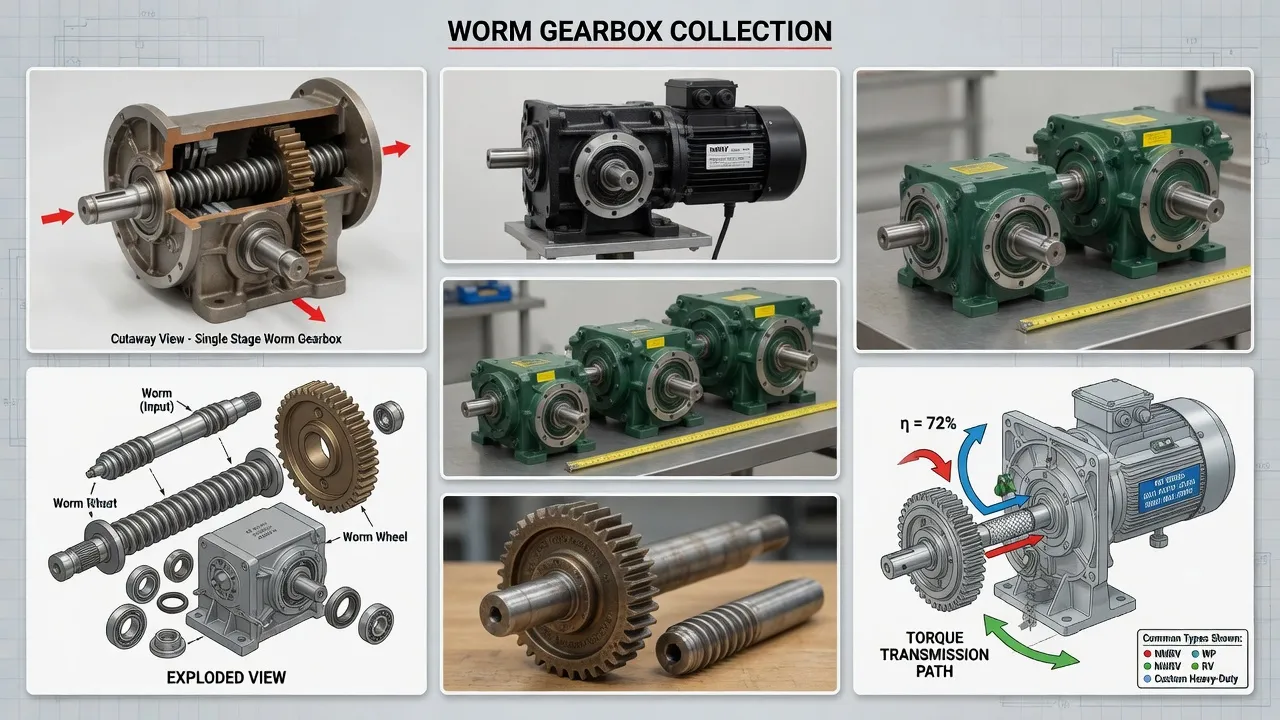
The input interface integrates with the drive motor — typically through a flange-mounted electric motor coupled directly to the worm shaft via shaft coupling or splined shaft connection. Standard motor mounting flanges follow IEC 56-180 frame sizes (European standard) or NEMA 56-365TC frame sizes (North American standard) depending on the regional market. The output interface presents the worm wheel shaft to the driven equipment — typical configurations include solid output shaft (with keyway for coupling to the driven shaft), hollow output shaft (sliding directly over the driven shaft for compact mounting), or output flange (for direct mounting of the driven equipment). The output configuration is specified during the gearbox order based on the driven machine interface requirements.
When You Actually Need a Worm Gear vs a Worm Gearbox
The decision between sourcing bare worm gear pairs versus complete worm gearboxes depends on the engineering depth of your application development team and the volume economics of your production program.
1
Buy Worm Gearboxes For: Standard Industrial Applications
If you’re driving a conveyor belt, mixer, winch, valve actuator, or any standard industrial machine, buy complete worm gearboxes. The engineering integration is already done. You select reduction ratio, output torque, and mounting configuration from a catalog — the manufacturer has already engineered the bearing arrangement, housing rigidity, lubrication system, and seal design. This applies to roughly 95% of industrial worm gear applications.
2
Buy Worm Gear Sets For: Custom Integrated Designs
If you’re designing a machine where the gear pair integrates directly into a custom housing — common in high-volume OEM products where the machine frame doubles as the gear housing — buy bare worm gear pairs. Your engineering team designs the bearing supports, lubrication arrangement, and seal interfaces matching the integrated machine design. This approach saves weight and cost in high-volume production runs (typically above 5,000 units annually) but requires substantial engineering investment.
3
Buy Worm Gear Sets For: Rebuilding Existing Gearboxes
If you’re rebuilding existing gearboxes during scheduled maintenance, you typically order replacement worm gear sets (worm shaft plus worm wheel as matched pair) rather than complete replacement gearboxes. The existing housing, bearings, and seal interfaces remain serviceable — only the gear pair has reached wear limits. This rebuild approach extends gearbox service life by 60-80% versus complete gearbox replacement at substantially lower cost.
4
Buy Worm Gearboxes For: Project Schedule Certainty
Complete gearboxes ship factory-tested with known performance characteristics — output torque, mechanical efficiency, backlash, sound emission. Bare gear pairs require integration engineering, bearing selection, housing design, and qualification testing before reaching equivalent confidence levels. For projects with tight schedule commitments, complete gearboxes eliminate 4-12 weeks of integration engineering and qualification testing time compared to component-level sourcing.
Common Procurement Confusion and How to Avoid It
The confusion between worm gear and worm gearbox terminology generates real procurement problems. The most common issue: an RFQ specifies “worm gears” when the requester actually needs complete gearboxes, leading to quotes for bare gear sets that fall below the project budget but require additional engineering investment to deploy. The opposite confusion also happens: an RFQ specifies “worm gearbox” when the requester needs replacement worm gear sets for an existing rebuild project, leading to over-spec quotes that include components the customer already owns.
The cleanest way to avoid this confusion is to use unambiguous procurement language. When you need the complete unit, specify “complete worm gear reducer assembly” or “worm gearbox with motor mounting flange and oil fill” — leaving no room for interpretation. When you need replacement gear components, specify “worm gear set (worm shaft and worm wheel matched pair)” or “worm gear rebuild kit” — making clear that supporting components are not needed. Including the application context (“for retrofit on existing gearbox model XYZ”) and the components you do versus do not need eliminates 95% of procurement misunderstanding.
Akgnx Co., Ltd offers both complete worm gearboxes and replacement worm gear sets, with the MRV NMRV Standard Worm Gearbox Series serving the largest installed base of complete unit applications and matched component sets available for rebuild orders on the same product line. For helical-hypoid right-angle applications where the geometric efficiency of helical gear meshing serves better than worm geometry, the KM Helical Hypoid Gearbox serves as a complete unit alternative — though importantly, this is not a worm gearbox at all, which highlights another category of confusion in the broader gear reducer market.
Other Gear Terminology Worth Knowing
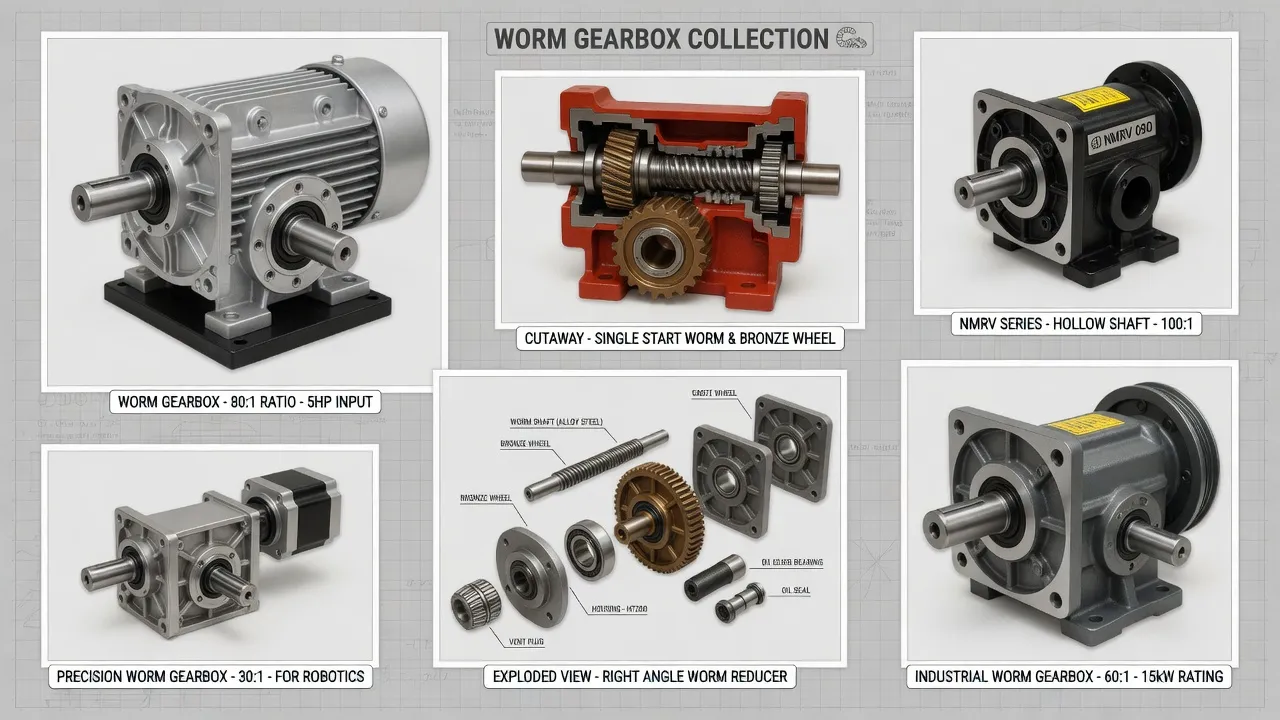
The worm gear / worm gearbox distinction has parallels across the broader gear product family. A helical gear is a component (the gear element with helical tooth profile); a helical gearbox is a complete unit containing helical gear pairs in a housing with bearings and lubrication. A spur gear is a component; a spur gear reducer is a complete unit. A planetary gear is a component (or more precisely, a gear set including sun gear, planet gears, and ring gear); a planetary gearbox is a complete unit. The pattern holds across the gear category: the gear name describes the component, and adding “gearbox” or “reducer” or “speed reducer” or “gear drive” describes the complete assembled unit.
Where this gets confusing in practice: some manufacturers use “gearbox” loosely to describe modular kit packages that may not include all the supporting components of a fully assembled unit. Always verify the actual scope of supply when ordering — confirm whether bearings, seals, lubricant fill, and motor mounting interface are included or quoted separately. Reference worm gear component technical references for detailed information on standalone gear specifications, and reference complete reducer specifications for assembled unit configurations.
Quick Reference: How to Specify Your Order
The table below shows the procurement language that produces clean quotes versus the ambiguous language that creates problems.
| What You Need | Use This Language | Avoid This Language |
|---|---|---|
| Complete ready-to-bolt unit | “Worm gearbox” or “worm gear reducer” or “worm speed reducer assembly” | “Worm gear” alone |
| Replacement gear components | “Worm gear set” or “worm and worm wheel matched pair” or “worm gear rebuild kit” | “Worm gearbox replacement” |
| Worm wheel only | “Worm wheel” or “bronze worm wheel” | “Worm gear” (ambiguous) |
| Worm shaft only | “Worm shaft” or “steel worm” | “Worm gear” (ambiguous) |
| Custom integrated design | “Worm gear pair for integrated housing design” | “Worm gear” alone (need to specify housing exclusion) |
Need Help Sourcing the Right Equipment?
Send your application requirements and we’ll clarify whether you need a complete worm gearbox, a replacement gear set, or a custom-integrated gear pair. We supply both complete units and component-level parts with engineering support.
Frequently Asked Questions
© Akgnx Co., Ltd · About Us · Contact Us · [email protected]