
A worm gearbox catalog page contains 15–20 technical parameters, abbreviations, and footnotes — and getting just one of them wrong (using the mechanical rating where the thermal rating applies, or ignoring the service factor column) leads directly to premature failure, warranty disputes, and unplanned production downtime. This guide decodes every parameter you’ll encounter in a standard NMRV worm gearbox catalog, explains what it means in plain engineering language, flags the five parameters most frequently misread, and shows you exactly how to cross-reference multiple parameters to arrive at a correct and confident specification.
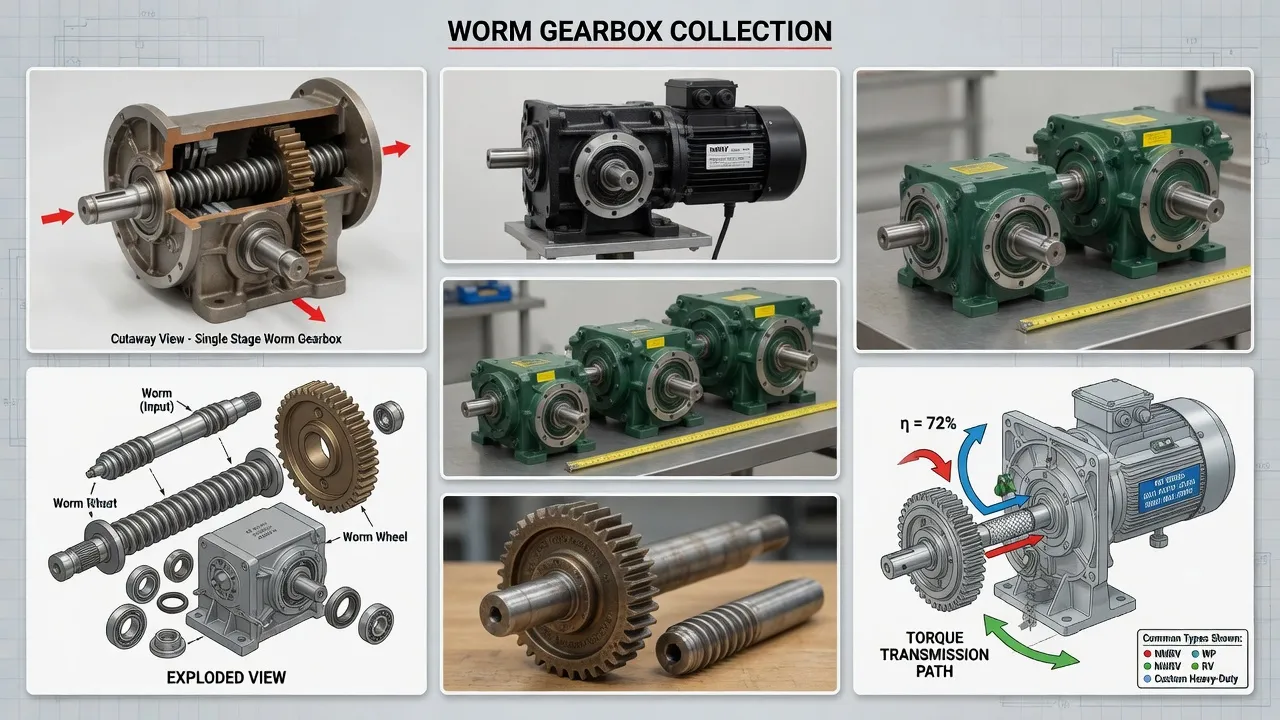
The Catalog Parameter Decoder — All 15 Key Fields Explained
| Symbol / Term | Full Name | What It Means & How to Use It |
|---|---|---|
| i | Reduction ratio | Motor turns ÷ output shaft turns. i = 50 means 50 motor revolutions = 1 output revolution. Governs output speed, self-locking, efficiency, and thermal loading. |
| n₁ | Input (motor) speed | Motor shaft speed in rpm. Catalog ratings are specified at a reference n₁ (usually 1,400 rpm). If your motor runs at a different speed, torque and thermal ratings require adjustment. |
| n₂ | Output speed | n₂ = n₁ / i. The actual output shaft rpm. Verify this matches your required output speed before finalising the selection. |
| M₂ / T₂ | Output torque (mechanical) | Maximum continuous output torque the gearbox can deliver based on gear tooth strength and bearing load capacity. Always compare your service-factor-adjusted required torque against this value. |
| P₁mech | Mechanical input power rating | Maximum input power based on gear and bearing strength. Derived from M₂ and efficiency: P₁ = M₂ × n₂ / (9,550 × η). Rarely the binding constraint at high ratios. |
| P₁therm | Thermal input power rating | ⚠ Most frequently ignored parameter. Maximum continuous input power based on housing heat-dissipation capacity. At ratios ≥40:1, this is almost always lower than P₁mech and is the binding constraint for continuous-duty applications. |
| η (eta) | Transmission efficiency | Percentage of input power delivered to the output shaft. Measured on run-in units at rated load and 40°C oil temperature. New units and cold-start conditions run 4–10% lower. Higher ratio = lower efficiency. |
| Sf | Service factor | Multiplier applied to actual load torque to account for shock loading and duty cycle. Always multiply your actual required torque by Sf before comparing to M₂. Typical values: 1.0 (light uniform) to 2.25 (heavy shock, 24h/day). |
| Fr1 | Input shaft radial load | Maximum radial (sideways) force the input shaft bearings can withstand. Relevant when a belt or chain drives the input shaft directly rather than a motor coupling. Typically 300–800 N for NMRV sizes. |
| Fr2 | Output shaft radial load | Maximum radial force the output shaft bearings can handle at mid-shaft. Critical for belt, chain, and sprocket drives — calculate actual Fr2 from (2 × T₂ / sprocket diameter) × tension factor and verify against catalog value. |
| Fa2 | Output shaft axial load | Maximum axial (along-shaft) force the output shaft bearings can handle. Relevant for helical couplings and drives that generate significant axial thrust. |
| IP rating | Ingress Protection class | Two-digit code: first digit = solid/dust protection (6 = dust-tight), second digit = water protection (5 = water jets, 6 = powerful water jets, 9K = high-pressure high-temperature washdown). IP55 = standard industrial; IP69K = food/pharma washdown. |
| Tamb | Ambient temperature reference | All thermal ratings are given at a reference ambient temperature — usually 20°C or 25°C. For every 10°C above reference, derate P₁therm by approximately 14%. At 40°C ambient, multiply catalog P₁therm by 0.71. |
| Mounting position codes | B3, B5, B6, V1, V5, V6 | Specifies gearbox orientation relative to gravity and the oil fill level required. B3 = horizontal foot-mount (most common); V1 = vertical input-down; V5 = vertical output-up. Each position requires a specific oil-fill volume — see the mounting-position oil table in the catalog. |
| Backlash / play | Output shaft free travel | Angular play at the output shaft when input is held stationary. Standard NMRV: 12–25 arcmin. Precision class (matched pair): <4 arcmin. Relevant for positioning applications — see our precision worm gearbox for servo-indexing applications requiring low backlash. |
The 5 Most Frequently Misread Catalog Parameters
- Using P₁mech instead of P₁therm for continuous-duty sizing: The mechanical rating is almost always higher than the thermal rating at high ratios. A catalog showing P₁mech = 3.2 kW and P₁therm = 1.8 kW at 50:1 means the motor must not exceed 1.8 kW continuous input — not 3.2 kW. Engineers who notice only the mechanical rating and size the motor to 3.0 kW will over-heat the gearbox continuously.
- Ignoring the ambient temperature derating footnote: Most catalogs specify P₁therm at 20°C ambient in a footnote. If your installation is in a hot climate (40°C ambient) or enclosed cabinet (35°C effective ambient), the thermal rating must be derated. Skipping this step is the second most common cause of premature failure in warm-climate installations.
- Comparing required torque directly to M₂ without service factor: The M₂ column in the catalog is the steady-state rated output torque under smooth uniform load. Your application almost never has uniform smooth loading — start-up torques, conveyor jams, agitator viscosity peaks, and reversals all multiply the peak torque. Applying the correct service factor (1.0–2.25) to your required torque before comparing to M₂ is non-optional.
- Assuming efficiency listed is the cold-start value: Catalog efficiency values are always tested on run-in units at 40°C oil temperature. Cold-start efficiency (oil at 10–15°C) is 6–12% lower, and new un-run-in units are 4–8% lower. If you’re sizing a motor for a gearbox that will see cold starts in an unheated outdoor building, use the cold-start efficiency (not the catalog value) for starting-current calculations.
- Misreading the motor flange compatibility: NMRV catalogs list compatible IEC motor frame sizes. IEC 80B14 and IEC 80B5 are different mounting standards — B14 is a smaller face-mount; B5 is the standard circular flange. Ordering an NMRV063 specified for B5 IEC 80 but mounting a B14 motor frame will result in a geometrically incompatible assembly. Always confirm B5 or B14, and confirm the IEC frame number (56, 63, 71, 80, 90, 100…) matches your specific motor.
How to Read the Catalog Ordering Code
Standard NMRV ordering codes follow this structure — knowing the code means you can decode any supplier’s reference number:
Frame / center distance |
Ratio |
Motor flange type |
Mounting position |
IP rating
Additional suffixes commonly seen: /P (precision grade, lower backlash), /SH (stainless steel housing), /HT (high-temperature lubricant fill), /HS (hollow shaft output), /F (flange-only mount, no foot). These suffixes are not fully standardised between manufacturers — always confirm the supplier’s code structure before assuming identical meaning. Our full NMRV worm gearbox catalog documents all available configuration codes in detail. For additional parameter reference across worm gearbox specifications, see the worm gearbox parameter reference.
Worked Example — Reading the Full Catalog Entry for NMRV090-50
A complete catalog entry for NMRV090 at 50:1 ratio (typical entry values):
- i = 50:1 → output speed at 1,400 rpm input = 28 rpm
- M₂ = 640 Nm → maximum output torque (mechanical rating)
- P₁mech = 2.8 kW → maximum input power (mechanical)
- P₁therm = 1.9 kW → maximum continuous input power (thermal, at 20°C) ← this is the binding limit
- η = 72% → efficiency at rated load, run-in, 40°C oil
- Fr2 = 4,200 N → maximum output shaft radial load at mid-shaft
- IP55 → standard protection; IP65 option available
- Weight = 14.5 kg
To verify suitability for an agitator application at 280 Nm required torque, 28 rpm, running 16 h/day (Class II): design torque = 280 × 1.50 = 420 Nm < 640 Nm M₂ ✓. Actual input power = (280 × 28) / (9,550 × 0.72) = 1.14 kW < 1.9 kW P₁therm ✓. Output shaft radial load from coupling: assume 1,200 N < 4,200 N Fr2 ✓. All checks pass — NMRV090-50 is correctly sized for this application.
Frequently Asked Questions
The catalog shows both “rated torque” and “maximum torque” — which do I use?
Use rated (continuous) torque for sizing against service-factor-adjusted load torque — this is the value the gearbox can handle indefinitely. Maximum torque (sometimes also called “peak” or “starting” torque, typically 1.5–2× rated) is the torque the gearbox can handle for short periods (typically 30 seconds to 2 minutes). Use maximum torque to verify the gearbox survives motor starting surges, jam events, or emergency stops — not as the basis for continuous sizing.
What does “C2 = 10,000 h” mean in the catalog?
C₂ or L₁₀ is the bearing L10 life — the number of operating hours at which 10% of identically sized and loaded bearings are statistically expected to fail. C₂ = 10,000 h means 90% of bearings will still be operating at 10,000 hours under the catalog test conditions. It is not the “guaranteed life” — it is a statistical reliability indicator. Actual service life depends on contamination, misalignment, and lubrication quality.
Why are efficiency values sometimes given as a range (e.g., 68–74%)?
The range reflects variation across manufacturing tolerance bands, lubricant types, input speeds, and load levels within the catalog test conditions. The high end (74%) represents optimum conditions (PAO synthetic, run-in unit, 60–80% rated load, 1,400 rpm input). The low end (68%) represents less favourable but within-spec conditions (mineral oil, higher ratio within the cell, slightly below optimal load). Use the midpoint for motor sizing and the low end for thermal budget worst-case calculation.
The catalog says “self-locking when i ≥ 30.” Is this guaranteed?
Self-locking at ratio ≥30:1 is a design property under specified conditions (dry or correctly lubricated worm mesh, room temperature, static load). It is not a guaranteed safety function. Worn worm wheels, wrong lubricant, vibration, or dynamic shock loads can disrupt self-locking in borderline-ratio units. For safety-critical positional hold (lifts, cranes, personnel platforms), a certified fail-safe brake is mandatory regardless of the self-locking ratio specification in the catalog.
Have a Catalog Entry You’re Not Sure How to Interpret?
Send our engineering team the catalog page and your application requirements — we’ll verify the selection is correct across all parameters and flag any thermal, radial load, or service-factor issues before you order.
Non-Standard Catalog Entries — Special Configurations
Beyond the standard NMRV catalog, suppliers offer several non-standard configurations that appear in quotations and need to be decoded:
- Double-input (dual-input) shaft: Input shaft extends from both sides of the housing — allows motor mounting from either end or a hand-wheel on the unused side. Common in manual-override applications like valve actuators and packaging machine changeovers. Note in catalog as “/DI” or “double shaft input.”
- Extended output shaft: Output shaft machined longer than standard to accommodate specific coupling or sprocket geometries without an adaptor. Usually specified with exact shaft length and a second keyway position. Adds setup cost but eliminates an adaptor component from the assembly.
- Tandem (stacked) configuration: Two worm gearboxes mechanically coupled in series for very high ratios — effectively a field-assembled double-reduction unit where standard double-stage units are unavailable in the required torque class. Catalog typically lists the individual unit specifications; the combined ratio and efficiency must be calculated from first principles.
- Right-hand vs left-hand output: Standard worm gearboxes output rotation direction is fixed by the worm helix hand (right-hand or left-hand cut). If your application requires the output shaft to rotate in the opposite direction for a given motor rotation, either specify the opposite helix-hand variant or reverse the motor. Catalog entries typically specify “RH” (right-hand) or “LH” (left-hand) worm — read this carefully when the output rotation direction is critical.
Cross-Referencing Competing Supplier Catalog Data
When comparing NMRV-class worm gearboxes from competing suppliers, three parameters require careful cross-referencing:
- Whether M₂ is rated at 1,400 rpm or at a different reference speed: Some suppliers rate M₂ at 960 rpm (the output speed from a 50:1 gearbox driven by a 6-pole 2-pole motor) — which produces a higher torque number than 1,400 rpm input because the slower input reduces centrifugal oil-flinging losses. A higher M₂ number from a lower reference input speed is not a better gearbox — verify the reference n₁ in the catalog footnotes before comparing.
- Whether thermal rating is at 20°C or a higher ambient: A supplier rating P₁therm at 40°C ambient will show a lower (more conservative) number than one rating at 20°C. Both may be technically accurate for their stated conditions, but the 40°C rating appears less competitive while actually being more honest about hot-climate installations.
- Bronze alloy specification: Standard CuSn12Ni2 is not the same as C93200 “leaded bronze” or CuSn6 tin bronze. Ask for material certificates — the worm wheel alloy is the single biggest quality differentiator in the NMRV class and is rarely mentioned prominently in marketing materials.