
Worm gearbox efficiency is the single most misunderstood performance parameter in gear drive selection — and the source of the most costly misspecifications. Engineers frequently cite “50–90% efficiency” from a catalog footnote without understanding why it varies so dramatically across that range, or what specific design choices and application conditions push it toward 90% vs toward 50%. This article explains the physics of worm gear efficiency from first principles, provides an efficiency table covering the full ratio range with quantified data, and details seven evidence-based methods for improving efficiency in worm gearbox applications.
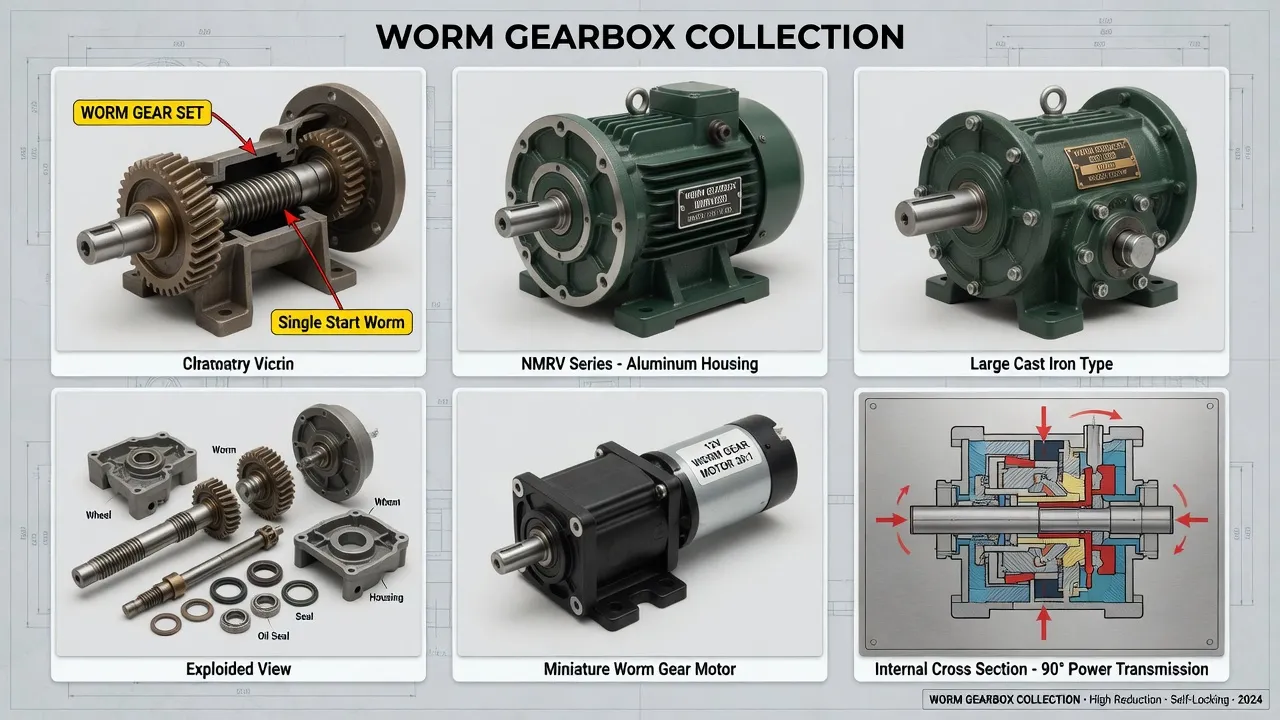
Why Worm Gearbox Efficiency Varies — The Root Physics
Unlike helical or spur gears — which transmit power primarily through rolling contact — worm gears operate predominantly through sliding contact. The worm thread slides across the worm wheel tooth face as the worm rotates. Every meter of sliding contact converts a fraction of the transmitted power into heat through friction. The efficiency equation for a single-stage worm gearbox is:
Where: αn = normal pressure angle (typically 20°), µ = coefficient of friction between worm and wheel, γ = lead angle of the worm
The critical variable is the lead angle γ. Lead angle is the angle between the worm thread and a plane perpendicular to the worm axis — essentially how “steep” the worm thread is. The lead angle is directly related to the reduction ratio:
- At low ratios (5:1–10:1): the worm has multiple starts (threads), producing a large lead angle (15°–25°). Large lead angles mean the thread pushes the wheel teeth with a more favorable force direction — less energy wasted in friction, higher efficiency.
- At high ratios (50:1–100:1): a single-start worm gives a small lead angle (3°–6°). Small lead angles mean the thread presses nearly perpendicular to the wheel face — maximizing tooth-face contact force and friction. More energy wasted, lower efficiency.
This is why efficiency decreases monotonically with increasing reduction ratio — it is a direct physical consequence of the lead angle geometry, not a quality or manufacturing issue. A perfectly made 100:1 worm gearbox will always be less efficient than a perfectly made 10:1 worm gearbox, everything else being equal.
Worm Gearbox Efficiency Table — 5:1 to 100:1 with Real Conditions
The table below consolidates efficiency data from ISO 14521 methodology, experimental data published in Gear Solutions Magazine (Investigations on the Efficiency of Worm Gear Drives, 2016), and manufacturer acceptance test data. Values reflect run-in units at 40°C oil temperature with PAO synthetic lubricant — the most favorable normal operating condition. New units (before run-in) and cold-start conditions run 5–10% lower.
| Ratio (i) | Lead Angle γ (approx.) | Efficiency η — Mineral Oil | Efficiency η — PAO Synthetic | Self-Locking |
|---|---|---|---|---|
| 5:1 | 21°–26° | 86–90% | 89–93% | No |
| 7.5:1 | 18°–22° | 84–88% | 87–91% | No |
| 10:1 | 14°–18° | 80–85% | 84–88% | No |
| 15:1 | 10°–14° | 75–80% | 79–84% | No (borderline) |
| 20:1 | 8°–11° | 72–78% | 76–82% | Borderline |
| 30:1 | 6°–8° | 68–74% | 73–79% | Typically yes |
| 50:1 | 4°–6° | 64–70% | 69–75% | Yes |
| 60:1 | 3.5°–5° | 62–68% | 67–73% | Yes |
| 80:1 | 2.8°–4° | 58–64% | 63–69% | Yes |
| 100:1 | 2.3°–3.5° | 55–61% | 60–67% | Yes |
Data reference: ISO 14521 worm gear load capacity methodology + Gear Solutions Magazine experimental data (2016). Values represent run-in units at 40°C oil temperature, rated load, PAO or mineral oil as specified. Cold-start efficiency is 5–10% lower; new (unrun-in) units are 4–8% lower.
What Affects Efficiency Beyond Ratio — The 5 Variables
Reduction ratio is the dominant variable, but five additional factors explain the spread within each ratio band in the table above. Understanding them gives you the levers to push toward the high end of each efficiency range:
- Lubricant type and viscosity: PAO synthetic lubricants consistently outperform mineral oils by 3–7 percentage points at equivalent conditions. The reason: PAO has a flatter viscosity-temperature curve, maintaining adequate film thickness at operating temperature without the excessive viscosity at cold-start that causes churning losses. Correct viscosity grade matters equally — an oil that is too thick (ISO VG460 in a gearbox rated for VG220) causes churning losses; too thin fails to maintain the EHL film. Follow the manufacturer’s viscosity specification for the operating temperature range.
- Input speed (sliding velocity): Efficiency improves with increasing sliding velocity at the mesh — higher speed reduces the coefficient of friction in the EHL regime. A worm gearbox running at 1,400 rpm input is typically 2–5% more efficient than the same unit running at 700 rpm, because the higher sliding velocity allows a thicker, lower-friction lubricant film to form. Very high speeds (above 3,000 rpm) introduce churning losses that offset the EHL-friction improvement.
- Run-in time: New worm gearboxes are typically 4–8% less efficient than run-in units. The run-in period (typically 50–200 hours at graduated load) allows the worm and wheel surfaces to micro-conform, improving tooth contact pattern and reducing asperity friction. Never test a new unit’s efficiency immediately after installation and assume that represents the steady-state value.
- Load level (percentage of rated torque): Efficiency is typically highest at 60–80% of rated load. At very light loads (below 20% rated), no-load losses (bearing drag, seal friction, lubricant churning) become proportionately large, reducing efficiency. At overload (above 100% rated), tooth-contact stress increases friction at the mesh. Design your application so the gearbox runs at 60–80% of its rated torque for best efficiency.
- Oil temperature: Efficiency increases as oil temperature rises toward 40–60°C operating range, because lubricant viscosity decreases (reducing churning losses). This is why efficiency values in catalogs are specified at a defined oil temperature — usually 40°C or 60°C. Gearboxes that never reach operating temperature (short-cycle intermittent duty) run less efficiently than their catalog specification predicts.
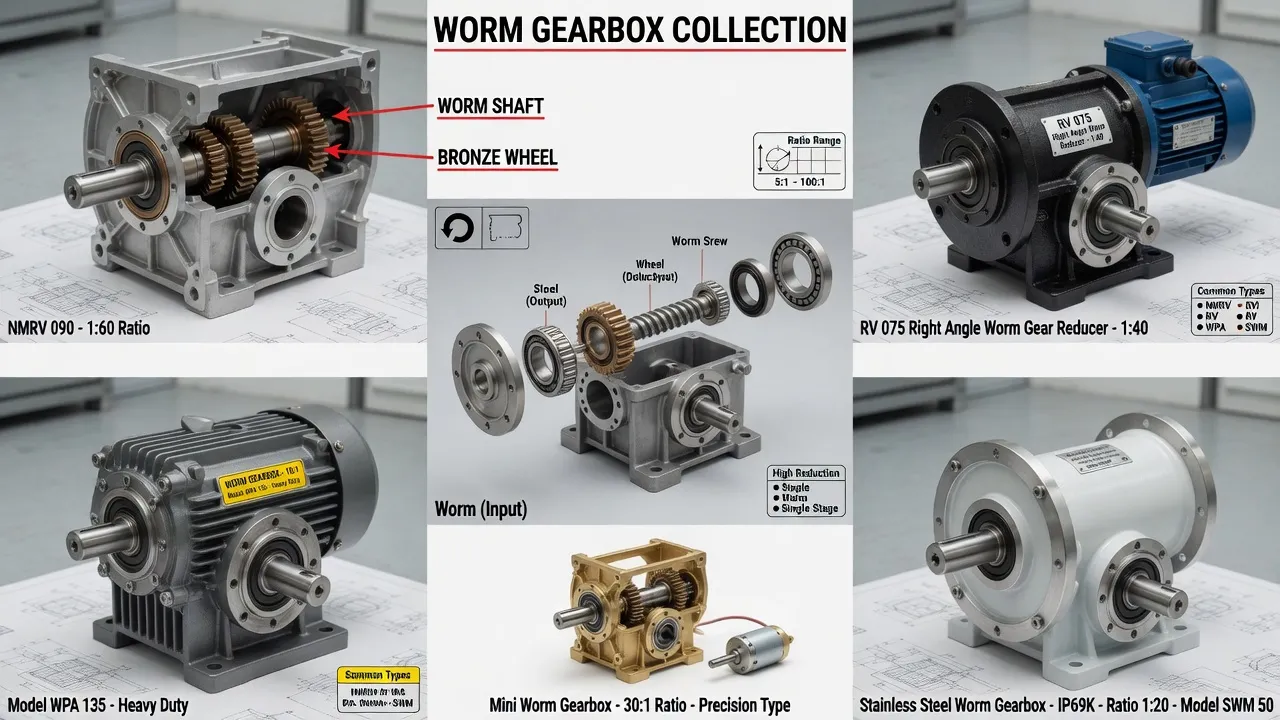
The Run-In Effect — Why Your New Gearbox Runs Hot at First
The run-in phenomenon is unique to worm gearboxes (it is less significant in rolling-contact helical gears) and causes significant confusion in the field. A brand-new worm gearbox will:
- Run 4–8% less efficiently than its catalog specification
- Run noticeably hotter than at steady-state
- Produce a slightly metallic tint in the first oil change lubricant (micro-wear particles from surface bedding)
This is normal and expected. The micro-conformance of the worm thread against the bronze wheel teeth — guided by lapping during manufacturing and completing during field run-in — produces the tooth-contact pattern required for full-load rated efficiency and service life. Many field engineers alarm unnecessarily when they see elevated temperatures in a new gearbox installation; the correct response is to monitor temperature trend over the first 50–100 hours of operation. If temperature stabilizes and declines as the gearbox beds in, the unit is performing normally. If temperature continues to rise after 100 hours, investigate potential sizing, lubrication, or overload issues.
Recommended run-in procedure: start at 25% rated load for the first 4 hours, increase to 50% for the next 8 hours, increase to 75% for the next 16 hours, then verify temperature stability at full rated load. Change the lubricant after the first 200 hours to remove micro-wear particles from the run-in process.
7 Evidence-Based Ways to Improve Worm Gearbox Efficiency
If you have identified efficiency as an issue in your application, here are seven interventions in descending order of impact:
- Switch to PAO synthetic lubricant (3–7% gain): If the unit is running on mineral oil, switching to ISO VG220 PAO synthetic is the single highest-impact, lowest-cost efficiency improvement available. The improved viscosity-temperature profile at operating temperature reduces mesh friction and churning losses simultaneously. ROI is typically 3–8 months on the lubricant cost.
- Reduce the ratio by using a multi-start worm (5–12% gain at high ratios): If the application can tolerate a slightly different output speed, specifying a two- or four-start worm rather than single-start increases the lead angle, directly increasing efficiency. A 2-start worm at 50:1 total ratio (10:1 helical pre-stage + 5:1 worm) runs dramatically more efficiently than a single-start 50:1 worm. This is the design principle behind the helical-worm (S-series) architecture.
- Switch to a helical-worm (S-series) design (8–18% gain): For applications where efficiency has become the primary driver, replace the single-stage worm gearbox with a helical-worm two-stage unit. The helical pre-stage handles the high-speed input at 95–96% efficiency; the worm secondary stage handles the right-angle output at a lower ratio (better efficiency). Combined efficiency 75–88% vs 60–75% for single-stage worm at equivalent overall ratios.
- Ensure correct operating temperature (1–3% gain): If the gearbox never reaches operating temperature (short-cycle intermittent applications), the lubricant viscosity remains high, increasing churning losses. Installing a small oil-bath heater for cold-start applications, or allowing adequate warm-up time before full-load operation, can recover 1–3 percentage points of efficiency.
- Operate at 60–80% rated load (1–4% gain): Very light loads produce proportionally large no-load losses. If the current application is consistently running below 30% of rated torque, the gearbox is oversized. Downsizing to a smaller frame running at a higher percentage of its rated torque will improve efficiency and reduce unit cost simultaneously.
- Specify correct viscosity grade for operating temperature (1–4% gain): Over-viscous lubricant causes churning losses; under-viscous fails the EHL film. If the operating oil temperature is confirmed above 60°C continuously, a lower viscosity grade (VG150 or VG220) reduces churning. If the gearbox runs cold (below 30°C continuously), a higher viscosity grade (VG320) maintains the required film thickness.
- Upgrade worm surface finish to CBN-ground Class 5 (2–5% gain): Standard catalog worm gearboxes typically use ISO 1328 Class 7 worm grinding (Ra 0.4 µm). Upgrading to Class 5 CBN-ground worms (Ra 0.2 µm) reduces the coefficient of friction at the mesh by approximately 8–12%, translating directly to efficiency improvement. This is a production-specification choice at purchase, not a field retrofit.
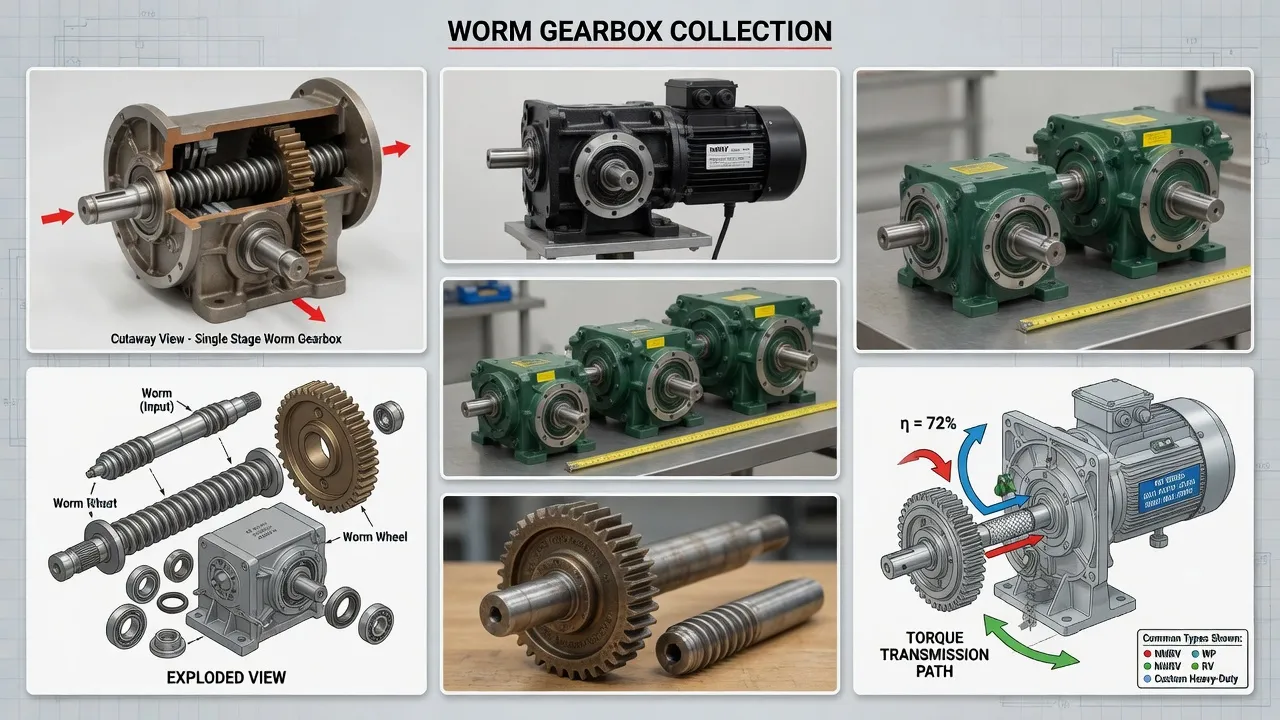
Thermal Power Rating — the Hidden Efficiency Constraint
Every worm gearbox catalog contains two power ratings that engineers frequently confuse: the mechanical power rating (P₁mech) — limited by gear-tooth strength and bearing load — and the thermal power rating (P₁therm) — limited by the gearbox housing’s ability to dissipate the heat generated by friction losses.
At high reduction ratios (50:1–100:1), where efficiency is lowest, the thermal rating is almost always the binding constraint. Consider an NMRV063 gearbox at 80:1 ratio:
- Mechanical rating: 2.8 kW input
- Efficiency at 80:1: 62%
- Heat generated at 2.8 kW input: 2.8 × (1 − 0.62) = 1.06 kW of heat
- Thermal rating (housing surface area × temperature rise limit): typically 0.6–0.9 kW for NMRV063 at 20°C ambient
- Conclusion: the thermal rating limits input power to ~1.6–2.4 kW, well below the mechanical 2.8 kW rating
This is why continuous-duty worm gearbox applications at high ratios are frequently thermally limited — the gearbox must be derated or specified one frame size larger than the mechanical-torque analysis alone would suggest. Always check the thermal power rating from the catalog, especially for 24/7 applications and high ratios above 40:1. Exceeding the thermal rating by 20% continuously for 6 months will degrade the lubricant, carbonize the seals, and soften the bronze worm wheel — typically resulting in premature failure at 2–3 years instead of the expected 8–10 years.
Calculating the Real Energy Cost of a Worm Gearbox — Step by Step
Many engineers select gearboxes on mechanical criteria alone and never calculate the energy cost. Here is the three-step calculation:
- Determine power loss: Ploss = Pinput × (1 − η). Example: 5 kW input at 70% efficiency = 5 × 0.30 = 1.5 kW lost as heat.
- Calculate annual energy waste: Ewaste = Ploss × hours per year. Example: 1.5 kW × 4,000 hours/year = 6,000 kWh/year per drive.
- Convert to cost: Cost = Ewaste × energy tariff. Example: 6,000 kWh × €0.12/kWh = €720/year per drive.
For a plant with 30 similar drives: 30 × €720 = €21,600/year in wasted energy. Over a 7-year gearbox life that is €151,200 in energy cost that a higher-efficiency architecture could have saved — worth comparison against the purchase-price premium of a helical-worm or bevel-helical alternative when you are specifying a new installation.
Frequently Asked Questions
Is 70% worm gearbox efficiency really “bad”?
Context matters. For intermittent-duty, low-power applications (gate openers running 30 minutes/day, packaging machinery running 4 hours/day at 0.37 kW), 70% efficiency costs €15–25/year in energy — economically irrelevant compared to the worm gearbox’s purchase-cost and self-locking advantages. For 24/7 continuous-duty applications at 7.5 kW, 70% efficiency costs €1,000–1,400/year in energy — economically significant. Efficiency matters in proportion to duty cycle and motor power.
Does efficiency change over the gearbox lifetime?
Yes — in two directions. In the first 50–200 hours (run-in), efficiency improves as the worm and wheel surfaces conform. Over the full service life (6–10 years), efficiency gradually decreases as the bronze worm wheel wears, increasing tooth-mesh clearance and reducing the quality of the EHL lubricant film. A gearbox approaching end-of-life typically runs 5–10% less efficiently than a properly run-in mid-life unit, and runs progressively hotter as a consequence.
Can I measure my gearbox’s actual efficiency in the field?
Yes — the indirect thermal method is the most practical. Measure the gearbox’s steady-state housing surface temperature and subtract ambient temperature. A higher-than-expected ΔT indicates lower-than-expected efficiency. A precise direct efficiency measurement requires simultaneous input and output torque/speed instrumentation, which is not typically available in field conditions. Oil temperature monitoring (using a thermocouple or temperature-indicating sticker on the housing near the oil reservoir) gives the most reliable early-warning indication of efficiency degradation before it becomes a failure event.
What is the efficiency of a double-reduction worm gearbox?
A double-reduction worm gearbox has two worm-and-wheel stages in series. Combined efficiency is the product of each stage’s efficiency. If each stage is 70% efficient: 0.70 × 0.70 = 49% overall. For a 400:1 double-reduction unit (20:1 × 20:1 in two stages), expect 45–55% overall efficiency. For ratio requirements above 100:1, always evaluate whether a double-reduction worm, a helical-worm combination, or a worm-planetary combination offers the best efficiency-cost balance for your duty cycle.
Need a Worm Gearbox With the Best Efficiency for Your Duty Cycle?
Share your application duty cycle, ratio, input power, and daily operating hours — our engineers will recommend the most energy-efficient specification (standard worm, helical-worm, or alternative architecture) with a total-cost-of-ownership analysis.