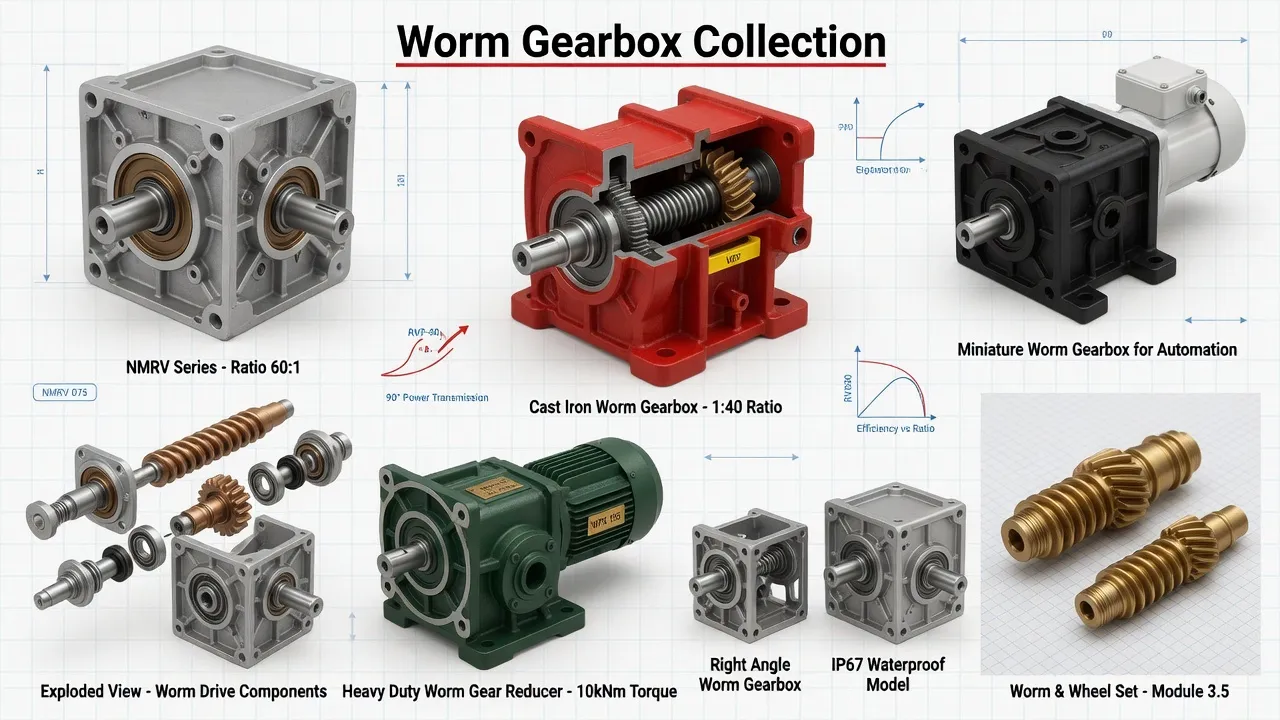
Worm gearbox backlash — the angular free play at the output shaft when the input is held stationary — is the most frequently asked-about parameter in precision and servo applications. Engineers designing positioning tables, robotic joints, cobot wrist axes, or servo-indexing equipment all eventually ask: “How much backlash should I accept, and what can I do to reduce it?” The answer requires understanding what backlash is, how it is measured, what causes it to vary across a production run, what change in end-of-arm positioning accuracy it produces, and which specification paths lead to <4 arcmin. This guide covers all five questions with the quantitative detail that enables a confident specification decision.
What Is Backlash — The Engineering Definition
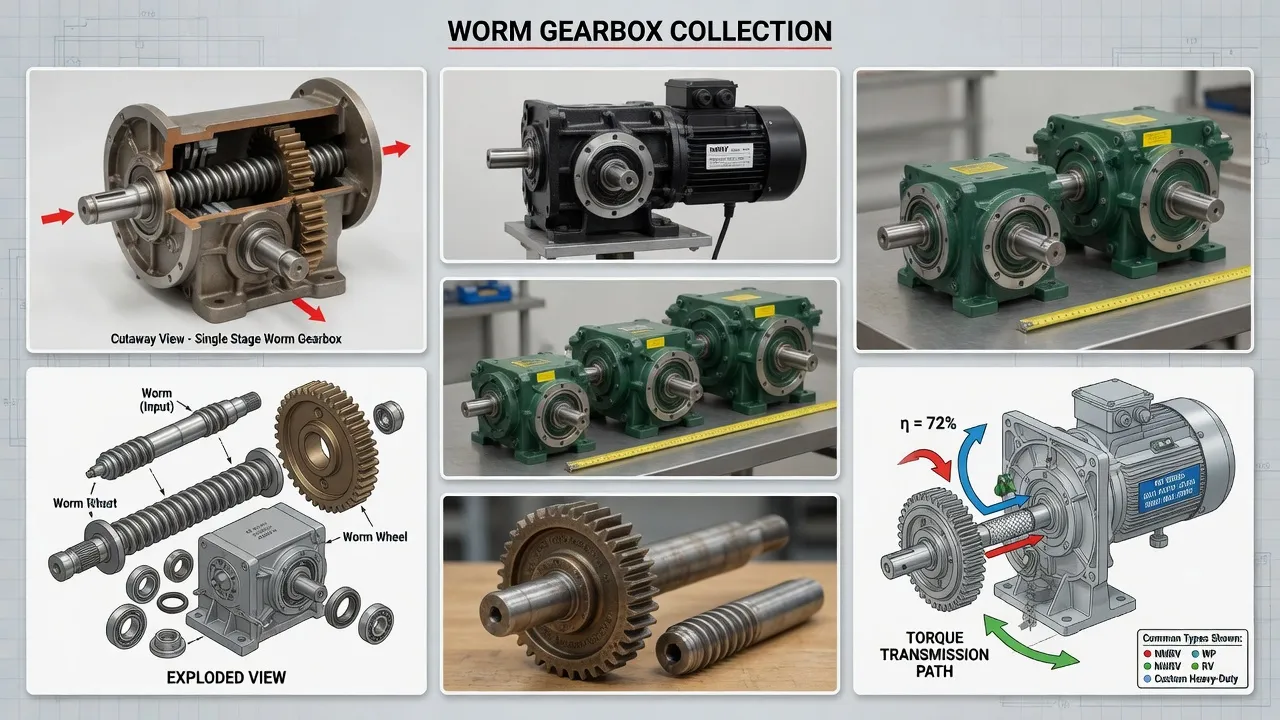
In a worm gearbox, backlash is the angular movement of the output shaft that occurs when the drive direction is reversed, before the gears re-engage and torque is again transmitted. It is measured by holding the input shaft stationary and rotating the output shaft in both directions — the total angular travel before the gears pick up in each direction is the backlash.
Backlash exists because of two design requirements that pull in opposite directions:
- Thermal expansion clearance: The worm and wheel mesh must have enough clearance (backlash) to accommodate differential thermal expansion between the steel worm and bronze wheel as the gearbox heats up from cold start to operating temperature. Without this clearance, a tight-mesh cold-start unit would seize under operating temperature thermal expansion.
- Manufacturing tolerance accumulation: Worm pitch, lead angle, wheel tooth spacing, and center distance all carry manufacturing tolerances. The backlash in any given unit is the sum of the clearances introduced by all these tolerances in their worst-case stacking direction.
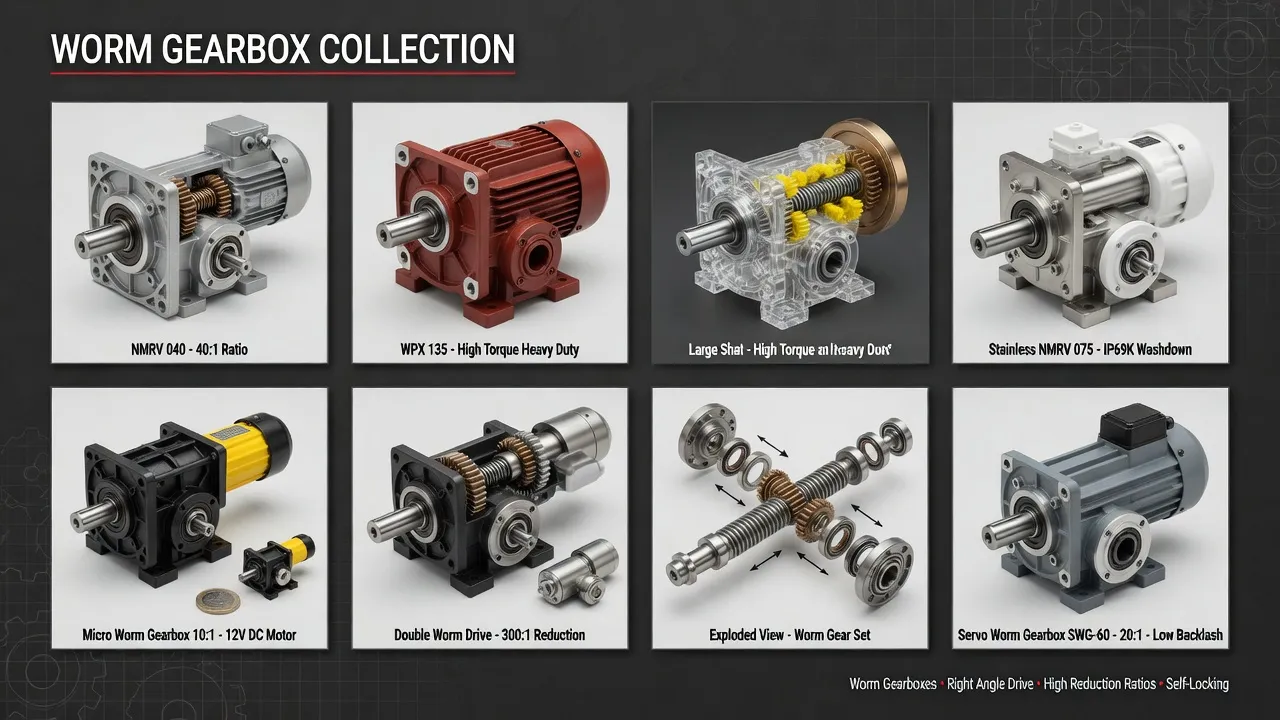
The result: standard catalog NMRV worm gearboxes carry 12–25 arcmin backlash at the output shaft — primarily reflecting the normal manufacturing tolerance distribution on worm pitch and tooth spacing. Precision-grade units with matched worm-and-wheel pairs achieve <4 arcmin by selecting pairs from the tight end of the production tolerance distribution.
How to Measure Backlash — Field Procedure
The standard field measurement method requires only a dial gauge and a measurement radius arm:
- Hold the input shaft stationary: Apply a locking device to the input shaft, or energize the motor with the brake applied if an electromagnetic brake is fitted. The input must be completely immobile during the measurement.
- Mount a dial gauge at a known radius from the output shaft centreline: Attach a dial gauge to a measurement fixture on the machine frame, with the gauge plunger contacting the output shaft or a disc mounted on the output shaft. Record the distance from gauge contact point to output shaft centreline — this is the measurement radius (r).
- Rotate the output shaft in one direction until the drive mesh picks up: Apply a small torque (typically 10–20% of rated torque) to pre-load the mesh in one direction. Zero the dial gauge at this position.
- Reverse the output rotation until the mesh picks up in the other direction: Apply the same small torque in the opposite direction. Record the dial gauge reading — this is the linear backlash (d) at the measurement radius.
- Convert to angular backlash: Angular backlash (in arcmin) = arctan(d / r) × (180/π) × 60. Example: d = 0.18 mm, r = 50 mm → angular backlash = arctan(0.18/50) × (180/π) × 60 = arctan(0.0036) × 3,438 arcmin = 0.206° × 60 = 12.4 arcmin.
| Dial Reading d (mm) | Radius r = 30 mm | Radius r = 50 mm | Radius r = 100 mm |
|---|---|---|---|
| 0.05 mm | 5.7 arcmin | 3.4 arcmin | 1.7 arcmin |
| 0.10 mm | 11.5 arcmin | 6.9 arcmin | 3.4 arcmin |
| 0.20 mm | 22.9 arcmin | 13.8 arcmin | 6.9 arcmin |
| 0.35 mm | 40 arcmin | 24 arcmin | 12 arcmin |
Acceptable Backlash Limits by Application Type
| Application Type | Backlash Limit | Gearbox Grade | Notes |
|---|---|---|---|
| Conveyors, agitators, fans | Any (12–25 arcmin) | Standard catalog | Backlash does not affect conveyor or mixer performance |
| Gate openers, solar trackers | Up to 25 arcmin | Standard catalog | Position hold is by self-lock, not zero backlash |
| Packaging machinery indexing | ≤15 arcmin | Standard – tight selection | Repeatability ±0.5–1 mm at typical arm length |
| Servo-indexing tables | ≤8 arcmin | Semi-precision | Closed-loop servo can compensate ≤8 arcmin in most cases |
| Cobot proximal joints (J1–J4) | ≤4 arcmin | Precision (matched pair) | ±0.1 mm at 300 mm arm radius |
| Precision positioning stages | ≤3 arcmin | High-precision (P4 bearings) | Worm approaching limit — consider cycloidal/harmonic below 3 arcmin |
How to Reduce Worm Gearbox Backlash — Four Methods
- Matched-pair selection (the primary method, achieves <4 arcmin): Every batch of worm gearboxes has a backlash distribution — typically 12–25 arcmin at standard grade. Precision-grade units are selected from the tightest 5–10% of the production distribution. The worm screw and wheel are tested as a matched pair, with the pair’s measured backlash certified and documented. Our precision low-backlash worm gearbox uses this matched-pair selection process to achieve certified <4 arcmin.
- Adjustable worm center distance (reduces backlash in field, achieves <8 arcmin): Some precision worm gearbox designs allow the worm shaft to be displaced slightly toward the wheel via an adjusting mechanism — reducing the worm-to-wheel mesh clearance and thus the backlash. This adjustment compensates for production tolerance variation and for field backlash increase from wear. Maximum useful adjustment is approximately 50% reduction from the as-shipped backlash.
- Preloaded dual worm gear (eliminates backlash, not commercially standard): Two worm wheels in mesh with the same worm, preloaded against each other in opposite rotational directions — effectively zero backlash. Complex to manufacture, expensive, and introduces preload-related friction losses. Used in military and space applications; not commercially available in standard NMRV format.
- Servo algorithm compensation (reduces apparent backlash for closed-loop applications): For servo-driven axes, the servo controller can compensate for backlash by applying a small pre-move in the direction of motion before each positioning move — taking up the backlash before the servo closes the position loop. Effective for backlash up to ~10 arcmin in typical servo configurations. Does not reduce mechanical backlash; reduces its effect on positioning accuracy.
Backlash vs End-of-Arm Accuracy — The Quantitative Impact
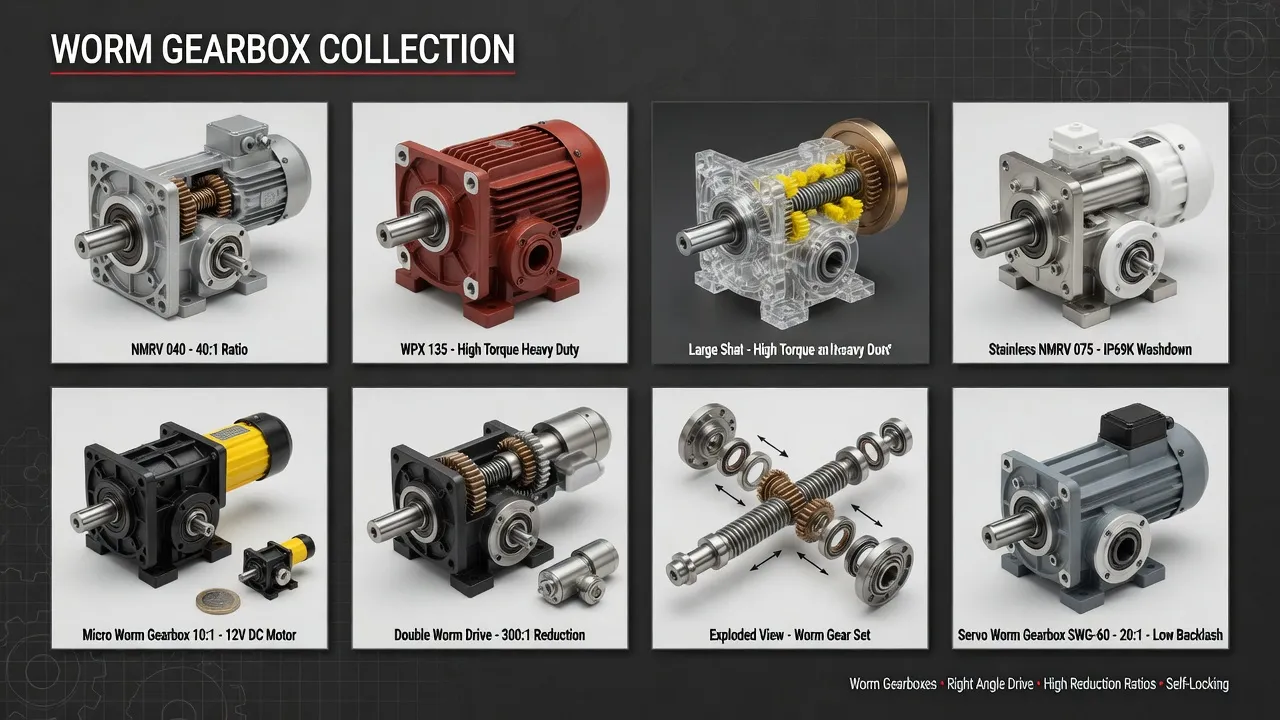
The linear positioning error at a given radius from the gearbox output shaft due to backlash is:
For practical quick estimation: Δ ≈ r × backlash(arcmin) / 3,438 (valid for small angles).
| Backlash | Δ at r = 50 mm | Δ at r = 200 mm | Δ at r = 500 mm |
|---|---|---|---|
| 25 arcmin (standard) | 0.36 mm | 1.45 mm | 3.6 mm |
| 12 arcmin (standard tight) | 0.17 mm | 0.70 mm | 1.75 mm |
| 6 arcmin (semi-precision) | 0.09 mm | 0.35 mm | 0.87 mm |
| 4 arcmin (precision matched) | 0.06 mm | 0.23 mm | 0.58 mm |
This table reveals that backlash matters most at long arm radii. For a short-radius SCARA Z-axis at 50 mm: even 12 arcmin standard backlash gives only 0.17 mm positioning error — acceptable for most industrial automation. For a cobot arm at 500 mm radius: 25 arcmin standard backlash gives 3.6 mm error — clearly unacceptable. Precision worm at 4 arcmin gives 0.58 mm at 500 mm — borderline for ±0.5 mm spec requirements. For the VRV030 precision specification covering servo and cobot applications, see our VRV030 precision worm gearbox. For the full worm gearbox precision specification reference, see the worm gearbox precision engineering reference.
Frequently Asked Questions
Does backlash increase over the service life?
Yes — as the bronze worm wheel wears, the tooth-face clearance increases, growing the backlash. A gearbox commissioned at 14 arcmin may reach 28–35 arcmin by the time the worm wheel requires replacement. This is the primary reason backlash measurement is the most useful field indicator of worm-wheel wear remaining. Document the commissioned backlash value and monitor trend — schedule worm-wheel replacement when backlash reaches 2× the commissioned value.
Is zero backlash achievable in a worm gearbox?
Not in a standard worm gearbox design — some clearance is required for thermal expansion and adequate lubrication film between worm and wheel. The lowest practical backlash in a production worm gearbox is approximately 2–3 arcmin, achievable with Class P4 bearings, CBN-ground worm to ISO 1328 Class 4, and individual matched-pair selection from the tightest production tolerance band. Below 2–3 arcmin, worm gearboxes become uncompetitive with harmonic drives and cycloidal reducers on backlash specification — the practical lower limit of standard worm technology.
Can backlash be reduced by tightening the worm-to-wheel center distance in the field?
Only on gearboxes designed with an adjustable worm shaft position — a feature found in some precision-grade worm gearboxes (eccentric bearing seat adjustment) but not in standard NMRV designs. On standard NMRV housings, the worm shaft bearing seats are fixed — there is no field adjustment available. Attempting to shift the worm shaft closer to the wheel in a non-adjustable design requires machining the housing, which is not a field-practical repair.
Does self-locking and backlash interact?
Yes — but in different dimensions. Backlash is the angular free play before the gears engage; self-locking is the resistance to back-drive once engaged. A high-backlash unit can still self-lock reliably — the backlash represents the free travel before the load is picked up by the gear mesh, at which point the self-locking geometry takes over. In positioning applications, the backlash shows as a positioning deadband on direction reversal even in self-locking units — the output “coasts” through the backlash angle before the mesh re-engages.
Need a Worm Gearbox With Certified Low Backlash for Your Positioning Application?
Tell our precision-drive team your required backlash limit, torque, duty cycle, and application radius — we’ll specify the correct precision matched-pair grade with certified backlash documentation.
Backlash vs Repeatability vs Accuracy — The Three Terms Decoded
Engineers often use backlash, repeatability, and accuracy interchangeably — but they measure different things:
- Backlash: The angular free play in the gear mesh — how far the output shaft moves before the gears re-engage on direction reversal. A direct property of the mechanical clearance in the worm-wheel mesh.
- Repeatability: The ability to return to the same position from the same approach direction and speed, measured over multiple identical cycles. A closed-loop servo system approaching from the same direction can achieve repeatability significantly better than the backlash value — because the servo loop compensates for the consistent mechanical response. Typical worm gearbox repeatability in a servo system: 1.5–2× better than the backlash value.
- Accuracy (absolute positioning): The ability to reach any commanded position from any starting point with the specified error. Affected by backlash (particularly on direction-reversal moves), gear pitch error, thermal expansion, and encoder resolution. Typical absolute accuracy of a worm gearbox servo axis: 2–5× worse than the backlash value due to accumulated gear pitch and mounting errors.
Practical implication for cobot and servo design: if your application spec says “±0.1 mm repeatability at 200 mm arm radius,” you need an axis backlash of approximately 0.1 / (200/3,438) = 1.7 arcmin — which means precision worm at <4 arcmin will achieve this repeatability spec when the servo approaches from a consistent direction. If the spec says “±0.1 mm absolute accuracy at 200 mm arm radius,” you need 1.7 arcmin absolute accuracy — which is tighter than standard precision worm can reliably deliver. Know which metric your specification actually requires.