
“Worm gearbox or planetary?” is one of the most debated architecture questions in servo, automation, and robotics drive design. Both deliver high reduction ratios in compact packages. Both are available from 5:1 to 100:1+ in single or multi-stage configurations. Yet they are built on fundamentally different operating principles — and those differences make each architecture clearly superior in specific application contexts. This article cuts through the noise with a direct data-driven comparison across every criterion that matters to automation engineers: efficiency, backlash, self-locking, noise, back-drivability, cost, and service life.
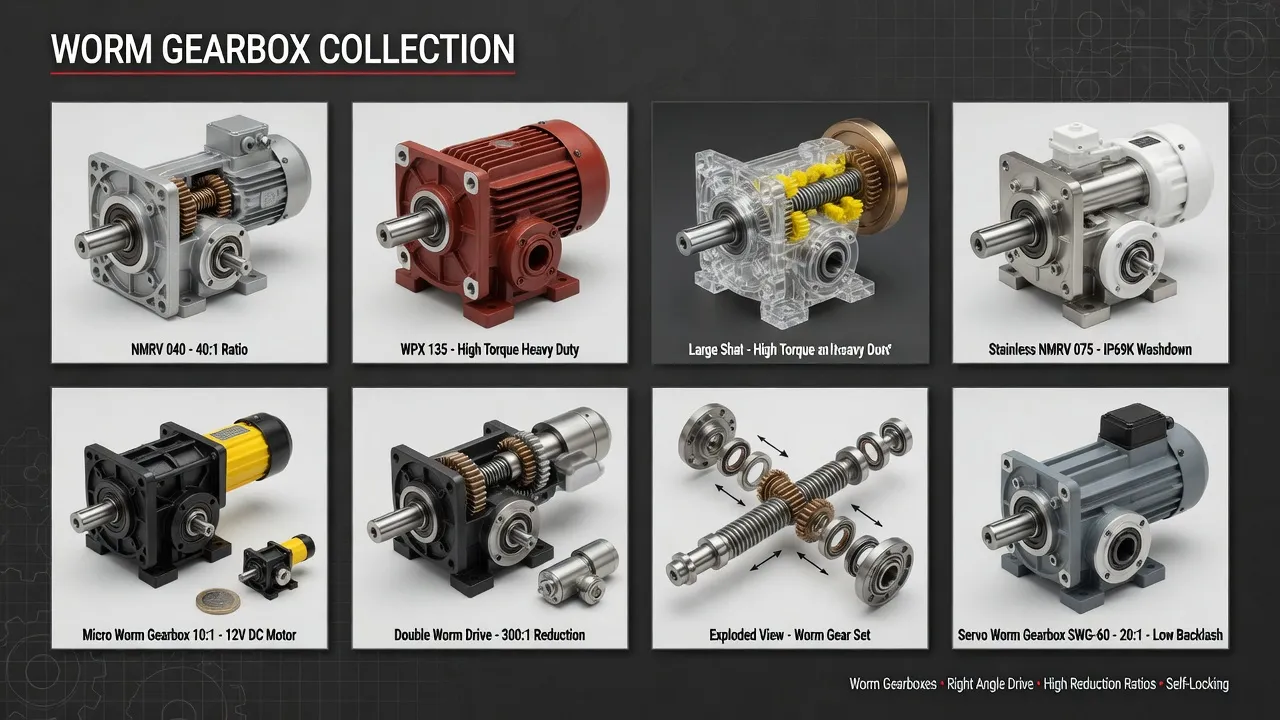
How Each Architecture Works — The Physical Difference
A worm gearbox transmits power through a threaded worm shaft meshing with a bronze worm wheel at 90°. The dominant contact mode is sliding — producing quiet operation, self-locking capability at high ratios, and a right-angle output geometry, but lower efficiency (60–85%) than rolling-contact alternatives.
A planetary gearbox uses a central sun gear driving multiple planet gears that orbit within a fixed ring gear. All contact is rolling — producing high efficiency (94–97%), high torque density, and concentric coaxial output, but no self-locking capability and requiring an electromagnetic brake for any hold-load function.
Head-to-Head Comparison Table
| Criterion | Worm Gearbox | Planetary Gearbox |
|---|---|---|
| Efficiency (50:1) | 68–74% | 94–96% |
| Self-locking hold | Yes (≥30:1) | No — needs brake |
| Backlash | 10–25 arcmin (std) / <4 arcmin (precision) | <1–5 arcmin |
| Shaft layout | Right-angle 90° | Inline coaxial |
| Noise level | 55–62 dB | 60–70 dB |
| Back-drivability | Not back-drivable (≥30:1) | Fully back-drivable |
| Single-stage ratio range | 5:1–100:1 | 3:1–10:1 per stage |
| Unit cost (equiv. torque) | Lowest | 3–6× worm |
| Torque density | Moderate | Very high |
| Heat generation | High (25–40% of input) | Low (3–6% of input) |
Efficiency — The Largest Performance Gap
At 50:1 ratio, a planetary gearbox runs at 94–96% efficiency vs 68–74% for a worm gearbox. For a 5.5 kW servo drive running 4,000 hours per year, that gap costs €1,155/year per axis in wasted energy at €0.12/kWh. In a 30-axis robotic assembly cell, that’s €34,650/year — dwarfing the planetary’s purchase-price premium over typical 3–5 year ROI horizons.
However: this matters primarily for continuous-duty applications. A gate opener running 20 minutes per day consumes so little energy that efficiency difference amounts to less than €5/year per drive — economically irrelevant. Always calculate actual annual energy cost before letting efficiency drive architecture selection.
Self-Locking vs Back-Drivability — Opposite Requirements
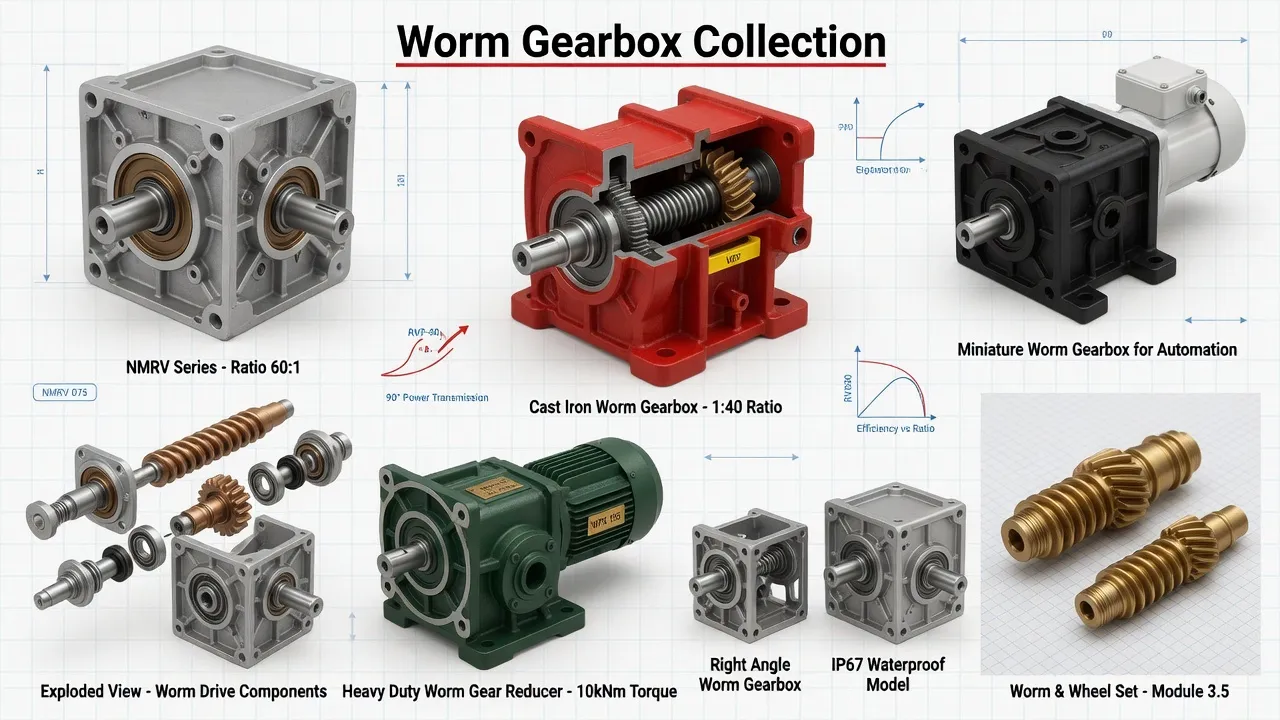
This is the most decisive application-level difference. Worm gearboxes at ratios ≥30:1 self-lock — the output shaft cannot be back-driven by load when the motor de-energizes. Planetary gearboxes are fully back-drivable at any ratio — the output shaft moves freely when load is applied and the motor is off.
- Self-locking is required: Gate drives, vertical lifts (with supplementary safety brake), battery-powered pallet jacks, solar tracker drives. Worm gearbox wins — planetary requires a brake module adding €80–€280 per axis plus cabling and failure-mode complexity.
- Back-drivability is required: Collaborative robot joints in gravity-compensation mode, force-controlled assembly axes, backdrive-teaching modes on cobots. Planetary wins — worm cannot be back-driven and is structurally unsuitable for these applications.
- Neither matters: Standard servo positioning (motor always powered during movement, encoder closes the loop) — both architectures work; efficiency and cost become the deciding factors.
Our precision worm gearbox for robotics covers the self-locking collaborative-robot application in detail — including the specific backlash and repeatability specifications achievable in worm-architecture cobot wrist joints.
Backlash — Where Planetary Has a Structural Advantage
Standard planetary gearboxes carry 3–8 arcmin backlash; precision-grade planetary gearboxes reach <1 arcmin. Standard worm gearboxes carry 12–25 arcmin; precision worm gearboxes reach <4 arcmin (matched-pair selected). The planetary’s rolling-contact mesh geometry produces lower backlash at equivalent manufacturing cost.
For positioning applications requiring ±0.05 mm end-of-arm repeatability or tighter, standard planetary is the preferred specification. For applications tolerating ±0.1–0.5 mm, precision worm gearboxes close the gap while costing 30–50% less than precision planetary alternatives. For applications tolerating ±1 mm or more (typical conveyor positioning, gate drives, solar trackers), backlash is not the governing criterion — cost, self-locking, or efficiency dominate the decision.
Cost — The Most Misunderstood Factor
At equivalent torque output, a precision planetary gearbox typically costs 3–6× a standard worm gearbox and 1.5–3× a precision worm gearbox. Purchase-price comparison alone rarely tells the complete story:
| Cost Factor | Worm Gearbox | Planetary Gearbox |
|---|---|---|
| Purchase price (100 Nm, 50:1) | ~$45 | ~$220 |
| Brake module (if required) | $0 (self-locks) | +$80–$280 |
| Annual energy cost (5 kW, 4,000 h/yr) | ~$1,080 | ~$150 |
| 5-year total cost (with brake on planetary) | $5,445 | $1,450 |
| 5-year total cost (no brake needed) | $5,445 | $1,250 (no brake) |
For continuous-duty servo applications above 2.2 kW, planetary almost always wins on 5-year TCO despite its higher purchase price. For intermittent-duty applications below 2 hours/day, the worm gearbox’s purchase-cost advantage is rarely recovered by energy savings — especially when the self-locking eliminates the brake module cost. For detailed selection guidance, the worm gearbox selection guide covers the full architecture-decision methodology.
The 5-Question Decision Framework
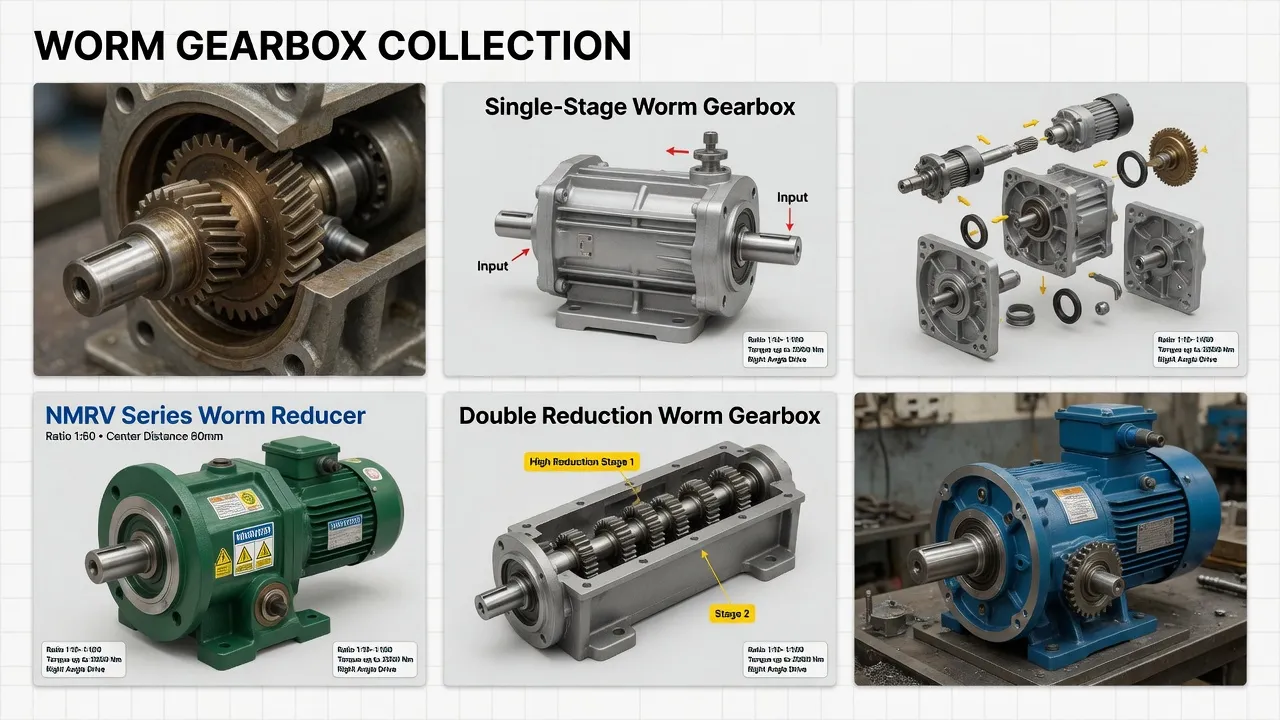
- Is right-angle 90° shaft offset needed? Yes → worm gearbox (planetary is inline coaxial).
- Is self-locking load-hold required without a brake? Yes → worm gearbox at ratio ≥30:1.
- Is the application running more than 4 hours/day above 2.2 kW? Yes → calculate planetary TCO; it usually wins on energy. No → worm gearbox purchase cost advantage is hard to overcome.
- Is back-drivability needed (cobot teaching, gravity compensation)? Yes → planetary only; worm gearbox is structurally unsuitable.
- Is backlash below 3 arcmin required? Yes → precision planetary is typically more cost-effective than matched-pair precision worm at equivalent backlash.
Frequently Asked Questions
Can a planetary gearbox replace a worm gearbox in a gate opener?
Mechanically yes, but it requires a fail-safe spring-applied brake module to hold the gate when power is removed. The brake adds €100–€300, cabling complexity, and a failure mode that must be analyzed in safety-related systems. For residential and commercial gate openers, the worm gearbox’s native self-locking makes it the structurally preferred specification.
Which runs quieter — worm or planetary?
Worm gearboxes run quieter at equivalent input speed — typically 55–62 dB vs 60–70 dB for planetary. The sliding-contact worm mesh produces no tooth-impulse vibration audible at the operator station; planetary tooth-pulse creates audible gear noise particularly at higher speeds. For cobot installations in office-adjacent or laboratory environments, the worm gearbox’s acoustic profile can be a meaningful selection factor.
Does a worm gearbox work in servo systems?
Yes — precision worm gearboxes (matched-pair selected, <4 arcmin backlash) are used in servo-driven cobot wrist joints, SCARA robot axes, and servo-indexing tables at 30–50% the cost of equivalent precision planetary. The application fit requires: self-locking acceptable or desired, right-angle output preferred, and positioning accuracy requirement compatible with <4 arcmin backlash (typically ±0.05–0.1 mm at typical robot arm lengths).
Which lasts longer — worm or planetary?
Both achieve 20,000–30,000 service hours when correctly sized and maintained. Worm gearboxes have a softer failure mode (gradual bronze wheel wear producing increasing backlash before failure); planetary gearboxes have harder failure modes (bearing fatigue, gear tooth pitting) with less forewarning. In continuous-duty high-power applications, planetary’s lower heat generation extends lubricant life and reduces seal degradation, giving it a practical service-life advantage over worm in those specific conditions.
Not Sure Which Architecture Fits Your Application?
Send our engineers your duty cycle, torque/speed, back-drive or self-lock requirement, and budget — we’ll return an architecture recommendation with TCO comparison within one business day.
Noise & Heat — Two Often-Overlooked Differentiators
Worm gearboxes run at 55–62 dB at 1 m; planetary gearboxes at 60–70 dB. The 6–10 dB gap is perceptible to the human ear as roughly twice as loud. For collaborative robot cells adjacent to operator workstations, food-retail dispensing equipment, medical imaging gantries, and lab automation, this acoustic advantage is a meaningful specification factor. The worm mesh’s sliding contact produces no tooth-impulse vibration at the gear-mesh frequency; planetary tooth-pulse creates audible gear noise particularly above 1,000 rpm input.
Heat generation tells the inverse story. At 50:1 ratio and 3 kW input: worm gearbox generates approximately 0.84 kW as heat (72% efficiency); planetary generates approximately 0.12 kW (96% efficiency). The worm’s higher heat output increases lubricant oxidation rate, accelerates seal degradation, and requires thermal power rating to be checked against catalog limits — none of which applies to planetary at equivalent absorbed loads.
Application Sectors — Real-World Specification Patterns
In practice, the most effective industrial drive systems use each architecture where it structurally fits:
- Worm gearbox specifications: Gate openers, solar trackers, pallet jack lift axes, door operators, food machinery right-angle drives, packaging machine indexing, laboratory automation quiet-ambient drives, conveyor tail-drive auxiliaries, textile machine auxiliary drives.
- Planetary gearbox specifications: Machine tool servo axes, high-speed pick-and-place servo axes requiring back-drivability in teach mode, inline conveyor head-pulley efficiency-critical drives, pump and fan servo drives requiring maximum efficiency at continuous duty, AGV/AMR high-cycle traction drives.
- Precision worm used in robotics: Cobot proximal joint (J1–J4) where accuracy is ±0.1–0.3 mm and self-locking reduces brake-module BOM cost — a design pattern growing rapidly in mid-tier collaborative robot products. Our planetary gearbox range covers the precision cobot-drive specification where back-drivability or sub-3-arcmin backlash is required.
Maintenance & Service Life Comparison
Both architectures target 20,000–30,000 service hours when correctly sized and lubricated. The failure modes and maintenance patterns differ:
- Worm gearbox: Bronze worm wheel wears gradually — increasing backlash is the field indicator. Service involves oil change at 8,000 hours, annual seal inspection, and bronze wheel replacement at 6–10 years. Sealed-for-life configurations require no scheduled service for the equipment design life. Failure is gradual with ample forewarning.
- Planetary gearbox: Rolling-element bearings and carburized-steel gears — very long service life under rated load. Oil change at 8,000 hours. Failure modes are bearing fatigue (harder to detect by simple backlash measurement) and gear tooth pitting. Condition monitoring through vibration analysis or oil sampling is recommended for critical planetary installations.