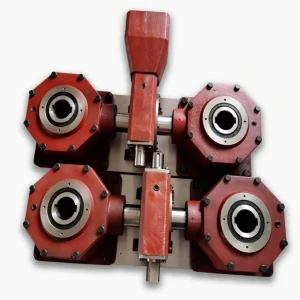
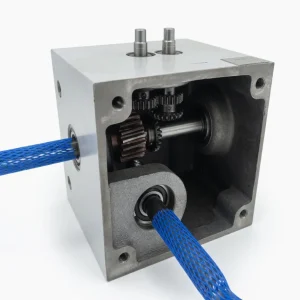
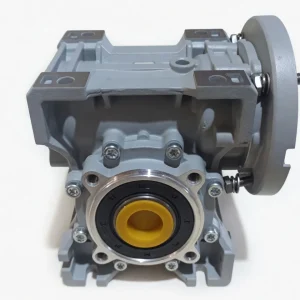
Description
A modern collaborative robot wrist joint executes 3.5–6.0 million reversal cycles across its 8–10 year service life, with positional repeatability requirements of ±0.05 mm at the tool flange. Achieving that repeatability through the kinematic chain requires every joint reducer to maintain backlash below 8 arcminutes — tight enough to keep cumulative end-of-arm positioning errors within tolerance. The VRV030 precision worm gearbox is engineered for this duty: 30 mm center distance, 25 Nm continuous output torque, ratios 5:1 to 100:1, with backlash specifications selectable at <8 arcmin (standard precision) or <4 arcmin (selected-pair class) for joints where positioning tolerance is most critical.
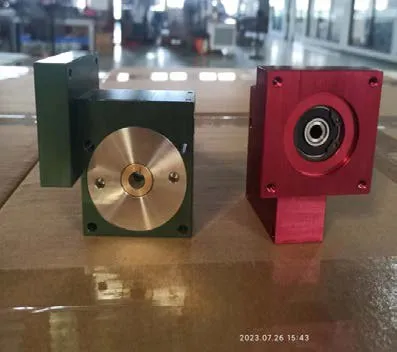
Key Specifications & Parameters of the VRV030 Precision Worm Gearbox
The VRV030 follows the standard NMRV030 mounting envelope but with three precision-class manufacturing upgrades: ISO 1328 Class 5 worm-screw grinding (vs Class 7 standard), backlash-selected gear pairs, and tapered roller bearings preloaded to a tighter axial-play specification. Ratings reference 1,400 rpm input speed under ISO 14521 worm gear load capacity methodology.
| Parameter | Value | Note |
|---|---|---|
| Center distance | 30 mm | NMRV030 standard envelope |
| Continuous torque | 25 Nm | Cobot wrist / joint duty |
| Peak (transient) torque | 42 Nm | Emergency-stop load |
| Reduction ratio range | 5:1 – 100:1 | 30:1 & 50:1 most common in robotics |
| Backlash — standard | <8 arcmin | Class 5 grinding + matched pair |
| Backlash — precision class | <4 arcmin | Selected-pair, post-lap measured |
| Repeatability | ±15 arcsec | Per ISO 9283 measurement |
| Total weight | 1.4 kg | Aluminum housing |
| Sound level | <55 dB at 1 m | Cobot office-environment compatible |
| Output bore | Ø14 mm | Solid or hollow-shaft |
| Servo motor compatibility | NEMA 23 / IEC 63B5 | Direct flange mount |
| Cycle endurance | ≥5 million cycles | Backlash growth <25% |
What Is a Precision Worm Gearbox for Industrial Robots?
A precision worm gearbox for industrial robots is a single-stage right-angle worm reducer manufactured to backlash specifications tight enough that cumulative joint position errors stay within end-of-arm repeatability tolerance. Standard industrial worm gearboxes (NMRV catalog grade) carry 15–25 arcminutes of backlash — acceptable for conveyor and packaging duty but unacceptable for robotic positioning. Precision-class worm gearboxes drop this to <8 arcmin or <4 arcmin through three engineering interventions:
- ISO 1328 Class 5 worm-screw grinding: Lead and profile errors held to ≤3 µm, surface finish Ra ≤0.2 µm. Standard-grade worms run Class 7 with 8–12 µm tolerances.
- Bronze worm-wheel matched-pair selection: Each cast bronze wheel is paired with a worm screw whose individual measurements complement the wheel’s tooth-profile geometry, achieving total composite error within the precision-class envelope.
- Bearing axial-play elimination: Tapered roller bearings preloaded to a tighter axial spec (typically 0.005 mm preload vs 0.015 mm general industrial), eliminating the bearing-side contribution to total system backlash.
Per ISO 10218 (industrial robot safety) and ISO/TS 15066 (collaborative robot specification), joint reducer backlash directly affects overall system repeatability per ISO 9283. The VRV030 standard-precision class supports cobot end-of-arm repeatability of ±0.1 mm; the precision class supports ±0.05 mm for tighter applications. For deeper background on precision worm gear design and selection, see the comprehensive worm gearbox technical guide covering ISO/AGMA precision-class methodology.
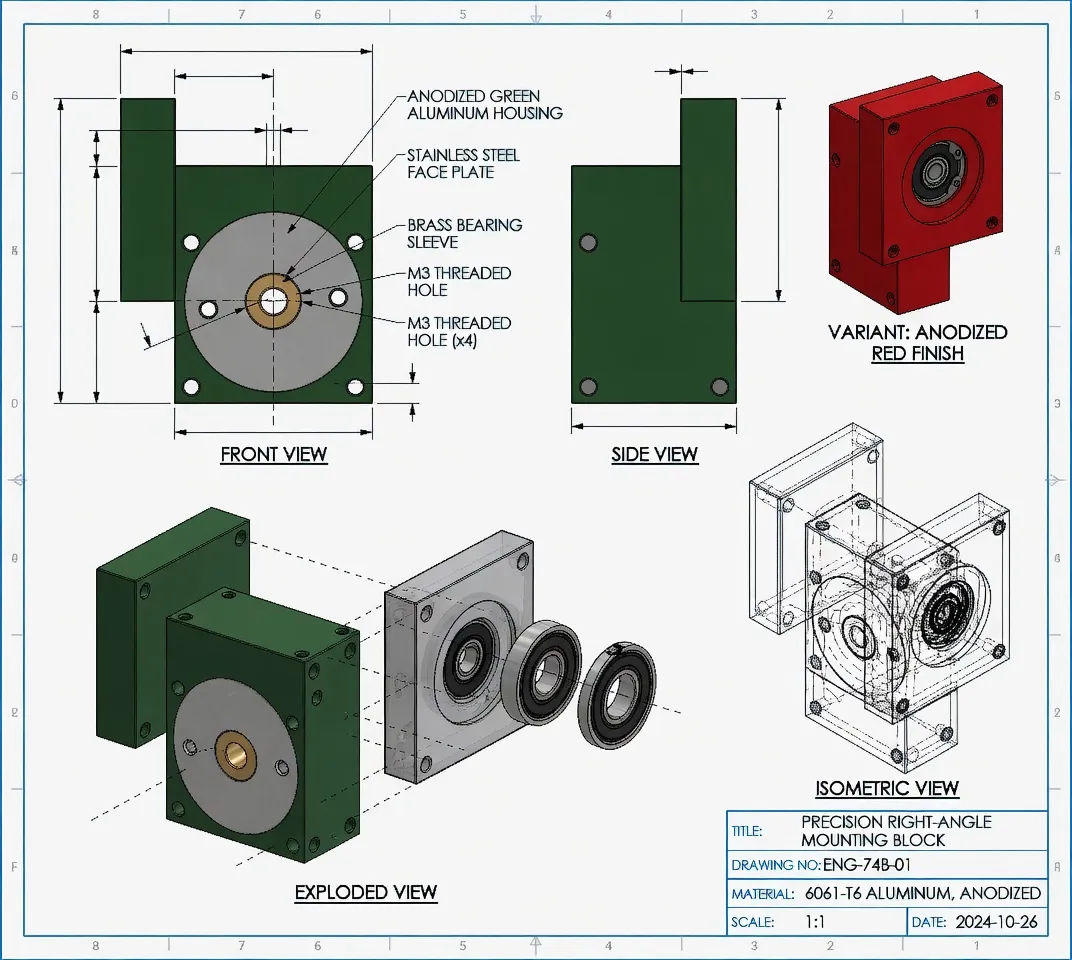
Types of VRV030 Variants for Robotic & Automation Applications
The VRV030 platform supports four standard variants to match different robot architecture and motor families. The same precision-class internals are used across all four; differentiation is in mounting interface and motor adapter design:
| Variant | Backlash Class | Motor Mount | Best Application |
|---|---|---|---|
| VRV030-S | <8 arcmin | IEC B5 / B14 flange | Standard automation joints |
| VRV030-P | <4 arcmin | IEC B5 / B14 flange | Cobot wrist joints, lab automation |
| VRV030-N23 | <8 arcmin | NEMA 23 flange | NEMA stepper / servo motors |
| VRV030-H | <8 arcmin | Hollow-shaft + flange | Direct joint shaft mount |
The NEMA 23 variant has grown rapidly with the surge in NEMA-frame closed-loop stepper systems used in light-payload automation. The 56 mm bolt-circle and Ø9.525 mm input bore directly accept NEMA 23 servo and stepper motors without an adapter plate — meaningful in compact robot wrist designs. For NEMA-23 motor pairing data and matched-pair selection guidance, the NEMA23 worm gear specifications knowledge base provides component-level reference data.
VRV030 Production Process — From Bronze Casting to Backlash-Tested Drive
Precision-class production differs from standard NMRV manufacturing in three key stages: profile-grinding tolerance, gear-pair matching protocol, and end-of-line backlash measurement. The full process:
- Bronze worm wheel casting: CuSn12Ni2 phosphor bronze centrifugally cast at controlled cooling rate, achieving HB 100–115 hardness and grain-size class 6 per ASTM E112. Each casting ultrasonic-tested per ASTM E114; precision class accepts <1.5% volumetric porosity (vs <2.0% standard).
- Worm screw machining & grinding: 20CrMnTi steel turned to rough profile, case-hardened HRC 58–62 (case depth 0.6–0.9 mm), then CBN profile-ground to ISO 1328 Class 5 with surface finish Ra ≤0.2 µm. Each worm individually measured on a CMM and mapped for downstream pair selection.
- Bronze wheel hobbing: Climb-cut hobbing on dedicated worm-wheel machines, achieving Class 5 tooth profile. Light-load run-in with the matching worm screw produces a uniform tooth-contact pattern verified by Prussian-blue check.
- Matched-pair selection: Each worm and worm wheel are paired based on individual CMM measurements to minimize total composite error. Precision-class (VRV030-P) pairs are selected from the tightest 8% of the production distribution; standard-class (VRV030-S) pairs from the central 60%.
- Assembly & preload: Tapered roller bearings preloaded to 0.005 mm axial spec on precision class, FKM (Viton) double-lip seals installed, sealed-for-life PAO synthetic lubricant injected (90 ml).
- Backlash & cycle test: Each unit measured for backlash on calibrated test stand — precision class rejects any unit >4 arcmin; standard rejects any >8 arcmin. Run-in for 30 minutes at rated load, with sound, temperature, and friction recorded.
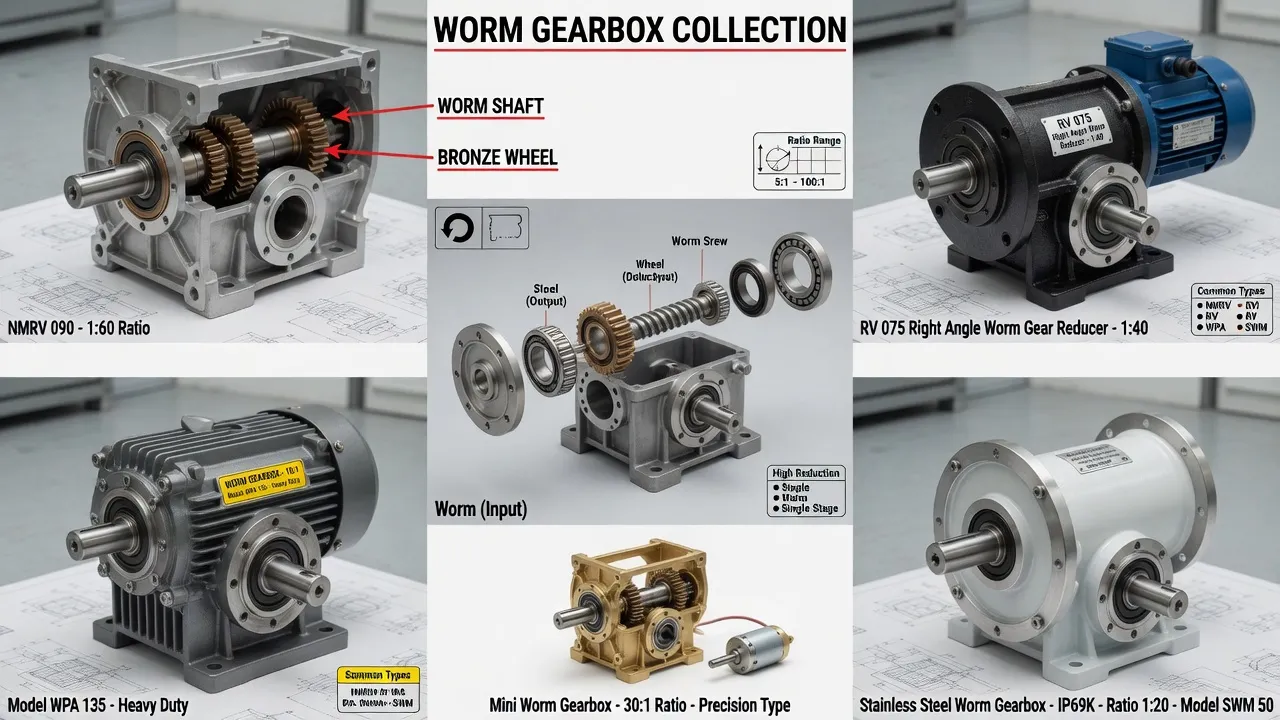
How to Select the Right Precision Worm Reducer for Robotic Joints
Precision-class selection adds backlash-allocation analysis on top of the standard worm gearbox sizing flow. The seven-step procedure:
- Specify end-of-arm repeatability: ISO 9283 repeatability target. Cobot light-payload typical: ±0.1 mm. Precision assembly cobot: ±0.05 mm. SCARA pick-and-place: ±0.02 mm.
- Allocate backlash budget per joint: Sum across the kinematic chain. For a 6-axis cobot at ±0.05 mm tool repeatability with typical link lengths, each joint contributes 0.5–1.5 arcmin of allowable backlash. Choose VRV030-P (<4 arcmin) for joints near the tool flange, VRV030-S (<8 arcmin) for proximal joints with shorter link arms.
- Calculate joint torque envelope: Continuous: gravity load + acceleration load. Peak: emergency-stop load (typically 1.6–2.0× continuous). Apply 1.4× service factor for typical 16-hour cobot duty.
- Determine reduction ratio: Joint output speed typically 60–180 rpm at maximum operational velocity. From a 3,000 rpm servo motor: 30:1 = 100 rpm; 50:1 = 60 rpm. Higher ratios increase resolution and self-locking property; lower ratios reduce friction loss and improve back-drivability.
- Confirm self-locking requirement: Cobot wrists with payload at full reach typically require self-locking property to hold position in emergency-stop without electromagnetic brake. Specify ratio ≥30:1 for self-locking; specify ratio ≤15:1 if joint must back-drive freely (some cobot teaching modes require this).
- Select motor mount: NEMA 23 (VRV030-N23) for closed-loop stepper systems; IEC B5/B14 (VRV030-S/P) for European servo motors; hollow-shaft (VRV030-H) for direct mount on link-shaft assemblies. Contact our precision worm gearbox engineering team with your servo motor specification for compatibility verification.
- Verify ISO 10218 / ISO TS 15066 cobot compliance: For collaborative robot applications, confirm the joint-level safety architecture matches ISO TS 15066 power-and-force-limiting requirements. The VRV030 contributes to compliance through its self-locking property and quiet operation; full system compliance requires complete safety engineering at the robot integration level.
Compatible Components & Spare Parts We Stock
| Component | Specification | Use Case |
|---|---|---|
| Precision worm shaft | 20CrMnTi, ISO 1328 Class 5 | Replacement worm screw |
| Bronze worm wheel | CuSn12Ni2, matched-pair grade | Field rebuild kit |
| Matched worm and gear set | Lapped pair, <4 arcmin or <8 arcmin | Complete drivetrain swap |
| Tapered roller bearings (pair) | Class P5 precision, preloaded | Service rebuild |
| FKM (Viton) seal kit | Double-lip, Ø14 / Ø9 | Annual seal replacement |
| NEMA 23 servo adapter | 56 mm BC, Ø9.525 input | NEMA motor platform change |
| IEC B5/B14 motor flange | 63B5, 63B14, 71B5 | European servo platform |
All VRV030 components are stocked as separate spares for service rebuild and OEM platform-line maintenance. Custom matched worm-and-gear-set production with target backlash specifications (down to <3 arcmin for ultra-precision applications) is supported via dedicated production scheduling. For detailed industrial robot application case studies, see the industrial worm reducer applications knowledge base.
VRV030 Application Sectors Across Robotics & Light Automation
The VRV030 is deployed across robotic and light-automation segments where the right-angle, self-locking, low-backlash combination outperforms harmonic and planetary alternatives on cost, lead time, or total system fit:
- Collaborative robot wrist joints: Cobots in the 3–10 kg payload class typically use VRV030-P (precision) at the wrist (joints 4–6) where positioning accuracy matters most.
- Industrial robot end-effector axes: Servo-driven gripper opening/closing, tool exchanger indexing, and similar end-of-arm motion axes.
- SCARA robot Z-axis & rotation: Vertical lift and tool-rotation axes on light-payload SCARA assembly robots.
- Laboratory automation: Automated pipetting, sample handling, and microplate-positioning equipment where compact, quiet operation is critical.
- Packaging & pick-and-place: Servo-driven product transfer arms, carton-erecting heads, and labeling-applicator drives.
- Medical device automation: Surgical robotics auxiliary axes, automated diagnostic equipment, and pharmaceutical assembly fixtures.
- Semiconductor handling: Wafer-handling robotics, photolithography stage indexing, and clean-room transport mechanisms.

What Robot OEMs & Automation Integrators Say About the VRV030
“Specified VRV030-P across 8,000 cobot wrist joints (joints 5 and 6) on our 5 kg payload collaborative robot platform. Backlash measured at <3.6 arcmin on factory acceptance — tighter than the <4 arcmin spec sheet. Achieved ±0.04 mm end-of-arm repeatability on first integration build.”
— Hiroshi T., Lead Mechanical Engineer, Cobot OEM, Japan
“Used VRV030-N23 with 200W closed-loop steppers on automated screwdriving cells across 14 production lines. The NEMA 23 direct flange-mount eliminated the adapter plate our competitor solution required — saved 22 mm of axis stack height on each cell. 18 months in service, all 84 axes still within original backlash spec.”
— Min-Jun L., Automation Engineer, Electronics Assembly, South Korea
“Built VRV030-H hollow-shaft units into a high-speed packaging robot wrist axis. The right-angle compact form factor fit our existing arm envelope where harmonic alternatives didn’t — saved a complete redesign of the upstream link. Self-locking property eliminated the brake module on our BOM.”
— Marco R., Senior Design Engineer, Packaging Automation OEM, Italy
“Specified VRV030-P on a microplate-handling robot for our pharmaceutical screening platform. The <4 arcmin backlash and sub-55 dB sound met our lab-environment requirements where competing harmonic drives were 3× the cost. Two years deployed across 47 instruments — zero gearbox-related service tickets.”
— Sophie van D., R&D Engineering Lead, Lab Automation, Netherlands
Innovation Highlights — What Makes VRV030 Different from Standard NMRV
Three engineering details distinguish the VRV030 from generic NMRV030 reducers in robotic and automation duty:
- Class 5 worm grinding (vs Class 7 standard): CBN profile-grinding holds lead and profile errors to ≤3 µm and surface finish to Ra ≤0.2 µm. This contributes roughly 60% of the backlash improvement vs standard-grade worms; the remainder comes from matched-pair selection and bearing preload.
- Matched-pair selection protocol: Each VRV030-P unit ships with a worm and worm wheel measured on CMM and matched for complementary tooth-profile geometry. Precision-class matched pairs come from the tightest 8% of the production distribution — comparable in backlash performance to entry-level harmonic drives at roughly 30–40% the cost.
- 5-million-cycle endurance verification: Production lots sample-tested under 75% rated load with continuous reversing cycles. Acceptance criteria: backlash growth <25%, no detectable bearing wear, no lubricant degradation. Equivalent to 8–10 years of typical 5,000-cycle/day automation duty.
Why Source the VRV030 Precision Worm Gearbox From Us
Three reasons robotic OEMs and automation integrators source VRV030 from gearboxesworm.net:
- Precision worm gearbox specialization: Precision-class worm gearbox manufacturing requires dedicated CBN grinding equipment and CMM-based matched-pair selection — capabilities most general worm gearbox suppliers don’t carry. The VRV030 production line is configured specifically for the <4 arcmin / <8 arcmin precision class. Read more about our precision worm gearbox engineering background.
- Cost advantage vs harmonic and cycloidal: Comparable backlash performance to entry-level harmonic drives (Harmonic Drive HD-CSF-2A class) and cycloidal reducers (Nabtesco RV class) at 25–40% the unit cost. Right pick for cobot and light-automation programs where harmonic-drive cost is hard to justify.
- Volume scheduling for OEM ramp-up: Annual contract pricing tiers at 250, 1,000, 5,000, and 25,000 unit volumes — with dedicated production allocation for OEM ramp-up programs. Critical for cobot and SCARA OEMs scaling from prototype to production volumes.
Frequently Asked Questions About the VRV030 Precision Worm Gearbox
1. How does the VRV030 backlash compare to harmonic drives and cycloidal reducers?
Entry-level harmonic drives (e.g., Harmonic Drive HD-CSF-2A class) carry <1 arcmin backlash; mid-tier cycloidal reducers (Nabtesco RV-E series) carry <1 arcmin. The VRV030-P at <4 arcmin sits one tier below these on backlash performance, but at 25–40% the unit cost. For cobot wrist joints and light-automation positioning where ±0.05 mm end-of-arm repeatability is acceptable, the VRV030-P is the cost-optimal choice. For ultra-high-precision applications requiring ±0.02 mm or tighter, harmonic or cycloidal remains the right fit.
2. Can the VRV030 handle the dynamic loads of cobot acceleration profiles?
Yes — the 42 Nm transient peak rating accommodates emergency-stop loads at full payload extension. For typical cobot duty (3–10 kg payload, 2 m/s end-of-arm velocity, 1 g acceleration), continuous joint torque sits below 25 Nm with peaks below 38 Nm, well within VRV030 envelope. For higher-payload industrial robots above 10 kg payload, specify the VRV040 frame which roughly doubles the torque capacity.
3. Is the VRV030 directly compatible with NEMA 23 stepper and servo motors?
Yes — the VRV030-N23 variant is engineered for NEMA 23 motor frames with 56 mm bolt-circle and Ø9.525 mm input shaft, accepting closed-loop stepper systems and NEMA 23 servo motors directly without an adapter plate. NEMA 17 motors mount via an adapter plate (we supply this as a standard accessory). NEMA 34 motors require the larger VRV040 frame for proper torque transmission.
4. What service life can I expect in continuous-duty cobot operation?
For typical 16-hour two-shift cobot service: 35,000+ hours, equivalent to 6–8 years. For 24/7 continuous-duty automation cells: 22,000+ hours, equivalent to 3–4 years. The 5-million-cycle endurance verification translates to roughly 1,500 cycles/day for 8–10 years — aligned with the design horizon of typical cobot deployments.
5. Does the VRV030 require periodic backlash measurement and adjustment?
Backlash on the VRV030 is fixed by gear-pair geometry and bearing preload at factory assembly — there is no field adjustment screw or shim provision. Backlash growth across the 5-million-cycle endurance window is <25%, meaning a unit shipped at <4 arcmin will measure <5 arcmin at end-of-life. For applications requiring fixed-target backlash across the full service life, schedule unit replacement at the 60–70% endurance mark rather than attempting field rebuild.
6. What’s the typical cost difference between standard and precision class?
VRV030-P (precision <4 arcmin) carries roughly 1.6–1.9× the unit price of VRV030-S (standard <8 arcmin), reflecting the matched-pair selection process and the tighter Class 5 grinding tolerance. At OEM volume tiers (5,000+ units), the precision premium narrows to 1.4–1.6×. For cobot OEMs, the typical mix is 70% standard class on proximal joints (1, 2, 3) and 30% precision class on distal/wrist joints (4, 5, 6) where positioning accuracy is most critical.
7. What standards govern precision worm gearbox specification for robotics?
ISO 1328 (gear quality grades) covers worm and worm-wheel manufacturing tolerance. ISO 14521 (worm gear load capacity) and DIN 3996 (worm gear strength) cover mechanical sizing. AGMA 6034 covers worm gearing nomenclature. ISO 9283 (industrial robot performance criteria) specifies the repeatability and accuracy measurement methodology that drives backlash budgeting at the joint level. ISO 10218-1/2 covers industrial robot safety; ISO TS 15066 covers collaborative robot operations. We provide compliance documentation against any of these on request.
Specifying a Precision Worm Gearbox for Your Robotic or Automation Project?
Send our precision-drive specialists your joint-level repeatability target, torque envelope, motor frame, and annual axis volume — we’ll return a sized VRV030 recommendation, backlash-allocation analysis, and OEM pricing within one business day.