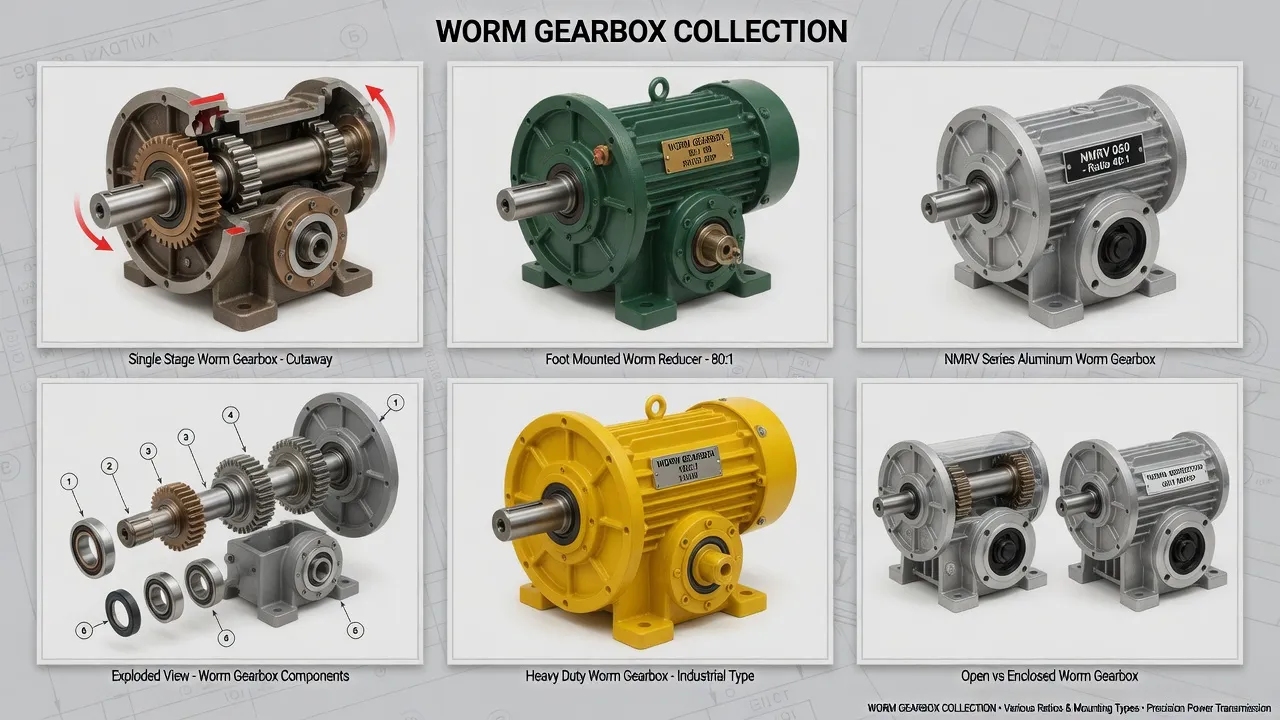
When an industrial OEM specifies a right-angle gearbox, the choice nearly always comes down to two architectures: the worm gearbox or the bevel-helical gear reducer. Both redirect the drive shaft by 90°. Both are available across wide torque and ratio ranges. Yet their engineering trade-offs pull in opposite directions — the worm gearbox is cheaper, quieter, and self-locking; the bevel-helical is more efficient, handles higher continuous power, and scales to very large torques without thermal constraints. Understanding where each architecture is genuinely the right call — and where the “obvious” choice is actually costing you money — is the purpose of this article.
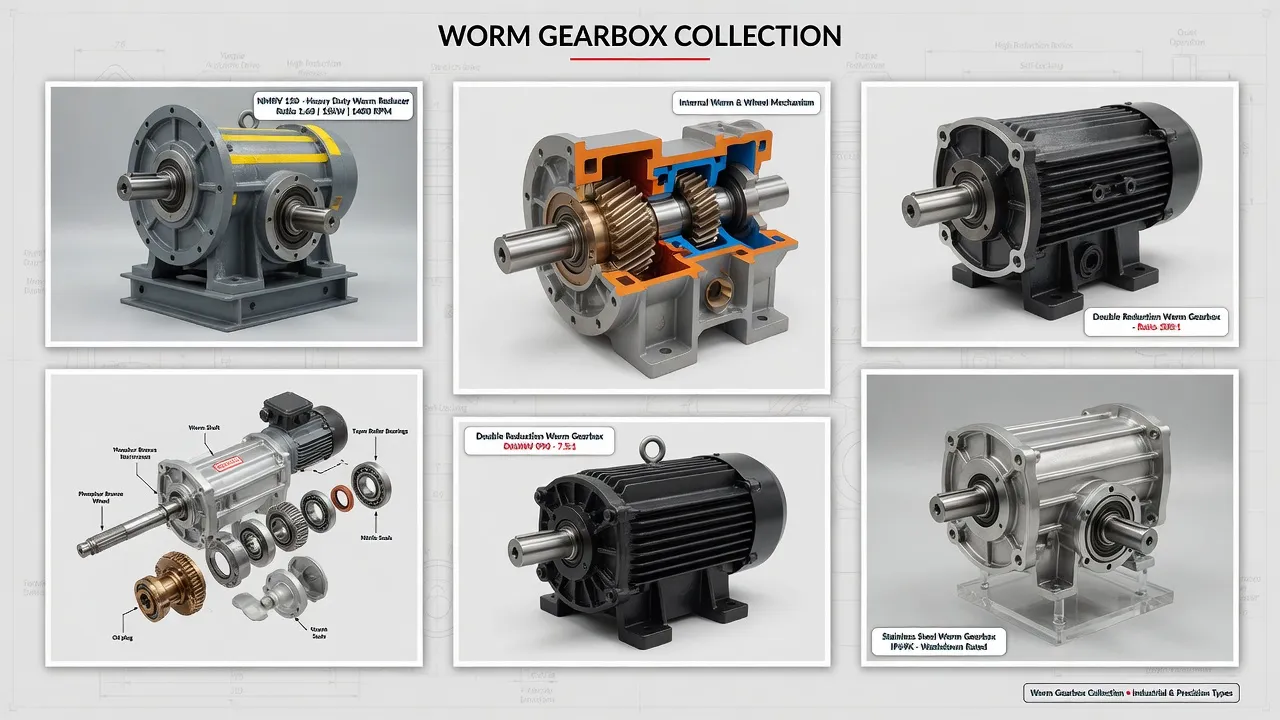
Architecture Fundamentals — Why They Behave So Differently
A worm gearbox achieves right-angle output through sliding-contact between the worm thread and the worm wheel tooth face. A bevel-helical reducer achieves right-angle output through a spiral-bevel final stage where teeth engage in rolling contact. That single difference — sliding vs rolling — creates essentially every performance distinction between the two:
- Sliding contact (worm): generates heat, reduces efficiency, creates self-locking, produces quiet mesh, achieves high single-stage ratios.
- Rolling contact (bevel-helical): minimal heat, high efficiency, cannot self-lock, audible tooth-pulse noise, requires multiple stages for ratios above ~20:1.
Full Comparison Table
| Criterion | Worm Gearbox | Bevel-Helical (K-Series) |
|---|---|---|
| Efficiency (50:1) | 68–74% | 94–96% |
| Self-locking | Yes (≥30:1) | No |
| Single-stage 100:1 | Yes | Multi-stage required |
| Noise level | 55–62 dB | 64–72 dB |
| Thermal power limit | Often limits at high ratio | Not applicable |
| Unit cost (equiv. torque) | 1× (baseline) | 2.5–3.5× |
| Annual energy cost (11 kW, 6,000 h) | €2,218/yr (70% eff.) | €396/yr (95% eff.) |
| Large torque (>10,000 Nm) | Heavy-duty only, high cost | K187 to 62,000 Nm |
The Energy Cost Gap — Quantified for OEM Decision-Making
The efficiency gap between worm and bevel-helical becomes a business case at real production scales. The break-even calculation for a right-angle conveyor drive running 16 hours/day:
- Drive absorbed power: 7.5 kW | Annual hours: 5,000 h | Energy tariff: €0.12/kWh
- Worm at 72% efficiency: 2.08 kW lost as heat → €1,248/year wasted energy
- Bevel-helical at 95% efficiency: 0.39 kW lost → €234/year wasted energy
- Annual saving: €1,014/drive/year
- Bevel-helical price premium over worm: ~€180 (K57 vs equivalent NMRV)
- Payback: 65 days
At this duty level, specifying a worm gearbox to save €180 on purchase price costs over €1,000/year in energy — a textbook false economy. For industrial application case studies comparing right-angle reducer architectures, see the industrial right-angle reducer application cases.
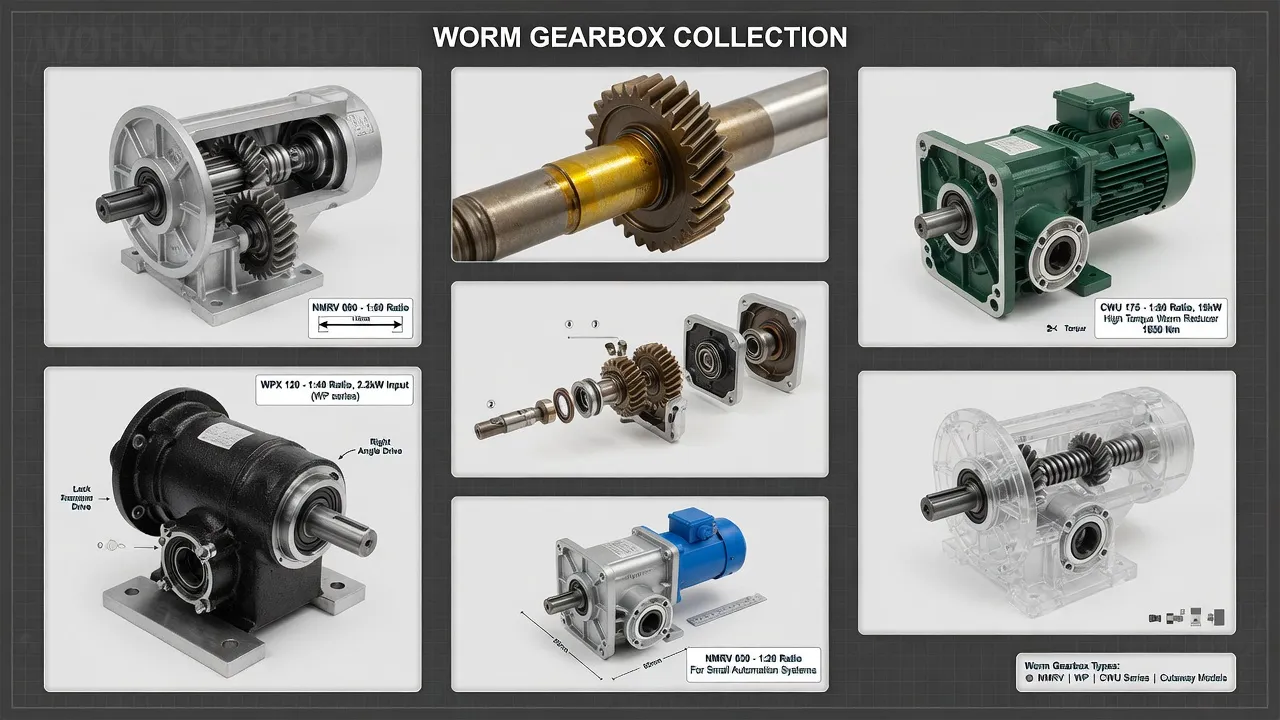
Where the Worm Gearbox Stays the Right Answer
Despite the bevel-helical’s efficiency advantage, five application contexts firmly favor the worm gearbox:
- Self-locking hold is required: Vertical drives, gate openers, lifts, solar trackers — the worm holds load without active power or brake modules. Bevel-helical requires a brake module adding cost and complexity.
- Intermittent duty below 4 h/day: At low annual hours, the energy cost difference is negligible. A gate opener running 30 min/day saves less than €10/year by switching to bevel-helical — the purchase-cost premium never pays back.
- High single-stage ratios (60:1–100:1) in compact envelope: A single-stage worm achieves 80:1 in ~150 mm axial length; a bevel-helical requires 3 stages and ~380 mm to achieve the same ratio. For space-constrained applications, worm wins.
- Quiet operation (office, food retail, lab ambient): Worm’s sliding-contact mesh runs 8–12 dB quieter than bevel-helical’s tooth-pulse. For noise-sensitive installations, worm is the preferred specification regardless of efficiency considerations.
- Low-power OEM cost-optimization: For applications below 0.75 kW at moderate duty cycles, the compact aluminum worm gearbox at its price point is nearly impossible to beat on total system cost. Our NMRV worm gearbox series covers this cost-optimized OEM specification in full.
The Decision Matrix for OEM Engineers
Use this decision matrix to reach the correct specification rapidly:
| Application Profile | Specify | Primary Reason |
|---|---|---|
| Gate opener, solar tracker, vertical lift | Worm | Self-locking load hold |
| 24/7 conveyor, agitator, fan above 3 kW | Bevel-Helical | Energy TCO over service life |
| Quiet ambient (office, lab, food retail) | Worm | Acoustic profile (sliding mesh) |
| Large torque (>5,000 Nm) continuous | Bevel-Helical | No thermal power limit |
| Compact 80:1 single stage | Worm | Single-stage high ratio |
| Intermittent <2 h/day, <1.5 kW | Worm | Purchase cost; energy irrelevant |
| 16 h/day, 5 kW+, no self-lock needed | Bevel-Helical | Payback <6 months on energy |
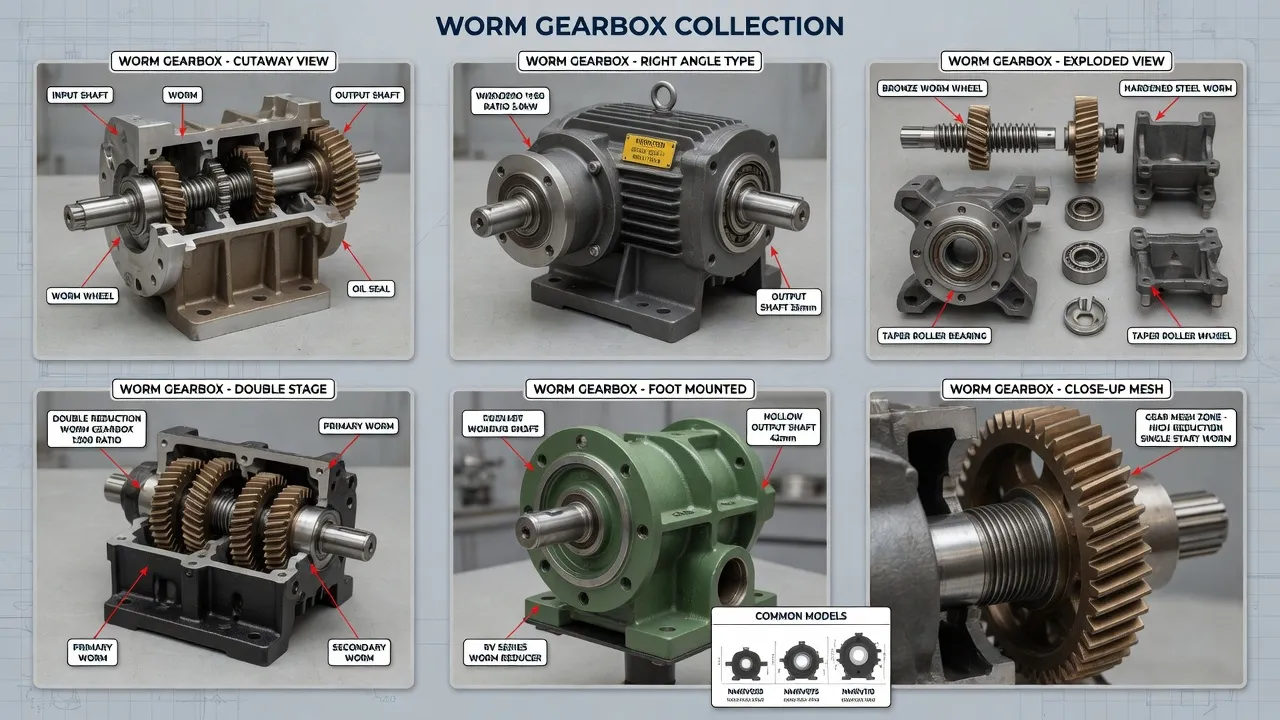
Frequently Asked Questions
Is there a hybrid option that combines worm and bevel-helical?
Yes — the helical-worm (S Series) combination reducer uses a helical pre-stage for high-speed efficiency combined with a worm final stage for right-angle output and self-locking. It delivers 75–88% efficiency vs 60–75% for single-stage worm, while retaining native self-locking. It occupies the cost and efficiency space between standard worm and full bevel-helical, and is the preferred upgrade specification for applications needing both improved efficiency and self-locking hold.
Can I retrofit a bevel-helical where a worm gearbox was originally specified?
Mechanically possible if the bevel-helical can match the existing mounting interface — many K-series bevel-helical reducers follow the SEW mounting convention that is compatible with European worm gearbox installations. The critical check: does the application rely on worm self-locking for load-hold? If yes, a fail-safe brake module must be added before switching. If no self-locking requirement exists, retrofit is straightforward in most cases.
Why does the bevel-helical cost 2.5–3.5× more than a worm gearbox?
The bevel-helical requires precision spiral-bevel gears manufactured on dedicated Gleason-type bevel-gear cutting machines, with each matched pair lapped together to achieve the correct tooth contact pattern. Spiral-bevel gear manufacturing is 3–5× more expensive per gear pair than worm-and-wheel manufacturing. Additionally, the multi-stage architecture means more gear pairs per unit. The cost premium reflects genuine manufacturing complexity — not margin arbitrage.
At what power level does the bevel-helical TCO clearly win?
Based on field data and TCO modeling: for applications running more than 8 hours/day, the bevel-helical payback on the purchase premium vs worm is typically under 12 months at absorbed power above 2.2 kW. For 16+ hours/day, above 1.5 kW absorbed power, payback is under 8 months. Below 0.75 kW absorbed or below 4 h/day duty, the worm gearbox purchase-cost advantage is rarely recovered by energy savings across the gearbox service life.
Need Help Choosing Between Worm and Bevel-Helical for Your OEM Project?
Share your absorbed power, daily operating hours, self-locking requirement, and unit volume — we’ll return an architecture recommendation with payback analysis within one business day.
Thermal Rating — The Worm Gearbox’s Hidden Constraint
Every worm gearbox catalog contains two distinct power ratings: the mechanical power rating (governed by gear-tooth strength and bearing load) and the thermal power rating (governed by the housing surface area’s ability to dissipate friction heat). At high reduction ratios where efficiency drops below 70%, the thermal rating often becomes the binding constraint — especially for continuous-duty applications running more than 8 hours per day.
Example: a standard NMRV075 at 50:1 ratio has a mechanical input-power rating of 4.2 kW but a thermal input-power rating of only 2.4 kW for continuous 24-hour duty at 20°C ambient. Specifying a 3.0 kW motor against this gearbox without checking the thermal rating overloads the thermal budget by 25% — causing lubricant degradation, seal carbonization, and shortened service life.
Bevel-helical reducers have no thermal power rating constraint. At 95–97% efficiency, the heat generated per kW of transmitted power is so small that the housing surface area provides more than adequate dissipation at any reasonable rated continuous load. This is why bevel-helical is the only viable specification for large continuous-duty right-angle drives above 15–22 kW absorbed load — worm gearboxes of equivalent torque simply cannot manage the thermal load.
The Helical-Worm Hybrid — the Middle Path
For applications needing right-angle output, self-locking capability, and meaningfully better efficiency than a standard worm gearbox — but where a full bevel-helical is either overkill or the self-locking requirement rules it out — the helical-worm (S-series) combination reducer occupies the middle ground:
- Architecture: Helical pre-stage (high-speed, high-efficiency rolling contact) + worm final stage (right-angle output, self-locking capability).
- Combined efficiency: 75–88% vs 60–75% for single-stage worm and 94–97% for bevel-helical.
- Self-locking: Yes at overall ratios ≥30:1.
- Cost: 1.3–1.8× standard worm gearbox; 0.5–0.7× bevel-helical at equivalent torque.
For OEM engineers who need the self-locking property (ruling out bevel-helical) but are running more than 6 hours per day (making worm gearbox energy cost significant), the helical-worm is typically the most cost-effective specification — delivering a 10–18 percentage-point efficiency improvement over standard worm at a purchase premium that pays back in 18–30 months.
Noise, Size, and Reliability Considerations for OEM Design
Three additional factors OEM engineers should incorporate into the architecture decision:
- Noise: Worm gearboxes run 8–12 dB quieter than bevel-helical at equivalent input speeds (55–62 dB vs 64–72 dB). For products sold into residential, food-retail, or office environments where noise affects product perception, the worm gearbox’s acoustic advantage is commercially meaningful.
- Axial length: At equivalent torque and ratio, bevel-helical reducers are typically 40–80% longer in the axial direction than worm gearboxes, due to the multi-stage helical arrangement. For machine-tool and robotic applications where axial space is constrained, the worm gearbox’s compact single-stage envelope may be the deciding factor.
- Reliability pattern: Both architectures achieve 20,000–30,000 service hours when correctly sized. Worm gearboxes fail gradually (bronze wheel wear increases backlash with ample forewarning); bevel-helical reducers may fail more suddenly through bevel-gear tooth pitting or bearing fatigue. For applications where unplanned downtime cost is very high (continuous process industries), the worm gearbox’s predictable wear pattern supports more reliable planned-maintenance scheduling.
Application Sectors — Where Each Architecture Dominates
The most efficient industrial plants use both architectures deliberately — each where it genuinely wins:
- Worm gearbox dominates: Gate openers, door operators, solar trackers (self-locking for wind-load hold), food machinery right-angle drives, conveyor tail-drive auxiliaries, textile machine auxiliary drives (self-locking yarn-tension hold), ice maker drives, agricultural auxiliary drives, packaging machine indexing where noise and cost govern.
- Bevel-helical dominates: 24/7 continuous conveyor head-pulley drives, agitator vertical-shaft drives running more than 8 hours/day, industrial fan and blower drives, pump right-angle drives in process plants, cooling tower fans, rolling-mill table drives — wherever the absorbed power and daily hours create an energy-cost gap that justifies the purchase premium.
- Shared territory: At 3–6 kW absorbed load and 6–10 hours/day duty, both architectures are viable and the decision comes down to whether self-locking, noise, or purchase-cost matters more in the specific OEM product context.