
Harmonic drives have long been the default specification for high-precision robotic joints and servo positioning axes. Their sub-1-arcmin backlash, high torque density, and coaxial zero-backlash design make them technically compelling. But at 3.5–5× the unit cost of a precision worm gearbox for equivalent torque, they are also the most expensive gear reduction option for precision positioning. This article directly compares the two architectures across every relevant specification criterion — and provides an honest assessment of when a precision worm gearbox delivers comparable positioning performance at a fraction of the cost, and when the harmonic drive’s technical advantages genuinely justify the premium.
How Harmonic Drives Work — the Key Differences
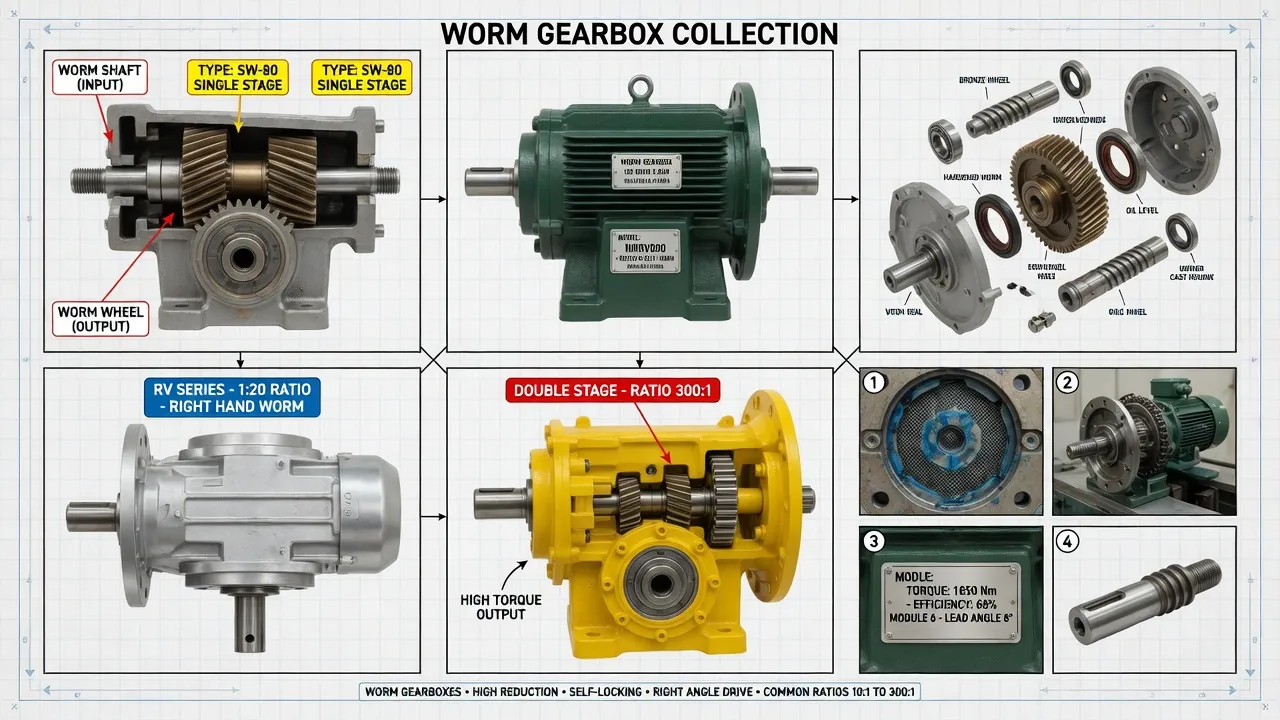
A harmonic drive (strain wave gear) consists of three components: a wave generator (elliptical input), a flex spline (thin flexible external gear), and a rigid circular spline (fixed internal gear). The wave generator deforms the flex spline into an elliptical shape, causing teeth to engage at two points simultaneously. Each input rotation advances the flex spline by two teeth relative to the circular spline — producing very high reduction ratios (50:1–320:1) with essentially zero backlash in a compact coaxial package.
The tradeoffs: the flex spline undergoes cyclic stress with every revolution, limiting life to 5,000–15,000 service hours in continuous high-load applications before flex-spline fatigue becomes a failure mode. Harmonic drives cannot self-lock (the flex spline back-drives freely), and the coaxial geometry does not permit right-angle output without a separate bevel stage.
Full Specification Comparison
| Criterion | Precision Worm Gearbox | Harmonic Drive |
|---|---|---|
| Backlash (precision grade) | <4 arcmin (matched pair) | <1 arcmin |
| Repeatability | ±10–15 arcsec | ±3–5 arcsec |
| Self-locking | Yes (≥30:1) | No |
| Back-drivability | No (self-locks at high ratio) | Yes |
| Shaft layout | Right-angle 90° | Coaxial inline |
| Efficiency | 65–80% (precision range) | 75–85% |
| Unit cost (100 Nm, 50:1) | $65–$120 | $280–$450 |
| Service life (continuous servo) | 20,000–30,000 h | 5,000–15,000 h (flex spline) |
| Torque ripple | Very low | Moderate (2× per revolution) |
| Stiffness (torsional) | Moderate | Very high |
The Backlash Gap — What Does It Actually Mean for End-of-Arm Accuracy?
The harmonic drive’s <1 arcmin backlash vs precision worm’s <4 arcmin sounds like a 4× difference — but its impact on end-of-arm positioning accuracy depends entirely on the arm geometry:
- At the wrist joint (50 mm from joint to tool flange): 4 arcmin backlash = 0.058 mm linear error; 1 arcmin = 0.015 mm linear error.
- At the shoulder joint (400 mm from joint to tool flange): 4 arcmin backlash = 0.47 mm linear error; 1 arcmin = 0.12 mm linear error.
For cobot wrist joints requiring ±0.05 mm end-of-arm repeatability, precision worm gearboxes at <4 arcmin sit at the edge of acceptable. For proximal shoulder joints where ±0.5 mm is acceptable, precision worm delivers the requirement at 35–50% of harmonic drive cost. This is the structural basis for using precision worm gearboxes on proximal joints and harmonic or cycloidal drives only on distal joints in cost-conscious cobot platforms — a design pattern increasingly common in mid-tier collaborative robot products.
Service Life — Where Precision Worm Has a Structural Advantage
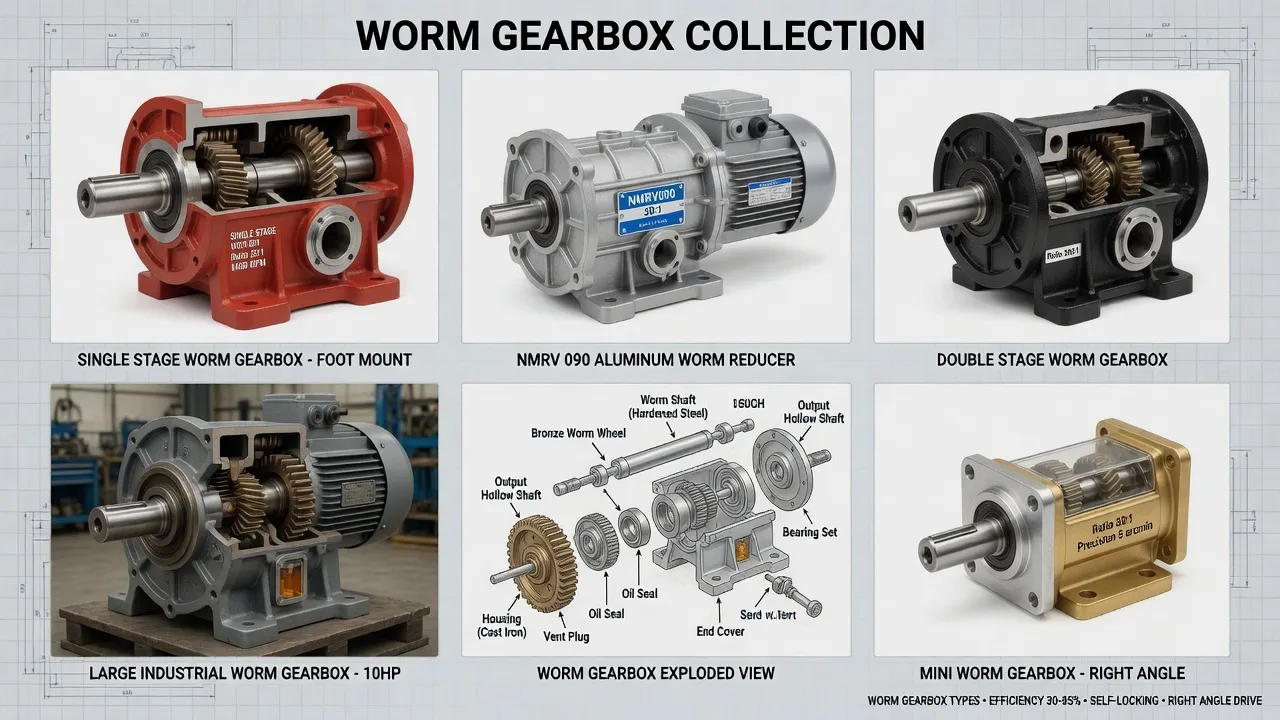
The harmonic drive’s flex spline undergoes cyclic bending stress with every revolution. Each cycle fatigues the flex spline material, eventually producing cracks and failure. Typical harmonic drive flex-spline life:
- Light-duty (30% rated load): 15,000+ hours
- Medium-duty (60% rated load): 8,000–12,000 hours
- Heavy-duty (80–100% rated load): 4,000–7,000 hours
A precision worm gearbox at equivalent loading runs 20,000–30,000 hours before major rebuild is required. For applications running continuous-duty servo cycles, the worm gearbox’s bronze wheel wear-mode is a gradual, predictable failure with forewarning (increasing backlash measured over time); the harmonic drive’s flex-spline fatigue is a more sudden failure mode with less field warning. For industrial automation deployments requiring 8–10 year maintenance-free operation, precision worm gearboxes have a meaningful service-life advantage over harmonic drives under continuous servo loading. Our precision low-backlash worm gearbox is engineered specifically for this continuous servo-positioning duty.
Cost Analysis — The Budget Cobot Case
For a 6-axis cobot design with a $2,000 target BOM for the gear-reduction system, precision worm enables a viable product at harmonic-drive-quality positioning on 4 of the 6 joints:
| Joint | Accuracy Need | All-Harmonic Cost | Hybrid (Worm+HD) Cost |
|---|---|---|---|
| J1 Shoulder | ±0.3 mm acceptable | $380 | $95 (prec. worm) |
| J2 Upper arm | ±0.2 mm acceptable | $380 | $95 (prec. worm) |
| J3 Elbow | ±0.15 mm acceptable | $380 | $95 (prec. worm) |
| J4 Forearm roll | ±0.1 mm acceptable | $380 | $95 (prec. worm) |
| J5 Wrist pitch | ±0.05 mm required | $380 | $380 (harmonic) |
| J6 Wrist roll | ±0.03 mm required | $380 | $380 (harmonic) |
| Total | $2,280 | $1,140 |
The hybrid architecture saves $1,140 per robot (50% reduction in gear-train cost) while meeting the same end-of-arm ±0.05 mm repeatability target at the tool flange. At 5,000 units/year production volume, that’s $5.7 million/year in BOM savings — the reason precision worm gearboxes are increasingly specified on proximal joints of cost-optimized cobot platforms. For detailed specifications on our matched-pair precision worm gearboxes, see the VRV030 precision worm gearbox. For a comprehensive engineering reference on precision worm gearbox design parameters, see the precision worm gearbox engineering reference.
When Harmonic Drive Is Clearly the Right Choice
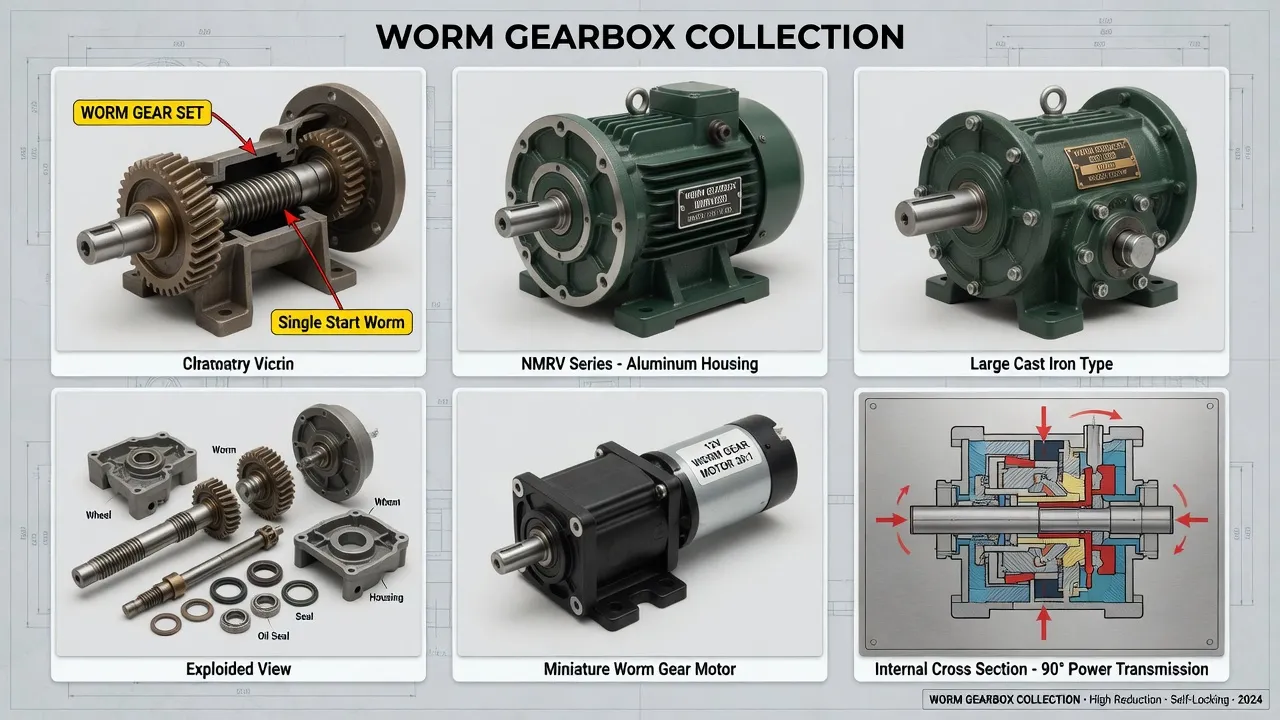
Five scenarios where the harmonic drive’s technical advantages justify its premium and precision worm cannot match:
- Sub-1-arcmin backlash is genuinely required: Semiconductor wafer handling, optical alignment equipment, surgical robotics — where positioning error below 0.01 mm at short arm radius is non-negotiable.
- Back-drivability is required: Force-controlled assembly, gravity compensation in cobot teaching mode, impedance-controlled medical robotics — worm gearbox cannot back-drive.
- Zero cogging or torque ripple is required: High-precision rotary stages and optical telescope drives where even the 2× per-revolution torque ripple of harmonic drives must be characterized and controlled — worm gearboxes are quieter but not zero-ripple.
- Extreme torque density in minimal space: Exoskeleton joints, miniature robot actuators — harmonic drives achieve torque densities of 50–80 Nm/kg; compact precision worm gearboxes run 12–25 Nm/kg.
- Coaxial inline zero-offset geometry is required: Some joint architectures require the output shaft to be coaxial with the input — the harmonic drive’s inline geometry is structurally required; a worm gearbox cannot provide it.
Frequently Asked Questions
Can a precision worm gearbox achieve <3 arcmin backlash?
Yes — matched-pair selected precision worm gearboxes with ISO 1328 Class 4 worm grinding and P4 precision bearings can achieve <3 arcmin backlash from the tightest 4% of the production distribution. This is specifically what our VRV040-P precision class is designed for. Below 3 arcmin, production yields drop significantly and cost approaches harmonic drive territory, making harmonic or cycloidal drives more cost-competitive for the truly ultra-precision range.
What is a cycloidal reducer, and how does it fit between worm and harmonic?
A cycloidal reducer (e.g., Nabtesco RV series) uses an eccentric cam driving cycloidal disc against a pin wheel, achieving <1 arcmin backlash and very high shock-load capacity. It sits between precision worm and harmonic drive on backlash, with better shock-load resistance than harmonic drives and 2–3× the cost of precision worm gearboxes. Cycloidal reducers are the preferred specification for heavy-payload robot joints (10–500 kg) where harmonic drives lack the shock-load robustness; precision worm gearboxes are preferred for lighter cobot joints where backlash is acceptable above 3 arcmin.
Is harmonic drive efficiency actually better than precision worm?
At high ratios and light loads, yes — harmonic drives run 75–85% efficiency, comparable to or slightly better than precision worm (65–80% in the precision range). The flex-spline hysteresis loss in harmonic drives increases at higher torque loads; at 80–100% rated load, harmonic drive efficiency drops to 72–78%. Precision worm gearboxes at high loads do not have this flex-spring hysteresis effect — their efficiency is more stable across the load range. In practice, the efficiency difference between the two architectures is modest and rarely the deciding factor.
Can I upgrade my harmonic drive joints to precision worm to reduce cost?
Depends on the joint. For proximal robot joints (J1–J4) where arm link length means ±0.1–0.3 mm accuracy is sufficient, precision worm is mechanically viable and the cost savings are substantial. For distal wrist joints (J5–J6) where tool accuracy drives the specification, assess your actual end-of-arm accuracy requirement: if ±0.05 mm or tighter is required, stay with harmonic or cycloidal; if ±0.1 mm is acceptable, precision worm at <4 arcmin can close the gap. Always verify with actual axis-level measurement rather than nominal backlash specifications alone.
Need Precision Worm Gearbox Specs for Your Cobot or Servo Project?
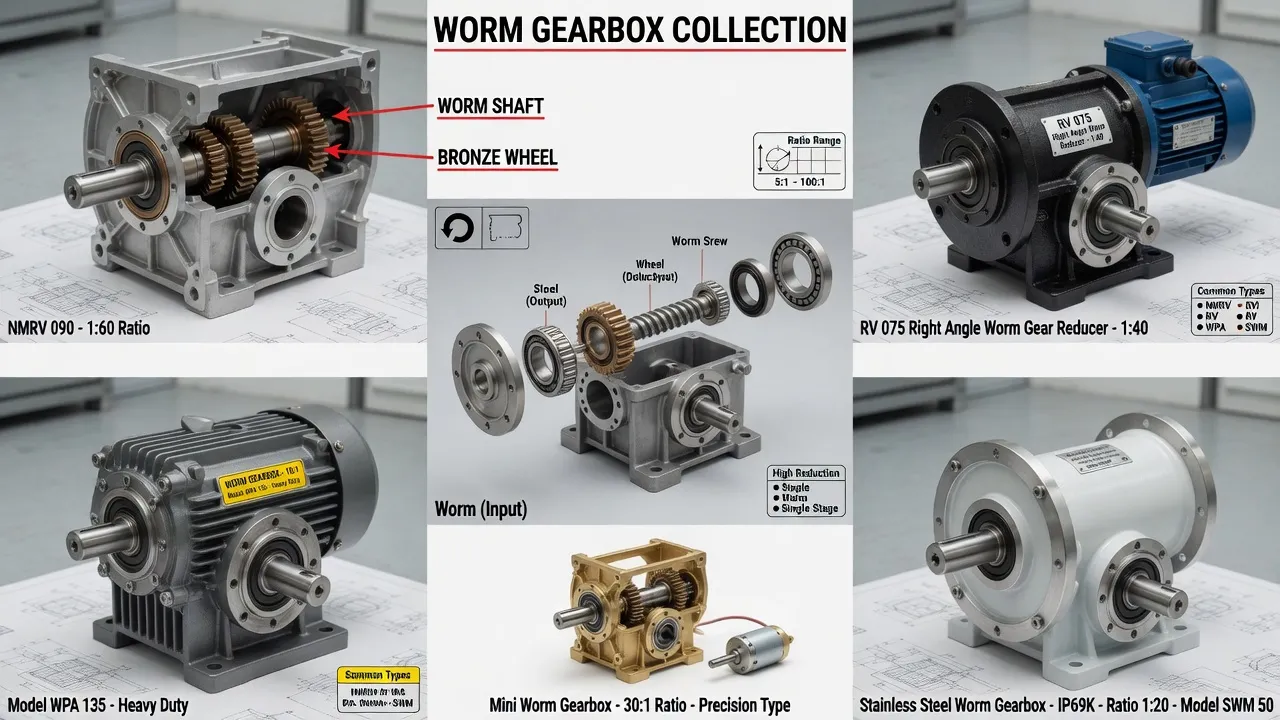
Send our precision-drive engineers your joint-level accuracy requirement, torque, duty cycle, and annual volume — we’ll return a matched-pair worm gearbox recommendation with backlash certification and cost comparison vs harmonic drive within one business day.
Torque Ripple — An Underappreciated Difference
Harmonic drives produce a characteristic torque ripple at twice the input revolution frequency — caused by the elliptical wave generator engaging the flex spline at two diametrically opposite points per revolution. At 1,000 rpm input and 100:1 ratio, this produces a 33 Hz output ripple (2 × 1,000/60 = 33 Hz). For most cobot positioning applications, this ripple is filtered by the servo loop and is imperceptible at the tool. For highly sensitive applications — optical telescope pointing, semiconductor wafer handling, vibration-sensitive measurement gantries — the harmonic drive’s ripple must be characterized and compensated in the servo algorithm.
Precision worm gearboxes produce essentially no periodic torque ripple — the sliding-contact mesh engagement is continuous and smooth. This makes precision worm gearboxes preferred for applications where torque ripple would couple into measurement sensitivity — laser interferometer stages, atomic-force microscope positioning, and similar scientific instrumentation drives.
Right-Angle Output — the Worm’s Structural Advantage in Compact Robots
Harmonic drives are inherently coaxial — input and output share the same axis. Achieving a right-angle output requires a separate bevel stage or a right-angle bevel-harmonic assembly, adding cost and axial length. Precision worm gearboxes inherently output at 90° — a structural property of the worm-and-wheel mesh geometry.
For compact robot wrist designs where the motor must be oriented perpendicular to the wrist output axis, the precision worm gearbox fits the geometry naturally — eliminating the bevel-adaptor stage required for a harmonic drive to achieve the same physical layout. This is the geometric reason worm gearboxes continue to be specified in many SCARA robot Z-axis and rotation-axis designs, even as harmonic drives dominate the 6-axis cobot joint market.
Practical Selection Guide — Precision Worm vs Harmonic Drive
| Application | Specify | Reason |
|---|---|---|
| Cobot proximal joints J1–J4, ±0.1–0.3 mm | Precision worm | ±4 arcmin meets accuracy; 35–50% cost saving |
| Cobot distal wrist joints J5–J6, ±0.05 mm | Harmonic drive | Sub-1 arcmin backlash required at short arm radius |
| SCARA Z-axis or rotation (right-angle output) | Precision worm | Native 90° geometry; no bevel adaptor required |
| Semiconductor wafer handler, ±0.01 mm | Harmonic drive | Sub-1 arcmin and zero torque ripple required |
| Servo indexing table, ±0.025° | Precision worm | <3–4 arcmin meets spec; self-locking holds position |
| Force-controlled collaborative task | Harmonic drive | Back-drivability required; worm cannot comply |
| Lab automation, ±0.1 mm, quiet ambient | Precision worm | Quieter + self-locking + 35% cost saving |