Description
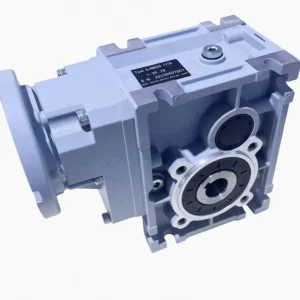
A modern broiler house holds 25,000 birds and runs feed augers, ventilation chains, drinker line winches, and manure scrapers around the clock. Drop one drive and the math gets ugly fast — feed sits in the auger, birds crowd the empty section, mortality climbs within hours. The PGV planetary gearbox from akgnx Co., Ltd was built around the gritty realities of farm equipment: dust ingress, ammonia atmosphere, hose-down cleaning between flocks, and the occasional 200% torque spike when a feed auger jams on caked grain. Two frame sizes — PGV035 and PGV045 — cover the working torque range of feed handling, ventilation, and waste-removal drives across poultry, swine, and dairy operations worldwide.
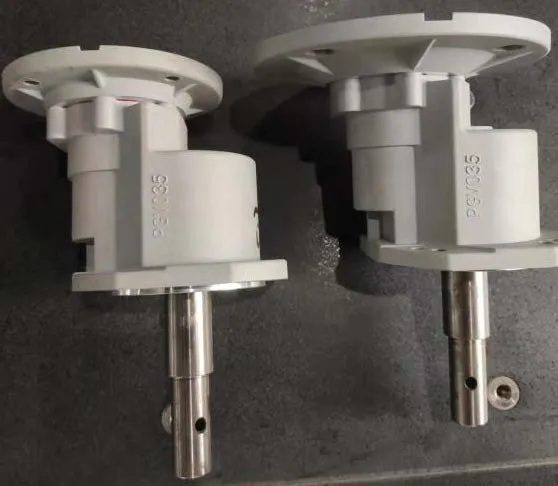
PGV Specifications: What Each Frame Covers
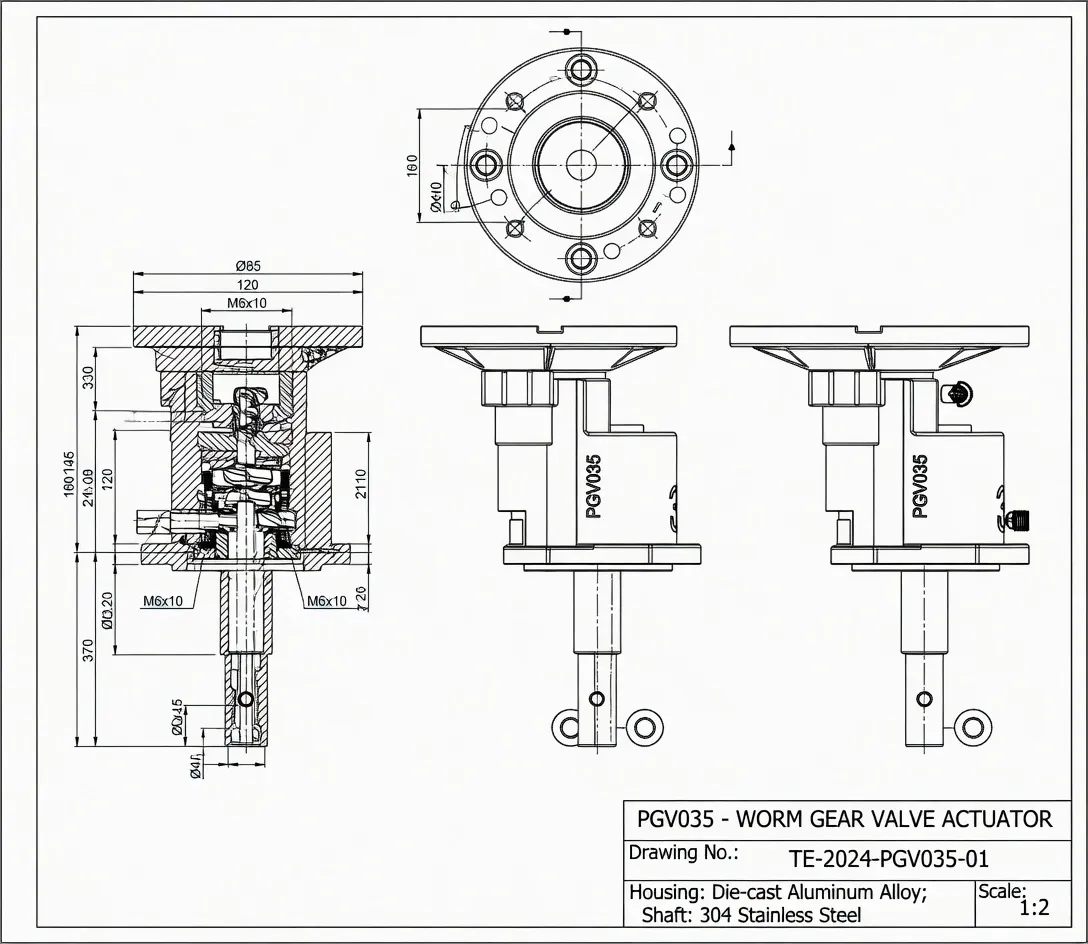
The PGV uses a single-stage or double-stage planetary gear arrangement — three or four planet gears revolving around a central sun gear, all enclosed in an internally-toothed ring. That layout splits the input torque across multiple gear teeth in mesh simultaneously, which is why a small-frame planetary handles torque that would need a worm reducer twice the weight. PGV035 takes care of feed augers, drinker hoists, and small fan drives in the 0.18–0.75 kW range. PGV045 steps up to manure scrapers, larger ventilation systems, and feed mixer wagons up to 1.5 kW. Output orientation is vertical by default — the geometry that fits feed-bin mounted augers and ceiling-suspended winches without an extra bracket.
| Parameter | PGV035 | PGV045 |
|---|---|---|
| Output flange size | 35 mm | 45 mm |
| Output torque (continuous) | 45 N·m | 95 N·m |
| Output torque (peak, <3 sec) | 85 N·m | 175 N·m |
| Single-stage ratios | 3, 4, 5, 7, 10 | 3, 4, 5, 7, 10 |
| Two-stage ratios | 15, 25, 50, 100 | 15, 25, 50, 100 |
| Efficiency per stage | 96–97% | 96–97% |
| Input power | 0.18–0.75 kW | 0.37–1.5 kW |
| Housing material | Die-cast aluminum, IP54 sealed | Die-cast aluminum, IP54 sealed |
| Gear material | 20CrMnTi, 58–62 HRC | 20CrMnTi, 58–62 HRC |
| Weight | 3.2 kg | 5.8 kg |
A Real Project: Feed Augers Across Twelve Broiler Houses
A poultry integrator in central Poland operates twelve 110-meter broiler houses, each with two feed augers running 18 hours a day. Through 2022 they were burning through worm gearboxes — typically 28 to 32 unit replacements a year across the site. The failure mode was always the same: dust got past the input shaft seal, mixed with the lubricant, ground its way through the bronze worm wheel within 12–14 months. Replacement cost (parts + electrician callout + bird welfare risk during the swap) ran around €420 per incident, plus the productivity hit when an auger sat dead until the technician arrived.
The site engineer trialled six PGV035 units on house 7 and house 8 in March 2023, paired with the same 0.55 kW IEC motors they’d been using. Twenty months later: zero failures across the trial group, against four failures in the matched control group of houses still on worm reducers. Surface temperature on the PGV runs 11°C cooler than the worm units, mostly because there’s no sliding worm-on-bronze contact bleeding power as heat. The grease they specified — a synthetic complex lithium with EP additives, factory-filled — hasn’t needed top-up. By Q3 2024 they’d swapped all 24 feed-auger drives across the twelve houses to PGV035 and budgeted the €600 unit-cost premium against an expected €10,000+ in avoided failures across the next five years.

Why Planetary Gears Survive Where Worm Reducers Fail in Animal Housing
Three things kill worm gearboxes in livestock housing, and the planetary architecture sidesteps each one. Dust contamination is the biggest. A broiler house generates roughly 50 grams of airborne dust per cubic meter during peak activity — feathers, dander, dried manure particles, feed fines. That dust finds its way through any imperfect seal. In a worm gearbox, contaminated oil cuts the bronze worm wheel like wet sandpaper. In a planetary, the gears are case-hardened steel running on case-hardened steel — orders of magnitude more abrasion-resistant than bronze. The same dust that destroys a worm wheel in 14 months barely scratches a hardened planetary gearset over the same period.
Ammonia atmosphere is the second factor. Poultry litter generates ammonia at concentrations of 25–50 ppm in the air; pig houses can hit 60 ppm in winter. Ammonia attacks bronze, forming green copper-ammonia complexes that flake off the worm wheel. The PGV uses no bronze components anywhere — every gear is steel, every shaft is steel, every bearing is sealed steel-on-steel. The third problem is shock loading. A feed auger that jams on a clump of caked grain transmits a 200%+ torque spike back through the drive. Worm gearboxes handle this poorly because the bronze wheel yields locally and develops stress concentrations. Planetary gears split the torque across three or four planet teeth simultaneously, and the load-sharing keeps any single tooth below its yield point.
PGV Applications Beyond Feed Augers
Feed augers are the most common installation, but the PGV ends up in several other livestock and farm-equipment positions. Drinker line hoists — the cable winches that raise the drinker line during cleaning between flocks — use PGV035 with a 25:1 or 50:1 ratio. The output speed of 28–56 rpm matches the cable drum speed for a smooth lift. Manure scraper drives in dairy alleys use PGV045 paired with a 1.1 kW motor, where the high startup torque handles a frozen scraper bar in winter without the worm reducer’s tendency to stall. Ventilation curtain winches on poultry house side walls use PGV035, where the ratio (typically 100:1 two-stage) gives precise positioning — important for matching house ventilation to outside temperature.
Outside livestock housing, PGV ends up in greenhouse window-vent drives (similar dust + humidity profile), small grain bin sweep augers (the lower frame size handles bin diameters up to 7 m), feed mill bag-house dampers, and irrigation pivot turn-drives in dryland farming regions. The common thread: outdoor or semi-outdoor mounting, dust exposure, intermittent shock loading, and a need for service intervals measured in years rather than months.
PGV vs Worm vs Cycloidal — Picking the Right Geometry
| Feature | PGV Planetary | MRV Worm | Cycloidal |
|---|---|---|---|
| Efficiency at 50:1 | 93% | 62% | 85% |
| Shock load tolerance | Excellent | Poor | Very good |
| Dust resistance | Excellent (steel-on-steel) | Poor (bronze wheel) | Good |
| Ammonia resistance | Excellent | Poor | Good |
| Self-locking | No | Yes (above 30:1) | Partial |
| Service interval | 5–7 years | 12–18 months | 3–4 years |
| Unit cost (relative) | 1.6× | 1.0× | 2.5× |
| Best fit for farm equipment | Feed augers, scrapers, fans, winches | Gates, lifts requiring hold | Robotics, precision drives |
For drinker hoists where you actually need self-locking to hold the line at a set height, the answer isn’t dropping the planetary — it’s adding a brake motor. PGV with a brake motor delivers both the dust-tolerance of the planetary and the holding capability of a worm. The combination costs less than a cycloidal and outperforms a worm in dirty environments.
Selecting and Sizing a PGV for a Farm Drive
- Calculate continuous output torque from the driven equipment. For a feed auger, T = (volumetric capacity × auger length × material density × friction factor) / output speed. For a manure scraper, T = (scraper bar mass + estimated manure weight × friction coefficient) × wheel radius.
- Add a service factor of 1.5 for normal farm duty (covers occasional auger jams and scraper drag), 2.0 if the equipment runs 24/7 with no maintenance window, 2.5 for outdoor exposure with freeze risk.
- Pick the ratio: i = motor RPM / required output RPM. Most feed augers run 30–60 rpm output, which from a 1400 rpm motor means i = 25 to i = 50. PGV double-stage covers both.
- Verify the radial overhung load from the driven shaft. Auger drives apply roughly half their continuous torque as overhung load if direct-coupled — fine for PGV up to its catalog limit. For belt-driven loads, calculate F_R from belt tension.
- Specify the input motor: IEC 71 frame for PGV035 (0.55 kW typical), IEC 80 or 90 for PGV045 (1.1 kW typical). Brake motor is a sensible default for hoist applications.
Brand Compatibility for Farm Equipment Builders
| akgnx PGV | Bonfiglioli 300L | Brevini EP | Comer Industries |
|---|---|---|---|
| PGV035 single-stage | 300L1 size 1 | EP 18 | PGA 18 |
| PGV035 two-stage | 300L2 size 1 | EP 25 | PGA 25 |
| PGV045 single-stage | 300L1 size 2 | EP 35 | PGA 35 |
| PGV045 two-stage | 300L2 size 2 | EP 45 | PGA 45 |
For OEM machine drives — PGV is field-installed on poultry equipment from Big Dutchman, Roxell and Plasson, on dairy systems from DeLaval and GEA Farm Technologies, on pig housing from Skiold and Schauer Agrotronic, and on feed-mill machinery from Bühler and CPM-Roskamp. Compare planetary and worm reducer options before specifying for a particular OEM model.
Spare Parts and Customization Options
akgnx supplies all common PGV components individually for repair and custom configurations:
- Planet gear sets: Three-planet or four-planet carriers with matched gears and needle bearings. Pre-lapped contact pattern verified before shipment.
- Output shafts: Solid (with key or splined) and hollow output configurations — see custom output shaft options for non-standard lengths.
- IEC motor adapters: Frame 71, 80, and 90 with B5 or B14 flanges, ±0.02 mm concentricity machined.
- Brake motor variants: AC brake motor with 50 ms release/engage time, available from 0.37 kW upward, perfect for drinker hoist holding duty.
- Sealing upgrades: FKM lip seals for ammonia exposure, taconite seals for the dirtiest dust environments (grain bin sweeps, manure handling).
- Synthetic grease fill: Lithium complex with EP additives, NLGI grade 2, factory-charged for the gearbox lifetime.
Why Farm Equipment Buyers Pick akgnx PGV
akgnx has manufactured planetary gear products for 17 years, with the PGV series in continuous production since 2012. We ship around 18,000 PGV units annually, predominantly to OEM farm equipment builders and direct to large livestock operations across Europe, Russia, and the Americas. Lead time on PGV035 and PGV045 stock items is 9 working days; custom configurations including non-standard ratios, brake motors, or special seals ship within 18 days. Each unit ships with a no-load run test report and ISO 9001:2015 certificate. Pricing typically runs 38–48% below European-branded equivalents at delivered cost. The 24-month warranty covers gears, bearings, and integrated motor windings. More about akgnx production and quality systems.
What PGV Customers Tell Us
“Switched from worm to PGV035 across our 400-sow operation about two years ago — feed augers, drinker hoists, total of 14 drives. Zero failures since. Previously we’d been replacing 4 to 5 worm reducers a year on the feed lines alone. The brake motor on the drinker hoists works exactly as advertised, holds position with no drift overnight.”
— Stefan H., Farm Manager, integrated swine operation, Germany
“Used PGV045 on a manure scraper retrofit in our dairy free-stall barn. The scrapers used to stall on frozen lanes in winter — replaced an underrated worm unit with the PGV and the stall problem disappeared. Steel-on-steel gearing handles the cold start much better.”
— Niamh O., Dairy Operations Manager, dairy farm, Ireland
“We build poultry feed equipment and started spec-ing PGV035 as our standard auger drive about 18 months ago. Customer service calls dropped — the dust ingress complaints we used to get with worm units are gone. Our service team likes them too because the swap procedure is simpler.”
— Bart V., Engineering Lead, poultry equipment OEM, Belgium
“Bought four PGV045 for greenhouse window-vent drives — different industry but same dust and humidity profile as a poultry house. Twenty months in, no rust spots, no oil weeping, no service interventions. Considering them for the next project too.”
— Diego M., Greenhouse Engineer, commercial vegetable grower, Spain
PGV Questions Farm Operators Ask
Q1: Will the PGV survive ammonia atmosphere in a poultry or pig house?
Yes — the PGV uses no copper or bronze components anywhere in the gearset, so ammonia attack on the gears is a non-issue. Standard FKM input shaft seal handles ammonia exposure up to about 80 ppm continuously. For really high-ammonia environments (deep pit pig houses), specify the upgraded FKM/PTFE seal package.
Q2: What happens when a feed auger jams on caked grain?
The peak torque rating handles a 200% spike for up to 3 seconds — that covers the typical jam-and-stall event before the motor overload trips. The planetary gearset shares the load across all three planet teeth simultaneously, so no single tooth sees the full load. Worm reducers fail in this scenario because the bronze wheel yields locally.
Q3: Can the PGV be hosed down between flocks?
Standard IP54 rating handles low-pressure hose-down (under 30 bar). For high-pressure pre-flock cleaning at 80–100 bar, point the spray away from the input shaft seal and breather. If hose-down at high pressure happens daily (very rare in livestock — more common in dairy), step up to IP66 sealing as an upgrade option.
Q4: How does the brake motor option work for drinker hoists?
The brake is a spring-applied disc brake on the motor end shaft. When power is on, an electromagnet pulls the brake disc back, releasing the rotor to turn freely. Power off — spring snaps the brake closed in 50 ms, holding the motor at zero rpm. The drinker line stays exactly where it stopped. Tested for 1 million cycles minimum.
Q5: What’s the typical service interval?
Synthetic grease fill is rated 25,000+ hours, which equates to 5–7 years of typical farm duty. No scheduled grease change required. If the gearbox runs continuously (24/7) at full load, plan a single inspection at 20,000 hours to check the breather and lip seals.
Q6: Can I replace a Big Dutchman OEM auger drive with a PGV035?
In most cases yes — the OEM units use a 35 mm output flange that matches the PGV035 dimensionally. Send us the OEM part number; we’ll confirm fitment and ratio match before shipping. Reach our farm drives team for retrofit details.
Stop Replacing Feed-Auger Drives Every Year
Send us your application — auger length, feed type, runtime, and we’ll size the PGV plus motor in 8 hours.