Description
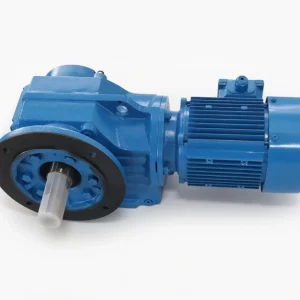
If your facility runs ten NMRV worm reducers around the clock, swap them all for KM helical-hypoid gearboxes and you’ll claw back roughly 18,000 kWh per year on the same workload. That’s the math that brings most plant engineers to KM in the first place. The KM050, KM063, and KM075 from akgnx Co., Ltd are right-angle reducers built around a helical input stage and a hypoid bevel output — the same gear architecture used in automotive rear axles, scaled down for industrial drive duty. Where a 50:1 worm reducer wastes 38% of input power as friction heat, a 50:1 KM holds efficiency above 90% across its full ratio range. The mounting bolt pattern matches RV/MRV exactly (with one exception we’ll cover below), so you can plan a swap without redrilling a single hole.
KM Series Specifications: Three Frame Sizes That Cover Most Demand
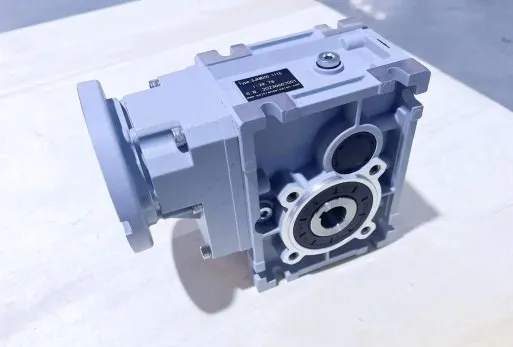
akgnx ships the KM in three frame sizes — KM050, KM063, KM075 — built as either two-stage or three-stage units. The frame number tracks the output flange diameter in millimeters, matching the corresponding RV/MRV worm gearbox dimensions. All gears are 20CrMnTi alloy steel, gas-carburized to a case depth of 0.6–0.9 mm and ground after heat treatment to AGMA Q9–Q10 quality. Housings are pressure die-cast aluminum on KM050 and KM063, switching to grey cast iron at KM075 and above for the higher torque density. Surface finish is shot-blasted, phosphated, then coated in RAL 5010 blue or RAL 7035 silver-grey — buyer’s choice.
| Frame | Output Torque (N·m) | 2-Stage Ratio Range | 3-Stage Ratio Range | Input Power (kW) | Weight (kg) |
|---|---|---|---|---|---|
| KM050 | 120 | 7.5–60 | 50–300 | 0.18–2.2 | 8.5 |
| KM063 | 220 | 7.5–60 | 50–300 | 0.37–4.0 | 14.0 |
| KM075 | 350 | 7.5–60 | 50–300 | 0.55–5.5 | 22.0 |
Five Reasons Plants Move from Worm to KM
Worth being concrete here, because every benefit comes with a number behind it.
1. Energy savings of 25–35% per drive. A KM running at 50:1 ratio holds 90–92% efficiency. The equivalent RV/MRV worm at the same ratio delivers around 60–63%. On a 1.5 kW conveyor running 6,000 hours a year, that gap converts to about 3,200 kWh saved annually per drive. At industrial electricity rates of US$0.12/kWh, payback on the KM unit-cost premium typically lands inside 14–18 months.
2. Cooler running temperature. Less wasted power means less waste heat. Surface temperature on a KM in steady-state continuous duty runs 12–18°C lower than the worm equivalent. For installations where the gearbox lives inside a control cabinet or a temperature-sensitive product zone, that single-figure difference often eliminates the need for a forced-air cooler.
3. Quieter operation. The hypoid output gear has a longer line of contact than a spiral bevel and engages with less impact than a worm hitting a wheel tooth. Sound pressure measured at 1 m from the housing typically sits at 60–63 dB(A) for a KM063, against 65–68 dB(A) for an MRV063 at the same load. Five decibels doesn’t sound like much on paper — in a packaging hall it’s the difference between needing hearing protection and not.
4. Higher service life. Bronze worm wheels wear; case-hardened steel hypoid gears don’t, in any meaningful sense, until they hit pitting fatigue beyond 30,000 hours. Field service intervals on a KM run roughly twice as long as on the equivalent worm reducer. If you’ve been replacing reducers on the same conveyor every two to three years, KM stretches that to five-plus.
5. Drop-in dimensions. Output flange, output shaft height, foot pattern — KM matches RV/MRV. The single exception: KM050 has slightly different mounting compared to RV050 (flange OD differs by 8 mm). Frame sizes 063, 075, 090, and 110 are direct interchanges. For most retrofits, “drop-in” is literally what happens.

When to Pick a KM Over a Worm Reducer (and When Not To)
KM isn’t always the right answer. The economics tip toward worm in three specific scenarios. First, applications under 0.37 kW running less than 2,000 hours a year — the energy savings won’t pay back the price premium. Second, applications that require self-locking. The KM is fully reversible at every ratio; if the load can backdrive (lifts, gates, rotary tables holding a load against gravity), you need the friction lock that only a worm gearbox provides. Third, very high-ratio low-power positions — at 200:1 or above with input under 0.5 kW, a worm-and-wheel set in two stages stays compact while a 3-stage KM gets bulky.
The decision matrix below makes the call simpler than ratio tables and torque curves on their own:
| Application Profile | Best Choice | Reason |
|---|---|---|
| Conveyor, S1 duty, >0.55 kW, >3000 hrs/year | KM | Energy savings drive payback |
| Lift, gate, hoist, rotary table | MRV (worm) | Need self-locking |
| Mixer, agitator, low-volume process | KM | Heat reduction matters |
| Intermittent duty, <1 hr/day total runtime | MRV (worm) | Lower upfront cost |
| High ratio (>200:1) at low power | MRV double-stage | More compact |
| Quiet environment (lab, food hall, retail) | KM | 5 dB(A) quieter |
How the Hypoid Output Stage Actually Works
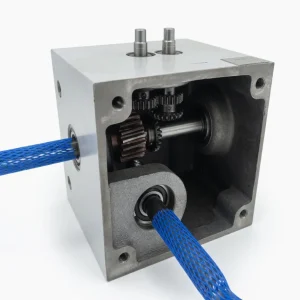
The defining feature of a KM is the hypoid output stage. A hypoid gear pair is a bevel gear set where the pinion axis is offset from the wheel axis — picture two crossed lines that don’t intersect, where a standard bevel gear has axes that meet at a point. The offset gives several practical wins. Tooth contact is no longer a single moving point but a sliding line, so contact stress drops at the same load. The pinion can be made larger in diameter (because it doesn’t have to taper to a point), so it carries more torque. And the offset arrangement means the pinion can sit below the wheel axis, which is exactly what you want when the input shaft enters the housing horizontally and the output drives a vertical or angled load.
The trade-off is manufacturing complexity. Hypoid gear cutting needs a Gleason-pattern generator (or its modern CNC equivalent) and a final lapping operation that pairs each pinion to a specific wheel — they’re sold as matched sets and can’t be mixed. That’s why hypoid-output reducers cost more than spiral bevel reducers, and why generic NMRV plants don’t make them. akgnx runs dedicated hypoid lapping cells specifically for the KM line.
Industries That Benefit Most from a KM Swap
Five sectors deliver the fastest payback on a worm-to-KM conversion. Food and beverage packaging — case erectors, label applicators, cap feeders running multi-shift schedules — captures the energy savings plus the quieter operation that matters in a retail-supply environment. Automated logistics and warehousing, where a single distribution center might run 80–120 conveyor drives, sees compounded electricity savings on the order of US$15,000–30,000 per year. Light manufacturing and assembly lines benefit from heat reduction; KM drives let you specify lower-rated motor cooling fans or skip enclosure ventilation entirely. Commercial laundries and dishwashing tunnels appreciate the longer service interval — wet-environment duty hits worm reducer wheels hard, and stepping up to KM with a stainless output shaft cuts replacement frequency by half. And dosing/feeding equipment in the chemical and water-treatment industries values the predictable output speed at varying load, which the higher-stiffness gear train delivers without the slip-stick that worms exhibit at low loads.
Brand Compatibility Reference
If your facility already runs reducers from one of the brands below, the KM is a direct or near-direct replacement. The size mapping that follows lets you specify a KM swap from an existing part number on the nameplate.
| akgnx KM Size | Bonfiglioli A | Tramec K | STM HM / Aokman KM |
|---|---|---|---|
| KM050 | A05 | K50 | HM50 / KM50 |
| KM063 | A10 | K63 | HM63 / KM63 |
| KM075 | A20 | K75 | HM75 / KM75 |
For OEM machine drives — KM is field-installed on packaging lines from Marchesini, IMA, Cama and OPM, on case-handling equipment from Wexxar and Loveshaw, and on conveyor systems from Interroll, Itoh Denki and Hytrol. Talk to us about specific OEM model fits before ordering, since some builders use proprietary motor flanges that need an adapter ring. See helical worm reducer alternatives if you’re comparing across the akgnx range.
Selecting Input and Output Configurations
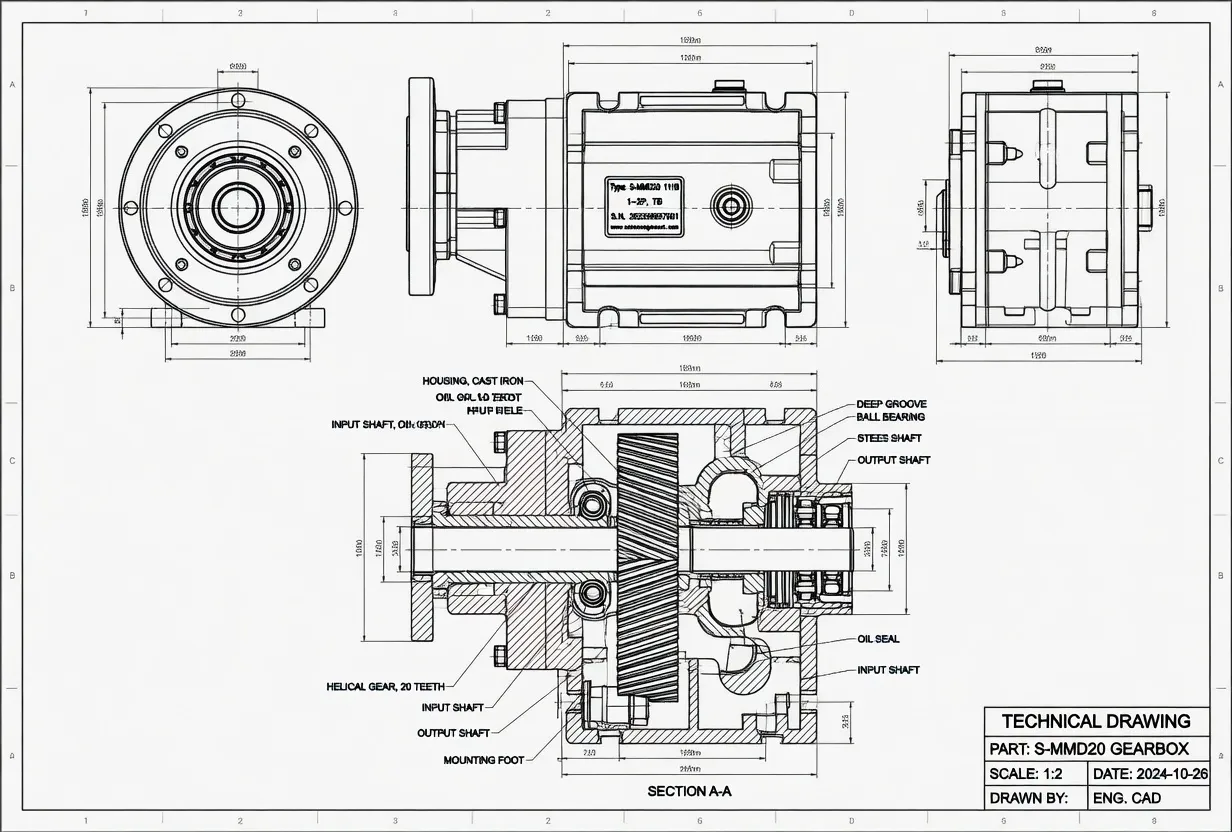
KM ships with five input options and three output options — eleven combinations covering nearly any installation. On the input side: direct-coupled motor (AC, AC brake motor, DC, or servo with encoder pre-fit), IEC B5 or B14 hollow input flange, NEMA C-face flange, servo motor flange (with reduced backlash bearings), or solid input shaft for belt or chain drive. On the output side: keyed hollow shaft (most common), hollow shaft with output flange (for vertical pump or agitator drives), or plug-in solid shaft (for direct couplings and chain drives).
The configuration that solves the most installation problems for first-time KM buyers: hollow output shaft + IEC B5 motor flange + brake motor. That setup lets you bolt the KM directly onto a driven shaft (no coupling alignment), bolt a standard IEC motor onto the gearbox (no special fits), and stop the load instantly when the line e-stops (the brake motor releases the holding torque on power-up, then re-engages within 50 ms when power drops).
Spare Parts and Matched Components
akgnx stocks the components that get specified individually for KM rebuilds and custom configurations:
- Hypoid gear matched sets: Pinion-and-wheel pairs lapped together, supplied with the contact pattern photograph showing 75%+ tooth engagement. Order by ratio and frame size.
- Helical input gears: Module M1.5–M3 single helical, ground to AGMA Q9, 20CrMnTi case-hardened.
- Output shafts: Solid shafts in C45 induction-hardened steel; hollow shafts available with keyway or shrink-disc-ready profile — see helical worm reducer shafts.
- Bearings: SKF or NSK tapered roller pairs for the output shaft, deep-groove ball bearings on the input.
- Motor adapters: IEC, NEMA, and servo-motor flange rings with concentricity machined to ±0.02 mm.
- Synthetic gear oil: ISO VG220 PAO factory-fill (lifetime), VG320 for high-ambient or shock-load duty.
Why Buyers Pick akgnx for the KM Range
akgnx has manufactured power-transmission components for 17 years, and the KM line has been in continuous production since 2014. Hypoid gears are cut and lapped in a dedicated production cell, separated from worm-gear lines to prevent ferrous-bronze cross-contamination. Every KM ships with a no-load run test report, hypoid contact pattern photograph, and ISO 9001:2015 conformity certificate. Lead time on KM050–KM075 stock items is 9 working days from order; custom configurations including special ratios or non-IEC motor flanges ship within 21 days. The 24-month warranty covers gears, bearings, housings, and integrated motor windings. More about akgnx production capability.
What KM Customers Say After 12+ Months
“Replaced 22 NMRV63 worm units with KM063 across our distribution center conveyor system. Energy meter on the conveyor sub-panel shows we’re pulling 14% less power on the same throughput. Inverters used to overheat in summer; that’s gone now. The retrofit took two days per shift, mostly because we had to re-key the output shafts.”
— Hugo P., Maintenance Engineer, e-commerce fulfillment center, Netherlands
“Bought six KM050 for a new bottling line — used Bonfiglioli A05 on the previous line and wanted to compare. Mounting interface was identical, no surprises during install. Eight months in, the KM units run quieter than the Bonfiglioli at the same RPM, and our service log is empty for both.”
— Anders L., Project Engineer, beverage packaging line builder, Denmark
“We specified KM075 with brake motor for a vertical mixer drive. Self-locking wasn’t a hard requirement, but the 50 ms brake response gives us better process control on the dosing cycle. Build quality looks comparable to the Italian unit we replaced — and it cost about 35% less landed.”
— Aleksei V., Technical Director, chemical processing OEM, Estonia
“Pleasant surprise: ordered KM063 with NEMA C-face flange (we run American motors locally), and akgnx had it on the spec sheet — didn’t need an adapter. Lead time was 11 working days plus shipping. Documentation was thorough, all in English.”
— Roger T., Mechanical Engineer, conveyor manufacturer, Canada
FAQ on the KM Helical-Hypoid Gearbox
Q1: Will my electricity savings really pay back the price difference?
If your duty cycle exceeds 3,000 hours per year, yes — typically inside 14–18 months for the KM050/063 frame. Below 1,500 hours per year, the math gets thinner; do the calculation against your local power tariff before deciding.
Q2: Can the KM run vertically with the motor pointing down?
Yes, but specify the mounting position at order time. Vertical-down (V5) requires a slightly higher oil fill and an upper bearing seal that’s rated for permanent oil immersion. Standard horizontal-fill units don’t have either — running them vertical-down causes the upper bearing to dry out within months.
Q3: How do I know if my motor’s flange will fit?
Check the motor nameplate for the IEC frame designation (B5, B14, or B3 plus a flange size like 80, 90, 100). Send us those numbers; we’ll confirm direct fit or specify the adapter ring needed. NEMA C-face motors also fit with a separate adapter we keep in stock.
Q4: Are KM gears noisier when worn?
Hypoid gears that have run their natural service life develop a characteristic mid-frequency hum (around 800–1200 Hz) about 1,500 hours before pitting failure. Worm gears, by contrast, get noisier as the bronze wheel wears unevenly. The hum is actually a useful predictive maintenance signal — start sourcing a replacement when you hear it.
Q5: Can I run the KM on a variable-frequency drive (VFD)?
Yes, across the full speed range from about 5 Hz to 60 Hz. Below 5 Hz the integrated motor’s cooling fan stops being effective; for sustained low-speed operation, specify a forced-cooled motor variant. Above 60 Hz the gearbox is fine but motor-side derating applies — check input torque limits.
Q6: Do KM units need oil changes?
Synthetic PAO ISO VG220 factory-fill is lifetime — no scheduled change for the KM050 or KM063 in normal duty. KM075 with continuous heavy load benefits from a single oil change at 20,000 hours. Mineral-oil-filled custom variants need replacement every 8,000 hours.
Q7: How fast can you ship if I have an emergency replacement?
Stock KM050 to KM075 with standard ratios ship same-day for orders received by 11 AM China time. Air freight to most destinations is 4–6 days. Reach our drives team for emergency procurement.
Calculate Your Energy Savings on a KM Retrofit
Tell us your existing reducer count, runtime, and tariff — we’ll send back a ROI estimate plus delivered KM pricing within 8 hours.