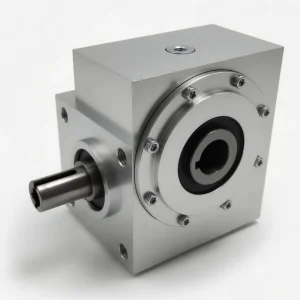
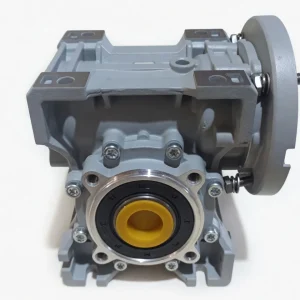
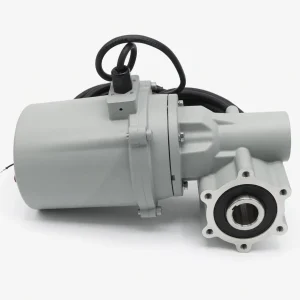
Description
A modern dairy or beverage processing line subjects its drive components to two to three high-pressure caustic washdowns per shift, with cleaning cycles using 80°C water at 80–100 bar plus pH 12+ alkaline cleaning agents. A standard aluminum-housed worm gearbox fails seal integrity within 6–12 months in this environment. The HSRV stainless steel NMRV gearbox series is engineered for it: 304 or 316 stainless housing (depending on chemistry exposure), IP69K-rated washdown sealing, NSF-H1 food-grade lubricant fill, and EHEDG-aligned hygienic geometry that drains cleaning fluid completely between cycles. Output torque ranges from 24 Nm on the HSRV030 to 820 Nm on the HSRV150 frame.
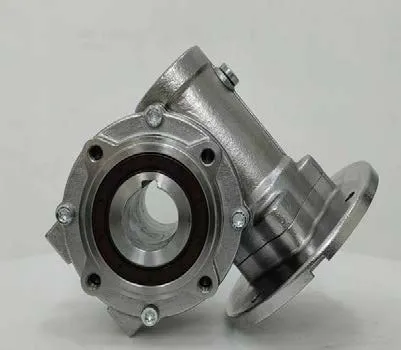
Key Specifications & Parameters of the HSRV Stainless Steel Worm Gearbox
The HSRV series spans seven frame sizes from HSRV030 through HSRV150, covering the torque envelope of typical food processing, beverage filling, and pharmaceutical equipment auxiliary drives. All frames share the same hygienic-design seal package, IP69K rating, and NSF-H1 lubricant fill option — differentiated only by torque capacity and output bore diameter. Ratings reference 1,400 rpm input per ISO 14521 worm gear load capacity methodology.
| Frame | Center Distance | Continuous Torque | Output Bore | Weight |
|---|---|---|---|---|
| HSRV030 | 30 mm | 24 Nm | Ø14 mm | 3.6 kg |
| HSRV040 | 40 mm | 62 Nm | Ø19 mm | 6.8 kg |
| HSRV050 | 50 mm | 98 Nm | Ø25 mm | 10.5 kg |
| HSRV063 | 63 mm | 180 Nm | Ø25 mm | 16.4 kg |
| HSRV075 | 75 mm | 295 Nm | Ø28 mm | 24.0 kg |
| HSRV110 | 110 mm | 560 Nm | Ø42 mm | 52 kg |
| HSRV150 | 150 mm | 820 Nm | Ø55 mm | 94 kg |
Note: All HSRV frames support reduction ratios from 5:1 to 100:1, with self-locking holding force at ratios ≥30:1. IP69K washdown rating is standard across all frames. Material specification 304 or 316 stainless is selectable per application chemistry exposure.
What Is a Stainless Steel Worm Gearbox & Why Food Industry Needs It
A stainless steel worm gearbox is a right-angle worm gear reducer with the entire wetted exterior — housing, mounting flange, output cover, and exposed shaft — manufactured from 304 or 316 austenitic stainless steel rather than the cast iron or aluminum typical of general industrial worm gearboxes. The stainless construction addresses three failure modes specific to food, beverage, and pharmaceutical processing environments:
- Caustic CIP/SIP corrosion: Cleaning-in-place chemistries (NaOH, HNO₃, peracetic acid) at pH 12+ corrode aluminum housings within months. 304/316 stainless resists these chemistries indefinitely.
- Galvanic compatibility: Food and beverage equipment frames are predominantly stainless. A non-stainless gearbox creates a galvanic couple that accelerates corrosion at the mounting interface; stainless eliminates the issue.
- Hygienic geometry compliance: EHEDG (European Hygienic Engineering & Design Group) and 3-A Sanitary Standards require external surfaces with radii ≥3 mm, no horizontal flat surfaces that pool water, and crevice-free joints. The HSRV housing geometry is engineered to these requirements.
Per ISO 14159 (hygiene requirements for food machinery design) and the EHEDG Doc 13 hygienic design criteria, a properly-specified stainless worm gearbox must also use externally-cleanable seal designs and food-contact-compatible lubrication. The HSRV achieves both: FKM (Viton) double-lip seals with smooth external geometry, and NSF-H1 / FDA 21 CFR 178.3570-compliant lubricant fill on the food-grade variant. Detailed industrial application case studies covering food-line gearbox specification are available at the industrial worm reducer applications knowledge base.
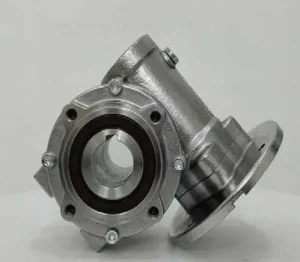
Types of HSRV Stainless Worm Gearbox — 304 vs 316 vs Specialty
The HSRV platform supports four material configurations to match different processing environments. The right specification depends primarily on chemistry exposure (chloride content, peracetic acid concentration, brine immersion frequency) and secondarily on regulatory requirements specific to the end-product market.
| Variant | Housing Material | Lubricant Fill | Best Application |
|---|---|---|---|
| HSRV-304 | 304 stainless | PAO synthetic | General food & bakery lines |
| HSRV-304-FG | 304 stainless | NSF-H1 food-grade | Direct food-contact zones |
| HSRV-316 | 316 stainless | PAO synthetic | Dairy, brine, seafood |
| HSRV-316-PH | 316L electropolished | NSF-H1 food-grade | Pharmaceutical & biotech |
The 304 vs 316 selection rule of thumb: specify 316 whenever chloride exposure exceeds 200 ppm (typical of meat brining, seafood processing, and salted dairy products), or when peracetic acid sanitizer concentration exceeds 0.4%. Specify 304 for general bakery, beverage, and produce processing where chloride exposure is minimal. The 316L electropolished variant adds a Ra ≤0.4 µm surface finish required for pharmaceutical and biotech equipment under USP <1058> cleaning validation requirements.
HSRV Production Process — From Stainless Billet to Validated Hygienic Drive
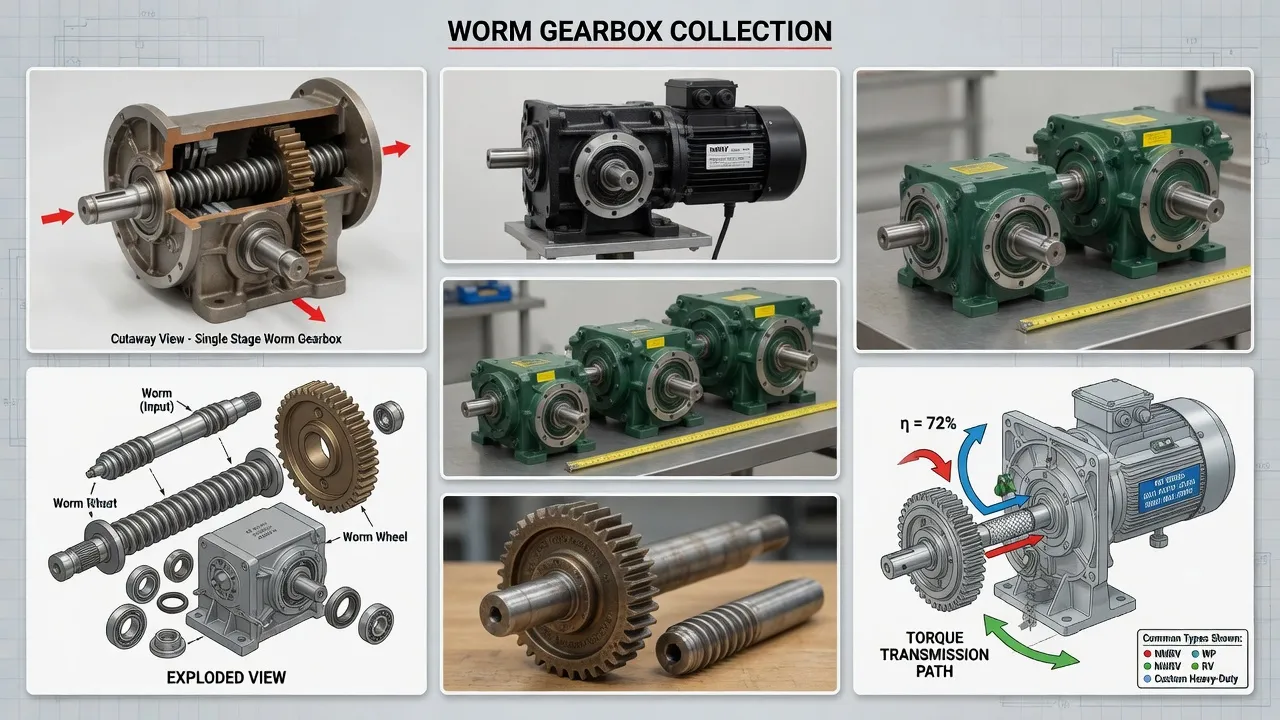
The HSRV stainless production flow differs from a standard aluminum NMRV worm gearbox in three key stages: housing manufacturing (machined billet vs die cast), surface finishing (passivation/electropolish vs powder coat), and final assembly (hygienic torque-controlled fasteners vs general-purpose). The full process:
- Stainless billet machining: 304 or 316 stainless billet stock is CNC-machined to housing geometry. Stainless cannot be die-cast; subtractive machining is the only viable production route, which is why stainless worm gearboxes carry a meaningful price premium over aluminum equivalents.
- Bronze worm wheel casting: CuSn12Ni2 phosphor bronze centrifugally cast, hardness HB 95–110. Bronze remains the worm wheel material even on the stainless variant — austenitic stainless does not have the bearing-surface properties required for the worm-mesh sliding contact.
- Worm screw machining: 17-4 PH stainless steel (precipitation hardening grade) used on the HSRV-316-PH variant for full stainless drivetrain in pharmaceutical applications. Standard variants use 20CrMnTi case-hardened steel for mechanical durability.
- Surface treatment: Standard variants receive citric acid passivation per ASTM A967, removing iron contamination from machining. Pharmaceutical variants additionally undergo electropolishing to Ra ≤0.4 µm per ASTM B912.
- Hygienic assembly: FKM (Viton) double-lip seals installed with smooth external geometry per EHEDG criteria. Lubricant fill (PAO synthetic or NSF-H1 food grade per variant) injected at controlled volume.
- Validation testing: Each unit pressure-tested to IP69K (80–100 bar high-pressure spray from all directions, 80°C water temperature). Acceptance: zero internal moisture detected after 72-hour post-test inspection.
How to Select the Right HSRV Worm Reducer for Food & Beverage Equipment
Use this seven-step procedure for HSRV specification. The hygienic-grade selection adds a chemistry-exposure step beyond the standard worm gearbox sizing methodology.
- Calculate continuous & peak torque: Apply 1.5× service factor for general food line duty, 2.0× for shock-loaded duty (dough mixers, meat grinders, packaging closure heads).
- Determine output speed: Most food line conveyors run 28–47 rpm; mixer/agitator drives run 30–180 rpm. Calculate ratio = motor rpm / required output rpm.
- Specify chloride exposure: Measure or estimate chloride concentration in your typical wash chemistry. >200 ppm chloride or >0.4% peracetic acid → specify 316 stainless. Otherwise → 304 stainless.
- Confirm food-contact requirement: If the gearbox sits in the food-product zone (Zone 1 per EHEDG classification), specify NSF-H1 food-grade fill (HSRV-XXX-FG variants). If only splash zone (Zone 2), standard PAO synthetic fill is acceptable.
- Verify pharmaceutical requirements: For biotech and pharmaceutical applications under USP <1058> or FDA cGMP, specify the HSRV-316-PH electropolished variant with full Ra ≤0.4 µm surface validation.
- Select frame size: Match service-factor-adjusted torque to the HSRV frame catalog rating. Specify one frame size larger than calculated when the application includes high-pressure CIP washdown impacts.
- Choose mounting: Foot mount with stainless brackets, B5 flange for direct couple to driven shaft, or hollow-shaft for direct mount on conveyor head pulleys.
Compatible Components & Spare Parts We Stock
| Component | Specification | Use Case |
|---|---|---|
| Stainless worm shaft | 17-4 PH or 20CrMnTi, M1.5–M5 | Pharmaceutical or standard service |
| Brass worm wheel | CuSn12Ni2, custom keyway | Field rebuild kit |
| Worm and gear set (matched) | Lapped pair, hygienic-grade | Complete drivetrain swap |
| FKM (Viton) seal kit | Double-lip, IP69K-rated | Annual seal replacement |
| NSF-H1 lubricant refill | ISO VG320, 21 CFR 178.3570 | Periodic refill (if required) |
| Stainless mounting hardware | 316 SS bolts & brackets | Hygienic installation |
| Tapered roller bearings | SKF / NSK, food-grade grease | Service rebuild |
All HSRV components are stocked as separate spares for service rebuild work and OEM platform-line maintenance programs. The matched worm-and-gear set is the single most-ordered service item for HSRV deployments — reference the worm and gear set technical reference for material and machining specifications when ordering custom-tooled gear pairs for proprietary OEM platforms.
Hygienic Design Compliance — EHEDG, 3-A, USDA & FDA
The HSRV design follows the leading hygienic equipment standards used in food, beverage, and pharmaceutical equipment validation:
- EHEDG Document 13: Hygienic design criteria for closed processing equipment — external radii ≥3 mm, no horizontal flat surfaces, drainable geometry. The HSRV housing geometry is third-party-evaluated to these criteria.
- 3-A Sanitary Standards 31-04: Hygienic equipment design for the U.S. dairy industry. The HSRV-316 variant carries 3-A symbol authorization for direct dairy application, with the supporting documentation package available upon order.
- USDA equipment acceptance: HSRV stainless variants accepted for USDA-inspected meat, poultry, and seafood processing facilities (USDA Food Safety and Inspection Service equipment acceptance program).
- FDA 21 CFR 178.3570: NSF-H1 lubricant fill on the FG variants is qualified for incidental food contact, with FDA registration documentation supplied upon shipment.
- USP <1058> / <1116>: The HSRV-316-PH electropolished variant is qualified for cleaning validation under United States Pharmacopeia chapters governing equipment qualification and microbiological control of pharmaceutical processes.
What Food, Dairy & Pharmaceutical Engineers Say About the HSRV
“Specified HSRV-316 across 32 conveyor drives in our cheese-processing facility. Three CIP cycles per day at 80°C with 1.5% NaOH wash. 18 months service, zero seal failures, zero corrosion at the mounting interfaces — previous brand was failing every 9–10 months.”
— Henrik J., Plant Reliability Engineer, Dairy Processing, Denmark
“Used HSRV-316-PH on a sterile filling line in our biotech facility. The electropolished surface passed our cleaning validation on first attempt — saved roughly four weeks of validation re-work that the previous (non-EP) gearbox would have required. NSF-H1 fill simplified the QA documentation considerably.”
— Carolina M., Pharmaceutical Process Engineer, Spain
“Installed 28 HSRV-304-FG units on bakery dough mixer drives. Daily flour-dust exposure plus weekly washdown was killing aluminum gearboxes within 14 months. Two years on the HSRV units now with zero failures — and the food-grade fill closed an audit finding from our 2023 BRCGS recertification.”
— Marek W., Maintenance Manager, Industrial Bakery, Poland
“Replaced 14 worn-out gearboxes on a tuna canning line with HSRV-316 frames in 80:1 ratio. The seafood-brine environment had been brutal on the previous brand. 11 months in, all 14 still running clean — and the U.S. inventory shipment got us replacements in 8 days vs the 12-week European brand quote.”
— Maria F., Process Engineer, Seafood Processing, Mexico
Global Markets & Regulatory Compliance Documentation
HSRV stainless worm gearboxes ship into more than 35 countries each year, with the largest export concentrations in the European Union (Germany, Netherlands, Italy, Spain, Poland), the Middle East & GCC (UAE, Saudi Arabia), Latin America (Mexico, Brazil), and Southeast Asia (Vietnam, Thailand, Indonesia) — food & beverage processing markets with strong hygienic-equipment investment.
Compliance documentation we maintain by market:
- European Union: EHEDG Document 13 design conformity statement; CE machinery declaration; EC 1935/2004 food-contact compliance; REACH SVHC / RoHS 2 declarations.
- United States: USDA equipment acceptance; 3-A Symbol Authorization (HSRV-316 variant); FDA 21 CFR 178.3570 NSF-H1 lubricant compliance; FSMA preventive controls compatibility.
- Sustainability footprint: 304/316 stainless content sourced 70% from recycled streams; ISO 14001:2015 environmental management; sealed-for-life lubrication on standard PAO variants eliminates field oil change waste; shipping packaging is 100% recyclable cardboard with no plastic foam.
- Halal / Kosher: NSF-H1 lubricant on the FG variant carries Halal Trust certification (for GCC export) and OU Kosher certification (for US/Israeli kosher dairy markets).
Why Source the HSRV Stainless Worm Gearbox From Us
Three factors that consistently drive food, beverage, and pharmaceutical equipment OEMs to specify HSRV from gearboxesworm.net:
- Hygienic-design engineering specialization: EHEDG and 3-A compliance is engineered into the HSRV design rather than retrofit-claimed on a generic platform. The geometry, surface finish, seal placement, and lubricant chemistry are all specified to the relevant hygienic standard from initial design phase. Read more about our hygienic worm gearbox engineering background.
- Documentation completeness: Each HSRV ship-to-customer includes the relevant compliance package: material certificates, surface finish reports (electropolished variants), passivation reports per ASTM A967, NSF-H1 chemistry validation. This documentation flow is what closes audit findings — not just a marketing claim of compliance.
- Worm gearbox specialist supply chain: Our entire production focus is worm gearbox; the HSRV is not a niche derivative of a broader catalog. Contact our hygienic worm gearbox engineering team with your specific application chemistry profile and audit requirements for project-specific spec review.
Frequently Asked Questions About the HSRV Worm Gearbox
1. What’s the actual difference between IP67 and IP69K, and why does food industry need IP69K?
IP67 covers immersion to 1 m water depth at ambient temperature, but does NOT cover high-pressure spray. IP69K (per ISO 20653) tests specifically for 80–100 bar high-pressure spray at 80°C from multiple angles — the actual condition food and beverage line CIP washdown produces. A gearbox rated IP67 but not IP69K can fail seal integrity in food-line service even though it “passes” immersion tests. The HSRV is rated IP69K specifically because that’s the operationally relevant standard.
2. Can I use 304 stainless instead of 316 to save cost?
For general bakery, beverage, and produce processing, yes — 304 stainless is fully adequate and saves roughly 18–25% on housing material cost. For dairy (calcium chloride and salt exposure), meat brining, seafood processing, or any application using peracetic acid sanitizer above 0.4%, 304 will pit and corrode within 12–24 months. 316 carries the molybdenum addition (2–3% Mo) that resists chloride pitting. The decision rule: if chloride exposure exceeds 200 ppm, specify 316.
3. What does the HSRV cost compared to a standard aluminum NMRV?
HSRV-304 carries roughly a 2.4–3.0× cost premium over equivalent aluminum NMRV at single-unit pricing. HSRV-316 adds another 18–25% over HSRV-304. HSRV-316-PH (electropolished pharmaceutical) adds another 30–40% over HSRV-316. The premium reflects the subtractive machining route (vs aluminum die-cast), the stainless raw material cost, and the hygienic surface finishing. For applications where stainless is required, the premium is unavoidable across any supplier — what matters is engineering quality and documentation depth.
4. Is the HSRV mechanically interchangeable with standard NMRV mounting?
Yes — HSRV mounting envelopes match the standard NMRV dimensional convention frame-by-frame: HSRV040 matches NMRV040, HSRV063 matches NMRV063, etc. For most retrofit installations, HSRV is direct mechanical drop-in for failed aluminum NMRV units in food-line service. This is the recommended retrofit path when an aluminum NMRV has corroded out and the operator needs to upgrade to stainless.
5. Does the HSRV require special lubrication maintenance?
Standard PAO synthetic fill: change every 8,000 hours or 24 months in typical food-line service. NSF-H1 food-grade fill: change every 6,000 hours or 18 months (food-grade lubricants generally have shorter service intervals than industrial PAO due to additive package limitations). For continuous-duty applications above 16 hours/day, halve these intervals. Lubricant condition monitoring (oil sample at 50% interval) is the recommended best practice for food-line gearboxes.
6. What lead times apply for HSRV configurations?
HSRV-304 in common ratios (15:1, 30:1, 50:1, 80:1) ships from finished-goods stock within 7–10 business days. HSRV-316 typically ships within 3 weeks (production-to-order). HSRV-316-PH electropolished variant typically 4–5 weeks given the additional surface finishing time. For OEM volume orders (50+ units), production allocations and contract pricing tiers are available — contact our team for project-specific scheduling.
7. How does the HSRV compare to a helical gearbox for hygienic applications?
A helical reducer offers higher efficiency (94–97% vs 65–75% for worm) but loses two important hygienic-design properties: self-locking holding (helical can back-drive) and right-angle compact form factor (helical is inline). For food line conveyors and packaging machines that benefit from self-locking and right-angle geometry, the worm gearbox is structurally the better fit. For continuous-duty mixer or pump drives where efficiency matters more, a stainless helical or bevel-helical reducer is worth evaluating.
Specifying a Stainless Worm Gearbox for Your Food, Beverage or Pharma Application?
Send our hygienic-drive specialists your application chemistry, torque/ratio, motor frame, and audit requirements — we’ll return a sized HSRV recommendation, compliance documentation summary, and pricing within one business day.