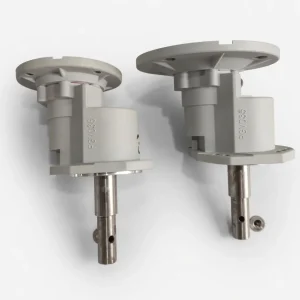
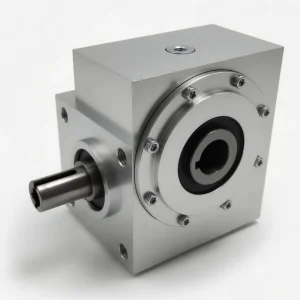
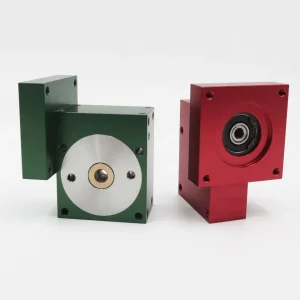
Description
A typical industrial band saw cutting structural steel sections generates blade-side reaction-force peaks of 3,800–6,200 N at the moment of tooth engagement — with the impact event occurring 18–24 times per second across the cut duration. The worm gearbox driving the blade must absorb the cyclic shock-load profile while maintaining cut accuracy and self-locking the blade against retraction during emergency-stop events. The SRV138 is engineered specifically for this duty: 380 Nm continuous torque with 2.4× shock-load capacity, 5:1 to 100:1 ratios, vibration-damped iron-reinforced housing for blade-harmonic suppression, and self-locking holding capacity at all ratios ≥30:1. Built for saw OEMs serving structural steel, lumber, and primary metal cutting markets.
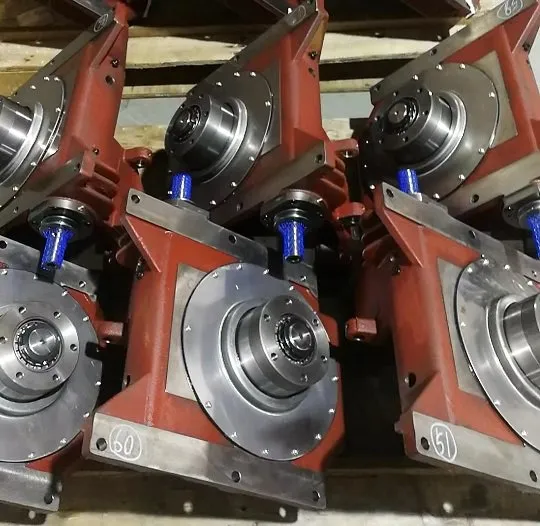
Key Specifications & Parameters of the SRV138 Saw Machine Worm Gearbox
The SRV138 occupies a 138 mm flange-diameter mounting envelope sized to match the saw-machine industry-standard interfaces. Cast-iron-reinforced housing for cyclic shock-load resistance, bronze worm wheel hardened for repetitive impact loading, case-hardened steel worm screw with deep case-depth specification. All ratings reference 1,400 rpm input under ISO 14521 worm gear load capacity methodology with shock-load service-factor adjustment per AGMA 2001-D04 (gear duty classification).
| Parameter | Value | Note |
|---|---|---|
| Mounting envelope | 138 mm flange | Saw-machine industry standard |
| Continuous torque | 380 Nm | Cutting-duty steady-state |
| Peak shock-load torque | 912 Nm (2.4×) | Tooth-engagement impact |
| Reduction ratio range | 5:1 – 100:1 | 15:1, 30:1, 50:1 most common |
| Self-locking threshold | ≥30:1 ratio | Holds blade at e-stop event |
| Vibration damping | 10–14 dB attenuation | vs std cast-iron housing |
| Total weight | 23.5 kg | Iron-reinforced housing |
| Output bore | Ø38 mm | Solid or hollow shaft |
| Radial output load | ≤7,200 N | Cyclic loading rated |
| Sealing rating | IP65 | Sawdust/coolant tolerant |
| Operating temperature | -10°C to +75°C | Saw-room ambient envelope |
| Cycle endurance | ≥15 million cuts | 75% load shock-cycle test |
What Is a Saw-Machine Worm Gearbox & Why Cutting Equipment Specifically Needs It
A saw-machine worm gearbox is a worm reducer engineered for the cyclic shock-load profile that defines industrial cutting equipment — band saws, cold-cut circular saws, log mill saws, and metal-cutting bandsaws. The cutting-duty profile differs from steady-state continuous duty in three measurable engineering dimensions:
- Cyclic tooth-engagement shock loading: Each saw-tooth-to-workpiece engagement event generates a transient torque spike 1.8–2.4× the steady-state cutting torque, with the impact frequency scaled to the blade-tooth count and feed rate. A standard worm gearbox sized for steady-state duty fails gear-mesh contact-fatigue and bearing-side fatigue at 30–45% of expected service life under this profile. The SRV138 specifies deeper worm-screw case-hardening (1.0–1.5 mm vs 0.6–0.9 mm general industrial) and a higher-grade bronze worm wheel (CuSn12Ni2-A vs CuSn12Ni2 standard) to accept the cyclic shock-load envelope.
- Blade-vibration harmonic suppression: Saw blades generate harmonic vibration in the 80–320 Hz band during cutting operation, with frequency content varying by blade tooth count, feed rate, and workpiece material. The vibration feeds back through the blade-drive shaft into the gearbox housing, accelerating bearing-side wear if not damped. The SRV138 iron-reinforced housing damps blade-band vibration by 10–14 dB compared to a standard cast-iron NMRV-style housing of equivalent torque rating.
- Self-locking blade-tension hold at emergency-stop: When a saw-machine emergency-stop activates (operator interlock, blade-break detection, jam event), the gearbox must hold the blade stationary against the residual cutting tension and the operator-side push-back load. Worm-architecture self-locking at ratios ≥30:1 holds the blade through the gear-mesh geometry; alternative architectures require an electromagnetic brake module that can fail electromechanically and represents an OSHA / ISO 13849 functional-safety analysis dependency.
Per ISO 14521 (worm gear load capacity), DIN 3996 (worm gear strength), AGMA 6034 (worm gear nomenclature), and ISO 13849 (machinery safety control systems) for the self-locking functional-safety contribution, a properly-sized SRV138 at 1.7× shock-load service factor delivers a cycle-count endurance exceeding 15 million cuts — equivalent to 5–7 years of typical industrial saw-machine duty at 8,000–12,000 cuts per shift. For deeper background on worm gearbox application case studies in cutting equipment and saw machinery, see the industrial worm reducer applications knowledge base.

Types of SRV138 Configurations for Saw Machine Applications
The SRV138 platform supports four standard variants matching different saw-machine architectures and cutting-process duty profiles:
| Variant | Output Style | Motor Type | Best Application |
|---|---|---|---|
| SRV138-S | Solid shaft Ø38 | 3-phase 380V AC | Standard band saws & cold cut |
| SRV138-H | Hollow shaft Ø38 | 3-phase 380V AC | Direct blade-drive shaft mount |
| SRV138-VFD | Solid shaft Ø38 | Inverter-duty motor | Variable feed-rate cutting |
| SRV138-HD | Solid shaft Ø38 | Heavy-duty industrial | Log mill & primary metal saws |
The SRV138-VFD variant has grown rapidly with the broad adoption of variable-feed-rate cutting on modern band saws — allowing the operator to optimize the feed-rate to material hardness and section size in real-time. The SRV138-HD variant is the operationally critical specification for log mill primary breakdown saws and large-diameter primary metal saws, where the cutting-duty cycle approaches 95% load utilization through the production shift. For saw-OEM motor pairing options across the AC inverter-duty universe, the worm gear motor specialist resource provides current motor-platform compatibility data.
SRV138 Production Process — Shock-Load Engineered Manufacturing Flow
The SRV138 production flow extends standard heavy-duty worm gearbox manufacturing with three saw-machine-specific control points: deeper worm-screw case-hardening, iron-reinforced vibration-damped housing manufacturing, and end-of-line shock-cycle acceptance test. Six stages:
- Bronze worm wheel casting: CuSn12Ni2-A high-grade phosphor bronze centrifugally cast in graphite molds, achieving HB 105–125 hardness — harder than the standard CuSn12Ni2 used in general-industrial worm gearboxes to support repetitive impact loading. Each casting passes ultrasonic verification per ASTM E114 with porosity acceptance <1.0% volumetric.
- Worm screw deep case-hardening: 17CrNiMo6 steel turned to rough profile, then case-carburized to HRC 60–62 with case depth 1.0–1.5 mm (deeper than the 0.6–0.9 mm standard for general industrial worm gearboxes), then CBN profile-ground to ISO 1328 Class 6 with surface finish Ra ≤0.3 µm. The deeper case-depth provides the impact-fatigue resistance required for cyclic tooth-engagement shock-load.
- Iron-reinforced housing manufacturing: EN-GJL-250 grey cast-iron housing with cast-in vibration-damping ribs at the gear-mesh region. The cast-iron housing mass-loads the gear-mesh resonance frequency outside the saw-blade harmonic band (80–320 Hz), delivering the 10–14 dB vibration attenuation. Stress-relief annealing at 580°C for 12 hours before precision CNC machining of bearing seats and mounting interfaces.
- Symmetric tooth-flank lapping: Each worm and worm wheel pair runs together for 40 minutes under graduated shock-load (alternating 100% / 175% of rated torque every 5 minutes) with lapping compound, achieving uniform tooth contact pattern verified by Prussian-blue check on both flanks.
- Heavy-duty bearing assembly: Tapered roller bearings preloaded to 0.005 mm axial-play specification, sized for 7,200 N radial load capacity at the blade-pulley contact point. FKM (Viton) double-lip seals with secondary labyrinth protection for sawdust and coolant exclusion. ISO VG320 PAO synthetic lubricant injected at 425 ml volume.
- Shock-cycle acceptance test: Each unit tested through 1,000 shock-load cycles at 175% rated torque on calibrated test stand, with backlash growth (<3%), oil temperature rise (ΔT <30°C), and vibration spectrum (RMS <3.5 mm/s per ISO 10816-3) recorded. Acceptance: zero detectable bearing-side rumble; no gear-mesh chatter; backlash within shipping spec.
How to Select the Right Worm Gearbox for Your Saw Machine Project
A six-step procedure aligns SRV138 specification with saw-machine cutting-duty requirements. The saw-specific steps (shock-load profile assessment and blade-harmonic damping classification) replace general-industrial assumptions used for catalog reducer selection.
- Calculate continuous cutting torque: Continuous: cutting-process steady-state torque under typical workpiece engagement. For typical structural-steel band saws: 220–320 Nm continuous at 50–90 m/min blade speed. For log mill primary breakdown: 180–280 Nm continuous at 800–1,400 m/min blade speed. For cold-cut circular saws on solid bar stock: 280–380 Nm continuous.
- Quantify shock-load profile: Peak torque per tooth-engagement event = continuous torque × shock factor. Apply shock factor 1.8× for steady cuts in homogeneous material; 2.0× for interrupted cuts in structural sections; 2.4× for cold-cut on hardened stock or bandsaws on irregular log profiles. The SRV138 2.4× rating accommodates the full shock-load envelope without service-factor compromise.
- Determine output speed: Band-saw blade pulley: 220–380 rpm output (corresponds to 50–90 m/min linear blade speed depending on pulley diameter). Cold-cut circular saw: 80–180 rpm output. Log mill primary saw: 380–620 rpm output.
- Confirm self-locking requirement: All saw-machine emergency-stop systems benefit from gearbox self-locking property to satisfy ISO 13849 functional-safety analysis without dependency on a separate brake module. Specify ratio ≥30:1 to engage the self-locking property; ratio ≥50:1 provides additional self-locking margin even with bronze-wheel wear over the service life.
- Select variant configuration: Standard duty (SRV138-S/H) for typical band-saw and cold-cut applications; VFD variant (SRV138-VFD) for variable-feed-rate cutting with closed-loop torque control; HD variant (SRV138-HD) for log mill primary breakdown and large-diameter primary metal saws with continuous high-load duty.
- Specify motor & verify mounting: 3-phase 380V/440V AC induction motors typical (4–15 kW depending on saw size). Inverter-duty motors (NEMA MG1 Part 31 compliant) for VFD variant. Confirm input rotation direction matches the saw-blade drive convention. Contact our saw-machine drive engineering team with your saw OEM platform, blade specifications, and feed-rate requirements for sized recommendation.
Compatible Components & Spare Parts We Stock
| Component | Specification | Use Case |
|---|---|---|
| Heavy-duty worm shaft | 17CrNiMo6, deep case 1.0–1.5 mm | Replacement worm screw |
| High-grade bronze worm wheel | CuSn12Ni2-A, HB 105–125 | Field rebuild kit |
| Matched worm and gear set | Lapped pair, dual-flank tested | Complete drivetrain swap |
| Tapered roller bearings (pair) | Heavy-duty, 7,200 N rating | Service rebuild |
| FKM seal kit | Double-lip + labyrinth, IP65 | Annual seal replacement |
| PAO synthetic lubricant refill | ISO VG320, shock-load rated | Service interval refill |
| Inverter-duty motor | NEMA MG1 Part 31, 4–15 kW | VFD variant motor swap |
All SRV138 components are stocked as separate spares for saw-machine field service and OEM in-line replacement programs. The matched worm-and-gear-set is the most-ordered service item across saw-machine deployments — recommended preventive replacement at the 12-million-cycle mark to maintain peak cutting accuracy. For deeper technical reference on saw-machine worm gearbox material specifications and shock-load engineering, see the comprehensive worm gearbox technical guide.
SRV138 Application Sectors Across Industrial Saw Machinery
The SRV138 is deployed across the full industrial saw machinery category — from primary forest products through finished metal-cutting operations — on cutting drives where the shock-load + self-locking + vibration-damping combination outperforms standard NMRV-grade alternatives:
- Industrial band saws (metal): Horizontal and vertical band saws cutting structural steel, stainless, aluminum, and non-ferrous materials. Typical SRV138-S at 30:1 ratio for blade-pulley speeds of 220–380 rpm.
- Cold-cut circular saws: Heavy-duty cold-cut saws for solid bar stock and structural sections. The 2.4× shock-load rating accommodates the high tooth-engagement impact of large-section cold cutting.
- Log mill primary saws: Primary breakdown saws in lumber mills cutting raw logs into cants and slabs. Typical SRV138-HD heavy-duty variant given the 95%+ load utilization across production shifts.
- Sawmill resaws & gang saws: Secondary breakdown saws in lumber processing, including gang saws cutting multiple boards simultaneously from cants.
- Stone & concrete cutting: Heavy-duty diamond-blade saws for granite, marble, and concrete cutting in quarry and construction-material processing operations. The IP65 sealing accommodates wet-cutting coolant exposure.
- Pipe cutting machines: Industrial pipe-cutting equipment for steel-pipe and stainless-pipe processing in pipeline and pressure-vessel fabrication. Self-locking property holds the cutting head position during pipe-rotation indexing.
- Composite material cutting: Specialized saws for fiberglass, carbon-fiber composite, and aluminum-honeycomb panel cutting in aerospace and automotive composite-part fabrication.
- Tire-recycling saws: Heavy-duty cutting equipment in scrap-tire recycling and crumb-rubber production facilities, where the abrasive-rubber cutting-duty profile suits the SRV138 shock-load engineering.
What Saw OEMs & Cutting-Equipment Operators Say About the SRV138
“Specified SRV138-VFD across 18 horizontal band-saw drives in a structural-steel service center. The closed-loop torque feedback through the inverter-duty motor combined with the 2.4× shock-load rating allowed us to push feed rates 22% higher than the previous gearbox-limited setup — meaningful productivity gain on the production line.”
— Stuart M., Engineering Director, Steel Service Center, New Zealand
“Replaced 24 worn-out worm gearboxes across our cold-cut circular saw fleet. Failure mode in the previous units was bronze worm-wheel impact-fatigue at the 14–18 month mark — right at the cyclic shock-load failure point. The SRV138 deeper case-hardening and CuSn12Ni2-A higher-grade bronze directly address what we were experiencing.”
— Hila B., Maintenance Engineering Lead, Steel Tube Plant, Israel
“Specified SRV138-HD heavy-duty variant on our log mill primary breakdown saw modernization — 14 saws across the production line. 22 months in continuous-shift duty, all 14 still running on factory-spec lubricant fill, blade cuts staying within tolerance through the cycle-count budget. Self-locking property closed the ISO 13849 functional-safety analysis on first review.”
— Jukka N., Plant Engineering Manager, Lumber Mill, Estonia
“Built SRV138-H hollow-shaft units into 32 vertical band saws shipping to construction-equipment-fabrication customers. Drop-in fit on all 32 with the standard saw-machine mounting envelope. The vibration-damped housing eliminated the cabinet-resonance issue we’d been chasing on the previous generation — saved acoustic-shielding redesign work.”
— Carlos R., Mechanical Design Engineer, Saw Machine OEM, Colombia
Why Source the SRV138 Saw Machine Worm Gearbox From Us
Three reasons saw-machine OEMs and cutting-equipment operators source SRV138 from gearboxesworm.net rather than catalog general-industrial reducer suppliers:
- Saw-machine engineering specialization: The deeper worm-screw case-hardening, CuSn12Ni2-A higher-grade bronze worm wheel, and iron-reinforced vibration-damped housing are not catalog options at general worm gearbox suppliers — they require dedicated material specifications, specific manufacturing tooling, and specialized shock-cycle test capacity. The SRV138 production line is configured specifically for saw-machine cutting duty. Read more about our saw-machine worm gearbox engineering background.
- Saw OEM platform compatibility: We maintain a verified compatibility chart of SRV138 mounting interfaces against the major saw-machine OEM platforms (Behringer, Kasto, Amada, DoAll, MEP, FMB, Wood-Mizer, USNR, Linck). For most retrofit installations, the SRV138 is direct mechanical drop-in — saves the bracket fabrication step that European-brand sources typically require.
- Volume scheduling for OEM and end-user channels: Annual contract pricing tiers at 50, 250, 1,000, and 5,000 unit volumes — with private-label badging available at 2,500+ units for OEMs marketing branded saw-machine products. Critical for saw OEMs scaling new platforms and for end-user fabrication operations standardizing across multi-saw fleets.
Frequently Asked Questions About the SRV138 Saw Machine Worm Gearbox
1. Why does the cyclic shock-load profile of saw cutting fail standard worm gearboxes?
Standard worm gearboxes use 0.6–0.9 mm case depth on the worm screw and standard CuSn12Ni2 bronze (HB 95–110) on the worm wheel — sized for steady-state continuous duty. Each saw-tooth-engagement event drives a transient torque spike 1.8–2.4× the steady-state value, with frequency content matching the blade tooth-count and feed rate. Repetitive impact-loading at this peak amplitude exceeds the case-depth fatigue limit of standard worm screws and the bronze hardness limit of standard worm wheels — producing tooth-flank pitting and case-spalling failures at 30–45% of expected service life. The SRV138 deeper case-depth (1.0–1.5 mm) and higher-grade bronze (CuSn12Ni2-A at HB 105–125) accept the cyclic shock-load envelope without premature fatigue.
2. How does the iron-reinforced vibration-damped housing affect cutting accuracy?
Saw blades generate harmonic vibration in the 80–320 Hz band that feeds back through the blade-drive shaft into the gearbox housing. Standard housing geometries amplify this vibration into the gear-mesh, creating two operationally relevant problems: (1) accelerated bearing-side wear, and (2) cut-surface chatter marks visible on the workpiece. The SRV138 iron-reinforced housing damps blade-band vibration by 10–14 dB, reducing both the bearing wear rate and the cut-surface chatter. Customer field data shows visible improvement in cut-surface finish quality and a 40–55% extension of bearing service life vs unreinforced cast-iron housing of equivalent torque rating.
3. Is the SRV138 mechanically interchangeable with the saw-machine industry standard mounting?
Yes — the 138 mm flange diameter, output-shaft dimensions (Ø38 mm bore), and overall mounting envelope match the saw-machine industry-standard convention used across major saw OEM platforms. The SRV138 functions as direct mechanical drop-in replacement for failed saw-machine gearboxes from competing brands. Verify motor frame compatibility (most saw-machine motors are 3-phase 380V/440V AC induction in the 4–15 kW range; all standard frames supported) and confirm input rotation direction matches the existing installation.
4. What service life can I expect in continuous-duty saw machine operation?
For typical 16-hour two-shift industrial saw service at 8,000–12,000 cuts per shift: 35,000+ hours service life, equivalent to 5–7 years. For continuous 24/7 high-volume duty on log mill primary breakdown saws: 22,000–28,000 hours, equivalent to 3–4 years. The 15-million-cycle endurance verification translates directly to these calendar-time projections at typical saw-machine cycle frequencies. Annual seal kit replacement plus the recommended worm-and-gear-set preventive replacement at the 12-million-cycle mark are required to achieve full service life.
5. How does the self-locking property satisfy ISO 13849 functional-safety requirements?
ISO 13849 (machinery safety control systems) classifies the saw-machine emergency-stop function as a safety-related part of control system requiring documented PL (performance level) analysis. When the e-stop circuit de-energizes the motor, the gearbox must hold the blade stationary until the kinetic energy fully dissipates. The SRV138 self-locking property at ratios ≥30:1 holds the blade through purely mechanical gear-mesh geometry — no electromagnetic component, no failure mode dependency. This contributes to PL d or PL e classification of the e-stop function without requiring a separate brake module in the safety analysis. We provide the supporting documentation for PL analysis on request.
6. What’s the cost premium of SRV138 over a standard heavy-duty NMRV-style worm gearbox?
SRV138 carries roughly 1.5–1.8× the unit price of equivalent-torque general-industrial heavy-duty NMRV-style worm gearboxes, reflecting the deeper worm-screw case-hardening, CuSn12Ni2-A higher-grade bronze, iron-reinforced vibration-damped housing, and the shock-cycle acceptance test. At OEM volume tiers (1,000+ units), the premium narrows to 1.3–1.5×. For saw-machine applications with cyclic shock-load duty, the longer service life (typically 2.5–3.5× vs general-industrial worm gearboxes in the same duty) and avoided cutting-quality degradation typically pay back the cost premium within 12–20 months of operation.
7. What lead times apply for SRV138 standard vs custom configurations?
Standard SRV138-S and SRV138-H in common ratios (15:1, 30:1, 50:1, 80:1) ship from finished-goods stock within 7–10 business days. SRV138-VFD with pre-mated inverter-duty motor typically ships within 14 business days based on motor selection. SRV138-HD heavy-duty variant ships within 3 weeks given the dedicated production schedule. For OEM volume orders (250+ units annually) with custom configurations or private-label badging, dedicated production allocations align with 4–6 week project schedules — contact our team for project-specific scheduling.
Specifying a Worm Gearbox for Your Saw Machine or Cutting Equipment Project?
Send our saw-machine drive specialists your saw type, blade specifications, cutting-duty profile, and motor frame — we’ll return a sized SRV138 recommendation, lead time, and OEM volume pricing within one business day.