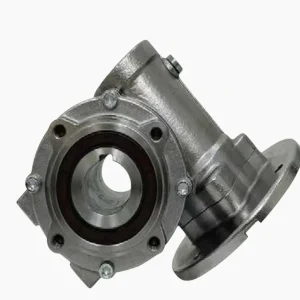
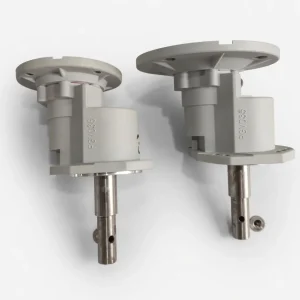
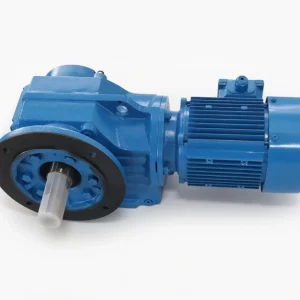
Description
A modern integrated steel mill operates roughly 180–240 auxiliary drives per cast-and-roll line, each handling continuous-duty torque between 15,000 and 80,000 Nm in ambient temperatures sustained at +85°C to +130°C through the cast-roll-anneal sequence. A standard worm gearbox rated for general industrial duty fails housing thermal-deformation, lubricant viscosity collapse, and seal lip degradation within 6–14 months in this environment. The RR528–RR577 heavy-duty worm reducer series is engineered specifically for the metallurgy operating envelope: 18,500–78,000 Nm continuous torque, dual-stage worm-helical architecture, foundry-grade cast-iron housing, and a high-temperature seal-and-lubrication package qualified for sustained +130°C ambient operation.
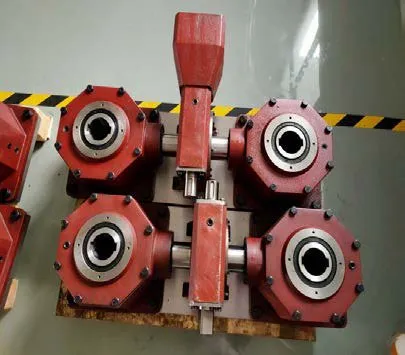
Key Specifications & Parameters of the RR528–RR577 Heavy-Duty Series
The RR series spans five frame sizes from RR528 through RR577, covering the torque envelope of typical metallurgical auxiliary drives — ladle-handling cars, mold-oscillation drives, dummy-bar feeders, roll-stand auxiliaries, and cast-strand bending mechanisms. All frames share the dual-stage worm-helical architecture, foundry-grade housing, and high-temperature seal package. Ratings reference 1,470 rpm input under ISO 14521 worm gear load capacity methodology with +85°C ambient derating; +130°C peak ambient is supported with adjusted service-factor.
| Frame | Continuous Torque | Peak Torque | Output Bore | Weight |
|---|---|---|---|---|
| RR528 | 18,500 Nm | 32,000 Nm | Ø110 mm | 680 kg |
| RR538 | 28,000 Nm | 48,000 Nm | Ø130 mm | 1,050 kg |
| RR548 | 42,000 Nm | 72,000 Nm | Ø160 mm | 1,580 kg |
| RR568 | 58,000 Nm | 99,000 Nm | Ø180 mm | 2,150 kg |
| RR577 | 78,000 Nm | 132,000 Nm | Ø200 mm | 2,940 kg |
Note: All RR frames support reduction ratios from 50:1 to 800:1 across the dual-stage worm-helical architecture (helical pre-stage + worm secondary stage). Standard ambient: -10°C to +85°C. High-temperature variant: rated to +130°C sustained with adjusted service-factor and synthetic high-temperature lubricant package.
What Is a Heavy-Duty Metallurgy Worm Gearbox & Why Steel Mills Specifically Need It
A heavy-duty metallurgy worm gearbox is a multi-stage worm reducer engineered specifically for the operating envelope of integrated steel mills, aluminum smelting plants, foundries, and continuous-casting installations. The metallurgy duty profile differs from general industrial duty across four measurable dimensions:
- Sustained high-temperature ambient: Auxiliary drives positioned near continuous-casting molds, hot-rolling stands, and reheat furnaces operate in sustained ambient temperatures of +85°C to +130°C. Standard NBR seal lip materials degrade at sustained temperatures above +90°C; standard mineral-oil lubricants drop below 50% rated viscosity at +120°C. The RR series uses FKM (Viton) seals rated to +200°C and PAO synthetic lubricant rated to +130°C sustained operation.
- High-torque shock-load profile: Cast-strand bending, mold-oscillation, and dummy-bar feeder drives carry shock-load peaks 1.7–2.2× their continuous rating during process-disturbance events. The dual-stage worm-helical architecture distributes shock load across two reduction stages rather than concentrating it on a single worm-and-wheel pair.
- 24/7 continuous-duty production cycles: Modern integrated steel mills run 8,400–8,600 hours/year with planned outage windows of 80–360 hours total. Auxiliary drives must achieve full reliability across this duty profile; service-life targets typically span 5–8 years between major rebuild events.
- Foundry-environment contamination: Iron-oxide scale, refractory dust, hot oil mist, and ambient airborne particulates create a contamination loading 8–12× what general industrial gearboxes encounter. The RR seal package combines FKM lip seals with secondary labyrinth protection to maintain sealing integrity across this environment.
Per ISO 14521 (worm gear load capacity), DIN 3996 (worm gear strength), and AGMA 6034 (worm gear nomenclature) with appropriate metallurgy-duty service-factor adjustments per AGMA 6010 (gear-drive selection methodology for industrial enclosed drives), a properly-sized RR-series gearbox at 1.8–2.0× service factor delivers an L10 service life exceeding 50,000 hours under typical metallurgy duty — equivalent to 6–7 years of 24/7 operation. For deeper background on heavy-duty worm gearbox application case studies in steel mills and metallurgy, see the industrial worm reducer applications knowledge base.

Types of RR Configurations for Metallurgy & Foundry Applications
The RR platform supports four configuration variants across each frame size, matching different metallurgy auxiliary-drive architectures. Internals share the dual-stage worm-helical architecture and foundry-grade housing; differentiation is in mounting interface, output style, and motor adapter:
| Variant | Output Style | Ambient Rating | Best Application |
|---|---|---|---|
| RR-S | Solid output shaft | +85°C standard | General mill auxiliaries |
| RR-H | Hollow shaft, shrink-disc | +85°C standard | Direct roller-shaft mount |
| RR-HT | Solid output shaft | +130°C high-temp | Cast-strand & mold drives |
| RR-AB | Solid + auxiliary brake | +85°C standard | Ladle & crane-drive duty |
The high-temperature RR-HT variant is the operationally critical specification for cast-strand, mold-oscillation, and roll-stand auxiliary drives where the gearbox is exposed to direct radiative heating from the casting strand or hot rolled product. The RR-AB variant adds a fail-safe spring-applied disc brake for ladle-handling and overhead-crane auxiliary applications where load-holding under full power loss is regulatory-required. For dual-stage worm-helical gear pair specifications and matched-pair selection for custom OEM platforms, see the worm and gear set technical reference.
RR Production Process — Foundry-Grade Heavy-Duty Manufacturing Flow
The RR series production flow is built around heavy-construction castings and through-hardened gear elements rather than the die-cast-aluminum + case-hardened-pinion approach used in lighter-duty NMRV manufacturing. Six stages:
- Cast-iron housing manufacturing: EN-GJL-250 grey cast iron sand-cast in dedicated foundry molds, with stress-relief annealing at 580°C for 12 hours followed by precision CNC machining of bearing seats and mounting interfaces. The foundry-grade housing provides the structural rigidity and thermal-shock resistance required for sustained metallurgy operation.
- Helical pinion & gear manufacturing: 18CrNiMo7-6 forged-steel blanks gear-cut on dedicated CNC hobbing centers, then case-carburized to HRC 60–62 (case depth 1.5–2.5 mm), then profile-ground to ISO 1328 Class 6 quality. The helical pre-stage handles the high-speed input reduction.
- Worm screw manufacturing: 17CrNiMo6 forged-steel worm-screw blanks turned to rough profile, case-carburized to HRC 60–62 with case depth 1.0–1.5 mm, then CBN profile-ground to ISO 1328 Class 7 with surface finish Ra ≤0.4 µm. The deeper case-hardening depth supports the high-torque continuous-duty requirements.
- Bronze worm wheel casting: CuSn12Ni2-A high-grade phosphor bronze centrifugally cast in heated molds, achieving HB 105–125 hardness with grain-size class 5–6 per ASTM E112. Each casting passes ultrasonic verification per ASTM E114 with porosity acceptance <0.8% volumetric for the heavy-duty class.
- Heavy-duty bearing assembly: Spherical roller bearings on the output shaft (sized for 50,000–220,000 N radial load capacity per frame size), tapered roller bearings on the worm-shaft assembly. Foundry-grade FKM (Viton) seal package with secondary labyrinth protection. Synthetic PAO lubricant rated for the specified temperature variant (standard +85°C or high-temperature +130°C).
- Acceptance & load-test: Each unit run-tested at 110% rated load for 4 hours with continuous oil-temperature, vibration-spectrum, and sound-level monitoring. Acceptance: temperature rise <55°C above ambient, vibration RMS <4.5 mm/s per ISO 10816-3 medium machinery class, no detectable bearing-side rumble or gear-mesh chatter.
How to Select the Right Heavy-Duty Worm Reducer for Metallurgy Equipment
A seven-step procedure aligns RR-series specification with metallurgy-duty requirements. The metallurgy-specific steps (ambient-temperature classification and shock-load profile assessment) replace general-industrial assumptions used for catalog reducer selection.
- Calculate continuous & peak torque: Continuous: process-load torque under steady-state operating conditions. Peak: shock-load events including emergency-stop, process-disturbance, and start-up break-out. Apply 1.8× service factor for general metallurgy auxiliary duty, 2.0× for cast-strand and mold-drive duty with sustained shock-load profile.
- Classify ambient temperature exposure: Standard ambient (-10°C to +85°C): general mill auxiliaries away from hot-zone radiative heating. High-temperature ambient (+85°C to +130°C sustained): cast-strand drives, mold-oscillation, dummy-bar feeders, roll-stand auxiliaries, reheat-furnace door drives. Specify the RR-HT variant for any application sustained above +85°C ambient.
- Determine output speed: Cast-strand bending: 0.6–2.4 rpm output (ratio 600:1–2,400:1, requires dual-stage architecture). Mold oscillation: 60–240 strokes/min (corresponds to ratio 50:1–200:1 depending on mechanism design). Ladle-handling cars: 4–14 rpm output. Roll-stand auxiliaries: 8–28 rpm output.
- Assess shock-load profile: For ladle-handling, dummy-bar feeders, and any drive that may encounter material-jam or process-disturbance events, specify the RR-AB variant with auxiliary brake to satisfy hold-load regulatory requirements per local mill safety codes.
- Select frame size: Match service-factor-adjusted continuous torque to the RR catalog rating; verify peak-torque rating accommodates the calculated shock-load envelope. Specify one frame size larger than calculated when the application includes both high shock-load AND high-temperature ambient (the dual derating compounds).
- Choose mounting: Foot mount with cast-iron-frame anchoring for typical mill-floor installations; flange mount on machine frames for integrated drive packages; hollow-shaft with shrink-disc for direct roller-shaft mount on roll-stand and table-roll auxiliaries.
- Specify motor & verify mounting: Industrial 3-phase 380V/690V/3,300V motors per regional mill standard; explosion-proof EX e or EX d motor variants for foundry-zone classified-area requirements; encoder feedback for speed-controlled servo applications. Contact our heavy-duty worm gearbox engineering team with your mill platform, drive type, and ambient-temperature specification for project-specific recommendation.
Compatible Components & Spare Parts We Stock
| Component | Specification | Use Case |
|---|---|---|
| Heavy-duty worm shaft | 17CrNiMo6, deep case-hardened | Major rebuild worm replacement |
| Bronze worm wheel | CuSn12Ni2-A, custom keyway | Major rebuild kit |
| Helical pinion & gear set | 18CrNiMo7-6, ISO 1328 Class 6 | First-stage rebuild |
| Spherical roller bearings | SKF/FAG/NSK heavy-duty | Output-shaft service |
| FKM seal kit (high-temp) | Viton + labyrinth, +200°C | Annual seal replacement |
| High-temp PAO synthetic refill | ISO VG460, +130°C rated | Service refill |
| Auxiliary disc brake | Spring-applied, fail-safe | RR-AB variant service |
All RR-series components are stocked as separate spares for major rebuild operations and outage-window planned maintenance programs. The matched bronze-worm-wheel + worm-screw set is the most-ordered major rebuild component at the 5–7 year service-life inflection point. For deeper technical reference on heavy-duty worm gearbox material specifications and metallurgical-grade requirements, see the heavy-duty worm gearbox technical guide.
RR-Series Application Sectors Across Steel Mills, Foundries & Metallurgy
The RR series is deployed across the integrated steel mill and foundry value chain — from raw-material handling through finished-product processing. Typical application categories:
- Continuous casting machine drives: Mold oscillation, dummy-bar feeders, cast-strand bending, and roll-strand drives across the casting machine. Typical application of the RR-HT high-temperature variant given the radiative heating from the casting strand.
- Hot rolling mill auxiliaries: Roll-gap adjustment drives, side-guide positioning, work-roll-balance auxiliaries, and finishing-stand-area material-handling drives. Sustained ambient temperature exposure suits the RR-HT specification.
- Reheat furnace mechanisms: Walking-beam drives, charge-door drives, discharge-door drives, and material-pusher mechanisms. The +130°C high-temperature variant accommodates the radiative heating from open furnace ports.
- Ladle-handling cars & transfer cars: Heavy-duty rail-mounted transfer cars handling 200–400 ton ladles between casting positions. Typical application of the RR-AB variant with auxiliary brake for hold-load safety regulatory compliance.
- Aluminum smelting auxiliaries: Pot-tending machine drives, anode-handling cranes, and crucible-handling auxiliaries in primary aluminum smelters. The acidic-fume environment around aluminum pot-rooms benefits from the FKM seal chemistry resistance.
- Foundry-equipment drives: Sand-mixing drives, mold-handling auxiliaries, melting-furnace tilt drives, and core-blower auxiliary drives in foundry casting operations.
- Steel processing line drives: Continuous galvanizing line auxiliaries, cold-rolling mill side drives, pickling-line transfer mechanisms, and finishing-line tension-roll drives.
What Steel Mill Engineers & Metallurgy Integrators Say About the RR-Series
“Specified RR548-HT high-temperature variants across 14 cast-strand bending drives on a slab-caster modernization project. The +130°C continuous-temperature rating closed the gap that two competing brands couldn’t match. 26 months in service with sustained ambient at +95–110°C, all 14 still running on factory-spec lubricant fill.”
— Konstantin V., Mechanical Reliability Manager, Integrated Steel Mill, Bulgaria
“Replaced 32 worn-out European-brand auxiliary drives across our walking-beam reheat furnace mechanisms. Drop-in fit on every position thanks to the standard mounting envelope. The RR568-HT variant has held up through 22 months of operation in sustained +120°C ambient — that’s the real-world test that catalog specifications can’t substitute for.”
— Yusuf D., Senior Plant Engineer, Steel Plant, Saudi Arabia
“Standardized RR538-AB across 18 ladle-transfer car drives at our foundry. The auxiliary spring-applied disc brake satisfied the local safety inspector’s hold-load regulatory requirement on first review — saved roughly 6 weeks of compliance documentation work that we’d budgeted for the project.”
— Andrés M., Project Engineering Lead, Foundry Operations, Chile
“Built RR577 frames into a custom anode-handling system for our primary aluminum smelter expansion. The dual-stage architecture handled the 70,000 Nm continuous duty profile through the start-up commissioning runs without temperature excursion concerns. 16 months production duty, no gearbox-related downtime events recorded.”
— Klaas H., Lead Mechanical Engineer, Aluminum Smelter, South Africa
Maintenance & Outage-Window Service Schedule for RR-Series Reducers
Heavy-duty metallurgy gearbox maintenance aligns with the mill’s planned-outage windows rather than calendar-time intervals. Recommended schedule:
- Quarterly oil-sample analysis: Track iron particle count (early bearing fatigue indicator), copper particle count (worm-wheel wear indicator), water contamination (seal-integrity indicator), and lubricant viscosity drift (additive-package depletion). The standard PAO synthetic factory fill is rated for 6,000 hours; the high-temperature variant is rated for 5,000 hours given the accelerated thermal degradation.
- Annual seal kit replacement (RR-HT variant): The high-temperature ambient accelerates FKM seal lip degradation; annual replacement maintains the rated lifecycle even in sustained +110–130°C ambient. Standard-temperature variants can extend to 24-month seal-replacement intervals.
- Lubricant change (per oil-sample condition or 5,000–6,000 hours): Schedule lubricant change at planned outage windows to coincide with other maintenance work. Pre-warm the gearbox to 40–60°C before draining to ensure complete oil removal; flush with fresh lubricant if the drained oil shows particulate accumulation above ISO 4406 18/16/13.
- Mid-life rebuild (5–7 years): Major rebuild including bearing replacement, seal kit replacement, and inspection of worm-wheel and worm-screw wear. The bronze worm wheel typically shows 15–25% tooth-flank wear at this point, still within operational tolerance but increasingly close to the wear-out replacement decision threshold.
- End-of-life replacement (10–14 years): Complete worm-and-gear-set replacement when bronze-wheel wear approaches 40%. At this point, typically more cost-effective to replace the worn-out gear pair in the existing housing rather than acquiring a new gearbox — the foundry-grade cast-iron housing has effectively unlimited service life.
Why Source the RR-Series Heavy-Duty Worm Gearbox From Us
Three reasons steel mill engineering teams and metallurgy integrators source RR-series from gearboxesworm.net rather than European brand-name alternatives or general industrial reducer suppliers:
- Heavy-duty metallurgy engineering specialization: The dual-stage worm-helical architecture, foundry-grade cast-iron housing, and high-temperature seal-and-lubrication package are not catalog options at general worm gearbox suppliers — they require dedicated foundry-side casting capacity, specific gear-cutting tooling, and high-temperature qualification testing. The RR-series production line is configured specifically for metallurgy duty. Read more about our heavy-duty worm gearbox engineering background.
- Cost competitiveness vs European brand-name: For metallurgy auxiliary drives in the 18,000–80,000 Nm torque range, the RR-series typically delivers 45–60% lower unit cost than equivalent SEW-Eurodrive, Bonfiglioli, or Flender heavy-duty offerings. For high-volume mill modernization projects (40+ drives), the cost gap typically exceeds the project total ROI by a meaningful margin.
- Mill-platform integration support: Our engineering team maintains compatibility documentation against the major mill OEM platforms (SMS group, Primetals Technologies, Danieli, Tenova) for direct retrofit specification. For most mill modernization projects, the RR-series functions as direct mechanical drop-in for failed European-brand auxiliary drives — saves the bracket fabrication and recommissioning work that typically delays modernization timelines.
Frequently Asked Questions About the RR-Series Heavy-Duty Worm Gearbox
1. Why dual-stage worm-helical architecture instead of single-stage worm or pure helical?
For metallurgy auxiliary drives requiring high reduction ratios (typically 100:1 to 800:1) at high-torque output, three architecture options exist: (1) single-stage worm at very high ratio — loses efficiency below 55% at 200:1+, generates excessive heat; (2) pure multi-stage helical — cannot self-lock, cannot achieve right-angle compact form factor; (3) dual-stage worm-helical — combines helical pre-stage efficiency (~96%) with worm secondary-stage self-locking and right-angle layout. The dual-stage gives the operationally relevant combination for typical metallurgy auxiliary drives.
2. What’s the actual difference between standard and high-temperature variants?
Standard ambient (-10°C to +85°C) uses NBR/HNBR seal lip materials and ISO VG320 PAO synthetic lubricant rated to +90°C. High-temperature ambient (+85°C to +130°C sustained) uses FKM (Viton) seal lip materials rated to +200°C and ISO VG460 high-temperature synthetic lubricant qualified for sustained +130°C. The HT variant carries roughly 8–12% unit cost premium over standard, but eliminates the early-failure mechanism that catalog general-industrial gearboxes encounter in metallurgy hot-zone applications.
3. Is the RR-series mechanically interchangeable with European brand mill auxiliary drives?
For most major mill OEM platforms, yes — mounting hole pattern, output shaft dimensions, and frame envelope match the heavy-duty industry standard convention used by SEW MC-class, Bonfiglioli HDP-class, and Flender H-class auxiliary drives. The RR-series functions as direct mechanical drop-in replacement for failed European-brand units in mill auxiliary-drive service. Verify motor frame compatibility (most metallurgy motors are IEC frame B5 with explosion-proof rating where required) and confirm input rotation direction matches the existing installation.
4. What lead times apply for RR-series given the heavy-construction manufacturing process?
Standard RR528 and RR538 ratings ship from semi-finished inventory within 6–8 weeks. Larger frame sizes (RR548, RR568, RR577) align with 10–14 week production schedules given the cast-iron foundry lead-time and gear-cutting capacity. High-temperature RR-HT variants typically add 2 weeks for the high-temperature lubricant and seal-package qualification testing. For mill modernization project schedules with 40+ drive replacement scope, dedicated production allocation can be arranged with 16–20 week project lead time — contact our team for project-specific scheduling.
5. Does the RR-series support explosion-proof certification for foundry-zone classified areas?
Yes, when paired with explosion-proof motors. The RR gear case itself does not require ATEX certification for typical Zone 22 (combustible dust) classification, but the integrated motor must carry the appropriate ATEX certification. We supply the gearbox with EX e (increased safety) or EX d (flameproof) certified motors per regional requirement — ATEX 2014/34/EU for European installations, IECEx for international, NEC Class II Division 2 for North American foundry-zone classification. Specify the application zone classification and we’ll match the appropriate motor variant.
6. What efficiency can I expect for energy-budget calculations?
Dual-stage worm-helical efficiency varies with ratio: 100:1 ratio runs 78–82% efficient at rated load; 300:1 ratio runs 70–75%; 800:1 ratio runs 60–65%. The helical pre-stage contributes 95–96% efficiency; the worm secondary stage contributes the remaining ratio at 65–85% efficiency depending on the worm-wheel ratio segment. For the metallurgy duty profiles typical of cast-strand and roll-stand auxiliaries (50:1–200:1 range), expect 75–85% efficiency at rated load. For continuous-duty 24/7 drive economics, calculate the lifecycle energy cost and compare against the architecture-selection trade-off.
7. What service life can I expect in continuous 24/7 metallurgy duty?
For typical 24/7 mill auxiliary duty in standard ambient: 50,000+ hours service life, equivalent to 6–7 years between major rebuild events. For sustained high-temperature ambient operation (+110–130°C): 35,000–45,000 hours, equivalent to 4–6 years. The bronze worm wheel becomes the wear-life-limiting component at 40% tooth-flank wear; the cast-iron housing has effectively unlimited service life. Mid-life rebuild at 5–7 years (bearing replacement + seal kit + worm wheel inspection) extends total gearbox service life to 12–16 years before a complete worm-and-gear-set replacement becomes necessary.
Specifying a Heavy-Duty Worm Gearbox for Your Steel Mill, Foundry, or Metallurgy Project?
Send our heavy-duty drive specialists your application duty, ambient temperature, motor frame, and platform OEM details — we’ll return a sized RR-series recommendation, lead time, and project-volume pricing within two business days.