Description
A modern textile mill runs 120–160 spinning frames or shuttle-less looms on a single floor, each housing 12–24 axes that demand a compact, quiet, self-locking worm gear reducer. Lint loading is the brutal reality: airborne fiber concentrations of 3–8 mg/m³ are routine, and fiber accumulation around shaft seals fails generic NMRV gearboxes within months. The FRV030 is a 30 mm center-distance compact worm speed reducer engineered specifically for textile duty: 18 Nm output torque, ratios 5:1 to 100:1, lint-deflector seal package, and self-locking property at ratios ≥30:1 that eliminates the electromagnetic brake circuit common in older textile drive designs.
Key Specifications & Parameters of the FRV030 Worm Speed Reducer
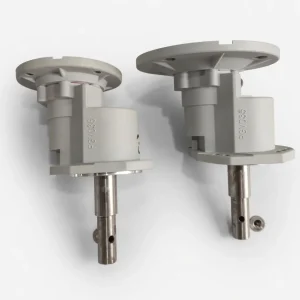
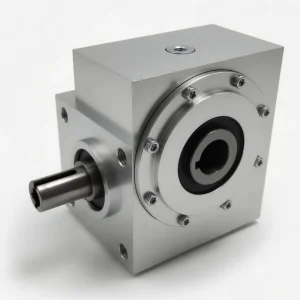
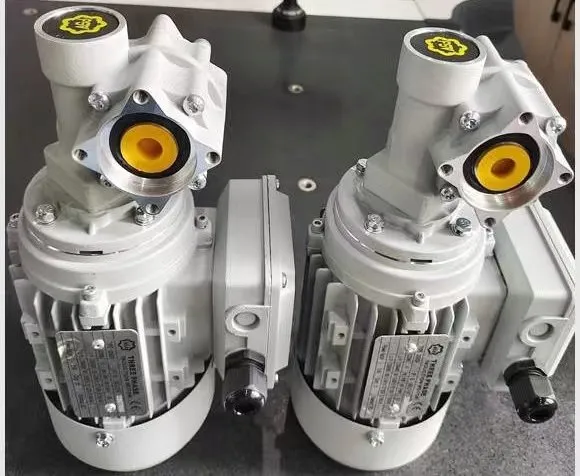
The FRV030 follows the standard NMRV030 mounting envelope, with bronze-on-steel worm architecture and an aluminum die-cast housing. Three textile-specific engineering choices distinguish it from a generic NMRV030: lint-deflector ring on each shaft seal, FKM (Viton) double-lip seals beneath, and tapered roller bearings preloaded for low-vibration operation. All ratings reference 1,400 rpm input per ISO 14521 worm gear load capacity methodology.
| Parameter | Value | Note |
|---|---|---|
| Center distance | 30 mm | NMRV030 standard envelope |
| Continuous output torque | 18 Nm | Sized for typical textile axes |
| Peak output torque | 31 Nm | Yarn-tension transient peaks |
| Reduction ratio range | 5:1 – 100:1 | 50:1 most common in textile |
| Self-locking threshold | ≥30:1 ratio | Eliminates brake circuit |
| Total weight | 1.2 kg | Aluminum housing |
| Sound level | <58 dB at 1 m | Important in mill ambient |
| Output bore | Ø14 mm | Solid or hollow shaft |
| Seal package | Lint guard + Viton | Standard on textile variant |
| Input motor frames | 63B5 / 63B14 / 71B5 | Standard IEC compact |
| Operating temperature | +5°C to +50°C | Mill ambient envelope |
What Is a Textile-Grade Worm Reducer & Why Does the Industry Use It?
A textile-grade worm gear reducer is a right-angle worm gearbox engineered to operate reliably in the lint-laden, vibration-rich, multi-shift-duty environment that defines yarn spinning, weaving, and fabric finishing facilities. The textile industry has been the single largest mature application category for worm gearboxes globally for over six decades — the worm-gear architecture matches three fundamental requirements that other gear types cannot collectively satisfy:
- Self-locking yarn tension hold: When a spinning frame or take-up drive de-energizes (end of run, doffing cycle, lot change), yarn tension must be maintained on the package to prevent unraveling. Worm gears at ratios ≥30:1 hold position statically without an electromagnetic brake.
- Quiet, smooth low-speed output: Mill ambient sound levels are tightly regulated under ILO occupational health guidelines. The sliding-contact mesh of a worm gear has no tooth-pulse vibration audible at the operator station, contributing meaningfully to overall mill sound compliance.
- Compact right-angle layout: Spinning frames, looms, and creels mount the drive motor perpendicular to the operating shaft for headroom and accessibility. Helical and planetary alternatives force inline geometry that doesn’t fit the typical textile machine envelope.
Per ISO 14521 and DIN 3996 worm gear methodology, an FRV030 sized at 1.5× service factor for typical 12–14 hour single-shift textile duty delivers an L10 service life exceeding 35,000 hours — equivalent to 8–10 years of typical mill operation. Detailed industrial reference cases for textile worm reducer applications are available at the industrial worm reducer application reference.

Types of FRV030 Configurations for Textile Applications
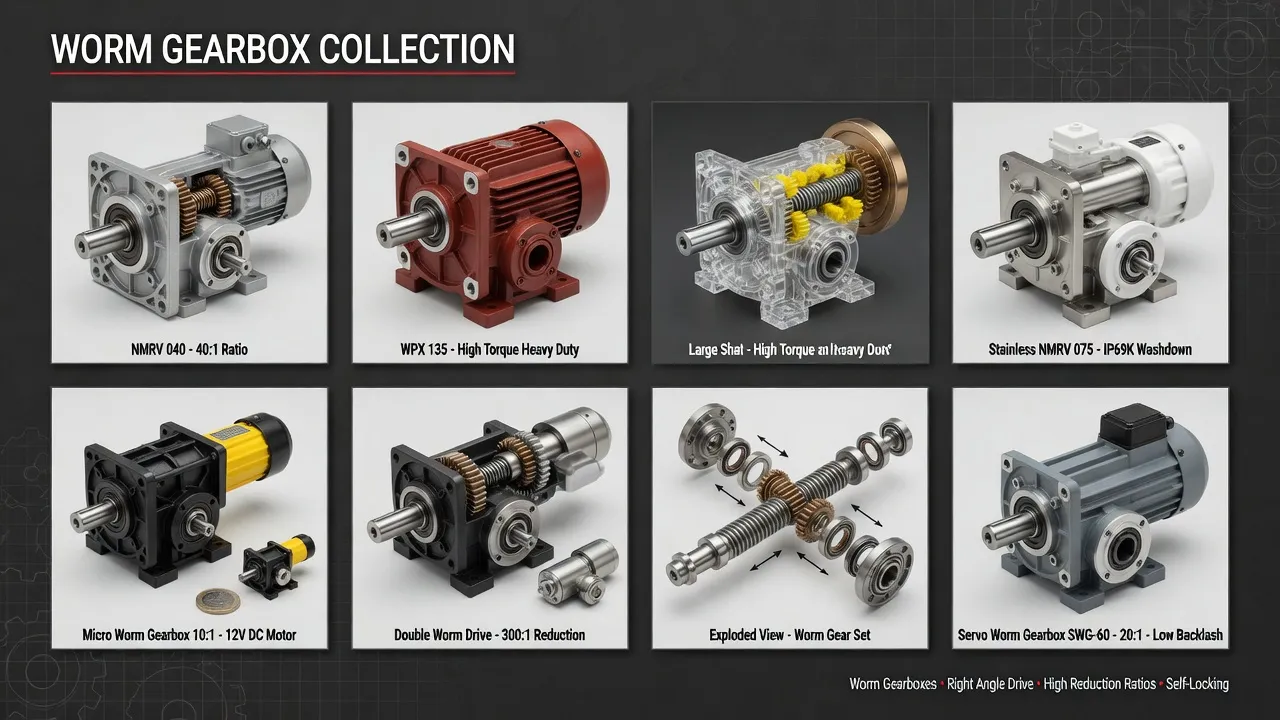
The FRV030 platform supports four standard configurations matching the four most common textile drive geometries. Same 30 mm gear-set internals across all four; the differentiation is in mounting interface, output style, and motor adapter:
| Variant | Output Style | Mounting | Best Application |
|---|---|---|---|
| FRV030-S | Solid shaft Ø14 | B14 flange | Yarn winder & take-up drives |
| FRV030-H | Hollow shaft Ø14 | Foot mount + torque arm | Direct creel shaft mount |
| FRV030-DS | Double-output shaft | B5 flange | Tandem winder pairs |
| FRV030-VFD | Solid shaft Ø14 | B5 + inverter motor | Variable-tension control |
The double-output-shaft FRV030-DS is the textile-industry-specific variant — both ends of the worm wheel shaft are output shafts, allowing one motor + one gearbox to drive a tandem pair of yarn winders or creel positions. This eliminates one motor, one drive, and one set of cabling per pair, which adds up across a 200-position creel installation.
FRV030 Production Process — From Casting to Lint-Tested Drive
The FRV030 follows a six-stage production process. The textile-specific stages (lint-deflector ring fitting and lint exposure validation) sit at the end of the flow, after the base worm gearbox is fully assembled.
- Bronze worm wheel casting: CuSn12Ni2 phosphor bronze centrifugally cast in graphite molds, achieving HB 95–110 hardness. Each casting ultrasonic-tested per ASTM E114 for porosity below 2% volume fraction.
- Worm screw machining: 20CrMnTi steel bar-stock turned, case-hardened HRC 58–62, profile-ground to ISO 1328 Class 7 quality with surface finish Ra 0.4 µm.
- Aluminum housing die-casting: ADC12 aluminum die-cast, externally treated for typical mill-floor environment. Symmetric mounting pattern supports B3, B5, V1, V3 orientations from the same casting.
- Lint-deflector ring fitting: A cellular polymer ring is fitted around each shaft externally to the FKM seal lip. The ring filters airborne lint and fiber down to 50 µm before fiber reaches the seal — this is the textile-specific manufacturing step missing from generic NMRV030 production.
- Assembly & lubrication: Tapered roller bearings preloaded to 4 N·m, FKM (Viton) double-lip seals installed, sealed-for-life PAO synthetic lubricant injected (95 ml).
- Lint-exposure acceptance test: Each production lot is sample-tested in a controlled-lint chamber simulating 14 days of mill exposure. Acceptance: zero fiber penetration past the deflector ring; zero seal lip contamination; no measurable backlash growth post-test.
How to Select the Right Worm Speed Reducer for Textile Equipment
Use this six-step procedure for FRV030 specification. The textile-specific steps (output-style choice and lint-environment confirmation) replace the “general industrial” sizing assumptions used for generic NMRV catalog sizing.
- Calculate yarn-tension torque: Continuous: working tension × package radius. Apply 1.4× service factor for typical winder duty, 1.7× for ring spinning frame drives where doffing-cycle peaks add transient load.
- Determine output speed: Yarn winder take-up: 80–180 rpm (ratio 8:1 to 18:1 from 1,400 rpm motor). Spinning frame creel feed: 14–28 rpm (ratio 50:1 to 100:1). Loom auxiliaries (warp let-off, fabric take-up): 8–25 rpm (ratio 60:1 to 100:1).
- Confirm self-locking requirement: All textile applications benefit from self-locking hold for doffing-cycle yarn tension management. Specify ratio ≥30:1 to take advantage of this property.
- Select output configuration: Single solid shaft (FRV030-S) for individual position drives; hollow shaft (FRV030-H) for direct creel shaft mount; double output shaft (FRV030-DS) for tandem winder pairs.
- Verify lint exposure level: All FRV030 variants ship with the lint-deflector ring as standard. For exceptionally heavy lint environments (cotton ginning, jute processing), specify the “textile-heavy” option which adds a labyrinth secondary seal external to the lint guard.
- Specify motor frame: 63B5/B14 (0.18–0.37 kW) for typical textile axes; 71B5 (0.55 kW) for higher-torque spinning frame applications. Contact our textile drive worm gearbox team with your loom model or spinning frame specification for compatibility verification.
Compatible Components & Spare Parts We Stock
| Component | Specification | Use Case |
|---|---|---|
| Bronze worm wheel | CuSn12Ni2, custom keyway | Field rebuild kit |
| Worm gear shaft | 20CrMnTi, ground M1.5–M2 | Replacement worm screw |
| Lint-deflector ring kit | Cellular polymer, 50 µm | Annual replacement |
| FKM (Viton) seal kit | Double-lip, Ø14 / Ø9 | Service rebuild |
| Worm and gear set (matched) | Lapped pair | Complete drivetrain swap |
| Compact IEC motor | 63B5/B14, 71B5 | Motor + gearbox unit |
| Output bearings (pair) | Tapered roller, preloaded | Service rebuild |
All FRV030 components are stocked as separate spares for textile mill maintenance programs. The lint-deflector ring is a 2-minute swap that doesn’t require draining lubricant — recommended annual replacement for heavy lint environments. For OEM-specific worm-and-gear-set production with custom tooth profiles or modulus, see the worm gear material and machining knowledge base for material-property guidance.
FRV030 Application Sectors Across the Textile Industry
The FRV030 is deployed across the full textile production chain — from raw fiber through finished fabric. Each application has a typical ratio range and configuration:
- Spinning frame creel feed: Ring spinning, open-end, and air-jet spinning creel drives. Typical FRV030-H at 60:1 to 80:1 with hollow-shaft direct mount on creel shafts.
- Yarn winder take-up: Cone winders, autocone winders, and assembly winders. Typical FRV030-S at 15:1 to 25:1 for take-up package speeds.
- Loom warp let-off & fabric take-up: Picanol, Toyota, Tsudakoma, and similar shuttle-less loom auxiliaries. Typical FRV030-S at 80:1 to 100:1 for slow controlled fabric movement.
- Tenter frame chain drive auxiliaries: Fabric finishing tenter frames with FRV030 driving overfeed, edge-clip, and width-control auxiliaries.
- Knitting machine secondary drives: Circular and flat-bed knitting machine yarn-feeder drives, where self-locking yarn tension hold is application-critical.
- Texturizing & covering machinery: False-twist texturizing, air-jet texturizing, and yarn covering machine drives.
- Carpet machinery: Tufting machine yarn-creel drives and yarn-tension control drives in carpet manufacturing.
What Textile Mill Operators & Loom OEMs Say About the FRV030
“Specified FRV030-DS double-output across a 360-position autocone winder retrofit. Eliminated 180 motors, 180 drives, and the corresponding panel space. Cabling labor savings on the project alone covered the gearbox cost premium — lint-deflector rings have stayed clean across 14 months of cotton processing.”
— Rajesh K., Plant Manager, Cotton Spinning Mill, India
“Used FRV030-H hollow-shaft units on warp let-off drives across 84 air-jet looms. Self-locking property maintained warp tension during weft-replenishment pauses without the brake module the OEM design called for. Saved roughly $145 per loom in eliminated brake hardware and cabling.”
— Mehmet Ö., Mechanical Engineer, Weaving Mill, Turkey
“Replaced 67 worn-out generic NMRV030 reducers across our knitting operation. Drop-in fit, sealed-for-life lubrication eliminated the quarterly oil-check task our maintenance crew had been doing. Cycle endurance is holding well 16 months in — previously we were rebuilding gearboxes every 8–10 months.”
— Ana C., Maintenance Director, Knitting Mill, Portugal
“Built FRV030-VFD into a tenter frame edge-clip drive with closed-loop tension control. Variable-speed performance held within 2% across 30–100% feed rate. The textile-specific lint guard kept fabric debris out of the seals through 11 months of polyester processing — clean inspection at the year mark.”
— David L., Equipment Engineer, Fabric Finishing OEM, China
Maintenance & Replacement Guide for Textile Worm Reducers
Textile mill gearbox maintenance has two distinct intervals: the annual lint-guard replacement (cheap, fast, prevents 70% of textile worm gearbox failures) and the scheduled rebuild interval at 8–10 years for sealed-for-life service:
- Annual lint-guard ring replacement: Each FRV030 carries a cellular polymer lint-deflector ring on each shaft (input and output). Replace annually in heavy-cotton-lint environments, every 18 months in synthetic-fiber environments. Procedure: pop off the old ring, slip on the new one, takes 90 seconds per shaft — no lubricant drainage required.
- Quarterly visual inspection: Check seal lip area for fiber accumulation past the deflector ring; check housing exterior for excessive vibration witness marks; confirm output shaft rotation is smooth without binding. Fiber accumulation past the deflector ring indicates the ring has reached end-of-life and needs replacement ahead of schedule.
- Lubricant condition (8–10 year): Sealed-for-life PAO synthetic factory fill is rated for the design life of typical textile mill duty. Oil sample analysis at the 5-year mark provides early warning of unexpected wear. Otherwise, no scheduled oil change is required.
- End-of-life replacement: When backlash exceeds operational tolerance (typically 20–30 arcmin in textile applications), replace the FRV030 unit rather than rebuilding. The fully-built replacement typically costs less than the labor to teardown, inspect, and rebuild a worn unit.
Why Source the FRV030 Worm Reducer From Us
Three reasons textile mill operators and loom OEMs source FRV030 from gearboxesworm.net:
- Textile-specific seal engineering: The lint-deflector ring + FKM seal combination is engineered for the textile mill environment, not adapted from generic NMRV. Field data from cotton-spinning customers shows 6–9× service life vs generic NMRV030 in the same applications. Read more about our textile worm reducer engineering background.
- Loom-OEM compatibility chart: We maintain a verified compatibility chart of FRV030 mounting interfaces against the major textile machine OEM platforms (Picanol, Toyota, Tsudakoma, Rieter, Schlafhorst, Murata). For most retrofit installations, FRV030 is direct mechanical drop-in — saves the bracket fabrication step that European-brand sources typically require.
- Volume pricing for high-axis-count textile operations: Annual contract pricing tiers at 100, 500, 2,000, and 10,000 unit volumes — with lint-guard ring service kit subscriptions available at 500+ units. The 2,000-unit tier saves 28–35% versus single-unit pricing — meaningful when a single mill carries 1,500+ FRV030 axes across its production floor.
Frequently Asked Questions About the FRV030 Worm Speed Reducer
1. How effective is the lint-deflector ring at protecting the seal lip?
The cellular polymer ring filters airborne lint and fiber down to 50 µm before the fiber reaches the FKM seal lip. Field data from heavy cotton-processing environments shows 6–9× seal life extension versus identical FRV030 units run without the lint guard. The ring is the most cost-effective single component in the FRV030 design — it adds roughly $1.20 per unit and prevents the most common textile-mill gearbox failure mode.
2. What is the FRV030 service life in continuous-duty mill operation?
For typical 16-hour two-shift mill service: 35,000+ hours, equivalent to 8–10 years of operation. For 24/7 continuous duty (synthetic-fiber spinning operations running through-the-week): 25,000+ hours, equivalent to 5–6 years. Annual lint-guard ring replacement is required to achieve these service intervals; without lint guard maintenance, expect 30–50% reduction in service life.
3. Can the FRV030 hold yarn tension when the motor is de-energized?
For ratios ≥30:1, yes — the worm gear is statically self-locking. When the motor de-energizes (end of run, doffing cycle, lot change), the gearbox holds the output shaft against the yarn tension load. The yarn package cannot back-drive through the worm. This is the primary reason worm gearboxes have dominated textile drive specifications for over six decades, despite the energy-efficiency disadvantage versus helical alternatives.
4. Is the FRV030 mechanically compatible with European loom OEM platforms?
Yes — mounting envelopes match standard NMRV030 dimensional convention, and we maintain a verified compatibility chart for the major loom and spinning frame OEM platforms (Picanol, Toyota, Tsudakoma, Rieter, Schlafhorst, Murata, Saurer). For most retrofit installations, FRV030 is direct mechanical drop-in. For specific machine model and mounting interface verification, contact our team with the OEM platform name and frame number.
5. What’s the worm gearbox vs helical gearbox decision in textile applications?
Worm wins on three textile-specific factors: self-locking yarn tension hold (helical cannot self-lock), right-angle compact form factor that fits typical loom and spinning frame envelopes (helical is inline), and quieter low-speed operation. Helical wins on energy efficiency (94–97% vs 65–75% for worm). For textile applications with daily continuous-duty hours below 16, the worm gearbox is structurally the better fit despite the efficiency disadvantage. For 24/7 continuous-duty applications where energy cost compounds, helical bevel reducers may offer better total cost of ownership.
6. Can the FRV030 be VFD-controlled for variable-tension applications?
Yes — with an inverter-duty motor (Class F insulation, NEMA MG1 Part 31 compliant) the FRV030 operates across the typical 30–100% speed range. Specify the FRV030-VFD variant with pre-mated inverter-duty motor for tenter frame edge-clip drives, advanced let-off systems, and similar variable-tension control applications. Below 30% rated speed, gear oil film thickness becomes marginal — consider vector-control VFD with encoder feedback for ultra-low-speed continuous tension control.
7. What lead times apply for FRV030 standard vs custom configurations?
Standard FRV030-S and FRV030-H in common ratios (50:1, 60:1, 80:1, 100:1) ship from finished-goods stock within 5–7 business days. The FRV030-DS double-output variant typically ships within 14 business days. The FRV030-VFD pre-mated motor variant ships within 10 business days. For mill-volume orders (500+ units annually) with custom OEM configurations, dedicated production allocations and contract pricing tiers are available — contact our team for project-specific scheduling.Specifying a Worm Speed Reducer for Your Textile Mill or Loom OEM Project?
Send our textile drive specialists your application type, yarn tension or fabric speed requirements, motor frame, and annual axis volume — we’ll return a sized FRV030 recommendation, lead time, and OEM volume pricing within one business day.