
A municipal wastewater treatment plant inlet works processing 80,000 cubic meters daily of raw sewage receives 6 to 10 tonnes of physical debris each day — rags, plastic waste, sanitary products, food waste, leaves, and grit that arrives mixed with the influent stream from the collection system. Mechanical bar screens at the headworks must continuously remove this debris before downstream pumps and treatment processes encounter the material — debris pass-through events damage submersible pumps within hours and clog biological treatment systems within days. The bar screen rake mechanism cycles roughly every 30-90 seconds across the screen face, lifting collected debris up the screen incline to discharge into a screenings handling system. Across 8,760 annual operating hours, each screen drive accumulates 350,000 to 1,000,000 rake cycles while exposed to splash from raw wastewater containing hydrogen sulfide, ammonia, and chlorides. Drive failure stops debris removal — the inlet works must either bypass the failed screen (risking debris pass-through to downstream equipment) or shut down influent flow until repairs complete. Properly specified bar screen worm gearbox equipment — built around stainless steel construction, compact mounting envelopes, and IP66 sealing rated for raw wastewater splash exposure — eliminates the recurring drive replacement cycles that mark the typical bar screen O&M experience.
This guide covers the unique drive duty profile of mechanical bar screens at municipal and industrial wastewater inlet works, addresses the corrosive splash environment and high-cycle rake duty, walks through selection criteria balancing cycle count durability with corrosion resistance, and provides a maintenance roadmap suitable for headworks operations with limited shutdown availability. Audience: water utility headworks supervisors, wastewater treatment plant maintenance leads, and consulting engineers specifying mechanical screening equipment for retrofit and new construction projects.
What Drive Demands Distinguish Bar Screens from Generic Industrial Service?
Bar screen drives combine four operational characteristics that distinguish them from any non-screening application. The first is the high-cycle rake duty: rake mechanisms cycle every 30-90 seconds during normal operation and as frequently as every 15 seconds during high-debris events (storm flow conditions or seasonal leaf loading). Cumulative cycle counts reach 800,000+ rake events within a single year of operation — accelerating fatigue patterns far beyond typical industrial duty profiles. The second characteristic is the corrosive raw wastewater splash environment: bar screen drives mount directly above raw wastewater channels, with splash exposure containing 15-30 ppm hydrogen sulfide, 25-45 ppm ammonia, and chloride levels varying by infiltration patterns and industrial discharge contributions.
The third characteristic is the periodic shock loading from debris jam events: rake mechanisms occasionally encounter heavy debris that resists clearing — large rags, accumulated stringy material, or solid waste objects that produce torque spikes 3-5× steady-state operating torque before either passing through the screen or triggering torque overload protection. The fourth is the compact mounting envelope: bar screen mechanical room space typically constrains drive mounting dimensions to compact configurations that fit alongside the screen body and rake mechanism without interfering with screening flow channels or access pathways. Screening equipment OEMs design around specific compact gearbox envelopes that accept a limited range of replacement drive specifications. The right bar screen drive worm gearbox selection addresses high-cycle fatigue resistance, raw wastewater corrosion protection, debris jam shock capacity, and compact mounting simultaneously per water treatment screening drive technical references.
How Do Stainless Steel Worm Drives Address Bar Screen Failure Modes?
AISI 304/316 Stainless Construction Resists Sulfide Corrosion
Bar screen splash environments contain hydrogen sulfide concentrations sufficient to attack standard cast iron gearbox housings within months of installation, particularly in sulfide-rich wastewater streams where microbial activity in the collection system produces elevated H2S generation. Stainless steel housings (AISI 304 standard, AISI 316 for elevated chloride exposure) resist sulfide corrosion across the full 20+ year service life expected at municipal wastewater facilities. The stainless construction extends to all external mounting hardware, breather valves, and fastener systems — eliminating the galvanic corrosion that retires standard steel hardware within 3-5 years of bar screen service.
Self-Locking Holds Rake Position During Debris Jam Resolution
When rake mechanisms encounter heavy debris jams that activate torque overload protection, the drive halts mid-cycle with the rake mechanism partially through its travel path. Self-locking worm gearbox architecture holds the rake position absolutely during the manual clearing operation that O&M staff perform to remove the offending debris — without risk of rake mechanism drift that would complicate the manual clearing procedure or risk operator injury during access to the screen body. Self-locking eliminates the need for active brake hardware that would add another failure mode in the high-cycle bar screen environment.
Technical Parameters: Bar Screen Drive Specification Window
The table below summarizes specifications distinguishing bar screen drives from generic industrial worm gearbox alternatives. Values reflect AGMA 6034-B92 worm gear power rating combined with water treatment industry conventions for high-cycle screening duty.
| Parameter | Bar Screen Spec | Generic Industrial |
|---|---|---|
| Housing material | AISI 304/316 stainless | Cast iron painted |
| Reduction ratio | 30:1 to 100:1 | 5:1 to 100:1 |
| Output torque (rated) | 600 – 4,500 Nm | 200 – 2,000 Nm |
| Peak shock capacity | 5× rated, jam protection | 2× rated typical |
| Cycle rate capacity | 600,000+ cycles/year | 50,000 – 100,000 typical |
| Sealing rating | IP66 raw wastewater splash | IP54 standard |
| Service factor | 2.5 minimum, 3.0 high-debris sites | 1.0 – 1.25 typical |
| Design service life | 15 – 20 years | 5 – 8 years |
The single specification most often miscalculated on bar screen projects is the cumulative cycle count for fatigue analysis. Catalog torque ratings assume cycle counts in tens of thousands across the equipment service life — bar screen applications reach millions of cycles within the same period. Service factor 2.5 minimum applied to steady-state rake torque covers typical municipal bar screen installations, with high-debris sites (combined sewer overflow service, food processing wastewater, paper mill effluent) justifying 3.0 service factor. Drives sized below 2.5 service factor fatigue within 5-7 years of bar screen service rather than reaching the 15+ year service life target that justifies stainless steel construction premium.
Application Matrix: Where Bar Screen Drives Operate
Climber Bar Screens (Front-Cleaned)
Climber bar screens use a single rake that climbs vertically up the screen face from below the water surface to the discharge point above the screen, depositing collected debris into a screenings handling chute. The single-rake architecture cycles every 60-180 seconds during normal operation, with output torque requirements ranging 800 to 2,800 Nm depending on screen width (typical 0.5-3.0 m channel widths) and debris density. The compact climber architecture suits municipal applications with moderate debris loading and supports straightforward maintenance access to the rake mechanism for routine inspection.
Multi-Rake Bar Screens (Continuous-Cleaned)
Multi-rake bar screens use chains carrying multiple rakes that continuously cycle past the screen face — providing continuous debris removal capability that handles higher debris loading rates than climber alternatives. The continuous chain rake architecture operates at slower individual rake cycle rates but maintains continuous capture rate matching influent debris loading. Output torque requirements range 1,200 to 4,500 Nm depending on screen width and chain rake count. Multi-rake screens typically deploy at large municipal facilities and combined sewer overflow applications where peak debris loading exceeds climber screen capacity.
Step Screens and Filter Screens
Step screens use multiple thin metal lamellae arranged in a staircase configuration that moves vertically to lift debris from the water surface — providing fine screening (typically 3-6 mm openings) compared to traditional bar screens (typical 6-25 mm openings). Drive specifications match bar screen patterns at slightly lower output torques (600 to 2,200 Nm) but with similar high-cycle fatigue requirements. The fine screening application produces higher debris capture rates that make screening capacity per unit width substantially higher than traditional bar screens.
Industrial Wastewater Screening Applications
Industrial wastewater facilities including food processing plants, pulp and paper mills, textile manufacturing, and beverage production deploy bar screens with specific debris characteristics distinct from municipal sewage. Food processing screens handle high-protein debris that produces sticky deposits requiring more frequent cleaning cycles. Paper mill screens handle long-fiber debris that resists rake clearing — sometimes justifying upgraded screen types. Drive specifications include compatibility with specific chemical exposure profiles that vary across industrial sectors. Reference specialty water treatment drive guides for industrial-specific application sizing.
Selection Roadmap: Step-by-Step Workflow
The four-step procedure below covers bar screen drive selection from initial requirements documentation through commissioning verification.
Calculate Rake Torque from Screen Geometry and Debris Loading
Determine rake mechanism torque from screen width, design debris loading rate (kg/m²/min during peak flow conditions), rake cycle frequency, and incline angle of the screen face. Document worst-case torque events from large-debris jam scenarios that produce 3-5× steady-state torque spikes. Industrial wastewater applications with sticky debris characteristics may require higher steady-state torque calculations to account for adhesion forces during rake travel.
Apply High-Cycle Service Factor for Bar Screen Duty
Multiply calculated steady-state rake torque by 2.5 service factor for typical municipal bar screen installations, 3.0 for combined sewer overflow service and high-debris industrial applications. The resulting equivalent uniform-duty torque must fall within catalog rating with peak shock capacity 5× rated for jam protection. Service factor below 2.5 produces drives that fatigue within 5-7 years of bar screen service rather than reaching the 15+ year service life target that justifies stainless steel construction.
Specify Stainless Steel Construction and Compact Envelope
Order AISI 304 stainless steel housing for typical municipal bar screen service, AISI 316 for elevated chloride exposure (coastal sites, infiltration-affected systems, or industrial applications with chloride-rich waste streams). Verify mounting envelope compatibility with the screen OEM’s drive bracket — bar screen mechanical room space typically constrains drive dimensions to compact configurations. Specify Viton fluoroelastomer seal materials rated for hydrogen sulfide and ammonia exposure at the H2S concentration levels typical of the specific service environment.
Verify Torque Overload Protection Coordination
Confirm torque overload protection setpoint coordination between the screen OEM’s existing electrical or mechanical jam protection system and the gearbox peak shock capacity. The protection system should activate before drive damage occurs but allow normal operation through routine torque variations. Verify motor overload protection coordinates with both drive jam protection and screen mechanical jam protection to ensure orderly shutdown sequences during severe debris events.
Spare Parts Integration: Headworks Asset Management
Water utility headworks operations prioritize spare drive inventory matching the consequences of bar screen outage — typically every utility carries one complete spare drive matched to each installed screen configuration. The bronze worm wheel meshing with case-hardened 20CrMnTi worm shaft reaches 25,000+ operating hours under proper synthetic lubrication and IP66 sealing protection — typically translating to 15-18 year service life under high-cycle bar screen duty.
The stainless steel housing eliminates the corrosion-driven failure modes that retire painted cast iron alternatives within 5-8 years of bar screen service. Premium-grade SKF or NSK tapered roller bearings handle the combined radial and axial loads typical of rake drive service with L10 fatigue life exceeding 25,000 hours under rated load. Viton fluoroelastomer seal lips with stainless garter springs maintain ingress protection across the raw wastewater splash exposure period. Reference stainless steel worm gear specifications for component-level technical details.
Spare parts kits combining worm shaft, worm wheel, complete bearing set, all shaft seals, gasket and o-ring kit, breather valve, and synthetic lubricant fill provide complete rebuild capability during scheduled major service events. Akgnx Co., Ltd ships kits packaged for water utility headworks inventory practices, with all wear components sourced from the same factory production runs to ensure dimensional consistency across rebuild cycles.
Cost & Sustainability: Total Ownership Across 20-Year Plant Life
Water utilities and consulting engineers evaluate bar screen drive investments across the headworks equipment economic life — typically 20 years matching depreciation schedules for major mechanical equipment. The table compares total cost of ownership for stainless-grade bar screen drives against painted cast iron alternatives across this horizon.
| Cost Component | Stainless HSRV | Painted Cast Iron |
|---|---|---|
| Initial unit price (FOB) | USD 1,800 – 6,200 | USD 580 – 1,800 |
| Service life bar screen duty | 15 – 18 years | 5 – 8 years |
| Replacement frequency | 1× over 20 years | 3 – 4× over 20 years |
| Lubricant change interval | 3 years synthetic | Annual mineral oil |
| Debris pass-through risk | Negligible | Substantial after year 4-6 |
| 20-year cumulative TCO | ~ 1.4× installed cost | ~ 5.5× installed cost |
Sustainability and compliance documentation accompanies every stainless-grade bar screen drive shipment. The housing carries CE marking per EU Machinery Directive 2006/42/EC and complies with RoHS Directive 2011/65/EU. Manufacturing follows ISO 9001:2015 quality management procedures with full material traceability from stainless steel housing chemical composition through case-hardened worm shaft heat-treatment records. Worm gear tooth geometry follows DIN 3974 quality grade Q8 with load capacity per AGMA 6034-B92 worm gear power rating methodology adjusted for bar screen high-cycle service factor.
Stainless steel housing materials recycle at end-of-life with high recycled-content rates compared to painted cast iron alternatives that produce paint waste during decommissioning. The 15-18 year service life eliminates 2-3 replacement cycles compared to painted alternatives, reducing the lifecycle environmental footprint substantially. Akgnx Co., Ltd manufactures stainless-grade bar screen drives through a dedicated water treatment drive program serving municipal water utilities, industrial wastewater treatment operators, and screening equipment OEMs.
Customer Testimonials from Headworks Operations
“Our wastewater treatment plant headworks processes approximately 150,000 m³ daily through 4 mechanical bar screens. We standardized on HSRV stainless drives in 2019 after experiencing escalating maintenance costs on the original painted cast iron drives that arrived with the headworks construction. Six years into operation, we’ve had zero corrosion-related drive failures across the 4 installed positions, with annual maintenance hours reduced from approximately 60 hours per drive to under 8 hours per drive.”
— Headworks Supervisor, Municipal Wastewater Plant, USA Florida
“As a screening equipment OEM serving the European municipal market, we evaluated multiple alternative drive suppliers for our standard climber bar screen package. Akgnx HSRV stainless drives passed our 800,000-cycle accelerated life test simulating 10-year bar screen duty plus salt-fog corrosion exposure for coastal installations. The compact AISI 316 envelope fits our screen mechanical room dimensional constraints across our standard product line widths without requiring envelope modifications.”
— Director of Engineering, Bar Screen OEM, Italy
“We retrofitted bar screen drives across 6 wastewater treatment plants in our utility district after experiencing chronic corrosion failures on the original painted cast iron units. The HSRV replacement drives mounted to existing screen brackets with minor adapter plate fabrication. Four years into the retrofit program, we’ve eliminated corrosion-related drive replacements that previously cost our utility approximately USD 180,000 annually in equipment and labor across the 12 affected screen positions.”
— Maintenance Director, Regional Water Utility, USA Coastal Florida
“Our paper mill effluent treatment system handles 12,000 m³ daily with elevated chloride exposure that retired our original drive supplier’s painted units within 4 years of installation. The HSRV-316 specification reached 10 years of installation service so far with zero corrosion-related failures across the 3 installed positions. The stainless steel construction also handles the periodic chemical cleaning events without seal degradation that affected the prior generation of drives.”
— Plant Engineer, Pulp & Paper Operations, Sweden
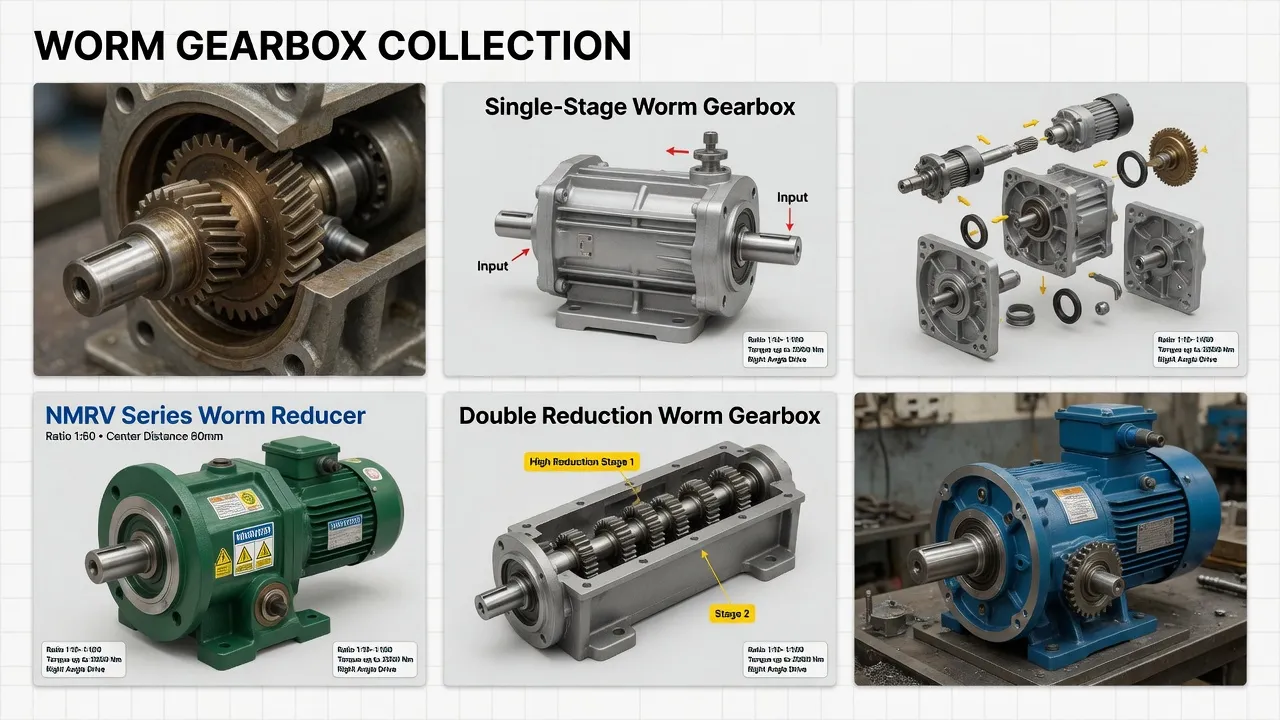
Recommended Drive: HSRV Stainless Steel for Bar Screen Service
For municipal and industrial wastewater bar screen applications across climber screens, multi-rake screens, step screens, and fine screening installations, the HSRV Stainless Steel Worm Gearbox in bar screen specification targets the 15-20-year-service, high-cycle, splash-protected service class with engineering features specifically chosen to address the failure modes that retire painted cast iron alternatives within 5-8 years of bar screen installation.
Specifications include AISI 304 stainless steel housing standard (AISI 316 available for elevated chloride exposure), centrifugally cast tin bronze ZCuSn10P1 worm wheel per ISO 1338 meshing with case-hardened 20CrMnTi steel worm shaft hardened to HRC 58-62 surface, fluoroelastomer (Viton) double-lip seals with stainless garter springs at all shaft penetrations, IP66 ingress protection plus splash-resistant breather configuration designed for raw wastewater exposure, synthetic polyalphaolefin (PAO) lubricant fill rated for 3-year drain intervals, and stainless steel A2 mounting hardware throughout. Reduction ratios from 30:1 through 100:1 with output torque ratings reaching 4,500 Nm continuous and peak shock capacity 5× rated output for jam protection. CE marking, RoHS compliance, and ISO 9001:2015 quality system certification ship with every unit.
Beyond the HSRV stainless frame, complete bar screen drive packages typically pair the gearbox with three-phase induction motors with electromagnetic brake assemblies, weatherproof control connection junction box rated for splash service, position indication encoder for screen control system integration, and full stainless steel A2 mounting hardware throughout. Akgnx Co., Ltd supplies matched drive packages for screening equipment OEMs and provides aftermarket replacement units for installed municipal and industrial wastewater facility fleets across major water markets globally.
Specifying Drives for Bar Screens?
Send screen type, channel width, design debris loading, and exposure conditions. We supply HSRV stainless drives engineered for 15+ year bar screen service with IP66 raw wastewater splash protection and 5× peak shock capacity.
Frequently Asked Questions
© Akgnx Co., Ltd · About Us · Contact Us · [email protected]