
An automated guided vehicle (AGV) operating in a 200,000 m² automotive parts distribution warehouse picks up shelf racks loaded with 1,500 kg of inventory and lifts them through a 60-90 mm vertical jacking stroke in under 2 seconds before transporting the rack across the warehouse floor at 1.5-2.0 m/s travel speed. Each AGV in a fleet of 80-150 units performs 600-1,200 jacking cycles per shift across multi-shift continuous operations — totaling 1.5-2.5 million jacking events per AGV across the typical 7-10 year fleet service life. The jacking mechanism mounts inside the AGV chassis with severe envelope constraints (typical 180-260 mm housing height limitation) while delivering output torque ranging 80-280 Nm to drive the lifting screws or scissor lift mechanisms. Drive failure on a single AGV in the fleet creates a stranded unit that blocks aisle traffic until removal — disrupting the warehouse material flow with cascading effects on order fulfillment timing. Properly specified AGV jacking mechanism worm gearbox equipment — engineered around compact envelope, high-cycle endurance, and matched battery-powered servo system integration — eliminates the unscheduled fleet outage events that disrupt automated warehouse productivity and order fulfillment metrics.
This guide covers the unique drive duty profile of AGV jacking mechanisms in automated warehouse and manufacturing applications, addresses the compact envelope constraints and high-cycle service requirements, walks through selection criteria balancing torque density with cycle life, and provides a maintenance roadmap suitable for AGV fleet operators managing large-scale automated material handling systems. Audience: AGV system OEMs, automated warehouse system integrators, manufacturing automation engineers, and fleet operations managers specifying drive equipment for AGV new builds and fleet retrofit projects.
What Drive Demands Distinguish AGV Jacking from General Service?
AGV jacking drives combine four operational characteristics that distinguish them from any non-AGV application. The first is the severe envelope constraint: AGV chassis design accommodates jacking drives within housing envelopes typically 180-260 mm height × 120-180 mm width, with mass below 8-15 kg per drive. Achieving the required output torque (80-280 Nm) within this envelope demands torque density 8-20 Nm per kg drive mass — well above typical industrial drive specifications. Multi-stage planetary architecture or compact precision worm geometries deliver the torque density needed for AGV chassis integration. The second characteristic is the high-cycle service profile: AGV fleets cycle 600-1,200 times per shift per unit, with cumulative cycle counts reaching 1.5-2.5 million events across the 7-10 year fleet service life — fatigue patterns typical of robotic equipment but applied to compact envelope drives.
The third characteristic is the battery-powered system integration: AGV electrical systems operate on 24V or 48V DC battery power with strict efficiency requirements to extend battery runtime between charging cycles. Drive efficiency directly affects AGV battery life — every percentage point of mechanical efficiency improvement translates to measurable runtime extension across the fleet. Multi-stage planetary architecture delivers 90-95% mechanical efficiency, substantially better than worm gear alternatives at the high reduction ratios typical of AGV applications. The fourth is the floor exposure environment: AGV operations expose the underside chassis (and integrated jacking drives) to floor dust, occasional spills, cleaning chemical exposure, and temperature variations across the warehouse environment. Drive specifications include sealed protection, sealed bearing arrangements, and compatibility with the cleaning protocols typical of automated warehouse environments. The right AGV jacking gearbox selection addresses envelope constraints, cycle life, efficiency, and warehouse environment exposure simultaneously per automation drive technical references.
How Do Compact Planetary Drives Address AGV Jacking Failure Modes?
Multi-Stage Planetary Architecture Delivers Compact Torque Density
Multi-stage planetary architecture distributes loading across multiple planet gears at each reduction stage, delivering the torque density required for AGV chassis integration. Two-stage and three-stage planetary configurations achieve reduction ratios from 16:1 through 80:1 within compact concentric envelopes — typically 80-150 mm diameter housing dimensions matching AGV chassis envelope constraints. The compact concentric architecture also simplifies servo motor integration with the planetary input stage accepting standard servo motor mounting flanges per IEC 72 frame specifications.
High Mechanical Efficiency Extends Battery Runtime
Multi-stage planetary architectures achieve 90-95% mechanical efficiency across the operating speed range — substantially better than equivalent worm gear configurations that deliver only 60-75% efficiency at the high reduction ratios typical of AGV jacking applications. The efficiency improvement directly extends AGV battery runtime by measurable amounts across the fleet operations — important for maintaining fleet utilization rates in operations where charging time competes with productive operations time.
Technical Parameters: AGV Jacking Drive Specification Window
The table below summarizes specifications distinguishing AGV jacking drives from generic industrial gearbox alternatives. Values reflect ISO 6336 helical/planetary gear power rating combined with AGV industry conventions for high-cycle compact-envelope service.
| Parameter | AGV Jacking Spec | Generic Industrial |
|---|---|---|
| Architecture | Multi-stage planetary | Worm or helical inline |
| Reduction ratio | 16:1 – 80:1 | 5:1 – 100:1 |
| Output torque (rated) | 80 – 280 Nm | 200 – 4,000 Nm |
| Torque density | 8-20 Nm/kg drive mass | 2-5 Nm/kg typical |
| Mechanical efficiency | 90-95% across range | 60-85% typical |
| Cycle rate capacity | 2.5 million cycles | 100,000-500,000 typical |
| Service factor | 2.0 minimum, 2.5 multi-shift | 1.0 – 1.25 typical |
| Ingress protection | IP65 dust and splash | IP54 standard |
The single specification most often miscalculated on AGV projects is the cumulative cycle count for fatigue analysis. AGV applications reach 1.5-2.5 million jacking cycles within the typical 7-10 year fleet service life — substantially beyond the cycle counts assumed by typical industrial gearbox catalog ratings. Service factor 2.0 minimum applied to lifting torque covers single-shift AGV operations, with multi-shift continuous operations justifying 2.5 service factor. Drives sized below 2.0 service factor experience progressive efficiency loss and bearing fatigue within 2-4 years of multi-shift fleet service rather than reaching the 7-10 year service life that justifies AGV fleet investment economics.
Application Matrix: Where AGV Jacking Drives Operate
Lift-and-Carry Warehouse AGVs
Lift-and-carry AGVs operate beneath shelf racks, lift the entire rack assembly through a short vertical jacking stroke (typical 60-90 mm), and transport the loaded rack to a destination point in the warehouse. The jacking drive specifications include output torque 120-280 Nm depending on rack payload class (typical 1,000-1,800 kg payload range), short-stroke high-cycle duty profile, and compact envelope matching the AGV chassis cavity. Major warehouse robotics OEMs deploy hundreds of thousands of these AGVs across e-commerce fulfillment, automotive parts distribution, and retail distribution applications.
Forklift AGVs and Tow Tractors
Forklift AGVs and automated tow tractors integrate jacking mechanisms in fork mast assemblies (forklift AGVs) or trailer hitch lift mechanisms (tow tractors). The drive specifications scale up from lift-and-carry AGVs with output torque 200-450 Nm depending on lifting mass and mast configuration. The forklift AGV applications also require longer-stroke vertical motion (typical 1,500-3,500 mm fork height range) requiring multi-stage lift mechanisms with the gearbox driving the lower lift stage and chain or roller mechanisms providing further mechanical advantage for the upper lift stages.
Manufacturing Cell AGV Workpiece Lifts
Manufacturing cell AGVs deliver workpieces between processing stations with integrated workpiece lifting mechanisms that present the workpiece to the processing station at programmed heights. Drive specifications include precision positioning for processing station coordination (typical ±0.5 mm vertical positioning accuracy) plus the high-cycle endurance of continuous shift production. Output torque requirements range 80-200 Nm typical for the smaller workpieces handled in single-station manufacturing cell applications.
Heavy-Duty AGVs for Container Handling
Heavy-duty AGVs serve container terminal operations and heavy industrial applications with payload capacities reaching 30,000-60,000 kg per unit. The jacking drive specifications scale up substantially with output torque requirements 800-2,200 Nm and reinforced shock loading capacity for the container engagement events. The drive envelope constraints relax compared to warehouse AGVs but cycle life requirements remain demanding due to multi-shift terminal operations. Reference heavy-duty material handling reducer specifications for container handling AGV drive sizing.
Selection Roadmap: Step-by-Step Workflow
The four-step procedure below covers AGV jacking drive selection from initial requirements documentation through commissioning verification.
Calculate Output Torque from Lifting Mass and Mechanism Geometry
Determine output torque from worst-case lifting mass × gravitational acceleration × mechanical advantage of the lifting mechanism (lifting screw lead, scissor lift geometry, or chain lift ratio). Document jacking time requirement (typical 1.5-3 seconds for 60-90 mm stroke applications) translating to angular velocity and acceleration profile requirements. Calculate dynamic torque from acceleration phases of the lifting motion profile.
Apply High-Cycle Service Factor and Verify Cycle Life
Multiply calculated steady-state lifting torque by 2.0 service factor for typical single-shift AGV operations, 2.5 for multi-shift continuous operations. The resulting equivalent uniform-duty torque must fall within catalog rating with verified cycle life capability of 2.5 million cycles or higher. Service factor below 2.0 produces drives that fatigue within 2-4 years of multi-shift fleet service rather than reaching the 7-10 year service life target.
Verify Envelope Constraints and Servo Motor Compatibility
Confirm drive envelope dimensions fit within AGV chassis constraints (typical 180-260 mm height × 120-180 mm width). Verify servo motor flange compatibility with AGV servo system (typically IEC 72 frame standard with 24V or 48V DC servo motor options). Specify shielded encoder cable specifications for EMC compatibility with battery-powered AGV systems. Confirm drive efficiency 90%+ across operating range to maintain battery runtime targets.
Specify Long-Life Lubrication and Sealed Bearings
Order long-life synthetic grease lubrication or sealed-for-life lubricant fills designed for the 7-10 year AGV fleet service life. Verify sealed bearing arrangements throughout the drive — open bearings would require periodic relubrication that AGV fleet operations cannot accommodate at the unit level. Specify IP65 ingress protection rated for warehouse floor exposure including dust, occasional spills, and cleaning chemical compatibility per warehouse environment specifications.
Spare Parts Integration: AGV Fleet Asset Management
AGV fleet operations prioritize spare drive inventory matching the consequences of fleet outage on warehouse material flow — typically every operations facility carries 2-3% of the installed AGV fleet count as forward-deployed spare drive stock. The case-hardened multi-stage planetary gears reach 2.5+ million cycle service life under proper sealed lubrication and shock loading protection — typically translating to 7-10 year service life under multi-shift AGV fleet operations.
Premium-grade SKF or NSK sealed angular contact ball bearings throughout the drive handle the combined radial and thrust loads typical of AGV jacking service with L10 fatigue life exceeding 2.5 million cycles under rated load. The sealed bearing arrangements eliminate the field relubrication requirements that AGV fleet operations cannot accommodate. The drive housing seal arrangement includes positive ingress protection from warehouse floor exposure including dust, occasional spills, and cleaning chemical compatibility per warehouse environment specifications.
Spare parts kits for AGV jacking drives typically include complete drive units rather than component-level spare parts, reflecting the AGV fleet maintenance approach of swap-and-repair rather than field rebuild. Akgnx Co., Ltd ships complete drive units packaged for AGV fleet inventory practices, with all wear components sourced from the same factory production runs to ensure dimensional consistency across the fleet. Reference precision drive component specifications for component-level technical details supporting major rebuild events that AGV OEMs and contract maintenance providers may perform on returned drive units.
Cost & Sustainability: Total Ownership Across 7-Year Fleet Life
Warehouse operations and AGV system OEMs evaluate jacking drive investments across the AGV fleet economic life — typically 7-10 years matching depreciation schedules for warehouse robotics capital investments. The table compares total cost of ownership for AGV-grade compact planetary drives against generic industrial alternatives across this horizon.
| Cost Component | AGV-Grade PGV | Generic Industrial |
|---|---|---|
| Initial unit price (FOB) | USD 380 – 1,200 | USD 180 – 600 |
| Service life AGV duty | 7-10 years multi-shift | 2-3 years |
| Replacement frequency | 1× over 7 years | 3-4× over 7 years |
| Battery efficiency benefit | 90-95% efficiency | 60-75% (worm) typical |
| Fleet outage cost | Negligible | USD 250-800 per event |
| 7-year cumulative TCO | ~ 1.4× installed cost | ~ 8.5× installed cost |
Sustainability and compliance documentation accompanies every AGV-grade drive shipment. The housing carries CE marking per EU Machinery Directive 2006/42/EC and complies with RoHS Directive 2011/65/EU. Manufacturing follows ISO 9001:2015 quality management procedures with full material traceability from planetary gear chemical composition through case-hardening heat-treatment records. Planetary gear tooth geometry follows ISO 6336 quality grade Q7 with load capacity per ISO 6336-2/3 methodology adjusted for AGV high-cycle service factor.
Sealed-for-life lubrication eliminates relubrication waste oil generation across the AGV fleet service life — a meaningful sustainability metric for AGV operators managing fleet-wide environmental compliance. The 7-10 year service life eliminates 2-3 replacement cycles compared to generic industrial alternatives, reducing the equipment lifecycle carbon footprint substantially. The 90-95% mechanical efficiency reduces battery charging energy consumption across the fleet by measurable amounts compared to lower-efficiency drive alternatives. Akgnx Co., Ltd manufactures AGV-grade compact planetary drives through a dedicated automation drive program serving AGV system OEMs, automated warehouse system integrators, and warehouse operations globally.
Customer Testimonials from AGV Operations
“Our e-commerce fulfillment center operates a fleet of 240 lift-and-carry AGVs across 3-shift continuous operations. We standardized on PGV-based jacking drives in 2020 after experiencing escalating fleet maintenance costs from drive failures with the original generic-spec drives. Five years into the standardization, we’ve reduced annual jacking drive replacements from approximately 35 events per year to under 10 events per year across the fleet. The improved fleet availability supports our order fulfillment service level commitments to our retail customers.”
— Operations Director, E-commerce Fulfillment, USA Eastern
“As an AGV system OEM serving the European automotive parts distribution market, we evaluated multiple alternative jacking drive suppliers for our 1,500 kg payload AGV product line. Akgnx PGV-based drives passed our 2.5-million-cycle accelerated life test simulating 8 years of multi-shift fleet operation plus floor environment exposure. The compact mounting envelope fits our standard chassis cavity dimensions across our AGV product range without requiring envelope modifications, supporting our standardized component approach across our product line.”
— Director of Engineering, AGV System OEM, Italy
“We retrofitted jacking drives across 65 forklift AGVs in our automotive parts distribution warehouse after experiencing chronic battery runtime degradation traced to drive efficiency losses on the original drives. The PGV replacement drives mounted to existing chassis brackets without modification. Two years into the retrofit program, the upgraded drives have improved AGV battery runtime by approximately 12 percent across the fleet, increasing fleet utilization from approximately 78 percent to over 87 percent across our two-shift operations.”
— Fleet Manager, Automotive Parts Distribution, Germany
“Our automated warehouse system integration projects deploy AGV fleets ranging from 80 to 350 units per facility across e-commerce and retail distribution applications. The PGV jacking drives we’ve used across 12 system deployments over the past 4 years have demonstrated approximately 30 percent fewer warranty claims than the previous drive supplier and 45 percent better battery efficiency benchmarks across comparable AGV fleet duty cycles. The reliability and efficiency improvements support our AGV fleet commissioning timelines and customer total cost of ownership commitments.”
— System Integration Director, Warehouse Robotics Integrator, Spain
Recommended Drive: PGV Planetary for AGV Jacking Service
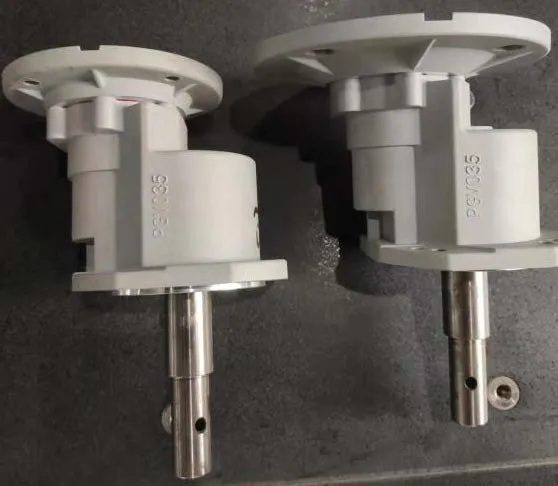
For lift-and-carry warehouse AGVs, forklift AGVs and tow tractors, manufacturing cell AGV workpiece lifts, and heavy-duty AGVs for container handling, the PGV Planetary Gearbox in AGV jacking specification targets the 7-10-year-fleet-service, high-cycle, compact-envelope service class with engineering features specifically chosen to address the failure modes that retire generic gearbox alternatives within 2-3 years of multi-shift AGV fleet service.
Specifications include cast aluminum housing for weight-optimized AGV chassis integration, multi-stage planetary architecture with case-hardened sun gears, planet gears, and ring gears (20MnCr5 hardened to HRC 58-62 surface) delivering 90-95% mechanical efficiency across the operating range, premium-grade sealed angular contact ball bearings rated for 2.5-million-cycle L10 fatigue life under combined radial and thrust loading, fluoroelastomer (Viton) double-lip seals with stainless garter springs at all shaft penetrations, IP65 ingress protection plus dust-resistant breather configuration designed for warehouse floor exposure, sealed-for-life synthetic grease lubrication eliminating field relubrication requirements, servo motor mounting flange per IEC 72 standard with matched encoder communication protocol options for major AGV servo systems, and stainless steel A2 mounting hardware throughout. Reduction ratios from 16:1 through 80:1 cover the full AGV jacking duty range. Output torque ratings reach 280 Nm continuous (with heavy-duty variants reaching 800 Nm for forklift AGV applications). Drive mass below 8 kg supports AGV chassis weight optimization. CE marking, RoHS compliance, and ISO 9001:2015 quality system certification ship with every unit.
Beyond the PGV planetary frame, complete AGV jacking drive packages typically pair the gearbox with battery-powered servo motors with matched encoder feedback (24V or 48V DC servo systems), shielded encoder cables rated for AGV electromagnetic environment, integrated electromagnetic brake assemblies for absolute position holding during loaded transport between warehouse positions, and full grade 8.8 stainless steel mounting hardware throughout. Akgnx Co., Ltd supplies matched drive packages for AGV system OEMs and provides aftermarket replacement units for installed AGV fleets across major automated warehouse markets globally.
Specifying Drives for AGV Jacking Mechanisms?
Send AGV chassis envelope, lifting payload, jacking stroke, and cycle requirements. We supply PGV planetary drives engineered for 7+ year fleet service with 90-95% efficiency and 2.5-million-cycle endurance.
Frequently Asked Questions
© Akgnx Co., Ltd · About Us · Contact Us · [email protected]