
A worm gearbox running too hot is one of the most common field complaints in industrial maintenance — and one of the most preventable failures. Unlike helical or planetary gearboxes where overheating is almost always a sign of mechanical overload or bearing failure, worm gearbox overheating is often a specification problem, not a hardware failure: the gearbox was correctly assembled, correctly installed, and is running within its mechanical torque rating — but its thermal power rating was never checked during selection. This article explains exactly why worm gearboxes run hot, how to calculate whether your gearbox is within its thermal limit, and seven proven interventions that reduce operating temperature in field-deployed units.
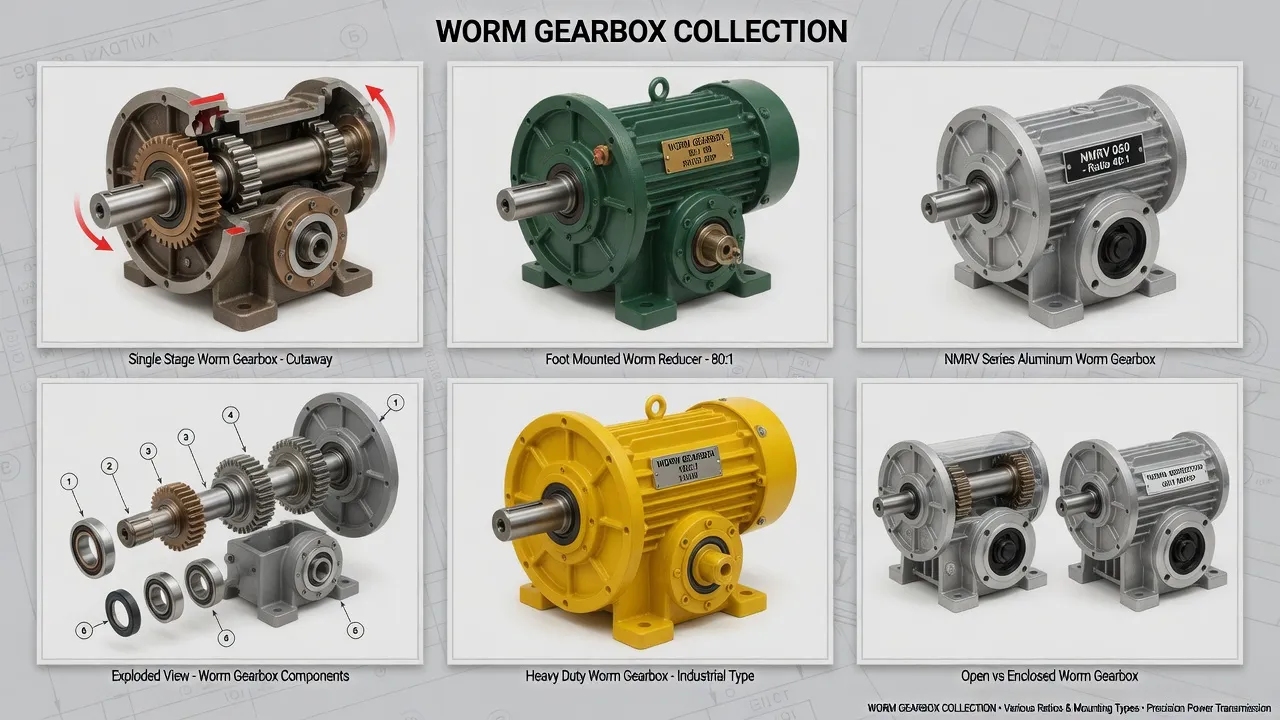
Why Worm Gearboxes Run Hotter Than Other Reducer Types
The worm gearbox generates more heat per unit of transmitted power than any other common gear reducer architecture. The physics reason: the worm thread slides across the worm wheel tooth face rather than rolling — and sliding friction converts a significant fraction of the input power to heat at the mesh contact zone.
At a 50:1 ratio where efficiency is approximately 70%, 30% of every watt of input power becomes heat inside the gearbox housing. For a 3 kW motor input, that is 900 W of continuous heat generation — roughly equivalent to a one-bar electric space heater running inside the casing. This heat must escape through the housing surface area by natural convection and radiation. When the rate of heat generation exceeds the rate of heat dissipation, oil temperature rises until it reaches a new equilibrium — or until the lubricant breaks down.
| Gearbox Type | Efficiency (50:1) | Heat at 3 kW Input | Relative Heat |
|---|---|---|---|
| Worm gearbox | 70% | 900 W | 7.5× |
| Helical-worm (S-series) | 82% | 540 W | 4.5× |
| Bevel-helical (K-series) | 95% | 150 W | 1.25× |
| Inline helical (R-series) | 96% | 120 W | 1× (baseline) |
The 6 Root Causes of Worm Gearbox Overheating
- Thermal power rating exceeded (most common): The gearbox was selected based on mechanical torque rating only. The thermal input-power rating — which is often lower than the mechanical rating at high ratios and continuous duty — was never checked. The gearbox is mechanically sound but thermally overloaded. This accounts for the majority of “new gearbox overheating” reports in the field.
- Wrong lubricant viscosity grade: Using a lubricant that is too viscous for the operating temperature creates churning losses — the oil resists the spinning worm shaft, generating additional heat before the gearbox even transmits load. ISO VG460 in a gearbox specified for VG220 at 40°C can raise housing temperature by 8–15°C.
- Incorrect mounting orientation: Worm gearboxes are oil-splash lubricated from a sump at the base of the housing. The oil fill level varies by mounting position (B3 foot-mount vs B5 flange-mount vs V1 vertical-input). Installing a B3-configured gearbox on its side without changing the oil fill port results in either an underfilled (worm wheel running partially dry) or overfilled (churning losses) condition — both raise temperature.
- Ambient temperature too high: Catalog thermal power ratings are specified at 20°C (sometimes 25°C) ambient. For every 10°C above the rating ambient, the allowable continuous input power drops approximately 10–15%. A unit specified at 20°C ambient running in a 45°C enclosure may need to derate to 65–75% of its catalog continuous power rating.
- Blocked ventilation: The aluminum housing of an NMRV gearbox dissipates heat by natural convection from its finned exterior surface. Mounting the gearbox against a solid wall, inside an unventilated panel, or with motor exhaust air blowing across it significantly reduces heat dissipation. A gearbox running in stagnant 40°C air inside a sealed enclosure can run 20–30°C hotter than an identical unit in free ambient air.
- Lubricant degradation: Used lubricant with depleted anti-wear additives or oxidation products from previous overheating episodes has higher boundary-friction characteristics, generating more heat at the mesh. Each overheating episode degrades the lubricant, raising the temperature in subsequent cycles — a self-reinforcing failure spiral that ends in worm wheel failure.
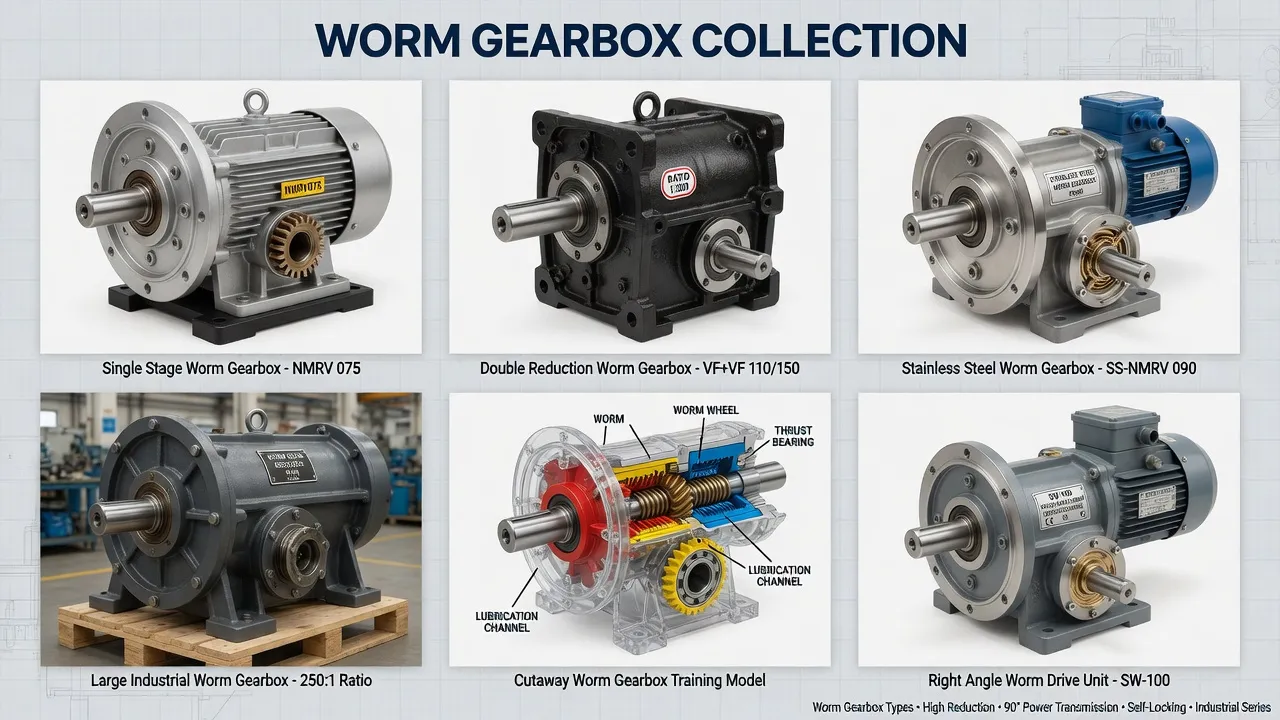
Thermal Power Rating — How to Check if You Are Within Limits
Every worm gearbox catalog page contains two separate power ratings. Most engineers read only the first:
- P₁mech (mechanical input power rating): Governed by gear tooth fatigue strength and bearing load capacity. For a 0.75 kW motor, the gearbox mechanical rating typically allows 1.5–3× this power.
- P₁therm (thermal input power rating): Governed by the housing surface area’s ability to dissipate heat at a defined reference ambient temperature (typically 20°C) and maximum oil temperature (typically 90°C). This is always lower than P₁mech at high ratios.
The check is simple: your actual continuous input power must be below both ratings. At ratio 50:1, an NMRV075 might have P₁mech = 4.2 kW but P₁therm = 2.1 kW. Running a 3 kW motor exceeds the thermal rating by 43% — even though the mechanical rating is not exceeded.
To calculate whether your gearbox is thermally within limits:
Step 1: P₁_actual = Required output power / efficiency = T₂ × ω₂ / η
Step 2: P₁_actual must be ≤ P₁therm from catalog at 20°C ambient
Step 3: If ambient > 20°C, apply derating: P₁therm_corrected = P₁therm × (90 − T_ambient) / 70
Example at 40°C ambient: P₁therm_corrected = P₁therm × (90−40)/70 = P₁therm × 0.71 → 29% derating
For our full NMRV worm gearbox series, both the mechanical and thermal input-power ratings are listed in the product catalog for each frame size, ratio, and input speed combination. For stainless steel food-industry versions with different thermal dissipation characteristics, the stainless steel worm gearbox has its own thermal rating data.
7 Proven Ways to Reduce Worm Gearbox Running Temperature
In order of increasing cost and complexity — start with interventions 1–3 before committing to hardware changes:
- Switch to PAO synthetic lubricant (free, or <€25 per unit). PAO synthetic oil maintains a lower film coefficient of friction at operating temperature than mineral oil, directly reducing mesh heat generation by 3–7 percentage points of efficiency. It also has a higher oxidation resistance, extending lubricant life before the next change. This is the first action to take in any overheating investigation. Flush the existing oil completely, fill with the same volume of ISO VG220 PAO synthetic. Observe temperature over the next 48–72 hours of operation.
- Verify and correct oil fill level for actual mounting orientation (<30 min, no parts cost). Confirm the gearbox mounting orientation (B3, B5, V1, V5, etc.) and verify the oil fill hole is the one specified for that orientation in the manual. Worm gearboxes have multiple plug holes for different mounting positions — the wrong plug is used as the fill reference more often than most maintenance teams realize. Drain and refill to the correct level for the installed orientation.
- Improve ventilation around the housing (low cost, structural modification). Ensure at least 50 mm clearance on all four sides and the top of the housing for free-convection airflow. If the gearbox is inside a panel enclosure, add a ventilation fan or install a heat exchanger on the panel door. Improving airflow from stagnant air to 1–2 m/s forced convection across the housing surface can increase natural heat dissipation by 40–60%, reducing steady-state temperature by 15–25°C.
- Add an external cooling fan on the input shaft (€40–€120 accessory). An input-shaft-mounted axial cooling fan increases housing surface convection, raising the effective thermal power rating by 40–80% depending on frame size. Most NMRV manufacturers offer a bolt-on fan kit for each frame size. This is the most cost-effective hardware upgrade for thermally overloaded applications.
- Up-size to the next frame (one-time purchase cost). A larger frame has more housing surface area and therefore higher thermal power rating. Moving from NMRV063 to NMRV075 at equivalent ratio typically increases the thermal rating by 30–45%. If the gearbox is thermally overloaded by 20–30%, one frame size up almost always resolves the issue. For the full NMRV range comparison, see the worm gearbox technical maintenance guide.
- Reduce the ratio by using a helical pre-stage (architectural change, highest impact). If the gearbox is at a high ratio (50:1–100:1), replacing it with a helical-worm (S-series) combination running the same overall ratio improves efficiency by 10–18 percentage points — directly reducing heat generation by the same proportion. An NMRV075 at 100:1 generating 1,200 W of heat can be replaced with an S-series at 100:1 generating 600–700 W — halving the thermal load on the housing.
- Install an external oil cooler (permanent solution for heavy continuous duty). For very high continuous-power applications where all simpler measures are insufficient, a small plate heat exchanger in the oil circuit removes heat directly from the oil before it transfers to the housing. This effectively removes the thermal power rating constraint entirely, allowing the gearbox to run at its mechanical power rating in continuous duty. Cost: €150–€500 for small-frame units including oil pump, cooler, and fittings.
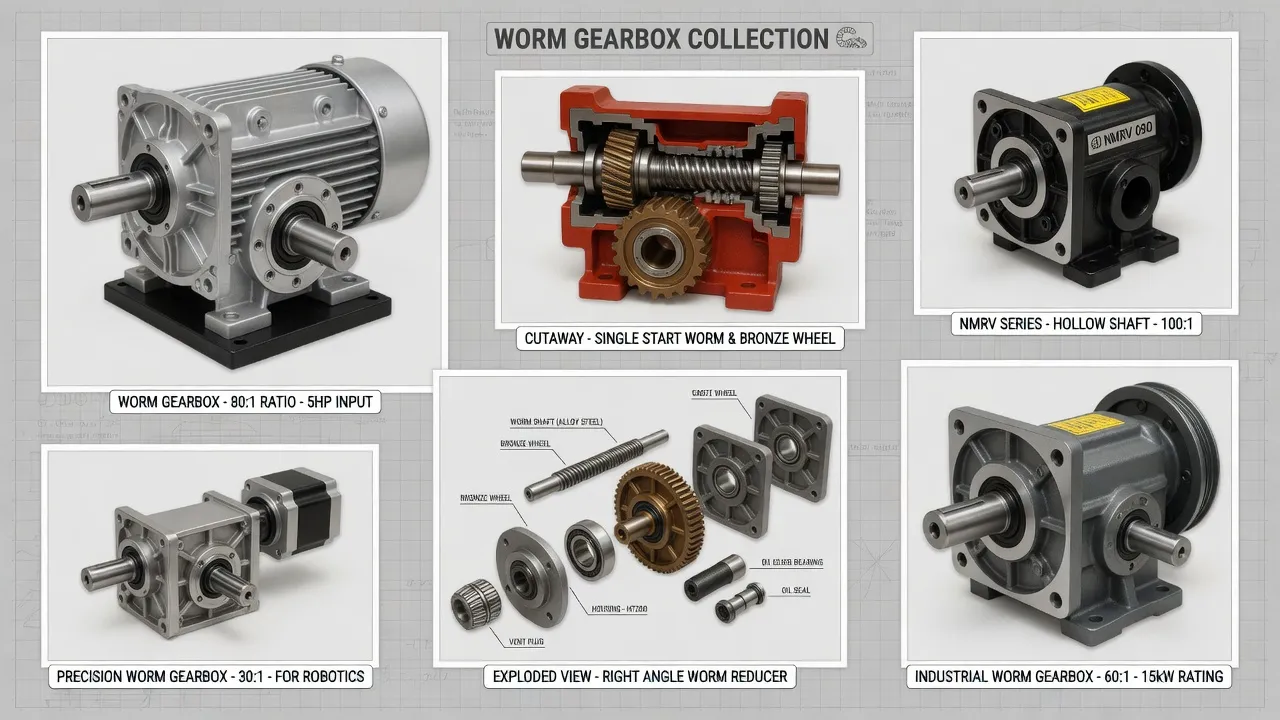
What Sustained Overheating Damages — and How Fast
Understanding the damage sequence helps prioritize urgency of intervention:
| Oil Temp (°C) | What is Happening | Action Required |
|---|---|---|
| 40–70°C | Normal operating range. Lubricant in good condition, optimal viscosity for EHL film. | None — monitor |
| 70–85°C | Elevated but acceptable. Oxidation rate increases; lubricant change interval shortens. | Reduce change interval to 4,000 h |
| 85–95°C | High. Mineral oil oxidation accelerates rapidly. FKM seals approach temperature limit. Bronze wheel surface softens slightly. | Investigate and apply a fix within 30 days |
| 95–110°C | Critical. Lubricant viscosity drops below EHL film threshold. Metal-to-metal contact begins. Seal carbonization. Bronze wheel wear rate accelerates 3–5×. | Reduce load or stop — apply fix within 48 h |
| >110°C | Failure imminent. Lubricant breakdown, seal failure, bronze wheel scuffing. Catastrophic worm wheel failure likely within hours to days. | Stop immediately |
Frequently Asked Questions
My new gearbox is running hot in the first week — is it faulty?
Probably not. New worm gearboxes run 4–8% less efficiently than run-in units, and the initial 50–200 hours of operation produces more heat as the worm and wheel surfaces micro-conform (run-in). Monitor temperature trend: if it stabilizes and gradually decreases over the first 50–100 hours, the gearbox is performing normally. If temperature continues to rise after 100 hours of normal-duty operation, investigate the six root causes listed above.
How do I measure oil temperature without removing the gearbox?
The most practical non-invasive method is to measure the housing surface temperature using an infrared thermometer or contact thermocouple on the surface directly above the oil sump. Housing surface temperature is typically 15–25°C below oil temperature for a standard aluminum NMRV housing in free ambient air. So a housing surface reading of 70°C corresponds to approximately 85–95°C oil temperature. Temperature-indicating stickers (irreversible color-change strips rated at 80°C, 95°C, 110°C) applied to the housing near the oil sump provide a permanent record of maximum temperature reached.
Can I add a heat sink to the housing to improve cooling?
Yes — adhesive aluminum heat sink fins can be applied to the flat surfaces of the housing to increase effective surface area. For small NMRV gearboxes (030–063), this can provide 15–25% additional heat dissipation in natural convection — roughly equivalent to increasing the thermal rating by that proportion. The fins must be applied with a thermally conductive adhesive (silicone with aluminium oxide filler) to ensure good thermal contact with the housing surface. This is a practical temporary measure; a permanent fix should address the root cause.
What is the maximum continuous oil temperature for a standard NMRV worm gearbox?
The standard catalog maximum oil temperature for NMRV gearboxes with FKM (Viton) seals and ISO VG220 PAO lubricant is 90°C continuous, 100°C short-term peaks (<2 hours). At 90°C oil temperature with a typical 18°C housing-to-oil differential, the housing surface temperature is approximately 72°C — the standard catalog thermal rating target. Standard NBR seals limit oil temperature to 80°C; if you are unsure which seal material your unit has, assume NBR and apply the 80°C limit until confirmed.
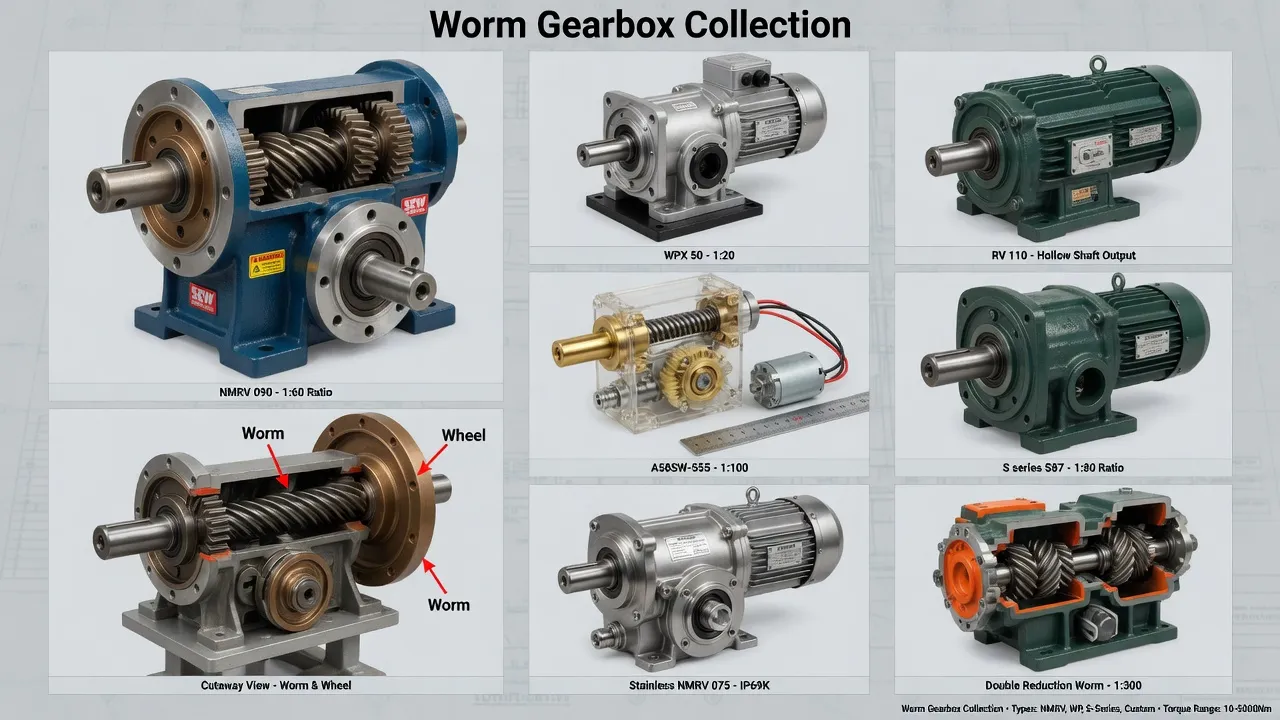
Dealing With a Worm Gearbox That Runs Too Hot?
Send our drive engineers your gearbox frame size, ratio, input power, duty cycle, and ambient temperature — we’ll diagnose whether you have a thermal overload, lubrication issue, or specification problem, and recommend the most cost-effective fix.