
A 42-meter bucket elevator lifting cement clinker from grinding mill to silo storage carries 320 kg of material in each of 280 buckets along the chain at any moment — roughly 90,000 kg of total inventory suspended above the boot pulley while the head sprocket drives continuously at 38 RPM. When that elevator stops mid-cycle, whether for scheduled maintenance or unplanned power loss, the entire material column tries to fall back through the chain return path. Modern bucket elevators rely on the worm gearbox drive package as the primary anti-runback safety device, with geometric self-locking holding the loaded chain absolutely without any external backstop, brake, or clutch component subject to maintenance failure modes. A loaded elevator running away through the boot section produces equipment damage typically running USD 80,000 to 250,000 in repair costs plus 5 to 14 days of plant production downtime — a single avoided incident pays for an entire fleet of properly specified drives many times over.
This guide covers the low-speed high-torque drive demands of bucket elevator applications, addresses the dust-contaminated abrasive environment typical of cement, mining, and grain handling installations, walks through selection criteria for service factor 2.0+ heavy-duty applications per AGMA 6034-B92 methodology, and provides maintenance roadmap guidance for installed elevator fleets. Audience: bucket elevator OEM engineers, plant maintenance directors, and procurement specialists sourcing replacement drives across cement, mining, agriculture, and bulk handling sectors.
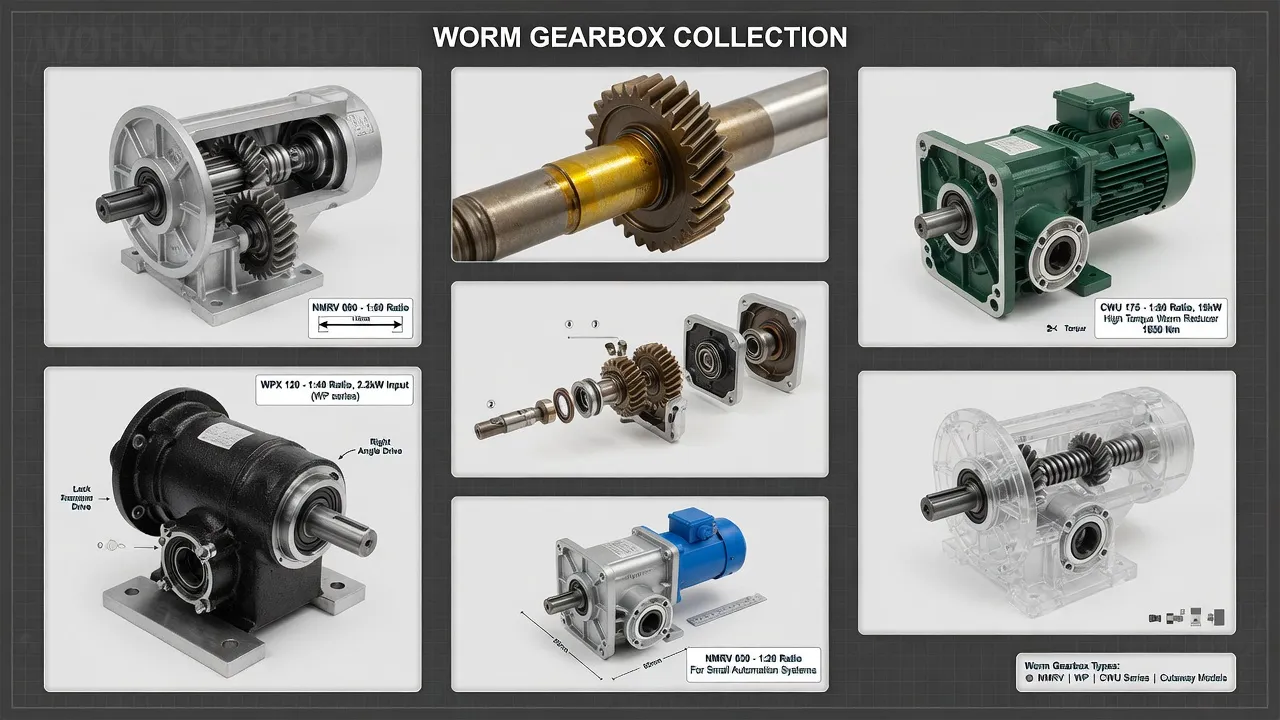
Why Are Bucket Elevators So Demanding on Drive Specifications?
Bucket elevators combine four operational demands rare in other material handling applications. The first is the absolute requirement for anti-runback protection — a loaded elevator that loses anti-reversal capability sends the entire material column crashing back through the boot section, potentially destroying the chain, buckets, boot housing, and surrounding structure within seconds. The second is the low-speed high-torque output profile required to lift heavy material columns at controlled speeds, typically 25 to 60 RPM at output torques ranging 4,000 to 35,000 Nm depending on elevator capacity. The third is the dust-contaminated abrasive environment surrounding cement, grain, and mineral processing elevators, where fine particulates infiltrate any imperfectly sealed housing and accelerate internal wear from inside.
The fourth demand is sustained continuous-duty operation with very few scheduled outage opportunities. Cement plants run elevators 7,500+ hours per year between scheduled maintenance windows. Grain elevators run 16 to 22 hours daily during 8-week harvest seasons. Mining processing plants run 24/7 across multi-year operating campaigns. The drive package must deliver this duration of continuous operation while handling occasional overload events from compacted material, oversized debris, or restart against settled product after extended shutdown periods. The bucket elevator worm gearbox selection therefore must address self-locking holding capacity, low-speed torque density, abrasive environment sealing, and continuous-duty fatigue rating simultaneously — none of these specifications is optional.
How Does Worm Gear Self-Locking Prevent Bucket Elevator Runback?
Geometric Anti-Reversal Without External Backstops
Worm gear self-locking depends on the worm thread lead angle remaining below the friction angle of the meshing surfaces. When the lead angle stays under approximately 5.7° (corresponding to reduction ratios above 30:1), the bronze worm wheel cannot back-drive the steel worm shaft regardless of applied output torque. Bucket elevator applications typically use reduction ratios from 40:1 to 80:1 in the worm stage, comfortably within the self-locking threshold. The mechanical reasoning: torque applied to the worm wheel through the loaded chain produces an axial force component on the worm thread, but the static friction force at this lead angle exceeds the back-driving force component and the system locks geometrically. No external backstop, no electromagnetic brake, no ratchet mechanism — the locking is inherent to the gear mesh geometry.
Holding Torque Capacity Across Loaded Chain Conditions
Self-locking holding torque on bucket elevator drives must exceed the worst-case back-driving torque from the loaded chain plus margin for transient peaks during settling motion. For a typical 35-meter elevator handling 250 tons per hour at 50 percent bucket fill, the worst-case back-driving torque reaches roughly 4,800 Nm at the gearbox output shaft. Specifying a worm gearbox with rated holding torque of 8,000 Nm at the operating reduction ratio provides 1.7× safety margin across loaded chain conditions. Heavy-duty bucket elevator drive packages such as the MFV hollow-shaft series target this duty class specifically with frame sizes scaled to deliver appropriate holding capacity at typical elevator operating ratios.
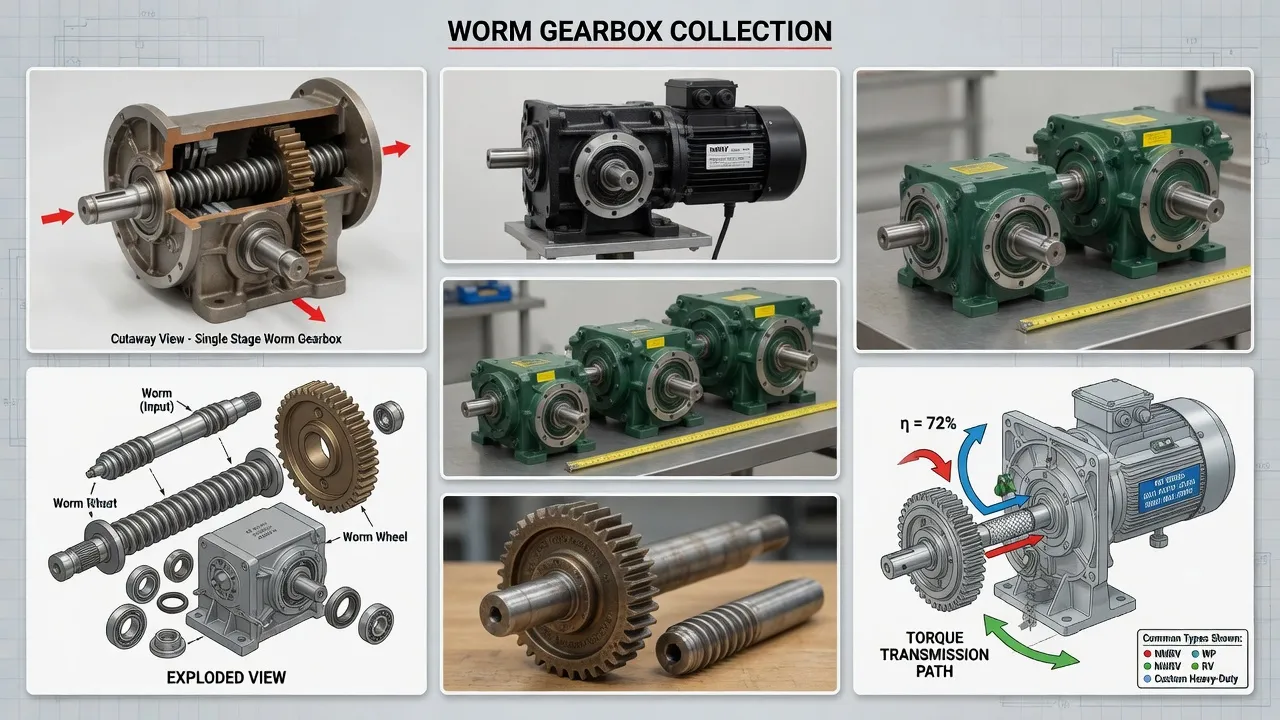
Technical Parameters: Heavy-Duty Elevator Specification Window
The table below summarizes specifications distinguishing bucket elevator drives from generic industrial alternatives. Values reflect AGMA 6034-B92 worm gear power rating combined with bulk material handling industry conventions for heavy-duty service factor and continuous operation.
| Parameter | Elevator Specification | Generic Industrial |
|---|---|---|
| Output configuration | 90° hollow shaft mount | 90° solid shaft typical |
| Reduction ratio range | 30:1 to 100:1 (within self-lock zone) | 5:1 to 100:1 |
| Output torque (rated) | 4,000 – 35,000 Nm | 200 – 2,000 Nm typical |
| Self-locking holding torque | 120 – 850 Nm static | 25 – 280 Nm typical |
| Service factor (heavy duty) | 2.0 minimum, 2.5 recommended | 1.0 – 1.25 typical |
| Operating temperature | -15 °C to +95 °C | -10 °C to +60 °C |
| Sealing rating | IP66 with dust deflectors | IP54 standard |
| Hollow shaft bore range | 40 – 120 mm direct mount | N/A (solid output) |
| Compliance | CE, RoHS, ISO 9001:2015 | CE only |
The single specification most often miscalculated on bucket elevator projects is the service factor. Catalog torque ratings assume uniform load with three or fewer starts per hour and no shock loading — conditions virtually no real bucket elevator meets. Material flow surges, occasional restart-against-compacted-material events, and the inherent shock loading from bucket fill cycles all combine to demand service factor 2.0 minimum, with severe applications justifying 2.5 to 3.0. Bucket elevators handling abrasive mining ore or aggressive materials should default to service factor 2.5 regardless of calculated steady-state torque, as the cumulative shock and abrasive loading shortens service life proportionally without proper margin.
Application Matrix: Where Heavy-Duty Elevator Drives Operate
Cement Plant Clinker and Raw Material Elevators
Cement production lines route raw materials and finished clinker through bucket elevators at multiple plant positions. Pre-grinder elevators carry crushed limestone and additives to the raw mill feed. Clinker cooler discharge elevators lift hot clinker (often 80 to 110 °C) from the cooler to the storage silos. Finish mill discharge elevators carry ground cement to the cement silo storage. Each position demands continuous-duty operation across multi-year campaigns with no scheduled stop opportunities. Output torques range 6,000 to 28,000 Nm depending on elevator capacity (typically 80 to 400 tons per hour). Self-locking eliminates the external backstop maintenance burden in dust-contaminated cement plant atmospheres.
Grain Elevator and Agricultural Bulk Storage
Grain elevators, oilseed processing, and agricultural bulk storage facilities use bucket elevators to lift product from receiving pits to overhead distribution hoppers feeding storage silos. Service combines harvest-season continuous duty with year-round receiving and shipping operations at moderate to high cycle counts. Output torques run 4,000 to 18,000 Nm depending on elevator capacity. Lubricant specification matters because grain processing temperatures may exceed 60 °C in dryer-fed elevators handling product directly from drying operations. Self-locking holds loaded grain columns absolutely during shutdown windows, eliminating safety risk to facility workers performing scheduled maintenance.
Mining Processing Plant Ore Elevators
Mining processing plants use bucket elevators to lift crushed ore between processing stages — typically between primary and secondary crushers, between grinding circuits, or between flotation and concentration stages. The applications combine highly abrasive ore characteristics with shock loading from oversized fragments that escape upstream screening. Service factor 2.5 minimum covers this duty class. Output torques range 8,000 to 35,000 Nm depending on ore density and elevator capacity. Specialty bronze worm wheel materials with enhanced abrasive resistance extend service life under aggressive mining duty.
Power Plant Coal and Ash Handling
Coal-fired power plants use bucket elevators for coal handling between rail receiving and bunker storage, plus ash handling from ash hoppers to disposal silos. Coal handling elevators typically run intermittent duty during fuel receiving operations, while ash handling elevators run continuous duty during plant operation. Output torques range 5,000 to 22,000 Nm depending on capacity. The combustion ash environment particularly challenges sealing and lubrication systems with elevated temperatures and chemical aggressiveness from the ash composition.
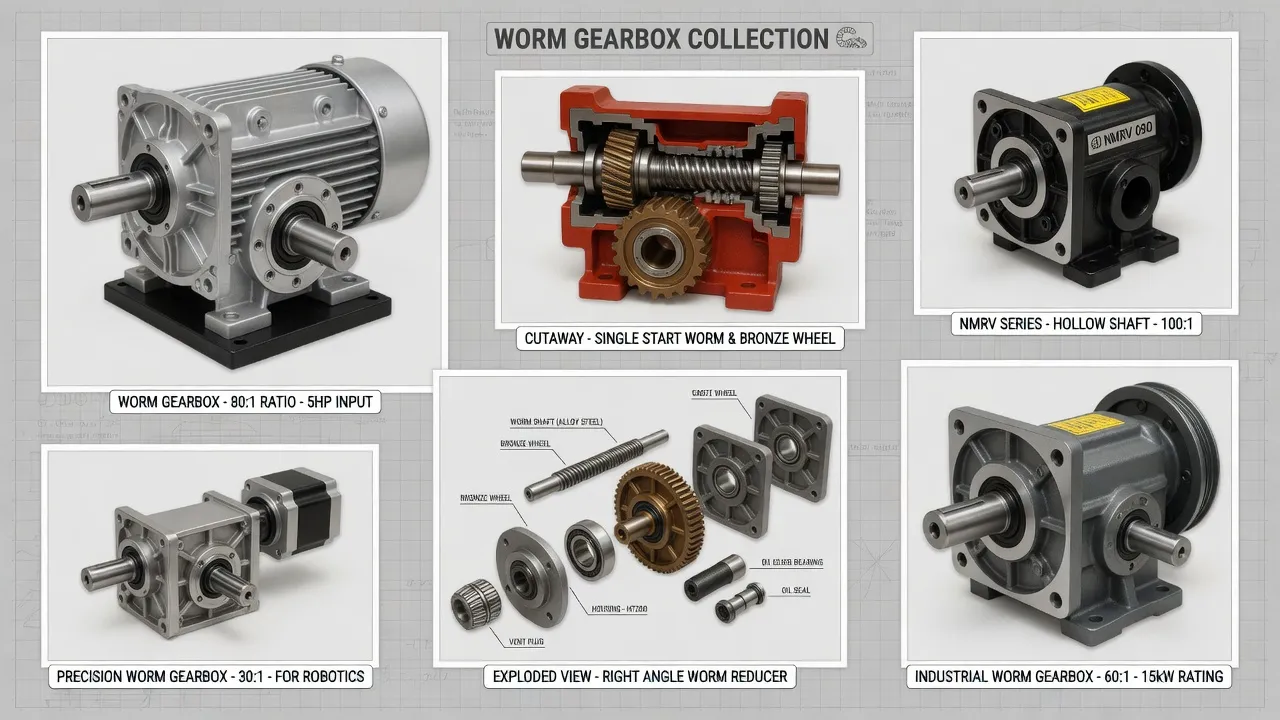
Selection Roadmap: Step-by-Step Workflow
The four-step procedure below covers heavy-duty bucket elevator drive selection from initial requirements documentation through commissioning verification.
Calculate Loaded Chain Lift Power and Holding Torque
Determine total chain lift power from material throughput rate × elevator height + bucket weight × chain speed + chain friction losses. Calculate worst-case static back-driving torque from loaded chain weight × head sprocket radius. The selected gearbox must deliver continuous output torque exceeding lift requirement plus self-locking holding torque exceeding back-driving torque by 1.5× safety margin. Document both values in the gearbox specification.
Apply Service Factor 2.0 Minimum, 2.5 for Abrasive Materials
Multiply calculated steady-state torque by 2.0 for general bulk material elevators, 2.5 for cement clinker and abrasive ore service, and 3.0 for severe shock applications including restart against compacted material. The resulting equivalent uniform-duty torque is what the catalog rating must exceed at the chosen reduction ratio. Service factor below 2.0 produces gearboxes that fail within 12 to 18 months of bucket elevator service regardless of other specifications.
Specify Hollow Shaft Mounting on Head Pulley Shaft
Order the gearbox with hollow output shaft sized to mate with the elevator head pulley shaft diameter (typically 60 to 120 mm depending on elevator capacity). Direct shaft mounting eliminates couplings, alignment surfaces, and the additional sealing points that any inline drive arrangement would require. Specify shrink disc or taper bushing connection between the hollow output bore and the head pulley shaft for reliable torque transmission across multi-decade service.
Verify IP66 Sealing for Dust-Contaminated Service
Confirm the gearbox sealing package includes IP66 ingress protection plus mechanical dust deflectors at all shaft penetrations. Specify Viton seal lips for chemical resistance to lubricant oxidation byproducts. Use synthetic polyalphaolefin (PAO) ISO VG 460 lubricant fill for elevators near heated process equipment, or synthetic polyalkylene glycol (PAG) ISO VG 460 for clinker cooler service where housing temperatures exceed 80 °C.
Spare Parts Integration: Heavy-Duty Drive Maintenance
Bucket elevator drive maintenance prioritizes replacement stock matching the multi-year campaign cycles of cement and mining plant operations. The worm shaft, machined from 20CrMnTi case-hardened steel with ground and polished thread surfaces hardened to HRC 58-62 per DIN 3974 quality grade Q8, reaches 35,000+ operating hours under proper PAO lubrication and dust protection. Worm shaft replacement is needed only at major plant rebuild events typically scheduled at 8 to 10 year intervals.
The worm wheel, centrifugally cast from premium tin bronze ZCuSn10P1 per ISO 1338 with ground tooth surfaces, is the higher-cycle wear component — replacement intervals run 25,000 to 35,000 hours under proper lubrication and sealing protection. Premium-grade SKF or NSK tapered roller bearings on the worm shaft handle both radial and axial loads typical of heavy elevator service. L10 bearing fatigue life under rated continuous duty exceeds 40,000 hours, with bearing replacement typically performed concurrent with worm wheel service rather than as a separate maintenance event.
Spare parts kits combining worm shaft, worm wheel, complete bearing set, all shaft seals, gasket kit, breather valve, and shrink disc components provide complete rebuild capability for installed elevator fleets. Akgnx Co., Ltd ships kits packaged for typical cement and mining plant maintenance shop inventory practices, with all wear components sourced from the same factory production runs to ensure dimensional consistency across the rebuild cycle and to support multi-elevator plant standardization.
Cost & Sustainability: Total Ownership Across 12-Year Campaign Service
Cement plant capital cycles align with refractory campaign rebuilds typically running 10 to 12 years, while mining plant operations run similar horizons matching extraction lease terms. The table compares total cost of ownership for heavy-duty bucket elevator gearboxes against generic industrial alternatives across this horizon.
| Cost Component | Heavy-Duty MFV | Generic Industrial |
|---|---|---|
| Initial unit price (FOB) | USD 2,200 – 6,800 | USD 1,400 – 3,800 |
| External backstop cost | Eliminated (self-locking) | USD 850 – 2,400 added |
| Replacement frequency | 1× over 12 years | 3 – 4× over 12 years |
| Lubricant interval | 7,000 hours / 28 months | 2,000 hours / 8 months |
| Runback incident risk | Eliminated (self-lock) | Backstop failure mode |
| 12-year cumulative TCO | ~ 1× installed cost | ~ 3.8× installed cost |
Sustainability and compliance documentation accompanies every heavy-duty MFV gearbox shipment. The housing carries CE marking per EU Machinery Directive 2006/42/EC and complies with RoHS Directive 2011/65/EU. Manufacturing follows ISO 9001:2015 quality management procedures with full material traceability. Worm gear tooth geometry follows DIN 3974 quality grade Q8 with load capacity per AGMA 6034-B92 worm gear power rating methodology adjusted for heavy-duty bucket elevator service factor.
Synthetic PAO and PAG lubricant fills produce 75 to 85 percent less waste oil over the equipment service life compared to mineral oil alternatives requiring quarterly changes — a substantial reduction in industrial waste oil disposal across cement plant and mining operation campaigns. Akgnx Co., Ltd manufactures heavy-duty bucket elevator gearboxes through a dedicated bulk material handling drive program serving cement, mining, agricultural, and power generation customers across major industrial regions globally.
Customer Testimonials from Bucket Elevator Operators
“Our cement plant lost an external backstop on the clinker discharge elevator during the 2022 summer campaign — runback damage cost USD 180,000 plus 9 days of plant downtime during peak production. We replaced all 6 elevator drives with self-locking MFV units during the next cold-end shutdown. 22 months in, zero runback events and we eliminated the external backstop maintenance burden entirely.”
— Maintenance Director, Cement Production Plant, Egypt
“As a bucket elevator OEM serving the grain handling industry, we evaluated five alternative gearbox suppliers for our standard heavy-duty package. MFV passed our 3,000-hour shock load test simulating restart against compacted grain with measured backlash growth under 0.04°. Akgnx held our annual production schedule across two consecutive years with consistent batch-to-batch quality.”
— Director of Engineering, Bulk Material Handling OEM, Argentina
“We sourced direct dimensional replacements for an installed fleet of 18 ore handling elevators across two copper mining sites. The MFV mounted to existing brackets without modification and reduced our annual gearbox replacement budget by 70 percent over 4 years. Documentation arrived complete with the first shipment including DIN 3974 quality grade verification and AGMA 6034-B92 calculation summary.”
— Plant Engineering Manager, Copper Mining Operation, Chile
“Power plant ash handling elevators face combined thermal and chemical aggressiveness that destroys generic gearbox installations within 14 to 18 months on average. The MFV with synthetic PAG fill and high-temperature Viton seals reached 5 years of service before our first scheduled major rebuild — substantially better than any alternative we previously deployed in this duty position.”
— Operations Manager, Coal-Fired Power Generation, Indonesia
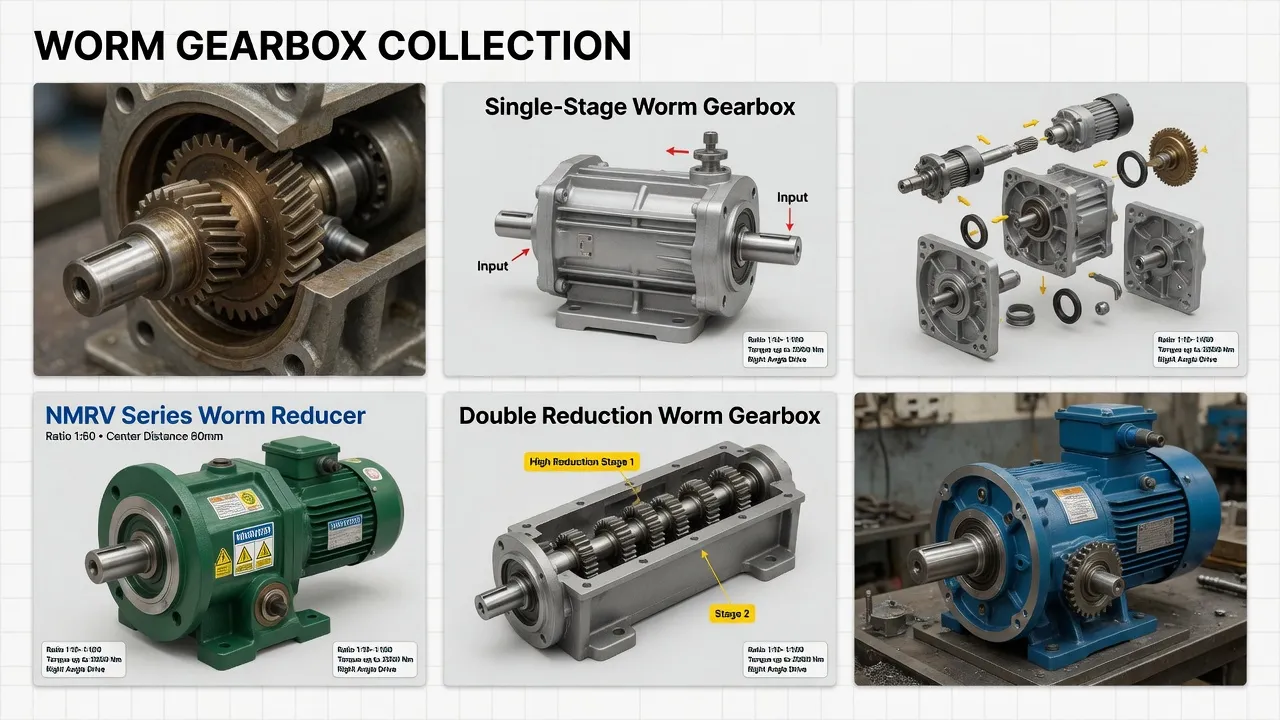
Recommended Drive: MFV Hollow Shaft Worm Gearbox for Bucket Elevators
For heavy-duty bucket elevator applications across cement, mining, grain handling, and power generation sectors, the MFV hollow-shaft worm gearbox targets the self-locking, low-speed high-torque, dust-resistant service class with engineering features specifically chosen to address the failure modes that retire general industrial alternatives within elevator campaign cycles.
Specifications include cast iron housing with two-coat industrial epoxy paint for corrosion and abrasion resistance, centrifugally cast tin bronze ZCuSn10P1 worm wheel meshing with case-hardened 20CrMnTi steel worm shaft per DIN 3974 quality grade Q8, fluoroelastomer (Viton) double-lip seals with stainless garter springs and mechanical dust deflectors, and IP66 ingress protection. Hollow output shaft bores from 40 to 120 mm enable direct mounting on elevator head pulley shafts. Reduction ratios from 30:1 through 100:1 maintain self-locking operation across the full duty range. Output torque on the MFV180 frame reaches 12,000 Nm continuous with self-locking holding torque to 850 Nm at 60:1 reduction. CE marking, RoHS compliance, and ISO 9001:2015 quality system certification ship with every unit.
Beyond the MFV frame, complete bucket elevator drive packages typically pair the worm gearbox with IEC TEFC three-phase induction motors at appropriate frame size (typically 7.5 to 75 kW depending on elevator capacity), shrink disc connection systems for backlash-free shaft mounting, and elastomeric shock-isolation couplings between motor and gearbox. Akgnx Co., Ltd supplies matched drive packages for bucket elevator OEMs and provides aftermarket replacement units for installed plant equipment fleets across major bulk material handling regions globally.
Specifying Drives for Heavy-Duty Bucket Elevators?
Send elevator height, material throughput, head shaft diameter, and required output torque. We supply MFV hollow-shaft worm gearboxes engineered for self-locking heavy-duty bulk material handling.
Frequently Asked Questions
© Akgnx Co., Ltd · About Us · Contact Us · [email protected]