
A 24-meter grain auger handling 180 tonnes of corn per hour during fall harvest from combine to grain cart to truck to elevator storage absorbs continuous duty for 14 to 18 hours per day across the 4 to 6 week harvest window — exactly the period when equipment downtime translates directly into delayed harvest, weather damage to standing crop, and lost revenue measured in tens of thousands of dollars per day. Beyond the throughput pressure, agricultural augers face peak shock loading from foreign object impacts (rocks, wood debris, occasional metal fragments) that occur unpredictably during continuous-duty operation, requiring drive trains capable of absorbing 4 to 6× steady-state torque events without permanent damage. Standard cast iron worm gearboxes specified for general industrial conveying service fail within 2 to 3 harvest seasons under this duty profile, with the failure mode typically appearing as worm shaft fatigue cracking from accumulated cyclic shock loading or seal failure from grain dust intrusion. Properly specified grain auger worm gearbox drives — engineered for shock-tolerant continuous-duty agricultural conveying with appropriate sealing for grain dust exposure — extend service life to 8+ harvest seasons while delivering the harvest-window reliability that grain operations economics demand.
This guide covers the unique drive duty profile of agricultural grain augers, addresses the shock loading and grain dust exposure environment typical of harvest and grain handling operations, walks through selection criteria balancing torque capacity with continuous-duty reliability, and provides a maintenance roadmap suitable for the narrow service windows of active harvest season schedules. Audience: grain auger OEM engineers, large-acreage farm operations managers, and procurement specialists sourcing replacement drives for installed grain handling equipment fleets.

What Drive Demands Distinguish Grain Augers from General Industrial Conveying?
Agricultural grain augers combine four operational characteristics rare in any non-harvest application. The first is the harvest-window duty intensity: drive equipment runs 14 to 18 hours per day across the 4 to 6 week harvest period at sustained near-peak load conditions, then sits idle for 8 to 10 months between harvest seasons. The continuous-duty intensity during harvest exceeds what most industrial drive specifications anticipate, while the long idle periods between harvests create lubrication challenges that no continuous-duty industrial drive faces. The second characteristic is the foreign object shock loading: grain handling operations encounter occasional rocks, wood debris, and metal fragments mixed with the grain stream, producing peak shock torque events of 4 to 6× steady-state during the impact cycle. Drives sized for average grain conveying torque alone fail through cyclic fatigue within 2 to 3 harvest seasons as the foreign object impacts accumulate.
The third characteristic is the grain dust exposure that defines all agricultural grain handling environments. Grain dust from corn, soybean, wheat, and other crops contains fine particle material that penetrates standard sealing packages within hours of operation, accumulating inside drive housings as a contamination layer that compromises lubricant effectiveness and accelerates seal degradation. Beyond contamination, grain dust suspended in air at concentrations above 50 g/m³ becomes potentially explosive, requiring drive equipment installations to comply with NFPA 61 grain dust handling safety standards including specific provisions for electrical equipment, surface temperature limits, and ignition source control. The fourth is the harvest weather exposure — drive equipment operates outdoors under whatever conditions the harvest window presents, including rain events that wet the operating equipment, dust storms during dry harvest conditions, and temperature extremes from frost mornings to high-heat afternoons. The right grain auger worm gearbox selection addresses shock loading capacity, dust exposure protection, and outdoor weather tolerance simultaneously per agricultural conveying gearbox technical references.
How Do Worm Gearboxes Handle Grain Auger Shock Loading?
Bronze Worm Wheel Provides Inherent Shock Absorption
Worm gearbox geometry distributes shock loading across a much larger contact area than rolling-contact alternatives, providing inherent shock absorption that protects both the drive train and the upstream motor from foreign object impact damage. The bronze worm wheel material (centrifugally cast tin bronze ZCuSn10P1 per ISO 1338) yields slightly under extreme shock loading rather than fracturing, absorbing impact energy through localized plastic deformation that does not compromise the gear meshing integrity. This shock-absorption property combined with the high reduction ratios typical of agricultural conveying applications (15:1 to 60:1) protects drive equipment from the foreign object encounters that destroy alternative drive technologies during grain handling operations.
Self-Locking Holds Auger Position During Power Loss
Grain augers loaded with grain at the time of power interruption experience reverse-driving forces from the column of grain in the auger flighting that would tend to rotate the auger backwards if the drive train allowed it. Self-locking worm gearboxes at reduction ratios above 40:1 hold the auger position during power loss events, preventing reverse rotation that would dump grain into unwanted positions and require significant cleanup time before resuming harvest operations. This self-locking capability is particularly important on inclined auger installations where gravity adds additional reverse-driving force to the grain column weight effect.
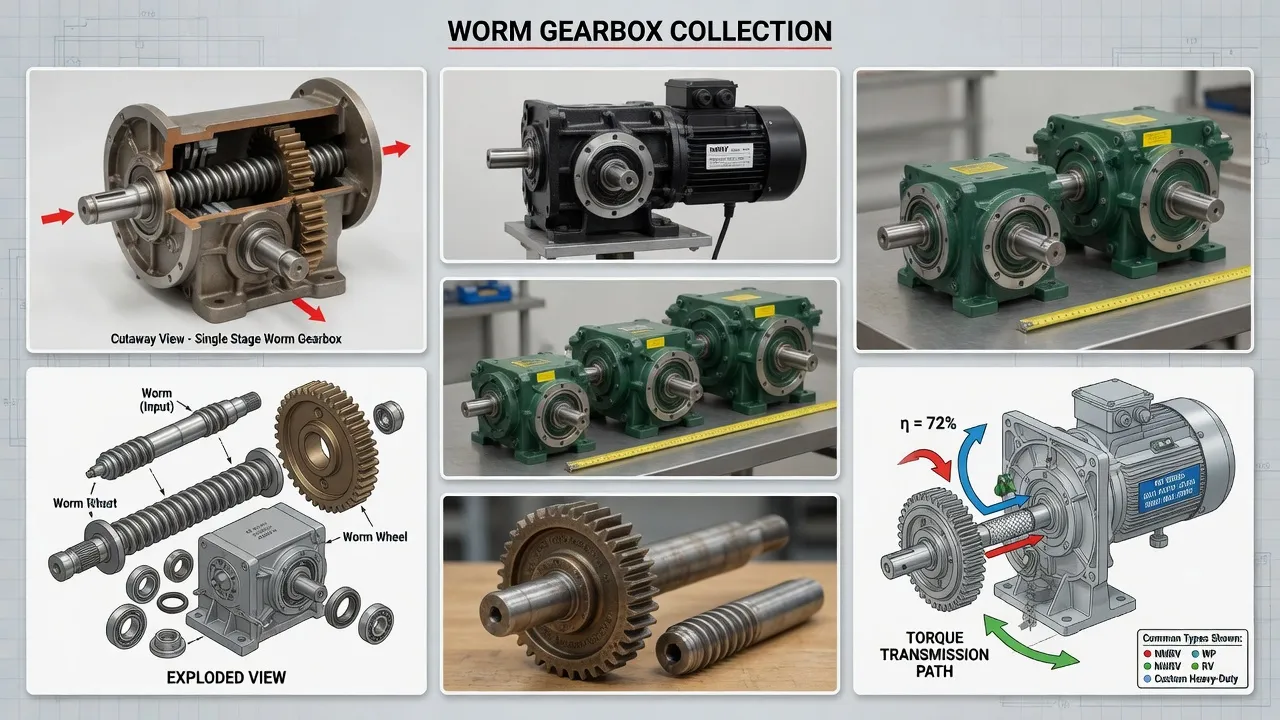
Technical Parameters: Grain Auger Drive Specification Window
The table below summarizes specifications distinguishing agricultural grain auger drives from generic industrial conveying alternatives. Values reflect AGMA 6034-B92 worm gear power rating combined with grain handling industry conventions for shock loading and harvest-season duty.
| Parameter | Grain Auger Spec | Generic Industrial |
|---|---|---|
| Output configuration | 90° solid or hollow shaft | 90° solid shaft typical |
| Reduction ratio range | 15:1 to 60:1 | 5:1 to 100:1 |
| Output torque (rated) | 320 – 2,800 Nm | 200 – 2,000 Nm |
| Service factor (shock duty) | 2.5 minimum, 3.0 recommended | 1.0 – 1.25 typical |
| Operating temperature | -25 °C to +55 °C | -10 °C to +60 °C |
| Sealing rating | IP66 dust-tight outdoor | IP54 standard |
| Lubricant | Synthetic PAO wide-temp | Mineral oil typical |
| Compliance | CE, RoHS, ISO 9001:2015, NFPA 61 ready | CE only |
The single specification most often miscalculated on grain auger projects is the service factor for shock loading. Catalog torque ratings assume uniform load with three or fewer starts per hour and minimal shock loading — conditions completely incompatible with grain handling service. Foreign object impacts produce peak torque events of 4-6× steady-state, with these events occurring unpredictably across continuous-duty harvest operation. Service factor 2.5 minimum covers typical commercial grain auger duty, with applications handling debris-prone grain streams (corn from field operations with stalk debris, soybean with rock content) justifying 3.0 to 3.5. Service factor below 2.5 produces drives that fatigue within 2-3 harvest seasons regardless of housing material.
Application Matrix: Where Grain Auger Drive Equipment Operates
Portable Field Grain Augers
Portable field grain augers transfer grain between combine harvesters, grain carts, semi-trucks, and on-farm storage during harvest operations. Auger lengths range from 14 meters for small commercial operations through 32 meters for large-acreage farms, with throughput rates from 80 to 280 tonnes per hour depending on grain type and auger diameter. Drive output torques range 320 to 1,400 Nm depending on auger size and grain weight density. The duty profile combines harvest-window continuous duty with the additional challenge of frequent setup-and-relocate cycles between field positions throughout the harvest period.
On-Farm Storage Bin Augers
On-farm storage bin augers fill and unload grain bins for medium-term grain storage during the period between harvest and grain marketing operations. The drive duty involves shorter daily operation hours than field augers (typically 4 to 8 hours per day during fill and unload events) but extends across longer time horizons (typically 6 to 9 months between harvest and complete storage clearance). Output torques range 480 to 1,800 Nm depending on bin size and discharge auger configuration. Self-locking holds the auger position absolutely during scheduled stops in fill or unload cycles without external brake hardware.
Commercial Grain Elevator Conveying
Commercial grain elevators handle grain from multiple farm origins through receiving augers, distribution systems, storage bin fill, and shipping conveyors that supply rail and truck loadout positions. Drive duty involves continuous-duty operation across the marketing year (longer than the harvest window for individual farm operations) with throughput rates from 200 to 800 tonnes per hour depending on elevator capacity. Output torques range 800 to 2,800 Nm. Stainless steel mounting hardware throughout supports the longer service exposure timeline of commercial operations compared to seasonal farm equipment.
Specialty Crop Augers and Seed Handling
Specialty crop and seed handling operations use augers designed for specific crop requirements including reduced damage rates for seed-grade material, gentle handling for premium specialty grains, and dedicated systems for organic certified grain streams that cannot share equipment with conventional production. Output torques typically run lower than commodity grain augers (240 to 800 Nm) because reduced rotational speeds protect crop integrity. Drive specifications match the same outdoor exposure and shock-loading considerations as commodity applications. Reference specialty grain handling reducer specification references for detailed sizing examples.
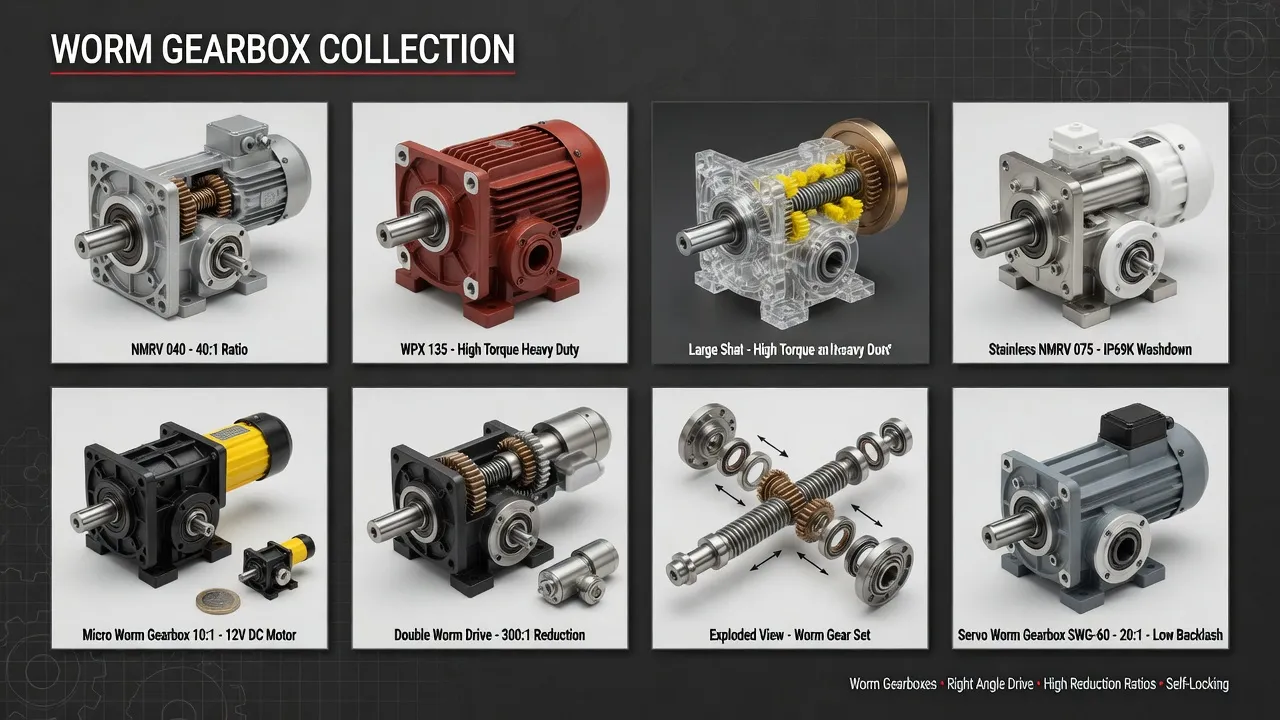
Selection Roadmap: Step-by-Step Workflow
The four-step procedure below covers grain auger drive selection from initial requirements documentation through commissioning verification.
Calculate Auger Conveying Torque from Grain Properties
Determine auger conveying torque from auger length, diameter, target throughput rate, and grain bulk density (typically 720 kg/m³ corn, 770 kg/m³ wheat, 780 kg/m³ soybean). Add inclination component for non-horizontal augers (typical 35-45° inclination on portable field augers adds substantial torque requirement). Document worst-case startup torque accounting for breakaway forces during initial fill cycles when the auger flighting must accelerate full grain column from rest.
Apply Service Factor 2.5 Minimum for Shock Loading Duty
Multiply calculated steady-state torque by 2.5 for typical commercial grain auger service, 3.0 for debris-prone grain streams, and 3.5 for severe shock applications including stone-prone field corn operations. The resulting equivalent uniform-duty torque is what the catalog rating must exceed at the chosen reduction ratio. Service factor below 2.5 produces drives that fatigue within 2-3 harvest seasons from cyclic shock loading regardless of housing material or other specifications.
Verify IP66 Dust-Tight Sealing for Grain Dust Exposure
Confirm the gearbox sealing package includes IP66 dust-tight ingress protection rated for grain dust environments. Specify Viton seal lips at all shaft penetrations with double-lip configuration to provide redundant dust exclusion. For applications inside grain dust hazardous areas (typical inside grain elevators and storage facilities), verify the gearbox surface temperature rating meets NFPA 61 requirements limiting external surface temperature below grain dust ignition threshold.
Specify Synthetic Lubricant for Wide Temperature Range
Order synthetic polyalphaolefin (PAO) lubricant fill rated for -25 °C to +55 °C operating range covering harvest-season weather extremes from frost mornings through high-heat afternoons under solar gain on dark-painted housings. Wide-range synthetic lubricants maintain pumping viscosity during cold startup events and resist thermal degradation during extended continuous-duty operation. Specify the lubricant requirement explicitly on procurement documentation rather than accepting default mineral oil fills.
Spare Parts Integration: Pre-Harvest Preparation Maintenance
Grain auger maintenance prioritizes replacement stock matching the pre-harvest preparation window typical of farm operations — typically 4 to 6 weeks of preparation work before first harvest cycle each fall. The worm shaft, machined from 20CrMnTi case-hardened steel with ground and polished thread surfaces hardened to HRC 58-62 per DIN 3974 quality grade Q8, reaches 18,000+ operating hours under proper synthetic lubrication and IP66 sealing protection — typically translating to 8 to 10 harvest seasons of grain handling service before major rebuild despite the cyclic shock loading inherent to grain auger duty.
The worm wheel, centrifugally cast from premium tin bronze ZCuSn10P1 per ISO 1338 with ground tooth surfaces, reaches 15,000 to 18,000 operating hours under proper lubrication. Premium-grade SKF or NSK tapered roller bearings handle the combined radial and axial loads with L10 fatigue life exceeding 18,000 hours under rated load. Output and input shaft seals (Viton with stainless garter springs and double-lip configuration) require preventive replacement at 4-year intervals during scheduled post-harvest service. Reference standard worm gear technical references for detailed component specifications.
Spare parts kits combining worm shaft, worm wheel, complete bearing set, all shaft seals, gasket kit, breather valve, and synthetic lubricant fill provide complete rebuild capability during pre-harvest preparation or post-harvest service windows. Akgnx Co., Ltd ships kits packaged for typical farm operations and grain elevator maintenance shop inventory practices, with all wear components sourced from the same factory production runs to ensure dimensional consistency across rebuild cycles.

Cost & Sustainability: Total Ownership Across 10-Season Service
Farm operations evaluate grain auger drive investments across 8 to 10 harvest season horizons matching typical equipment depreciation schedules. The table compares total cost of ownership for agricultural-grade grain auger drives against generic industrial alternatives across this horizon.
| Cost Component | Agriculture-Grade MRV | Generic Industrial |
|---|---|---|
| Initial unit price (FOB) | USD 420 – 2,200 | USD 320 – 1,400 |
| Service life in grain handling | 8 – 10 seasons | 2 – 3 seasons |
| Replacement frequency | 1× over 10 seasons | 3 – 4× over 10 seasons |
| Mid-harvest failure risk | Low (annual prep) | High in years 2-3 |
| Lubricant interval | 2 seasons / post-harvest | Annual replacement |
| 10-season cumulative TCO | ~ 1× installed cost | ~ 3.6× installed cost |
Sustainability and compliance documentation accompanies every agriculture-grade MRV gearbox shipment. The housing carries CE marking per EU Machinery Directive 2006/42/EC and complies with RoHS Directive 2011/65/EU. Manufacturing follows ISO 9001:2015 quality management procedures with full material traceability. Worm gear tooth geometry follows DIN 3974 quality grade Q8 with load capacity per AGMA 6034-B92 worm gear power rating methodology adjusted for grain handling shock loading service factor. NFPA 61 grain dust handling safety standards documentation ships with units specified for installation inside grain elevator dust hazardous areas.
Synthetic polyalphaolefin (PAO) lubricant fill produces 60 to 70 percent less waste oil over the equipment service life compared to mineral oil alternatives requiring annual changes — biodegradable lubricant chemistry options meeting OECD 301 standards address environmental concerns adjacent to cropland and grain storage facility operations. Akgnx Co., Ltd manufactures agriculture-grade worm gearboxes through a dedicated grain handling drive program serving auger OEMs, large-acreage farm operations, and commercial grain elevator operators across major cropland markets globally.
Customer Testimonials from Grain Handling Operations
“Our 4,800-hectare corn and soybean operation runs 6 portable grain augers and 14 storage bin augers across the operation. We replaced the original drives with MRV agriculture-grade units after losing two drives during the 2023 harvest week — the breakdown delays cost us roughly USD 38,000 in compressed harvest schedule. Two harvest seasons into the new units, zero in-harvest failures and our pre-harvest preparation time on drive systems dropped substantially.”
— Farm Manager, Row Crop Operation, Iowa USA
“As a portable grain auger OEM serving the agricultural market, we evaluated four alternative gearbox suppliers for our standard 24-meter auger package. MRV passed our 4,000-cycle shock loading test simulating foreign object impacts in field corn applications — measured backlash growth under 0.05° at test completion. Akgnx held our annual production schedule across two consecutive years for spring delivery commitments to dealer networks.”
— Director of Engineering, Grain Auger OEM, Canada
“Our commercial grain elevator handles 480,000 tonnes per marketing year across receiving, storage, and shipping operations. We standardized on MRV agriculture-grade drives across 32 auger positions during our 2022 facility upgrade. NFPA 61 compliance documentation arrived complete with the first shipment supporting our state grain elevator inspection compliance review. Three years into operation, zero unscheduled drive failures during peak receiving season.”
— Operations Manager, Commercial Grain Elevator, Kansas USA
“Specialty seed handling at our certified seed production facility requires gentler grain handling at lower auger speeds with maintained drive reliability across multi-year service. MRV at upgraded specifications reached 7 production seasons of service before our first scheduled major rebuild — better than any alternative we previously deployed in this duty position. The drive reliability also supported our seed quality certification by eliminating potential foreign material introduction from drive failure debris.”
— Plant Manager, Certified Seed Production, Hungary
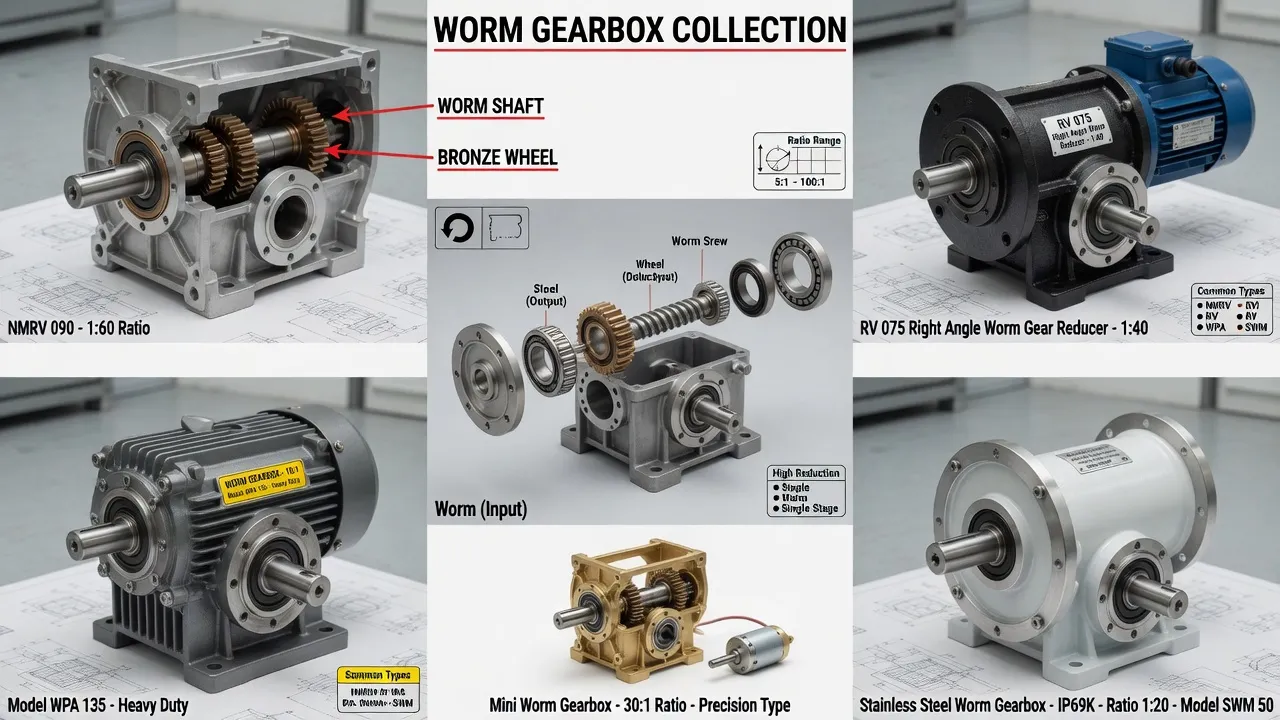
Recommended Drive: MRV NMRV Standard for Grain Auger Service
For agricultural grain auger applications across portable field augers, on-farm storage bin augers, commercial grain elevator conveying, and specialty crop handling, the MRV NMRV Standard Worm Gearbox Series in agricultural specification targets the shock-tolerant, harvest-duty service class with engineering features specifically chosen to address the failure modes that retire generic industrial alternatives within 2 to 3 harvest seasons of grain handling installation.
Specifications include cast iron housing with two-coat industrial epoxy paint plus UV-resistant topcoat for outdoor exposure, centrifugally cast tin bronze ZCuSn10P1 worm wheel meshing with case-hardened 20CrMnTi steel worm shaft per DIN 3974 quality grade Q8, fluoroelastomer (Viton) double-lip seals with stainless garter springs for grain dust exclusion, IP66 dust-tight ingress protection rated for grain handling environments, and synthetic polyalphaolefin (PAO) lubricant fill rated for -25 °C to +55 °C operating temperature range. Reduction ratios from 15:1 through 60:1 cover the speed and torque range typical of grain auger duty. Output torque on the MRV130 frame reaches 3,400 Nm continuous with shock loading capacity supporting service factor 3.0 applications. CE marking, RoHS compliance, and ISO 9001:2015 quality system certification ship with every unit, with NFPA 61 grain dust handling safety documentation available for elevator installations inside dust hazardous areas.
Beyond the MRV frame, complete grain auger drive packages typically pair the worm gearbox with agricultural-rated IEC TEFC induction motors at 5.5 kW through 18 kW frame size, weatherproof control connection box, soft-start motor starters reducing peak shock loading during initial fill events, and stainless steel A2 mounting hardware throughout. Akgnx Co., Ltd supplies matched drive packages for grain auger equipment OEMs and provides aftermarket replacement units for installed grain handling equipment fleets across major agricultural markets globally.
Specifying Drives for Grain Augers and Conveying?
Send auger length, throughput rate, grain type, and required output torque. We supply MRV NMRV worm gearboxes engineered for shock-tolerant agricultural grain handling service with IP66 dust-tight sealing.
Frequently Asked Questions
© Akgnx Co., Ltd · About Us · Contact Us · [email protected]