
Product Description
Overview
———————————————————————————————————————————————————————————————————————————————–
Quick Details
Model: UDL Brand Name: EED
Input Speed: 1400/min Output Speed: 880~1000/min
Ratio: 1.4~7 Output Torque: 1.5~118Nm
Color: Blue/Grey or on request Origin: ZHangZhoug, China (Mainland)
Warranty: 1 Year Application: Industry
———————————————————————————————————————————————————————————————————————————————–
Supply Ability
Supply Ability: 20000 Piece/Pieces per Month
———————————————————————————————————————————————————————————————————————————————–
Packaging & Delivery
Package: Polywood Case or customized.
Port: HangZhou/ZheJiang or on request
———————————————————————————————————————————————————————————————————————————————–
| TYPE | Step-less Speed Variator |
| MODEL | UDL series size:002,005,571,571,030,050,100 |
| RATIO | 1.4~7 |
| COLOR | Blue(RAL5571)/Silver grey (RAL9571) or on your request |
| MATERIAL | Housing:UDL 002,005,571 Aluminum Alloy ; UDL 571,030,050,100 Cast Iron |
| PACKING | Polywood Case or customized. |
| BEARING | C&U |
| SEAL | SKF |
| WARRANTY | 1 Year |
| INPUT POWER | 0.18kw,0.37kw,0.55kw,0.75kw,1.1kw,1.5kw,2.2kw,3.0kw,4.0kw,5.5kw,7.5kw |
| USAGES | Foodstuffs, Ceramics, Packing, Chemicals, Pharmacy, Plastics, Paper-making, Machine-tools |
| IEC FLANGE | IEC standard flange or on request |
| LUBRICANT | UB-3 |
| PAM | P | N | M | 0 | D | b | t | T | |
| IEC | |||||||||
| UDL002 | 63B5 | 140 | 95 | 115 | M8 | 11 | 4 | 12.8 | 4 |
| UDL005/TXF005 | 71B5 | 160 | 110 | 130 | M8 | 14 | 5 | 16.3 | 5 |
| UDL571/TXF571 | 80B5 | 200 | 130 | 165 | M10 | 19 | 6 | 21.8 | 6 |
| UDL571 | 90B5 | 200 | 130 | 165 | M10 | 24 | 8 | 27.3 | 6 |
| UDL030/050 | 100B5/112B5 | 250 | 180 | 215 | M12 | 28 | 8 | 31.3 | 6 |
| UDL100 | 132B5 | 300 | 230 | 265 | M12 | 38 | 10 | 41.3 | 6 |
About Xingda since 1984
HangZhou Melchizedek Import & Export Co., Ltd. is a leader manufactur in mechanism field and punching/stamp
ing field since 1984. Our main product, NMRV worm gear speed reducer and series helical gearbox, XDR,
XDF, XDK, XDShave reached the advanced technique index of the congeneric European and Janpanese produc
ts, We offer standard gears, sprockets, chains, pulleys, couplings, bushes and so on. We also can accept orders
of non-standard products, such as gears, shafts, punching parts ect, according to customers’ Drawings or sam-
ples.
Our company has complete set of equipment including CNC, lathes, milling machines, gear hobbing machine, g-
ear grinding machine, gear honing machine, gear shaping machine, worm grinder, grinding machines, drilling m-
achines, boringmachines, planer, drawing benches, punches, hydraulic presses, plate shearing machines and s-
o on. We have advanced testing equipments also.
Our company has established favorable cooperation relationships with sub-suppliers involving casting, raw mat-
erial, heat treatment, surface finishing and so on.
/* January 22, 2571 19:08:37 */!function(){function s(e,r){var a,o={};try{e&&e.split(“,”).forEach(function(e,t){e&&(a=e.match(/(.*?):(.*)$/))&&1
| Application: | Motor, Machinery, Agricultural Machinery |
|---|---|
| Hardness: | Hardened Tooth Surface |
| Installation: | Horizontal Type |
| Layout: | Coaxial |
| Step: | Stepless |
| Type: | Worm Reducer |
| Customization: |
Available
| Customized Request |
|---|
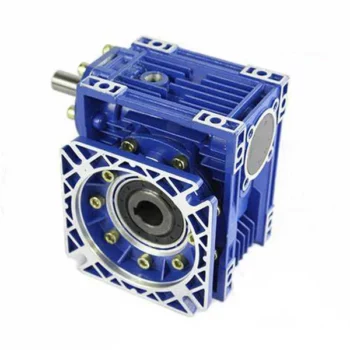
Common Problems and Troubleshooting for Worm Gearboxes
Worm gearboxes, like any mechanical component, can experience various issues over time. Here are some common problems that may arise and possible troubleshooting steps:
- Overheating: Overheating can occur due to factors such as inadequate lubrication, excessive loads, or high operating temperatures. Check lubrication levels, ensure proper ventilation, and reduce loads if necessary.
- Noise and Vibration: Excessive noise and vibration may result from misalignment, worn gears, or improper meshing. Check for misalignment, inspect gear teeth for wear, and ensure proper gear meshing.
- Leakage: Oil leakage can be caused by damaged seals or gaskets. Inspect seals and gaskets, and replace them if necessary.
- Reduced Efficiency: Efficiency loss can occur due to friction, wear, or misalignment. Regularly monitor gearbox performance, ensure proper lubrication, and address any wear or misalignment issues.
- Backlash: Excessive backlash can affect precision and accuracy. Adjust gear meshing and reduce backlash to improve performance.
- Seizure or Binding: Seizure or binding can result from inadequate lubrication, debris, or misalignment. Clean the gearbox, ensure proper lubrication, and address misalignment issues.
- Worn Gears: Worn gear teeth can lead to poor performance. Regularly inspect gears for signs of wear, and replace worn gears as needed.
- Seal Wear: Seals can wear over time, leading to leakage and contamination. Inspect seals regularly and replace them if necessary.
If you encounter any of these problems, it’s important to address them promptly to prevent further damage and maintain the performance of your worm gearbox. Regular maintenance, proper lubrication, and addressing issues early can help extend the lifespan and reliability of the gearbox.
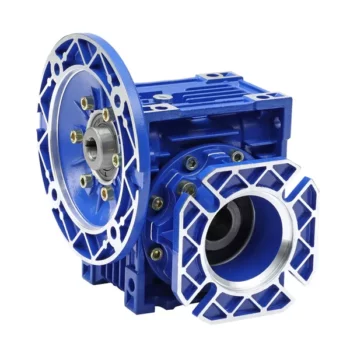
How to Calculate the Input and Output Speeds of a Worm Gearbox?
Calculating the input and output speeds of a worm gearbox involves understanding the gear ratio and the principles of gear reduction. Here’s how you can calculate these speeds:
- Input Speed: The input speed (N1) is the speed of the driving gear, which is the worm gear in this case. It is usually provided by the manufacturer or can be measured directly.
- Output Speed: The output speed (N2) is the speed of the driven gear, which is the worm wheel. To calculate the output speed, use the formula:
N2 = N1 / (Z1 * i)
Where:
N2 = Output speed (rpm)
N1 = Input speed (rpm)
Z1 = Number of teeth on the worm gear
i = Gear ratio (ratio of the number of teeth on the worm gear to the number of threads on the worm)
It’s important to note that worm gearboxes are designed for gear reduction, which means that the output speed is lower than the input speed. Additionally, the efficiency of the gearbox, friction, and other factors can affect the actual output speed. Calculating the input and output speeds is crucial for understanding the performance and capabilities of the worm gearbox in a specific application.
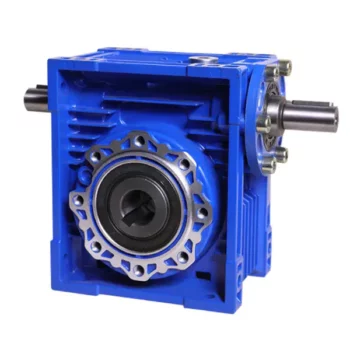
What is a Worm Gearbox and How Does It Work?
A worm gearbox, also known as a worm gear reducer, is a mechanical device used to transmit rotational motion and torque between non-parallel shafts. It consists of a worm screw and a worm wheel, both of which have helical teeth. The worm screw resembles a threaded cylinder, while the worm wheel is a gear with teeth that mesh with the worm screw.
The working principle of a worm gearbox involves the interaction between the worm screw and the worm wheel. When the worm screw is rotated, its helical teeth engage with the teeth of the worm wheel. As the worm screw rotates, it translates the rotational motion into a perpendicular motion, causing the worm wheel to rotate. This perpendicular motion allows the worm gearbox to achieve a high gear reduction ratio, making it suitable for applications that require significant speed reduction.
One of the key features of a worm gearbox is its ability to provide a high gear reduction ratio in a compact design. However, due to the sliding nature of the meshing teeth, worm gearboxes may exhibit higher friction and lower efficiency compared to other types of gearboxes. Therefore, they are often used in applications where efficiency is not the primary concern but where high torque and speed reduction are essential, such as conveyor systems, elevators, automotive steering systems, and certain industrial machinery.


editor by CX 2024-03-01