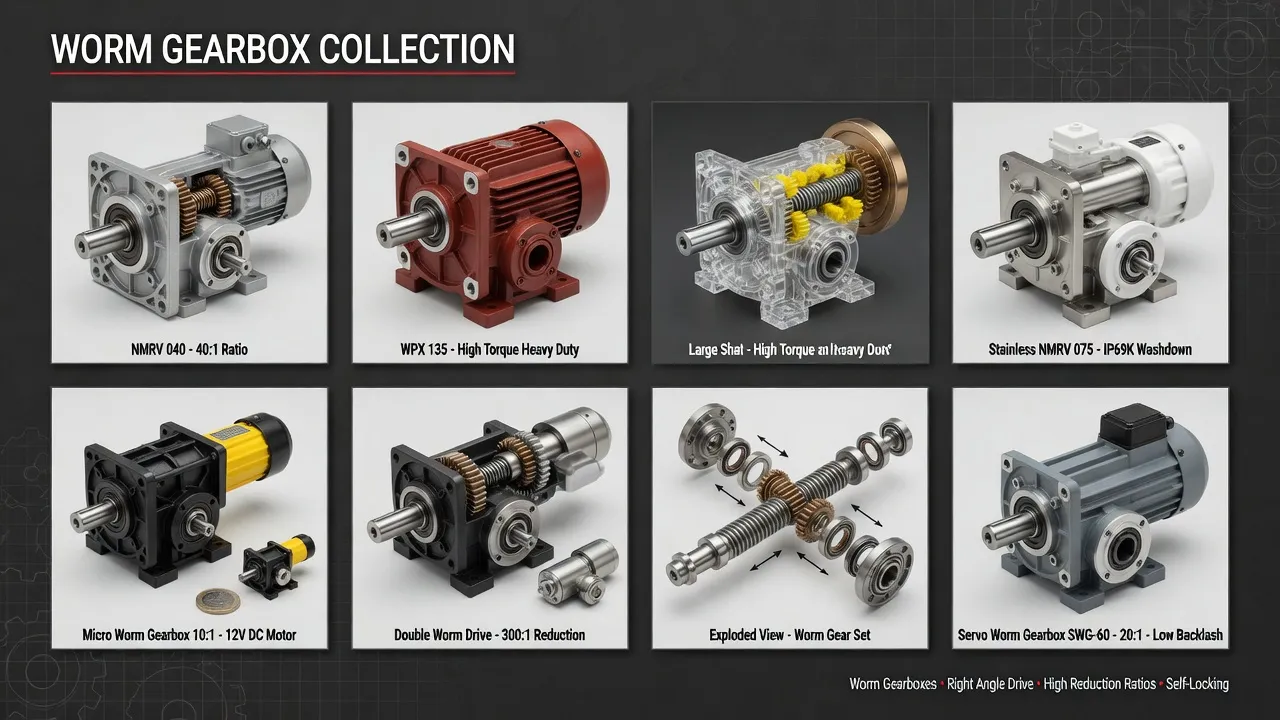
Worm gearboxes dominate the gate opener and door automation market for a single, decisive reason: native self-locking at ratios ≥30:1. A gate operator must hold the gate’s position when power is interrupted — during a power outage, a motor fault, or a control-system failure. The worm gearbox does this mechanically, without any brake module, relay, or control circuit. No other compact gear reducer provides this property at comparable cost. This guide covers every specification decision for gate-opener worm gearbox selection: how to calculate the holding torque requirement, which ratio provides reliable self-locking, what IP rating your environment needs, and how to match the motor to the gearbox for the correct combination of speed, torque, and duty cycle.
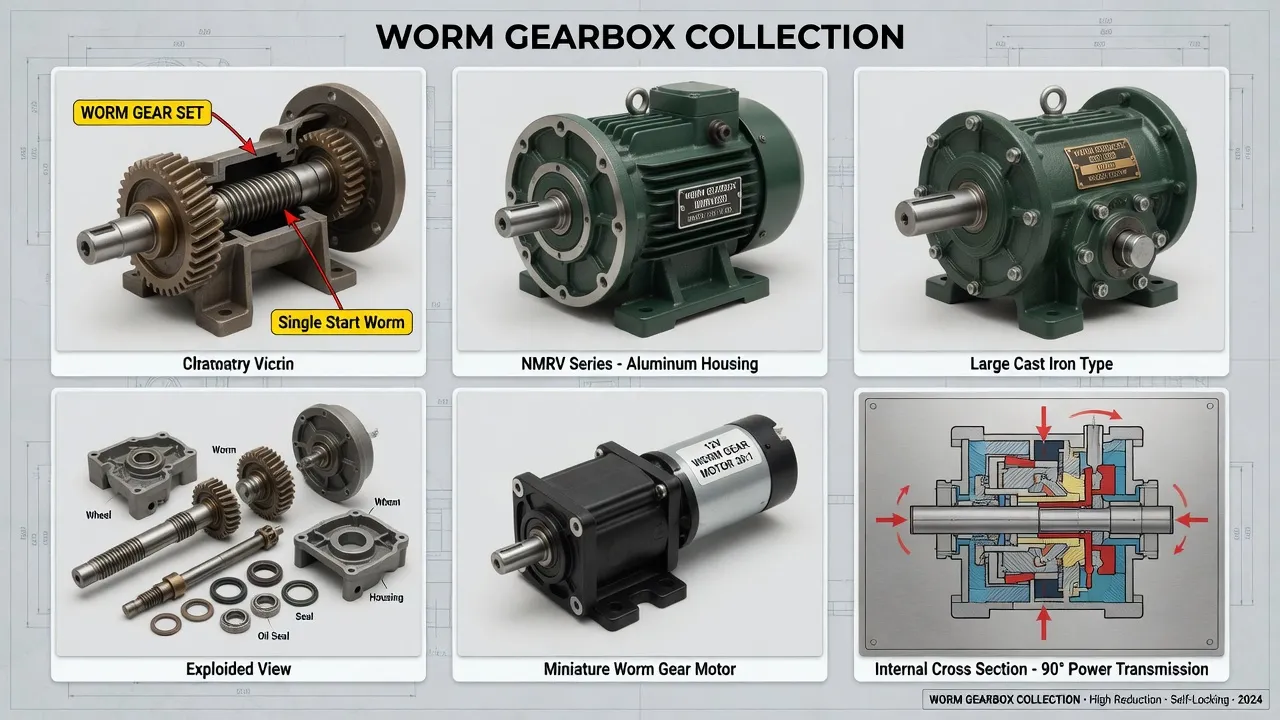
Why Self-Locking Is Non-Negotiable for Gate Openers
A sliding gate on a 5° driveway slope with a 200 kg leaf would roll backward under gravity the moment the motor de-energizes — unless the drive system can hold it. The three options:
- Mechanical door lock (padlock, mortice lock): Requires manual intervention to lock and unlock — defeats the purpose of automatic operation in normal use; only for security hold when the gate is fully closed.
- Electromagnetic brake on motor: Spring-applied electromagnetically released brake holds the gate when power is removed. Adds €80–€280 in parts, cabling, and control complexity. One more failure point in the system — brake release solenoid failure prevents the gate from opening. Requires 24V control power to release the brake, so a control circuit failure locks the gate.
- Self-locking worm gearbox: Worm thread geometry mechanically prevents back-drive when motor is de-energized. No electrical power, no control circuit, no additional components. The gate simply holds wherever the motor stopped it. Free with any worm gearbox at ratio ≥30:1.
For residential and commercial gate automation, self-locking worm gearboxes are the industry-standard specification — used in virtually every major gate operator brand worldwide as the core speed reduction and position-hold mechanism.
How to Calculate the Required Holding Torque
The holding torque requirement depends on the gate type, gate weight, and the mechanical linkage between the gearbox output and the gate. For the three main gate drive configurations:
| Gate Type | Holding Torque Formula | Example |
|---|---|---|
| Sliding gate (rack & pinion) | T = Ffriction × rpinion (friction hold from rack contact) | 150 kg gate on 5° slope: Fgravity = 150×9.81×sin5° = 128 N; T = 128 × 0.015 m pinion radius = 1.9 Nm at pinion — multiply by gearbox output ratio from pinion shaft |
| Sliding gate (chain drive) | T = Fgravity component × chain radius | 200 kg gate, 5° slope, 0.06 m drive sprocket radius: T = 200×9.81×0.0872×0.06 = 10.3 Nm at gearbox output |
| Swing gate (arm drive) | T = (gate weight × CoG distance × sin θ) / arm leverage | 80 kg leaf, 0.8 m CoG, 30° open on slope: more complex — consult OEM arm geometry datasheet |
In practice, most residential gate operator OEMs do not calculate holding torque from first principles — they specify the gearbox based on empirical operating torque requirements (opening/closing cycle torque) and verify that the self-locking ratio is ≥40:1. The holding torque from a self-locking worm gearbox at 40:1+ is typically several times the opening torque requirement, providing a large safety margin for wind loading and inclined-driveway installations.
Recommended design rule for gate operators: specify ratio ≥40:1 (not borderline 30:1) to ensure reliable self-locking across the full lubricant temperature range and worm-wheel service life. Use 50:1 as the standard default for residential applications and 60:1–80:1 for commercial heavy-duty gates where wind-load retention is a design requirement.
Ratio Selection for Gate Opener Applications
| Gate Application | Recommended Ratio | Output at 1,400 rpm | Notes |
|---|---|---|---|
| Residential sliding gate (<200 kg) | 40:1–50:1 | 28–35 rpm | Reliable self-locking; typical 3–8 sec open cycle |
| Commercial sliding gate (<600 kg) | 50:1–60:1 | 23–28 rpm | Higher self-locking margin for heavier gate; slower open for safety |
| Industrial heavy gate (>600 kg) | 60:1–80:1 | 17–23 rpm | Maximum self-lock margin; slow controlled movement |
| Security barrier (bollard, crash-rated) | 80:1–100:1 | 14–18 rpm | Maximum hold; very slow rise time acceptable for security context |
IP Rating for Gate Opener Environments
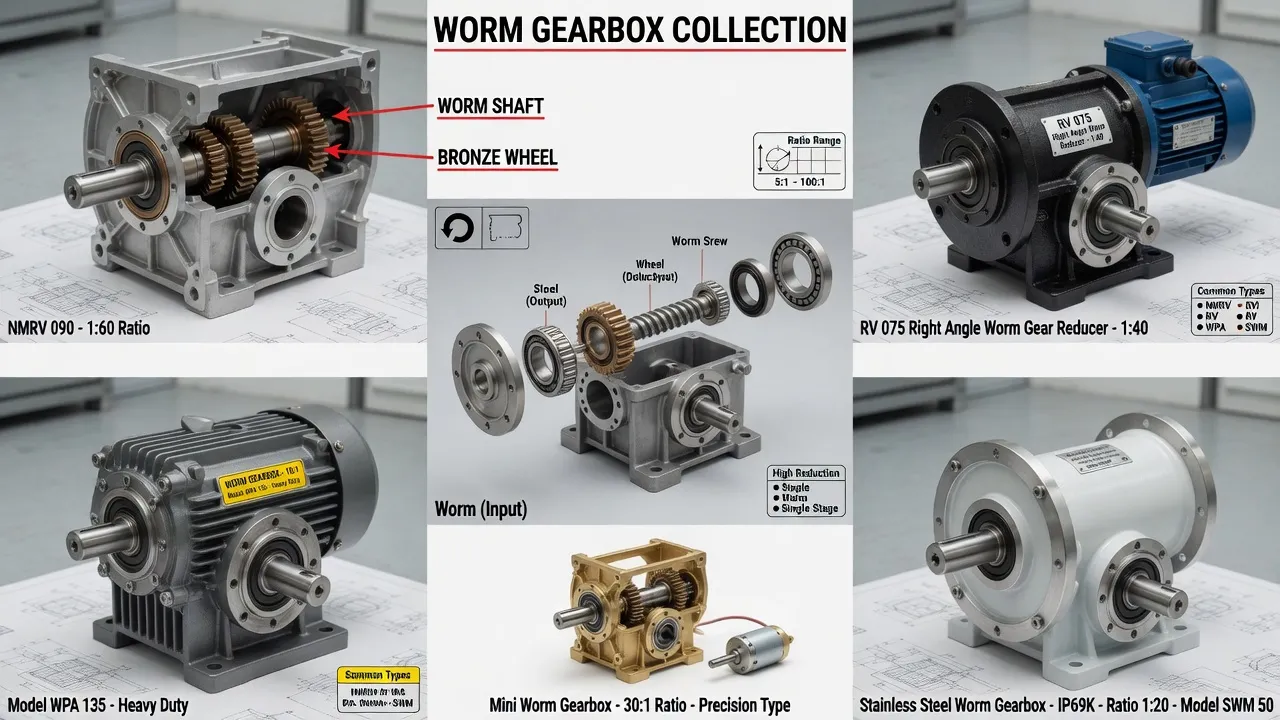
Gate operators are permanently installed outdoors — rain, dust, insects, garden hose splash, and temperature cycling are constant stressors on the drive mechanism. IP rating selection:
- IP54 (minimum acceptable for enclosed cabinet installation): Suitable only when the gearbox is inside a sealed cabinet that itself provides outdoor protection. The gearbox IP55 protects against internal cabinet condensation exposure.
- IP55 (standard outdoor): Adequate for gearboxes inside operator housings with moderate dust and rain exposure. Suitable for most residential gate operators where the motor-gearbox assembly is housed inside a die-cast aluminum or plastic enclosure with its own weather sealing.
- IP65 (exposed outdoor installation): Required when the gearbox is mounted without an external enclosure, or in coastal/marine environments with salt spray. FKM (Viton) shaft seals mandatory. Specify IP65 as minimum for commercial gate operators in any outdoor installation.
- IP66 (high-pressure water exposure): For industrial gate operators in environments subject to regular pressure washing (manufacturing facilities, wash-bay entrances, agricultural facilities).
Additionally, for coastal installations within 1 km of saltwater: specify epoxy-coated aluminum housing or stainless housing, and use PAO synthetic lubricant to resist the water-absorption tendency of mineral oils in high-humidity environments. Bronze worm wheels corrode faster in salt-humid air if lubricant degrades and seal integrity drops — PAO’s better oxidation resistance extends the seal-intact time before lubricant becomes contamination-susceptible.
Motor Pairing Guide — Matching the Motor to the Gate Gearbox
Gate opener motors have two distinct operating modes: the intermittent-duty motion phase (motor running, gate moving) and the static hold phase (motor de-energized, gate stopped, worm self-locking). Motor selection is governed by the motion-phase requirements only — the hold is handled by the worm geometry, not the motor.
- Duty cycle for gate operators: Residential: typically 10–30 cycles/day, 10–30 seconds run time per cycle, extended off time between cycles → intermittent duty class S3 (10–25%). The gearbox thermal budget for this duty is far more generous than for continuous-duty applications — the thermal calculation is not the binding constraint for typical gate operators.
- Motor type options: Single-phase AC capacitor-run motors (standard for residential, 0.18–0.37 kW); 3-phase AC motors with VFD for commercial and industrial (0.37–1.1 kW); 24V or 48V brushless DC motors for battery-backed solar-powered gate systems (growing segment).
- Motor sizing for gate duty: Practical rule: size the motor to deliver the required gearbox output torque at rated speed. For a 200 kg sliding gate requiring approximately 50 Nm output torque at 50:1 ratio, gearbox input torque = 50 / (50 × 0.72) = 1.39 Nm; motor at 1,400 rpm needs to deliver 1.39 Nm × 1.25 service factor = 1.74 Nm → P = 1.74 × 2π × 1400/60 = 255 W → 0.37 kW motor is appropriate.
For high-cycle commercial applications (200+ cycles/day) and battery-backed solar gate systems, the motor thermal class and efficiency become more relevant — specify Class F (155°C) motor insulation for high-cycle commercial duty, and brushless DC for solar/battery applications where motor efficiency affects battery life. Our NMRV worm gearbox range covers all standard IEC and NEMA motor flange interfaces for gate operator applications. For gate operator specific worm gearbox configurations, see the gate opener worm gearbox specifications reference.
Frame Size Selection for Common Gate Operator Platforms
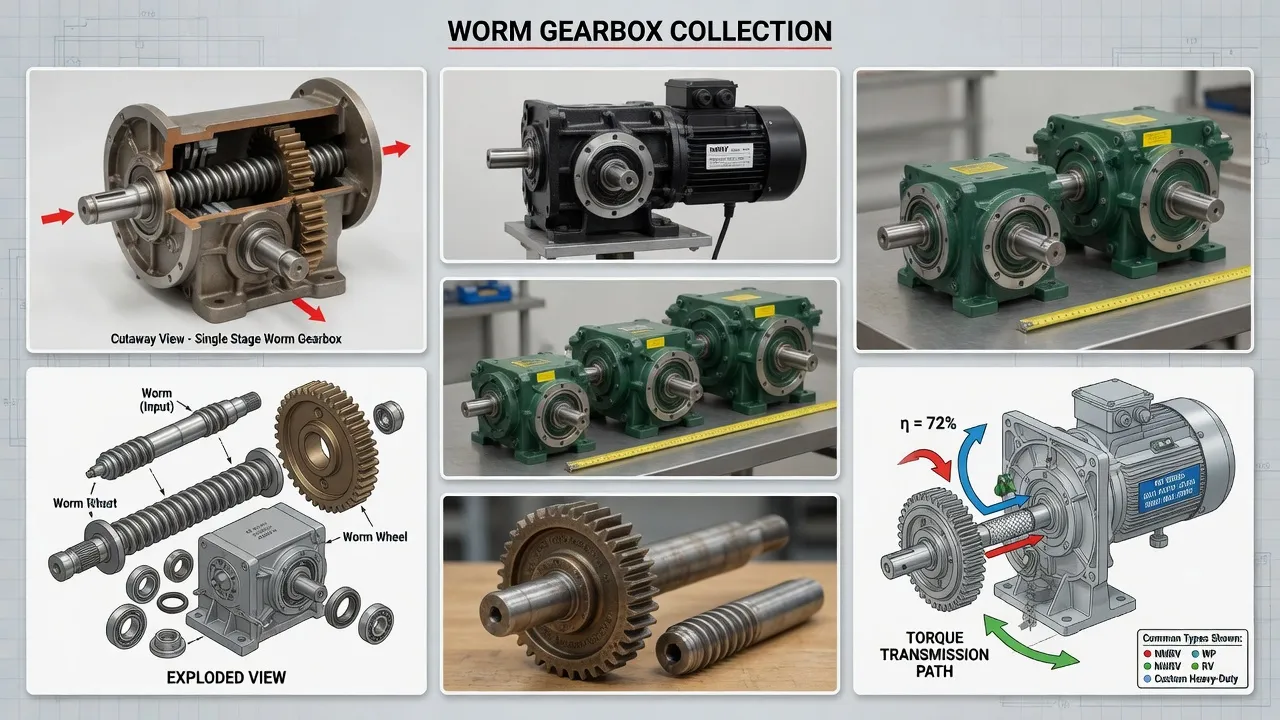
| Gate Platform | Gate Weight | Required Output Torque | Recommended Frame + Ratio |
|---|---|---|---|
| Residential sliding gate | 50–200 kg | 15–45 Nm | NMRV030–040, 40:1–50:1 |
| Commercial swing gate | 100–400 kg | 40–120 Nm | NMRV040–063, 50:1–60:1 |
| Industrial heavy gate | 400–1,000 kg | 100–300 Nm | NMRV063–090, 60:1–80:1 |
| Barrier arm (<8 m) | 15–40 kg arm | 8–30 Nm | NMRV030–040, 40:1–50:1 |
Frequently Asked Questions
Will the gate roll back if the power goes out?
No — not if a self-locking worm gearbox at ratio ≥40:1 is fitted. The mechanical self-lock prevents output shaft rotation when the motor is de-energized regardless of the load applied to the output. The gate holds its last position. Manual release: most gate operator designs include a manual emergency release mechanism that disengages the gearbox from the gate drive — allowing manual operation during power outages. Ensure the manual release is operable from both sides of the gate.
How many cycles per day can a standard NMRV handle?
For residential gate duty (S3 intermittent, 10–25% duty cycle, 20 second run time per cycle): 50–150 cycles/day is well within the thermal capacity of standard NMRV aluminum units. For commercial high-frequency applications (200–500 cycles/day) such as car park barriers or industrial access points: check the thermal input-power rating against the actual continuous equivalent power at the given duty cycle, and specify a cast-iron housing variant for its superior thermal mass and heat-dissipation capacity.
What lubrication does a gate opener gearbox need?
For outdoor gate openers operating in wide temperature ranges (−20°C to +50°C), PAO synthetic ISO VG220 is the preferred lubricant — its flat viscosity-temperature curve provides adequate film at high temperatures and free flow at cold starts, compared to mineral oil which can become very viscous at sub-zero temperatures and cause starting difficulty or seal stress. For sealed-for-life NMRV units in gate operators (a common OEM configuration), the factory PAO fill typically lasts the equipment design life (5–10 years at residential duty) without service access.
Can I use the same worm gearbox for both sliding and swing gate operators?
The gearbox itself is the same — same NMRV frame, same ratio, same motor flange. The difference is in the mechanical linkage from the gearbox output shaft to the gate: sliding gate operators typically use a rack-and-pinion or chain drive from the output shaft; swing gate operators use an articulated arm or linear actuator connected to the gearbox output. The gearbox output torque requirement and ratio selection are calculated the same way for both; the mounting orientation (B3, B5, or V1) may differ depending on the operator housing design.
Need a Worm Gearbox Specified for Your Gate Opener Platform?
Send us your gate type, gate weight, drive mechanism (rack/chain/arm), daily cycles, motor voltage, and IP requirement — we’ll return a complete NMRV specification with volume pricing within one business day.
Compact Gearboxes for Residential Gate Operator OEM Platforms
Residential gate operator manufacturers typically require very compact gearbox envelopes — the motor-gearbox assembly must fit inside an operator housing of 200–350 mm × 100–150 mm. The NMRV030 and NMRV040 frames are the standard for this application. Our NMRV worm gearbox series in the 030–050 range covers the residential and light-commercial gate operator segment completely.
For OEM gate operator platforms requiring sealed-for-life configurations with no oil fill or drain ports (simplifying the operator housing design), specify the “sealed-for-life PAO factory fill” variant — the gearbox ships with the correct PAO VG220 fill sealed in at the factory, with no field service required for the 10-year residential gate operator design life at typical duty cycles.