
A 250 kg wheelchair lift platform with a passenger aboard hangs 2.4 meters above ground level when the building loses electrical power. The motor stops. The brake — if it works — engages. But the brake has been a maintenance neglect item for 18 months, and one of its solenoid contacts has welded shut from earlier overcurrent events. There is exactly one thing standing between the elevated platform and a free-fall collapse: the self-locking property of the worm gearbox at the heart of the lift drive. Self-locking is the geometric phenomenon where a worm cannot be back-driven by torque applied to the worm wheel — the screw thread angle is steep enough relative to the friction coefficient that the wheel-side force cannot translate into worm rotation. This passive mechanical property has nothing to do with brakes, motor power, or control systems. It is a permanent geometric characteristic built into the gear pair at the design stage, and for thousands of applications worldwide — from elevator drives to subsea valve actuators to crane slewing systems — it provides the last line of safety protection when everything else fails.
This guide explains the physics of self-locking in worm gearboxes, derives the lead angle and friction coefficient relationships that determine self-locking behavior, walks through the design implications for safety-critical applications, and addresses the common misconceptions that lead procurement engineers to specify wrong-class drives for self-locking-dependent equipment. Audience: mechanical design engineers specifying drives for safety-critical equipment, equipment OEM engineering teams, code compliance specialists, and maintenance engineers supporting installed equipment fleets.
What Self-Locking Actually Means
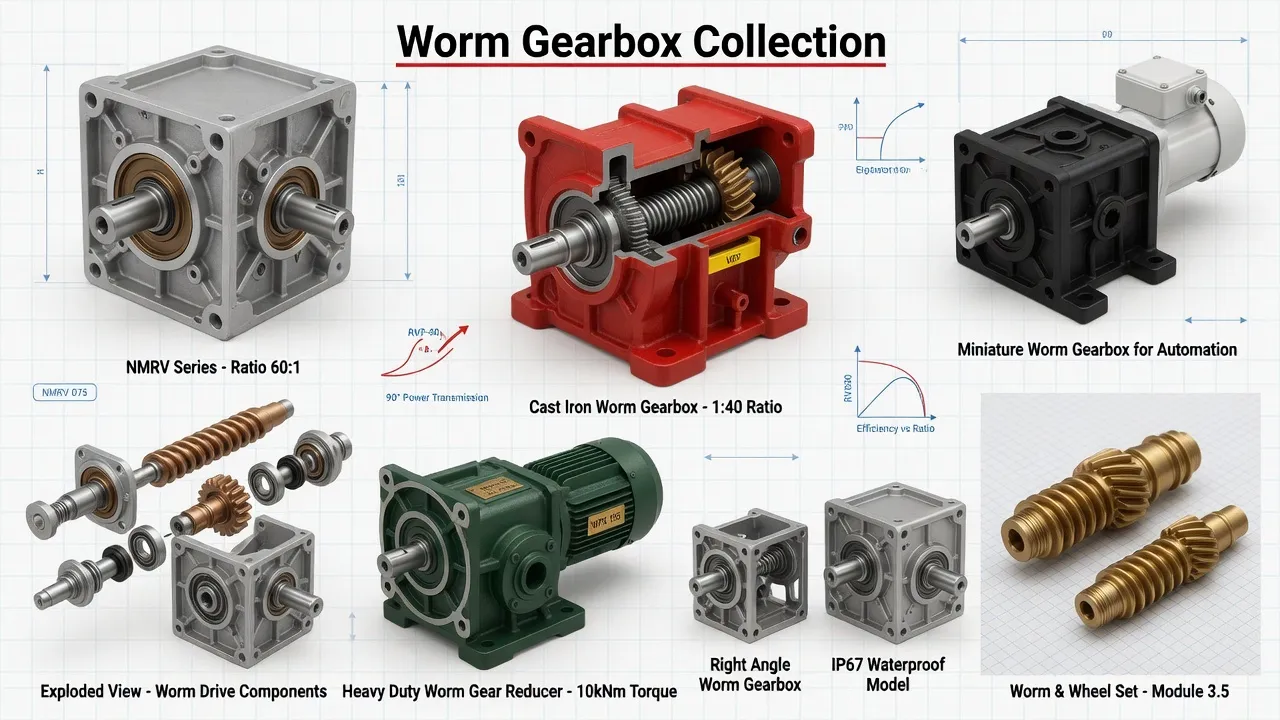
Self-locking in a worm gearbox means the output worm wheel cannot back-drive the input worm under any torque applied at the output shaft. Apply 1,000 Nm of torque at the wheel — the worm does not rotate. Apply 10,000 Nm — the worm still does not rotate. The wheel-applied force translates into elastic deformation of the gear teeth, frictional load in the bearings, and tooth surface contact stress, but it cannot produce angular rotation of the worm shaft. The output is locked by geometry until you actively rotate the worm from the input side. This stands in contrast to non-self-locking gear arrangements (helical gearboxes, spur gear reducers, bevel gearboxes) where torque applied at the output back-drives the input — without an active brake or motor torque holding the input, the load drops under gravity or external loading.
The self-locking property is not absolute across all worm gearboxes — it depends on the geometric relationship between the worm lead angle and the friction coefficient at the tooth contact surface. Worm gears with low lead angles (typically below 5°) and standard friction coefficients (typically 0.04-0.08 for steel-bronze contact under oil lubrication) are reliably self-locking. Worm gears with higher lead angles (above 12-15°) are reliably non-self-locking — they back-drive freely under load. Between these extremes lies the marginal-self-locking zone where back-drive behavior depends on operating conditions including lubricant viscosity, surface finish, and shock loading effects. Safety-critical applications must specify gear pairs comfortably inside the reliably-self-locking zone with engineering margin against marginal conditions.
The Physics: Lead Angle and Friction Coefficient
The self-locking condition derives from analyzing the force balance at the worm tooth contact surface. When torque applied at the wheel attempts to back-drive the worm, the wheel tooth pushes against the worm thread surface at the lead angle (the helix angle of the worm thread relative to the worm shaft axis). This force decomposes into two components: a component along the worm thread (which would rotate the worm if friction allowed), and a component perpendicular to the thread surface (which generates the friction force opposing motion). When the friction force exceeds the rotation-tendency force, the worm cannot rotate — the configuration is self-locking.
The mathematical condition for self-locking is straightforward: the worm is self-locking when the lead angle (λ) is less than the friction angle (ρ), where the friction angle is the arctangent of the friction coefficient (ρ = arctan μ). For typical steel-bronze contact under oil lubrication with friction coefficient 0.04-0.08, the friction angle is 2.3°-4.6°. Worms with lead angles below this friction angle are reliably self-locking; worms with lead angles above are non-self-locking. Engineering practice for safety-critical applications specifies lead angles below 2.5° to provide margin against friction coefficient variations from temperature changes, lubricant degradation, surface wear, and shock loading effects that temporarily reduce effective friction. Lead angle below 2.5° combined with standard lubrication conditions delivers reliably-self-locking behavior across the equipment service life.
Lead Angle Determines Reduction Ratio (And Self-Locking Together)
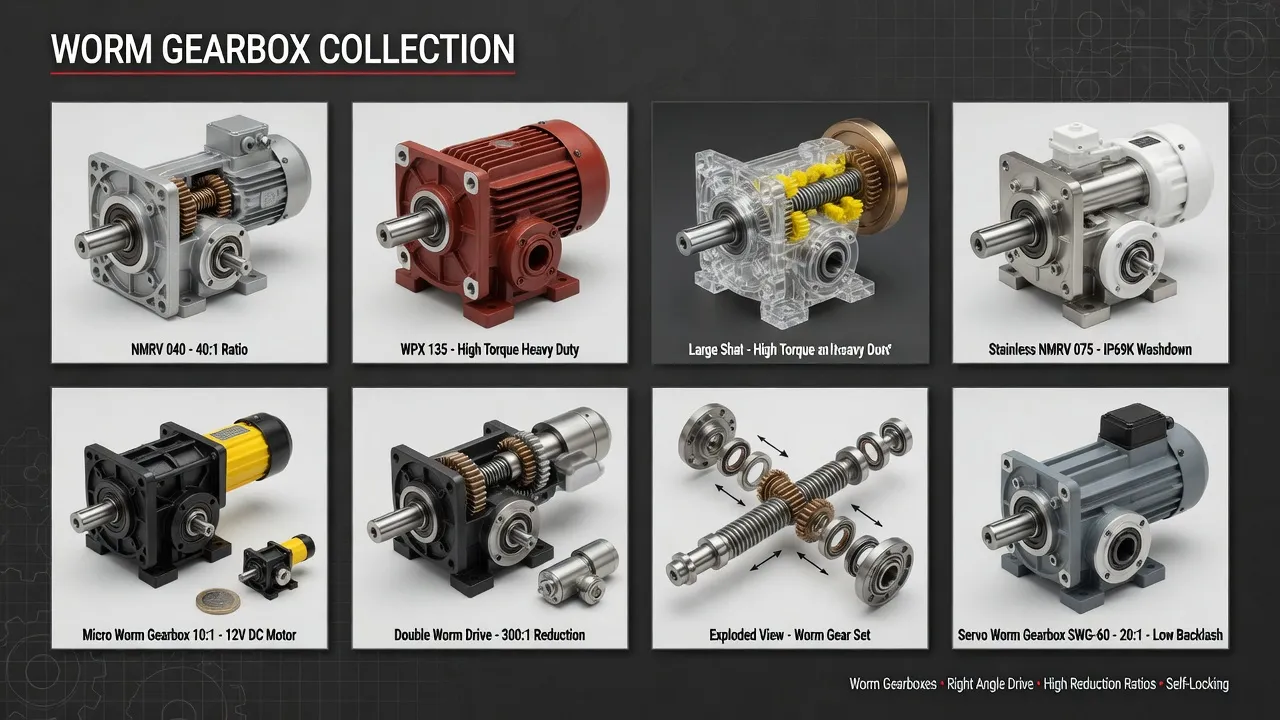
The connection between self-locking behavior and reduction ratio comes from the geometric relationship between worm lead angle and the number of thread starts on the worm. A worm with a single thread start has a small lead angle (typically 2°-4°) and produces high reduction ratios (typically 40:1 to 100:1 in a single stage). A worm with two thread starts has a moderate lead angle (typically 5°-8°) and produces medium reduction ratios (typically 20:1 to 50:1). A worm with four or six thread starts has a high lead angle (typically 10°-25°) and produces lower reduction ratios (typically 5:1 to 20:1) with high mechanical efficiency but no self-locking behavior.
This connection means buyers select self-locking behavior implicitly when they select reduction ratio. Specifying 50:1 to 100:1 reduction ratio essentially guarantees a single-start worm with self-locking lead angle. Specifying 10:1 or 15:1 reduction ratio essentially guarantees a multi-start worm with non-self-locking lead angle. There is no way to get high mechanical efficiency (90%+) with self-locking behavior in a worm gearbox — the geometry that produces high efficiency (high lead angle, multi-start worm) is fundamentally incompatible with the geometry that produces self-locking (low lead angle, single-start worm). Applications that need both high efficiency and inherent holding capability require different gear architectures — typically helical-hypoid gearing combined with an active electromagnetic brake mechanism.
Self-Locking Behavior by Reduction Ratio Class
The table below summarizes the typical relationship between worm gear reduction ratio, lead angle, mechanical efficiency, and self-locking behavior across common gear pair classes.
| Reduction Ratio | Typical Lead Angle | Mechanical Efficiency | Self-Locking |
|---|---|---|---|
| 100:1 | ~2° | 35-55% | Reliably self-locking |
| 80:1 | ~2.5° | 45-60% | Reliably self-locking |
| 60:1 | ~3.5° | 55-68% | Reliably self-locking |
| 50:1 | ~4.5° | 60-72% | Self-locking under normal conditions |
| 40:1 | ~5.5° | 65-75% | Marginal — depends on conditions |
| 30:1 | ~7.5° | 72-80% | Not reliably self-locking |
| 20:1 | ~11° | 78-85% | Not self-locking |
| 10:1 | ~18° | 83-90% | Not self-locking (overhauling) |
| 5:1 | ~25° | 85-92% | Not self-locking (free overhauling) |
The key takeaway: specify reduction ratios at or above 60:1 for reliably self-locking behavior. Ratios 40:1 to 50:1 enter the marginal zone where self-locking depends on lubricant condition, surface finish state, temperature, and other operating factors. Ratios below 40:1 should not be specified for applications requiring self-locking behavior — these gear pairs back-drive under load and need active brake mechanisms providing the holding function instead.
Safety-Critical Applications Where Self-Locking Saves Lives
Vertical Lifting Equipment with Passenger Risk
Vertical platform lifts, wheelchair accessibility lifts, stair chair lifts, and personnel-rated work platforms rely on self-locking worm gearboxes as the first line of safety protection. If electrical power fails or the active brake mechanism fails, the loaded platform must not fall under gravity loading — passenger injury risk demands absolute holding capability that the self-locking worm geometry provides passively without dependence on any active control system. Accessibility codes including ASME A18.1 (Safety Standard for Platform Lifts and Stairway Chairlifts) reflect this safety requirement, with verified self-locking architecture forming part of the code compliance demonstration. Specify reduction ratios 60:1 or higher with documented self-locking verification through factory holding capability tests.
Hyperbaric Chamber Doors and Pressure Vessel Locking
Hyperbaric chamber doors must remain locked absolutely throughout treatment sessions where chamber pressure 2.4-2.8 ATA (atmospheres absolute) acts to force the door open. Door locking mechanism back-drive would catastrophically depressurize the chamber with patient injury risk. PVHO-1 Safety Standard for Pressure Vessels for Human Occupancy requires verified self-locking architecture for door locking drives. Specify reduction ratios 60:1 or higher with PVHO-1 self-locking demonstration testing. Similar requirements apply to industrial pressure vessel doors, autoclave doors, and other pressure-containing equipment where inadvertent unlock events would cause dangerous depressurization.
Crane and Hoisting Equipment with Load Suspension
Industrial cranes and hoists holding suspended loads for extended periods rely on self-locking drives to maintain load position when the active brake system is not energized. While crane safety codes require dual-redundant brake systems as the primary holding mechanism, the self-locking gear architecture provides a third independent layer of safety protection. FEM 1.001 (European crane standard) and ASME B30.3 (North American tower crane standard) require this safety architecture for personnel-overhead hoisting operations. Specify reduction ratios 80:1 or higher for full self-locking margin under shock loading conditions typical of crane service.
Heavy Industrial Equipment with Catastrophic Failure Risk
Rolling mill screwdown systems, hydraulic press ram positioners, large valve actuators on pipelines, and similar heavy industrial equipment use self-locking worm drives to prevent uncontrolled position drift under load. Drift in these applications causes substantial equipment damage (USD 500,000-2,500,000 per incident) plus operator injury risk. The self-locking property eliminates the dependence on active control systems for safety-critical position holding. Reference heavy-duty self-locking reducer specifications for industrial application drive sizing.
Common Misconceptions About Self-Locking
Misconception 1: “All worm gearboxes are self-locking.” False. Only worm gearboxes with low-lead-angle worms (typically reduction ratios above 60:1) reliably self-lock. Multi-start worms used in low-ratio applications (typically below 30:1) do not self-lock. Generic specifications that say “worm gearbox” without specifying ratio do not guarantee self-locking behavior. Specify the reduction ratio explicitly and verify the supplier confirms self-locking certification.
Misconception 2: “Self-locking means the gearbox is more efficient.” Backward. Self-locking worm gearboxes have mechanical efficiency 35-65% — substantially less than non-self-locking alternatives (helical gearboxes at 92-98%, multi-start worm at 78-90%). The same geometric property that produces self-locking (high friction relative to lead angle) also produces low mechanical efficiency. Applications that prioritize efficiency cannot also have self-locking from worm geometry alone; they need separate active brake mechanisms for holding.
Misconception 3: “Self-locking gearboxes don’t need brakes.” Misleading. Self-locking holds position absolutely against torque applied at the output, but it does not provide stopping control during input-driven motion. A wheelchair lift moving downward with motor power needs a brake to stop at the correct floor position — the self-locking architecture only prevents falling during power-off conditions. Safety-critical applications combine self-locking gear architecture with active electromagnetic brake mechanisms for layered safety protection.
Misconception 4: “Self-locking is permanent — it never fails.” Mostly true but with caveats. Self-locking behavior is a permanent geometric property that does not degrade with wear in the way that active brake mechanisms degrade. However, shock loading events can momentarily exceed the static friction threshold and produce inch-by-inch back-drive (“creep”) under sustained vibration. Applications with significant shock loading exposure should specify reduction ratios well above the marginal threshold (80:1 or higher) to maintain self-locking margin under shock conditions.

How to Specify a Self-Locking Worm Gearbox
Specify Reduction Ratio 60:1 or Higher
Specify reduction ratio above 60:1 for reliably-self-locking behavior. For applications with shock loading exposure (lifting equipment under wind loading, cranes under dynamic load events), specify 80:1 or higher to maintain self-locking margin under shock conditions. Do not accept “marginal” self-locking specifications (30:1 to 50:1 range) for safety-critical applications where back-drive consequences include injury or major equipment damage.
Request Factory Holding Capability Test Documentation
Require factory test report demonstrating self-locking behavior under rated reverse-input torque. The test should apply progressively increasing torque at the output shaft and verify the worm shaft does not rotate. Premium suppliers provide serialized holding capability test reports with each gearbox shipment. Code compliance pathways including ASME A18.1, PVHO-1, and FEM 1.001 typically require this documentation as part of equipment commissioning.
Specify Synthetic Lubricant for Stable Friction Coefficient
Order synthetic polyalphaolefin (PAO) or polyalkylene glycol (PAG) lubricant fills that maintain stable friction characteristics across the operating temperature range and across the lubricant service life. Mineral oil alternatives experience friction coefficient variation with temperature plus progressive degradation that can reduce friction coefficient over time — potentially shifting the gear pair from self-locking into the marginal zone late in the lubricant service life. Schedule lubricant changes per manufacturer recommendations to maintain consistent friction behavior.
Apply Active Brake as Layered Safety, Not Replacement
Combine the self-locking gear architecture with active electromagnetic brake mechanism for layered safety protection. The active brake provides stopping control during input-driven motion and provides redundant holding capability beyond the passive self-locking property. Do not substitute the active brake for self-locking gear architecture or substitute self-locking gear architecture for the active brake — both protections are needed in the safety-critical applications where worm gear self-locking matters.
The MRV NMRV Standard Worm Gearbox Series offers reduction ratios from 7.5:1 through 100:1 across the full self-locking specification range, with factory holding capability test documentation available for safety-critical applications including wheelchair lifts, hyperbaric chamber doors, and crane slewing drives. For precision positioning applications combining self-locking holding capability with sub-arcsecond positioning accuracy (CNC rotary tables, medical imaging tables, semiconductor manufacturing equipment), the VRV030 Precision Worm Gearbox delivers the same self-locking architecture with DIN 3974 quality grade Q5 precision tooth geometry and backlash below 6 arcseconds.
When Self-Locking Is the Wrong Choice
Self-locking worm geometry is not universally appropriate. The same property that holds position against back-drive also imposes the low mechanical efficiency (35-65%) and the inability to free-wheel under any operating condition. Applications where these characteristics are problems should select non-self-locking gear architectures instead.
Emergency lowering requirements. Wheelchair lifts and similar accessibility equipment typically require emergency manual lowering capability that allows trained personnel to lower a stranded passenger without electrical power. Self-locking gear architecture prevents this manual lowering through the gear set — the lift must include a separate manual override mechanism (typically a hand crank coupled to the worm shaft from the input side) that bypasses the self-locking property by inputting torque from the worm side. Specify this manual override capability explicitly in safety-critical lifting applications.
High-efficiency continuous operation. Conveyor drives, mixer drives, fan and blower drives, and similar continuous-operation applications operate at full design speed for extended periods. The 35-65% mechanical efficiency of self-locking worm gear architecture wastes substantial electrical energy across continuous operation — for these applications, helical or helical-bevel gear architectures with 92-98% efficiency are economically far preferable. The energy cost difference between 50% efficiency and 95% efficiency at typical motor sizes accumulates to substantial annual energy cost across multi-decade equipment service life.
Reversing service. Applications where the load reverses direction frequently (printing presses, machine tool spindle positioning, robotic axes) waste energy in the gear mesh friction during direction reversal events. Self-locking gear architecture is especially poorly suited to high-reversal-frequency applications. Specify non-self-locking gear architectures with active brake mechanisms for these duty profiles.
Heat-sensitive applications. The 35-65% mechanical efficiency means 35-65% of input power converts to heat in the gear mesh. Applications with thermal constraints (food processing where ambient temperature is regulated, medical equipment near temperature-sensitive components) may struggle with the heat dissipation requirements of self-locking worm gear architecture. Specify alternative gear architectures or accept the heat dissipation impact and design appropriate cooling arrangements.
Industry Standards Governing Self-Locking Specifications
Multiple industry standards specify self-locking architecture requirements for safety-critical applications. ASME A18.1 Safety Standard for Platform Lifts and Stairway Chairlifts mandates verified self-locking architecture for accessibility lift drives with safety factor 5:1 minimum for load-bearing drive components. PVHO-1 Safety Standard for Pressure Vessels for Human Occupancy mandates self-locking architecture for hyperbaric chamber door locking mechanisms with redundant verification. FEM 1.001 (European crane standard) and ASME B30.3 (North American tower crane standard) require self-locking architecture as part of layered safety protection for personnel-overhead hoisting operations. EN 81-40 and EN 81-41 European accessibility lift standards parallel the ASME A18.1 requirements for European markets.
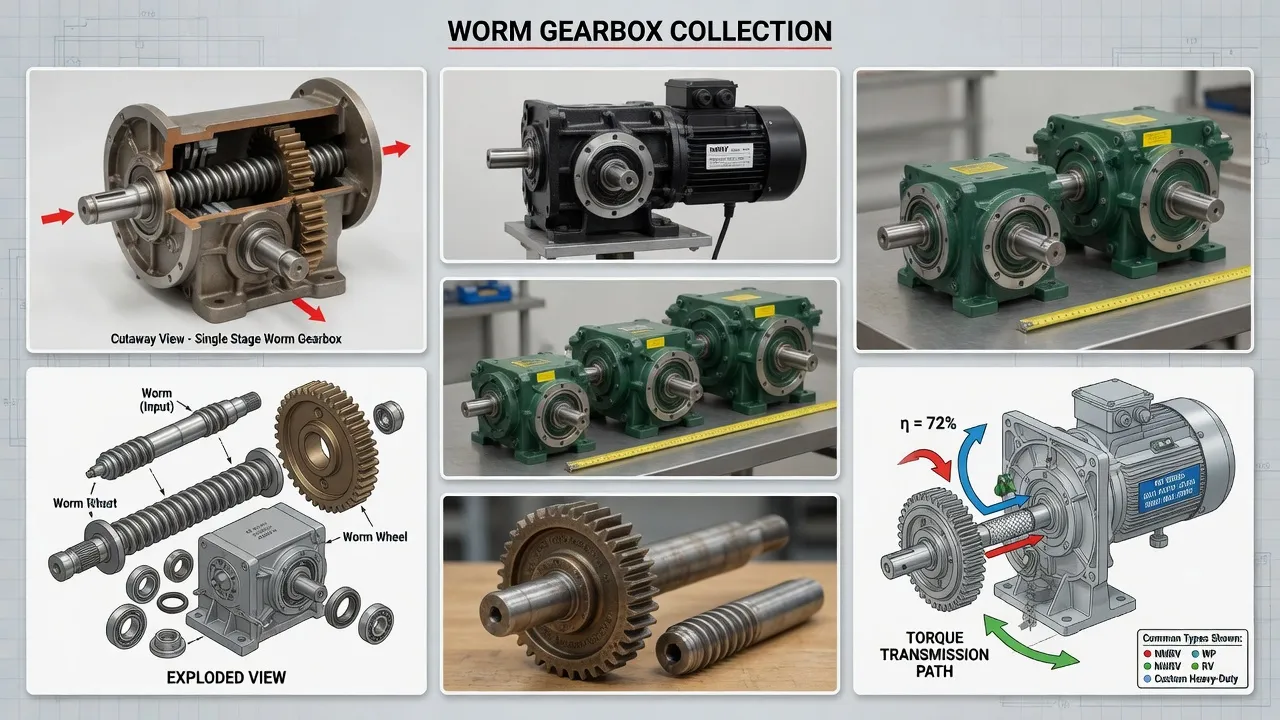
Worm gear tooth geometry follows DIN 3974 (German standard) with quality grades Q5 through Q12, with lower numbers indicating tighter dimensional tolerances. Worm wheel material specifications follow ISO 1338 for centrifugally cast tin bronze ZCuSn10P1. Worm gear power rating calculations follow AGMA 6034-B92 worm gear power rating standard, with safety factor adjustments for the specific application service profile. CE marking per EU Machinery Directive 2006/42/EC and RoHS Directive 2011/65/EU apply to European market shipments. Manufacturing follows ISO 9001:2015 quality management systems with material traceability per EN 10204 3.1 mill test reports for critical applications.
Specifying Self-Locking Drives for Safety-Critical Equipment?
Send application specifications including load mass, code compliance pathway (ASME A18.1, PVHO-1, FEM 1.001, etc.), and operating environment. We supply verified self-locking worm gearboxes with factory holding capability test documentation for accessibility lifts, pressure vessel doors, crane slewing drives, and other safety-critical applications.
Frequently Asked Questions
© Akgnx Co., Ltd · About Us · Contact Us · [email protected]